Panionium
The sacred hillside where twelve Ionian cities gathered each year as one people
Understand sacred places, explore living traditions, and learn how to engage respectfully with Pilgrim Map.
Access has not been verified. Check current local guidance before planning a visit.
Aydın, Turkey
Read the sources
Visit essentials
A quick read before you go
- Duration
- One to two hours at the sanctuary itself; combine with the Dilek Peninsula coastal areas and…
- Access
- Located approximately 17 km south of Kuşadası near Güzelçamlı village, within Dilek…
Overview
From Mt. Mycale's slope toward Samos, visitors see the same view as delegates to the annual Panionia. The sanctuary honored Poseidon Helikonios—an epithet linked to a mainland Greek cult, adapted here from a pre-colonial Carian sacred tradition. Its deliberate Aegean hillside setting, between the Asian shore and the islands, suited a maritime people worshipping the sea's lord.
The Panionium made Ionian identity real. The twelve cities—Miletus, Ephesus, Priene, Chios, Samos, and eight others—met for shared sacrifice and political deliberation. Herodotus, himself from the Ionian world, records major crises debated here; the festival gave Ionic identity a physical focal point and ritual calendar.
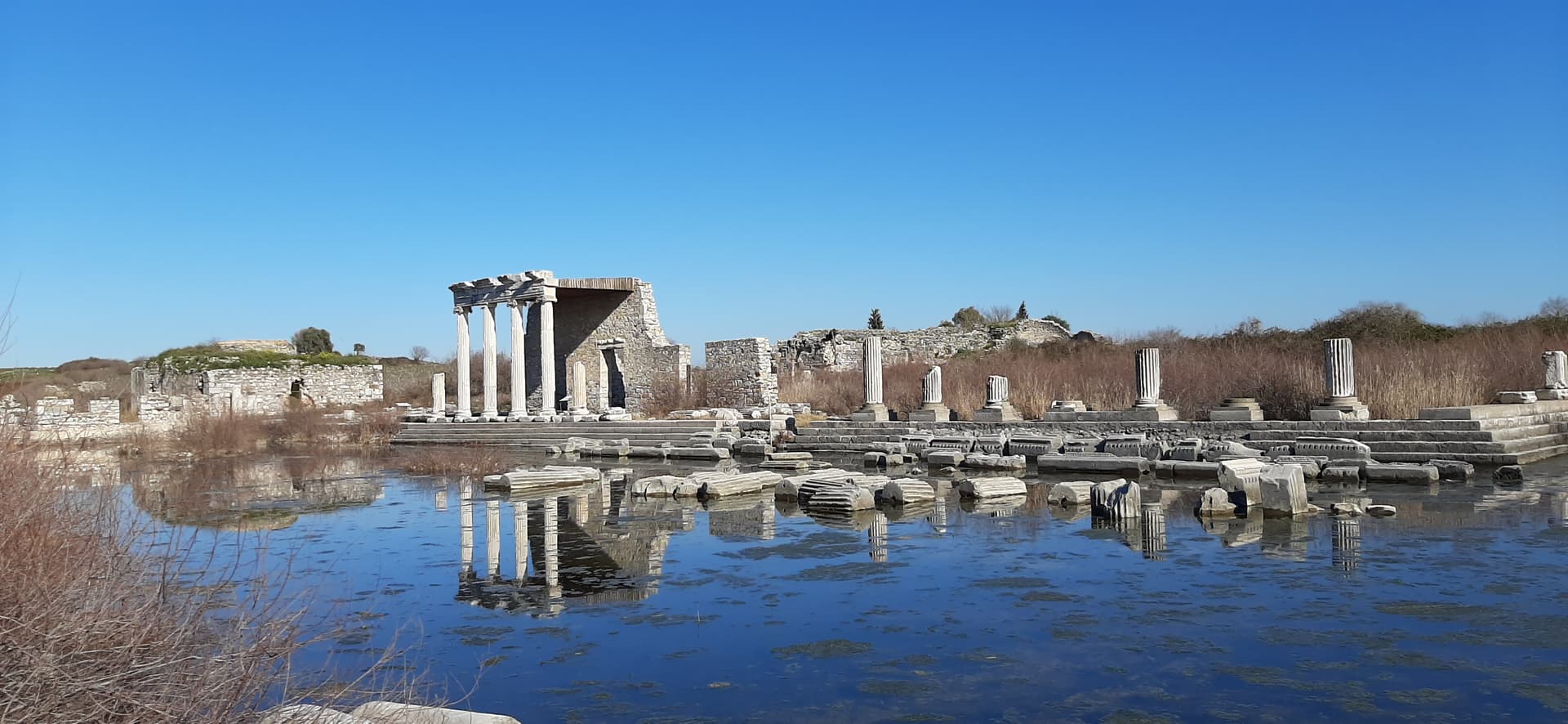
A rock-cut theater thirty-two meters across, with eleven rows of seats, served as the council chamber. Its modest, largely unmarked remains could now be missed by casual visitors despite the site's former civilizational importance.
Why this place is sacred
The Ionians of Asia Minor occupied an unusual position in the ancient Greek world: Greek by culture and language, but separated from the Greek mainland by the Aegean, living on the coast of Asia among Lydian, Carian, and Phrygian neighbors. The Panionium was the institution through which this dispersed people maintained its coherence. The decision to site the sanctuary on Mt.
Mycale — a dramatic peninsula overlooking the water toward Samos — expressed the liminal quality of Ionian existence: neither fully Asian nor fully European, always at the threshold between sea and land, between the Greek world and the East.
The cult of Poseidon Helikonios carried further layers of this in-between character. The epithet 'Helikonios' refers to the Helikon region of Boeotia in mainland Greece — a transplanted identity for a transplanted people. But the cult itself was adapted from a pre-existing Carian sacred tradition on the same mountain, making it doubly hybrid: Greek mythology clothing an Anatolian original.
This layering — indigenous Carian substrate, Greek narrative overlay, politically maintained as a pan-Ionian binding institution — gives the site an unusual complexity for what its modest remains might suggest.
The Panionia's political dimension deepened the sacred function. Bull sacrifice opened the proceedings; athletic and musical competitions followed; and then the real business of Ionian collective life was conducted in the small theater on the hillside. Sacred and political authority were not separated here — the gods witnessed the deliberations, and the deliberations were themselves an act of communal piety.
Federal sanctuary of the Ionian League, dedicated to Poseidon Helikonios; annual gathering place for sacrifice, athletic competition, and political assembly of the twelve Ionian cities.
From a possible pre-Greek Carian sacred site, to the archaic-era Panionium at an as-yet-debated higher elevation on Mt. Mycale, to the classical-era sanctuary on Otomatik Tepe (c. 540 BCE onward) — the site declined with the loss of Ionian political independence under first Persian, then Macedonian, then Roman rule, eventually ceasing function altogether. The location within a national park now protects the modest remains.
Experience and orientation
Arriving at the Panionium from Güzelçamlı means ascending into the Dilek Peninsula-Büyük Menderes Delta National Park, where the coastal vegetation and the views over the Aegean become progressively more open as you climb. The sanctuary site itself sits on Otomatik Tepe — a low hill with panoramic views toward the sea and Samos.
The small theater's rock-cut seats are the most immediately legible feature: eleven rows of stone seating arranged in a semicircle, the scale of a council chamber rather than a public theater.
The temenos wall and altar are present but require some archaeological literacy to read. This is a site where what you bring to it matters considerably more than what is visibly there to encounter.
Someone who arrives knowing the twelve Ionian cities by name, who has read Herodotus's account of the debates that took place here during the Persian crisis, who understands the specific quality of Ionian civilization — its philosophy, its science, its art, its politics — will find a site of extraordinary resonance. Someone arriving without that preparation will find a pleasant hillside in a national park.
The views themselves have sustained value. The prospect over the Aegean toward Samos, with the strait between them making the island feel close enough to call across, captures exactly the maritime, between-worlds position that defined Ionian existence. The Panionia assembled every year at a place that looked both toward the Greek island-world and toward the Asian shore — and that visual balance was not accidental.
The sanctuary is within the Dilek Peninsula-Büyük Menderes Delta National Park; pay the park entry fee at the main gate near Güzelçamlı. The Panionium is on Otomatik Tepe hill, approximately 17 km south of Kuşadası. Limited signage at the site; bring a map or downloaded reference material. The walk from the nearest road is moderate — appropriate footwear is useful. The national park entrance is at Cumhuriyet Mh., 09430 Güzelçamlı, Kuşadası.
Context and lineage
According to Herodotus, when the Greeks settled Ionia they encountered the Carian people already worshipping Poseidon Helikonios on Mt. Mycale. The Ionians adopted this cult, adapted it, and made it the binding religious institution of their new league of twelve cities. The earliest sanctuary was probably at a higher elevation on the mountain; around 540 BCE, following the Persian conquest of the Lydian kingdom and the reorganization of Ionian political life under Persian pressure, the sanctuary moved to Otomatik Tepe.
The classical-era Panionium visible today — with its rock-cut theater and altar — dates from this reorganization.
Pre-Greek Carian Poseidon cult on Mt. Mycale → Ionian adoption and transformation into the league sanctuary (archaic period, before 700 BCE) → classical reorganization on Otomatik Tepe (c. 540 BCE) → loss of political function under Macedonian and Roman rule → eventual abandonment → modern location within national park
Priene
Managing city
Herodotus
Primary ancient source
Hans Lohmann
Archaeologist
Traditions and practice
The Panionia opened with sacrifice: a bull offered to Poseidon Helikonios at the altar, with libations and the accompanying ceremonies that made the offering effective. Athletic competitions followed — running, wrestling, and the other standard events of Greek athletic festivals, but with the specific political resonance that participation implied membership in the Ionian community. Musical competitions celebrated the distinctive Ionian contribution to Greek literary and musical culture.
Then came the assemblies, held in the small theater-council chamber, where the representatives of the twelve cities debated the political crises of their time — responses to Persian pressure, questions of alliance and resistance, the ongoing negotiations of collective Ionian identity.
No active ceremonies take place at the site. The national park that contains it is visited for nature and hiking as well as historical interest.
Read Herodotus Book 1, chapters 141-170 before visiting — his account of the Ionian cities' responses to the Persian threat, debated at the Panionium, gives the rock-cut theater its full weight. When you reach the council chamber, sit in the stone seats and look at the scale of the space: twelve cities sent delegates here, and the decisions they made in this hillside room shaped the course of Greek civilization.
The smallness of the theater relative to the magnitude of what was deliberated within it is itself a contemplative experience. Then turn to face the sea view. The Aegean from this elevation, with Samos visible across the water, makes the maritime world of the Ionians physically present in a way no description manages.
Worship of Poseidon Helikonios
HistoricalThe Panionium was the sacred sanctuary of the Ionian League, dedicated to Poseidon Helikonios — an epithet linking the sea-god to a cult location on the Greek mainland, adapted here from a Carian tradition on Mt. Mycale. The annual bull sacrifice was the central act that bound the twelve cities together in a shared religious identity.
Annual bull sacrifice, libations, sacred games, communal feasting, religious processions — all organized and managed by the city of Priene
Ionian Political-Religious Assembly (Panionia)
HistoricalThe Panionia was simultaneously religious festival, athletic competition, and political council — the annual occasion that made the twelve Ionian cities one people. Herodotus describes it as the forum for major political crises, including the debates over collective responses to Persian expansion.
Shared sacrifice, athletic and musical competitions, political assembly in the council theater, communal deliberation on Ionian collective affairs
Archaeological Scholarship
ActiveThe site gained renewed academic attention from Hans Lohmann's 2004 proposal of a higher-altitude archaic Panionium on Mt. Mycale, sparking ongoing scholarly debate about the sanctuary's location and date of foundation. The site continues to be studied in the context of Ionian League history and Greek identity formation in Asia Minor.
Archaeological survey, academic publication, scholarly debate about the two possible Panionium locations
Perspectives and open questions
The Panionium is a site where scholarly debate about physical location intersects with deeper questions about how identity, religion, and politics were held together in the ancient world — and where the physical modesty of the remains makes the claims of historical significance harder, and more interesting, to argue.
Scholarly perspective
The primary ongoing scholarly question is the location debate: Hans Lohmann's 2004 identification of a possible archaic Panionium at a higher elevation on Mt. Mycale challenges the long-accepted Otomatik Tepe location. If both sites represent genuine Panionium phases, the question becomes one of continuous use with geographical shift — perhaps reflecting the political reorganization of the Ionian League after the Persian conquest of Lydia in 547 BCE.
The site's management by Priene is well-documented; the broader significance of the Panionia for the formation of Greek identity in Asia Minor is a continuing theme in Aegean studies.
Living and traditional perspectives
The Carian tradition that preceded the Greek Panionium is only partially recoverable. Ancient sources agree that the Ionians adopted an existing cult of Poseidon at Mycale — this rare acknowledgment of pre-Greek religious continuity makes the Panionium an unusual example of documented Greek religious syncretism with indigenous Anatolian culture.
The mountain of Mycale later became famous as the site of the Greek naval victory over the Persians in 479 BCE — a battle whose outcome secured the freedom of the Ionian cities and may have been understood as Poseidon's vindication of his sanctuary.
Alternative interpretations
The mountain overlooking the sea, dedicated to the god of earthquake and ocean, gathered once a year to renew the bonds of twelve cities who had crossed water to find their home: the Panionium encodes, in its geography and its mythology, an entire cosmology of belonging and separation.
For those drawn to places where human political organization reached for the sacred as its foundation, this hillside offers an encounter with a tradition in which identity was maintained by returning annually to the same hilltop and sacrificing together under the same sky.
Open questions
The Lohmann location debate remains open. The full character of the Carian cult that preceded the Greek Panionium is not recoverable from surviving evidence. The precise ritual procedures of the Panionia beyond sacrifice and assembly — the specific prayers, the ordering of events, the role of music and poetry — are not documented in sufficient detail to reconstruct.
Plan your visit
Access and arrival
Located approximately 17 km south of Kuşadası near Güzelçamlı village, within Dilek Peninsula-Büyük Menderes Delta National Park. Park entrance at Cumhuriyet Mh., 09430 Güzelçamlı, Kuşadası. National park entry fee required. Mobile signal may be unreliable in the more remote park areas; download maps offline. No facilities at the sanctuary itself — bring water. The park has a visitor center near the main entrance.
Kuşadası (17 km north) offers the widest range of accommodation. Güzelçamlı village has smaller guesthouses. The national park has no overnight facilities.
Respectful visit
Appropriate hiking attire; comfortable footwear for hillside terrain.
Freely permitted throughout.
None appropriate.
Respect national park regulations. Do not disturb, sit on, or remove any archaeological features. Stay on established paths where marked.
National park regulations apply throughout the site. Do not disturb archaeological features. The walk to the sanctuary involves moderate hillside terrain — appropriate footwear needed.
Location
Map loads as you approach this section.
Pilgrim reflections
A portrait of encounter, not a score
Pilgrims describe what they felt, how present they could become, and whether the place would shape a journey. There are no stars and no ranking of traditions.
No reviewed reflections yet
The first pilgrims can help describe the character of being here.
Share a reflection
Available after an account-backed “Been there.” Every reflection is reviewed before publication.
Nearby sacred places
Explore other sacred places in the region. Proximity does not establish access or travel time; check each place’s guidance.



References
Sources consulted for this page. Source categories describe the publication, not a guarantee that every claim is verified. Traditional accounts and outside interpretations may differ.
- 01Panionium, Modern Güzelçamlı, Turkey – The Ancient Theatre Archive — The Ancient Theatre ArchiveacademicSpecialized documentation of the small theater / council chamber
- 02Greek Festivals — Panionia (Smith's Dictionary, 1875) - LacusCurtius — William SmithacademicClassical scholarly reference on the Panionia festival and its rituals
- 03Panionium - Wikipedia — Wikipedia contributorsencyclopediaComprehensive overview including location dispute and Ionian League context
- 04Panionium | Turkish Archaeological News — Turkish Archaeological NewsacademicAggregated academic coverage
- 05Panionium | Turkey | Archaeolist — ArchaeolistacademicArchaeological site data and physical description
- 06Panionion (Panionium) Ancient City - Explore Kusadasi — Explore KusadasiguideVisitor and location information
- 07Panionium — Grokipedia — GrokipediaencyclopediaGeneral reference covering history and physical remains
Share a photo
Help visitors recognize Panionium. Every submission is reviewed before publication.