Olympos
Where eternal fire burns from the earth above a city swallowed by forest
Understand sacred places, explore living traditions, and learn how to engage respectfully with Pilgrim Map.
Access has not been verified. Check current local guidance before planning a visit.
Antalya, Turkey
Read the sources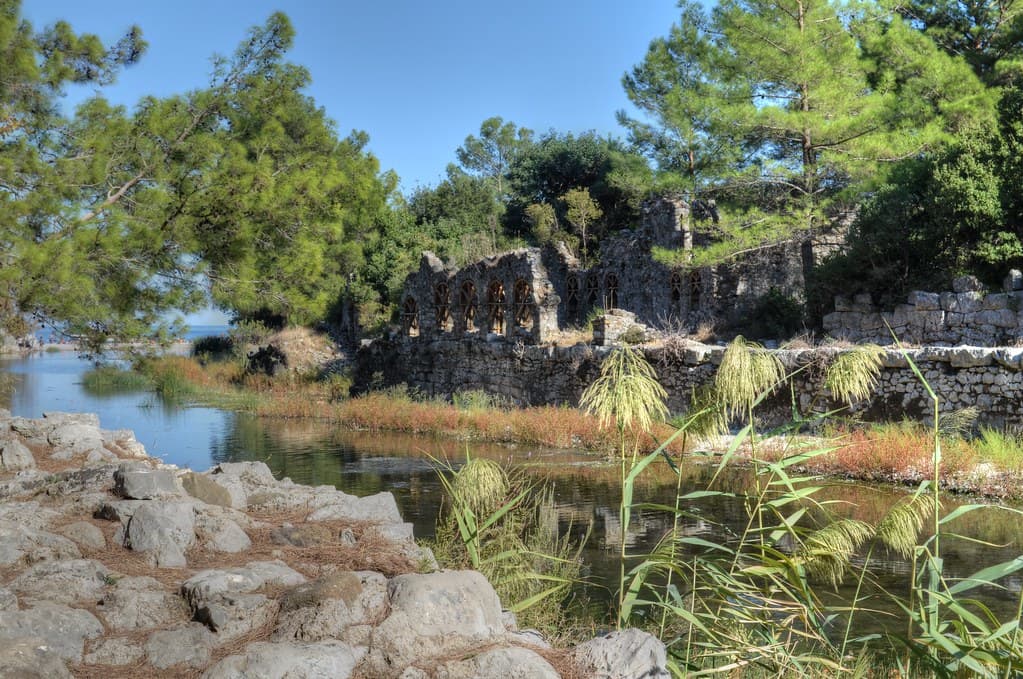
Image of Olympos. Image source
Visit essentials
A quick read before you go
- Duration
- Half day for the valley ruins and beach alone.
- Access
- Located approximately 90 km southwest of Antalya near Çıralı village, Antalya province.
Overview
Olympos occupies a narrow river valley on the Lycian coast, where ruins among plane trees and wild fig follow paved streets to a pale-pebble beach. Behind them, a mountain's lower slopes hold the perpetual Yanartaş fires.
Methane seeping through metamorphic rock has burned there without interruption for at least 2,500 years of recorded history, possibly much longer. Ancient Greeks understood the flames either as the burial place of the fire-breathing Chimaera, slain by Bellerophon on Pegasus, or as the surface expression of Hephaestus's underground forge. A temple to the fire god stood directly beside the flames, which also guided sailors along the Lycian coast.
Below, Olympos was one of six leading members of the Lycian League from at least the second century BCE. This federation of democratic cities issued coins bearing each member's symbols before Rome inherited the league. Byzantine Christians built a basilica in the fifth century; Turkish excavators uncovered its mosaics and entrance inscription only in June 2025. The Lycian Way still passes through a valley whose archaeology continues to emerge.
Why this place is sacred
The quality that makes Olympos feel sacred is not architectural — it is geological and perpetual. The Yanartaş flames burn whether or not anyone is watching. They burned when the Lycian sailors charted their course by them. They burned when the Chimaera myth was being told. They burned through the Byzantine centuries when a Christian community gathered in a basilica just below in the valley. They are burning now.
This continuity is the sacred core of Olympos. Fire from the earth, inexplicable to antiquity, generates an elemental power that accommodates successive interpretations without being exhausted by any of them. For the ancient Greeks and Lycians, it was Hephaestus — the lame divine craftsman whose forge was underground, whose work was transformation through heat. For mythological tradition, it marked where the Chimaera fell after Bellerophon's lance. For medieval Christian travelers, the self-igniting fires were wonders of creation.
For modern visitors who sit on the hillside after dark, watching the blue-orange flames against bare rock, it tends to generate silence before it generates explanation.
The valley below adds layering. The ancient city is not dramatically monumental — it is intimate, overgrown, traversed on foot through filtered light. The ruins are thick with atmosphere precisely because they are unresolved: half-excavated streets, a theatre partly reclaimed by vegetation, a temple gate whose dedicatee is still debated.
And beneath the trees, a fifth-century church whose floor mosaics were just uncovered, bringing the city's sacred timeline from Lycian myth through Roman occupation into late Christian antiquity in a single season.
The Chimaera site was originally a place of cult activity centered on the natural fire vents, attributed to Hephaestus. The city of Olympos functioned as a Lycian League member with civic temples, funerary monuments, and public religious life typical of the Anatolian Greek world.
The sacred geography moved from fire cult (Hephaestus/Chimaera mythology) through Lycian civic religion and Roman administration to Byzantine Christian worship. Today the site operates as an archaeological heritage area and hiking waypoint on the Lycian Way, while the Chimaera flames continue to attract informal spiritual visitors, particularly at night.
Experience and orientation
Most of Olympos is experienced on a single dirt path through a narrow valley. The path winds between stone walls half-buried in vegetation, past a Roman bath complex whose arches are still intact, through what remains of the main street where shops and civic buildings once lined the river. The scale is intimate. Plane trees and fig trees have colonized the ruins so thoroughly that the archaeology and the ecology are inseparable — you walk through both simultaneously.
The valley ends at the beach without warning. Ancient harbor works lie just below the waterline, visible on calm days. The transition from ruined city to open Mediterranean happens in about three steps, which is its own kind of spatial revelation.
The Chimaera flames require a separate approach. From Çıralı, a path climbs roughly 1.5 kilometers up the rocky hillside of Mount Olympos, gaining about 200 meters of elevation. The climb takes thirty to forty minutes depending on pace. During the day, the flames are visible but modest — small blue-orange vents in pale grey rock, surrounded by the blackened stone of centuries of burning. After dark, the transformation is complete.
The flames leap higher, their color shifts, and the surrounding darkness removes every modern reference point. Visitors describe sitting among the flames at night in the same terms: a quality of temporal dislocation, a sense of deep time that the ruined city below conveys intellectually but the living fire conveys physically.
Come to the valley in the morning, when the light is soft and the ruins are quiet. Come to Yanartaş after 20:00 in summer, when enough darkness has gathered to let the flames speak.
The ancient city is accessed from the south entrance near Çıralı village. The Chimaera flames (Yanartaş) are reached via a separate signed path from Çıralı, approximately 1.5 km uphill. Both sites share a single entrance fee but require separate approaches and timing. Night visits to the flames require torches and appropriate footwear for rocky terrain.
Context and lineage
The city appears on Lycian League coinage around 167–168 BCE, though settlement may be older. The name 'Olympos' was given to multiple places in the ancient Greek world, typically mountains associated with divine presence — the designation itself is a theological statement about the site's relationship to the gods.
The Chimaera myth places the origin of the sacred fire in heroic prehistory: Bellerophon, riding Pegasus, slays the fire-breathing beast on this mountain, and the flames of its death persist in the earth. The mythological account and the geological reality (methane seepage from Mesozoic ophiolitic rock) occupy the same landscape without contradiction.
The Lycian League was one of antiquity's most democratic federations. Each member city — Olympos held three of the league's total votes — contributed to collective governance and defense while maintaining local religious identity. When Rome absorbed Lycia in 43 CE, the league structure was retained as a model for provincial administration. The city prospered through the Roman Imperial period before experiencing decline in the third century.
A Christian community persisted here through the Byzantine period, their basilica only recently identified through excavation.
Lycian city-state (c. 2nd century BCE) → Lycian League member (167 BCE onward) → Roman provincial city (43 CE) → Byzantine Christian community (5th–7th century CE) → abandoned and covered by vegetation → rediscovered by European explorers (19th century) → ongoing Turkish Ministry of Culture excavations (since 2006)
Bellerophon
Mythological hero; traditional slayer of the Chimaera whose death created the sacred flames
Hephaestus
Greek god of fire and the forge; principal deity of the Chimaera flame site; temple erected at Yanartaş in his honor
Cicero
Roman orator and statesman; described Olympos as 'a city full of wealth and art' during his tenure as governor of Cilicia (51–50 BCE)
Strabo
Greek geographer (63 BCE–24 CE); documented Olympos as one of the largest Lycian settlements in his Geography
Traditions and practice
The Yanartaş flame site hosted a temple to Hephaestus directly beside the vents. Ancient practice would have included sacrificial offerings, prayer, and the tending of sacred flame — activities that the natural fire both inspired and centered. Lycian civic religion in the valley included temple ceremonies, funerary rites in the rock-cut tombs, and the public life of a league city.
The fifth-century Christian basilica attests to liturgical practice — baptism, Eucharist, regular assembly — continuing the sacred use of the valley floor.
No formal religious practices currently operate at Olympos. The Lycian Way, a long-distance walking trail that passes through the valley, has generated a secular but genuine pilgrimage culture among hikers who walk portions of the ancient Lycian landscape. Night visits to the Chimaera flames have developed their own informal contemplative character — sitting in silence among the burning vents, sometimes lighting a piece of bread in the larger flames, is widely practiced by visitors without religious affiliation.
Give the flames their proper time. The hillside path to Yanartaş climbs steadily for thirty to forty minutes — begin in late afternoon so you arrive in fading light and stay into full dark. Bring a torch, water, and something to sit on. The larger central vent burns reliably; the cluster of smaller vents nearby offers a different scale. Sit without explaining the experience to yourself immediately.
In the valley below, move slowly. The ruins reward unhurried attention more than systematic coverage. The Roman bath arches are best at morning light. The path toward the beach invites attention to the threshold between ruined civilization and open sea — the moment when paved stone ends and pebbles begin.
Hephaestus Fire Cult (Ancient Greek/Lycian)
HistoricalThe perpetual natural methane flames at Yanartaş/Chimaera were believed to be sacred to Hephaestus, god of fire and the forge. A temple to Hephaestus stood directly beside the flames. The site was also connected to the myth of the Chimaera slain by Bellerophon on his winged horse Pegasus.
Temple rituals, offerings to Hephaestus; the flame was used to light the first Olympic torch, according to tradition
Early Christianity
HistoricalA fifth-century church was built within the ancient city, attesting to a Christian community in Late Antiquity. Excavations completed in June 2025 revealed well-preserved mosaics and an entrance inscription confirming the structure's liturgical function.
Liturgical worship; building of basilica-style church with decorated mosaic floors
Lycian Civic Religion
HistoricalOlympos was one of the six leading cities of the Lycian League, a religiously and politically unified confederation. Civic temples and funerary monuments formed the sacred landscape of the valley.
Public ceremonies, temple dedications, royal and civic funerary rites
Archaeological and Heritage
ActiveActive excavations by the Turkish Ministry of Culture since 2006 continue to reveal the city's Lycian, Roman, and Byzantine layers. The site is within Beydağları Coastal National Park and on the Lycian Way hiking route.
Annual excavation campaigns; public heritage tourism; Lycian Way trekking
Perspectives and open questions
Olympos holds an unusual position in scholarly and cultural understanding because its most famous feature — the perpetual fire — is simultaneously a verified geological phenomenon and an authentic ancient sacred site. This double reality generates multiple legitimate interpretive frames.
Scholarly perspective
Geologists have confirmed that the Yanartaş flames result from natural seepage of methane through Mesozoic ophiolitic rock — a process that has continued for thousands of years. Archaeological work since 2006 has revealed the city's multi-period occupation from Hellenistic through Byzantine phases. The 2025 church discoveries are particularly significant, confirming a late antique Christian community and expanding the known timeline of sacred use at the site.
The Lycian League context places Olympos within one of the ancient world's most studied democratic confederations.
Living and traditional perspectives
The Lycian and Greek sacred tradition made the flames a place of genuine cult activity. A temple stood at the site because the fire was understood as divine presence — the underground forge of Hephaestus or the buried body of the Chimaera — not as metaphor. Ancient mariners used the flames as a navigational landmark, giving the sacred site also a practical function that reinforced its importance. According to tradition, the Olympic torch was first lit from these flames.
Alternative interpretations
The Chimaera flames appear in various modern esoteric traditions as an example of a genuine 'eternal sacred fire' — a category that includes the Zoroastrian fire temples of Iran and the Vestal flame of Rome. Some practitioners visit Yanartaş to perform informal fire meditations, regarding the geological permanence of the flame as a portal to elemental consciousness.
The Lycian Way hiking community has generated its own mythology around the site, treating the night flame visit as a transformative waypoint in the pilgrimage journey.
Open questions
The full extent of the ancient city remains buried under dense vegetation; excavations have revealed only a fraction of the urban plan. The 2025 Byzantine church finds suggest that the site's sacred importance extended well into late antiquity in ways not previously understood. The original configuration of the Hephaestus temple at Yanartaş — its architecture, votive deposits, and ritual layout — has not been fully documented.
Plan your visit
Access and arrival
Located approximately 90 km southwest of Antalya near Çıralı village, Antalya province. By car: take the D400 coastal road toward Finike, then follow signs for Çıralı/Olympos. By public transport: bus or dolmuş to Kumluca, then local minibus to Çıralı (not always frequent — check timetables). Entrance fee applies; Museum Card accepted. Open daily 08:00–21:00 (summer), 08:30–17:30 (winter).
Mobile phone signal is generally adequate in Çıralı village but can be unreliable on the Chimaera hillside — inform someone of your plans before an evening hike.
Çıralı village, immediately adjacent, offers a range of small guesthouses and family pensions within walking distance of both the ruins and the Chimaera trailhead. Booking in advance is advisable in high season (July–August). Olympos village to the north offers budget-oriented treehouse and bungalow accommodation popular with hikers on the Lycian Way.
Respectful visit
No dress code applies. Comfortable walking shoes are essential for the valley ruins on uneven stone surfaces. For the Yanartaş climb, sturdy footwear with grip is necessary on rocky terrain. Sun protection is important in summer; layers are advisable for evening flame visits when temperatures drop.
Photography is permitted throughout. Drone operation requires a permit within the Beydağları Coastal National Park — arrange this in advance through the park authority. Night photography at the Chimaera flames is rewarding but requires a tripod and knowledge of low-light technique.
No formal offering tradition currently exists. Some visitors informally leave small stones or natural objects near the larger flame vents; this is tolerated but not encouraged.
Do not remove archaeological materials, stones, or pottery fragments. Do not enter areas marked as active excavation zones. Camping within the ruins is prohibited. Respect national park regulations regarding wildlife and vegetation. The flames themselves should not be obstructed or interfered with.
The hillside to Yanartaş is rocky and uneven; appropriate footwear is essential. Night visits require a torch — the path is not lit. Do not attempt to extinguish or divert the flames. Within the national park, stay on marked paths and respect the ecological as well as the archaeological fabric of the site.
Location
Map loads as you approach this section.
Pilgrim reflections
A portrait of encounter, not a score
Pilgrims describe what they felt, how present they could become, and whether the place would shape a journey. There are no stars and no ranking of traditions.
No reviewed reflections yet
The first pilgrims can help describe the character of being here.
Share a reflection
Available after an account-backed “Been there.” Every reflection is reviewed before publication.
Nearby sacred places
Explore other sacred places in the region. Proximity does not establish access or travel time; check each place’s guidance.


References
Sources consulted for this page. Source categories describe the publication, not a guarantee that every claim is verified. Traditional accounts and outside interpretations may differ.
- 01Ancient mosaics and sacred inscriptions uncovered in Turkey's Olympos reveal early Christian history — Archaeology News Online Magazineacademic2025 excavation finds: fifth-century church mosaics and inscriptions
- 02Antalya Olympos Archaeological Site — Turkish MuseumsofficialOfficial Turkish cultural authority listing
- 03Olympos | Turkish Archaeological News — Turkish Archaeological NewsacademicScholarly excavation news and archaeological updates
- 04Olympos (Lycia) — Wikipedia — Wikipedia contributorsencyclopediaGeneral overview of site history and geography
- 05Olympos — Ancient Türkiye — Atlas AnatoliaguideDetailed site description and mythology
- 06Guide to the Ancient City of Olympos in Antalya: History & Tips — Antalya Tourist InformationguidePractical visitor information and opening hours
- 07Visit Yanartaş (Chimaera) in Olympos: Access, Tours, and History — Antalya Tourist InformationguideDetails on sacred Chimaera fire vents
- 08Antalya's hidden treasure: Ancient city of Olympos and its historical relics — Türkiye TodaySource contextCultural overview and recent site news
Share a photo
Help visitors recognize Olympos. Every submission is reviewed before publication.