Arykanda
A Lycian city on five mountain terraces, where temples to sun, fortune, and a god-emperor ascend toward the sky
Understand sacred places, explore living traditions, and learn how to engage respectfully with Pilgrim Map.
Access has not been verified. Check current local guidance before planning a visit.
Antalya, Turkey
Read the sources
Visit essentials
A quick read before you go
- Duration
- Allow at least three hours to traverse all five terraces.
- Access
- Located approximately 140 km from Antalya (2 hours by car) on the Elmalı–Finike mountain road…
Overview
Arykanda deliberately ascends a near-vertical mountain in five terraces linked by ancient steps; its theatre faces the rock wall. This vertical plan was theological as well as architectural: Lycian tradition treated high places as closer to the divine, and the name—almost certainly from a Luwian root meaning 'the place near the high rock'—suggests sacred geography guided settlement before construction. Flourishing from at least the sixth or fifth century BCE, the city adopted Greek forms while remaining distinctly Lycian.
Temples to Tyche (Fortune), Helios (the sun god), and the deified Emperor Trajan occupied successive levels: fortune at the civic level, solar power above, and imperial divinity at the summit. Elaborately carved sarcophagi and temple-type monumental tombs line the approaches, making arrival a passage through the honoured dead. Ankara University excavations since 1971 exposed a nearly 106-metre-long intact stadium and well-preserved theatre without dispelling the site's rarely crowded atmosphere.
Its altitude, isolation, and preservation offer the region's most complete encounter with Lycian mountain sacred urbanism.
Why this place is sacred
There is a quality in mountain-sited sanctuaries that flat-land temples cannot replicate: the atmosphere at elevation, the physical effort required to reach the sacred space, and the visual relationship between the temple and sky. Arykanda organized its entire civic and religious life around this vertical axis.
The Lycian people with Luwian ancestry who founded the city called it by a name meaning, in effect, the high place. They positioned their temples to ascend the cliff with them. The Temple of Tyche — Fortune, the unpredictable power that shapes human lives — occupied the agora level, woven into daily civic commerce. The Temple of Helios, the sun god, rose higher on a dedicated terrace with an orientation toward the rising sun.
The Temple of Trajan, at the summit, placed imperial deification at the highest accessible point. This arrangement was not accidental. It encoded a cosmology: the quotidian and the fortunate at the base, the cosmic and the solar above, the divine-human ruler at the peak.
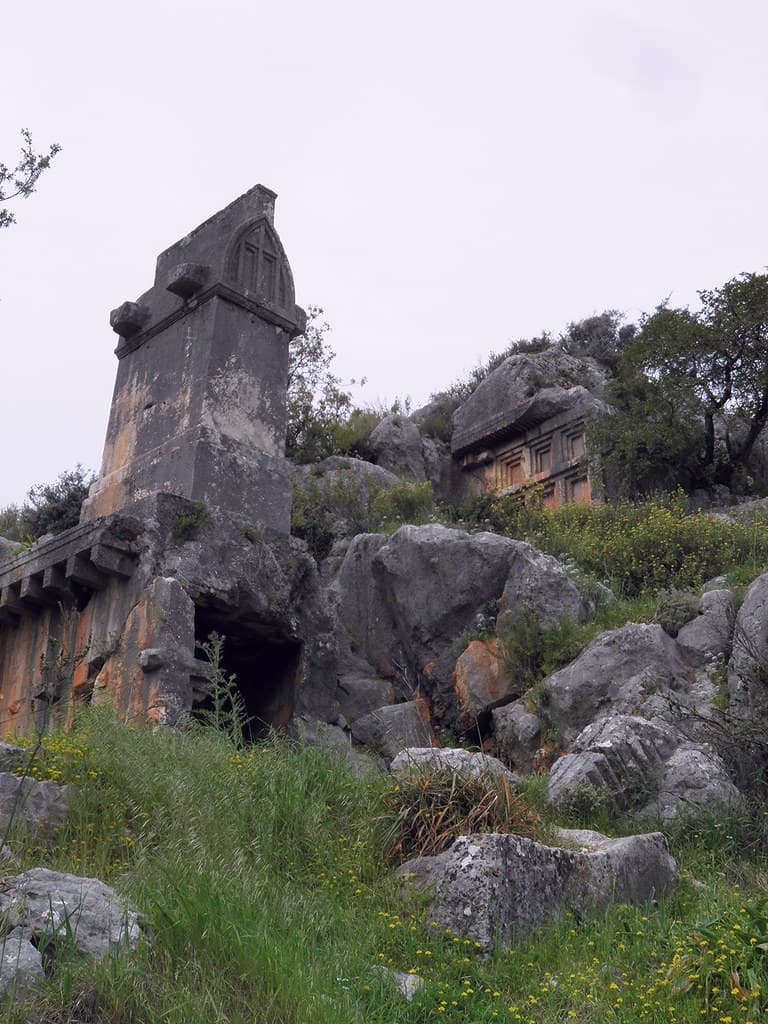
The necropolis adds a further dimension. The approach to Arykanda from below passes through elaborately carved monumental tombs — temple-type sarcophagi on tall podia, barrel-vaulted chamber tombs cut from the living rock. These are not modest graves. They are statements of perpetuity: the Lycian elite dead positioned their monuments at the gateway to the living city, ensuring that every arrival was also a passage through the realm of the honored ancestors.
Between the necropolis below and the imperial temple above, the city occupied a band of sacred geography bounded by death and divinity.
Religious and civic center for the indigenous Luwian-Lycian community of the Taurus mountain region; later integrated into Greek and Roman religious frameworks while maintaining its mountain-sacred character.
The city's sacred organization evolved from pre-Greek Luwian-Lycian tradition through Hellenization under Macedonian influence, Roman integration with the imperial cult, and finally Byzantine Christian occupation — when the settlement shifted south and basilicas replaced the civic temples. The elevated site was gradually abandoned in the medieval period.
Experience and orientation
The entrance to Arykanda deposits you at the lower terrace level. Begin with the necropolis tombs visible on the approach — allow yourself time to read the carved details of the sarcophagi before entering the city proper. The monumental barrel-vaulted tombs, cut directly from the rock face, demonstrate a command of stone carving that the Lycians maintained for centuries.
Ascend through the agora area, where the Temple of Tyche once organized civic life around fortune and exchange. The agora terrace opens to views of the pine forest below and, beyond it, glimpses of the Finike plain. The seven bath complexes distributed across the terraces — an unusually high number for a city of this size — speak to a culture that combined hygiene, sociality, and civic ritual in the same spaces.
The stadium terrace, at 106 meters long by 17 meters wide, is startlingly well preserved. Stone seating survives on the hillside edge; the track surface, though worn, is largely intact. Stand at either end and consider the athletic events that filled this space — the games that were simultaneously civic, religious, and competitive, the Lycian equivalent of Olympia.
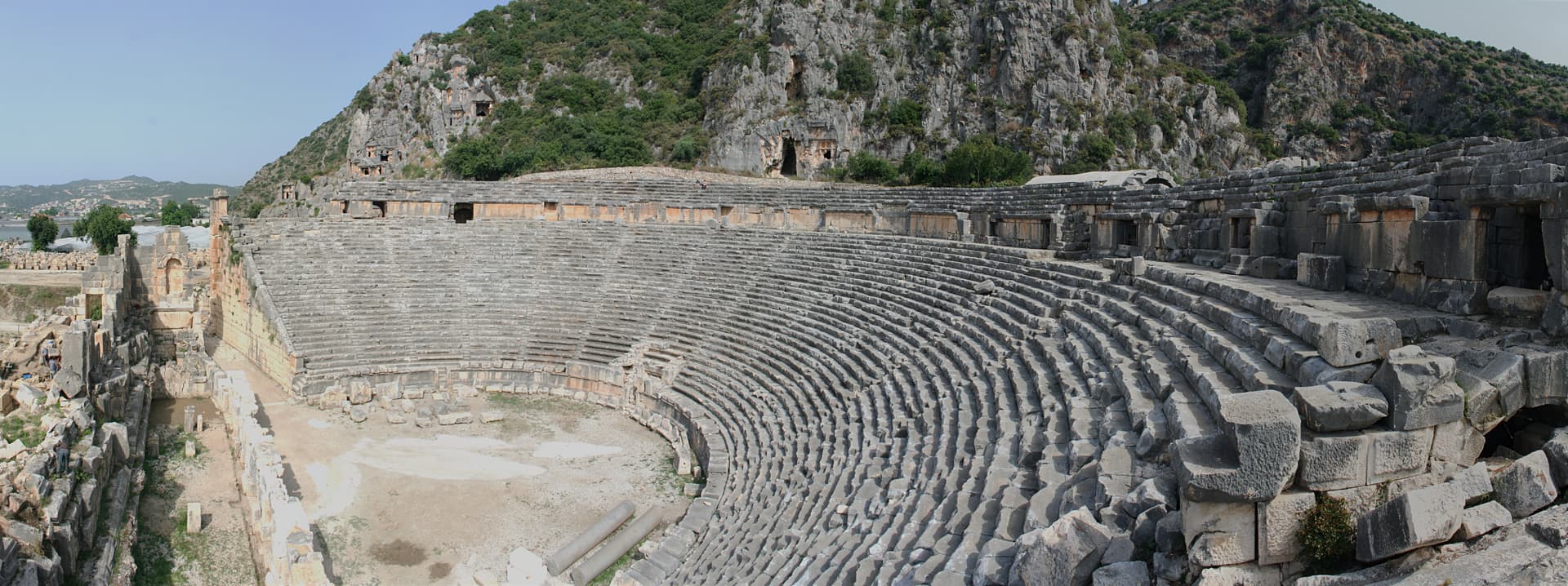
Continue upward to the theatre. Unlike many ancient theatres set against scenic distant views, Arykanda's theatre has the rock wall as its backdrop — the audience looked at the mountain, not past it. The acoustics, unchanged by centuries of disuse, still carry a whisper from the stage to the upper tiers.
The highest accessible terraces hold the Temple of Helios site. Come at sunrise or late afternoon when the light on the upper terrace has directional quality. The views of the Taurus range and the valley below from this elevation belong to a different category of landscape experience.
Allow at minimum three hours; the site covers significant vertical distance and each terrace requires its own attention. Wear walking shoes with ankle support — the paths between terraces are steep and sometimes loose. Bring at least two liters of water and sun protection; shade is limited on the upper terraces. The necropolis area below the main site can be explored before or after the terraces.
Context and lineage
The suffix '-anda' that ends the city's name is a marker of pre-Greek Anatolian (Luwian) origin, shared with cities such as Kyaneai and Araxa. This linguistic signature indicates that the settlement predates the Hellenization of Lycia and belongs to an earlier stratum of Anatolian sacred urbanism — one in which the choice of mountain location was already embedded in the name itself.
The physical remains trace back to at least the sixth or fifth century BCE, though the '-anda' suffix evidence suggests original occupation much earlier, possibly in the second millennium BCE when the Luwian language was widely spoken across Anatolia.
The city's peak prosperity arrived in the first through third centuries CE under Roman administration. A wealthy benefactor culture funded the seven bath complexes, the odeon, and the expansion of existing temples. The presence of a Hadrian portrait statue in the odeon and the Temple of Trajan at the summit terrace indicate that Arykanda actively cultivated its relationship with imperial Rome as a source of religious, political, and financial capital.
Pre-Greek Luwian-Lycian settlement (possibly 2nd millennium BCE) → Iron Age urban development (6th–5th century BCE) → Hellenized Lycian city (4th–2nd century BCE) → Lycian League member → Roman provincial city, peak prosperity (1st–3rd century CE) → Byzantine period, settlement shifts south (5th–6th century CE) → abandoned → identified by Charles Fellows (1838) → Ankara University excavations (1971–present)
Charles Fellows
British explorer and archaeologist who identified the site in 1838 during his survey of Lycian ruins; provided the first European description of Arykanda's terraced urban layout
Dr. Cevdet Bayburtluoğlu
Led excavations from 1971 with Ankara University; primarily responsible for the systematic archaeological record of the site's five terrace levels and temple complexes
Emperor Hadrian
Roman emperor (117–138 CE) whose portrait statue was found in the odeon; presence indicates Arykanda's participation in the imperial cult and patronage network
Emperor Trajan
Roman emperor (98–117 CE) to whom the summit temple was dedicated; the Trajaneum represents the city's most monumental act of imperial cult devotion
Traditions and practice
Each of Arykanda's three principal temples required distinct ritual practice. The Temple of Tyche in the agora served the civic need for divine intercession in uncertain human affairs — fortune was unpredictable and required regular propitiation. The Temple of Helios, oriented toward the rising sun, likely organized its ceremonies around solar events — sunrise rituals, seasonal dedications corresponding to the agricultural calendar.
The Temple of Trajan imposed the imperial religious requirement: games, sacrifices, and ceremonies honoring the deified emperor were obligations of every loyal city in the Roman world.
The stadium hosted athletic and perhaps musical competitions at intervals tied to civic festivals. Seven bath complexes distributed the daily ritual of purification, sociality, and bodily maintenance across the urban terraces. The Lycian funerary monuments in the necropolis were not merely graves but sacred sites of ancestral commemoration, requiring periodic visiting and offering.
No formal religious practices are conducted at Arykanda. Archaeological fieldwork by Ankara University continues in annual campaigns. Heritage visitors explore the site on self-guided or guided bases.
Ascend slowly, treating the climb as the terraces were designed to be experienced — as a gradual elevation through different registers of the sacred. Begin at the necropolis below, where the Lycian elite placed their most elaborate monuments at the city's threshold. Move through the agora and bath complexes, noticing how the architecture organizes daily life around civic ritual. Continue to the stadium terrace; stand at the starting line and face the length of the track.
Climb further to the theatre and test its acoustics — speak quietly toward the stage from the upper rows. Finish at the Helios terrace if you can time your visit for the light — the orientation toward the east means the upper terraces receive direct morning sun before the lower city does.
If you carry a notebook, consider writing something at the Helios terrace. The tradition of dedicating writing or intention to a sun god is documented across multiple cultures; the practice of pausing to articulate something at the highest accessible point of an ancient sacred hill belongs to an older pattern than any specific religion.
Lycian Civic Religion
HistoricalArykanda contained multiple temples across its terraces: a Temple of Tyche (Fortune) in the agora, a Temple of Helios on a higher terrace, and a Temple to the deified Emperor Trajan. This multi-deity framework was typical of Lycian cities that blended indigenous Anatolian religion with Greek and Roman forms.
Public sacrifices, civic dedications, votive offerings, festival processions through the agora
Emperor Cult (Roman Imperial)
HistoricalA temple to Trajan dominated the upper terrace, and a statue of Hadrian was found in the odeon. The city actively participated in the Roman imperial cult, which was both political and religious in nature.
Sacrificial rites, games, and ceremonies honoring the deified emperor; athletic competitions in the stadium tied to imperial festival calendar
Early Christianity and Byzantine
HistoricalEarly Christian basilicas were built at Arykanda through to the Byzantine period (6th century CE), when the settlement shifted south. The persistence of occupation demonstrates continuous sacred use of the landscape.
Christian liturgy; monastic or episcopal presence in Byzantine phase
Archaeological and Heritage
ActiveExcavations by Ankara University beginning in 1971 under Dr. Cevdet Bayburtluoğlu have uncovered some of Lycia's best-preserved remains. The site's remote mountain setting has protected it from modern intrusion.
Annual excavation campaigns; academic publication; heritage tourism by those seeking less-visited Lycian sites
Perspectives and open questions
Arykanda sits at the intersection of multiple scholarly and cultural conversations: the origins of Lycian sacred urbanism, the relationship between elevated sacred topography and divine proximity, and the layered adoption of Greek, Roman, and Christian religious forms by an indigenous Anatolian community.
Scholarly perspective
Archaeological scholarship situates Arykanda as one of the finest examples of Lycian mountain urbanism, distinctive for its vertical terrace organization and the quality of its preserved structures. The '-anda' suffix cities are recognized as the earliest Lycian foundations, predating Greek influence, making Arykanda's sacred topography a window into pre-Hellenistic Anatolian religious geography. Excavations since 1971 have provided one of the most complete stratigraphic sequences in Lycia, documenting the city's evolution from Iron Age foundation through Byzantine decline.
Living and traditional perspectives
Lycian sacred geography treated elevated positions as inherently closer to the divine — temples were built on high terraces, tombs on visible cliff faces, and the gods themselves were understood to inhabit the mountain peaks. Arykanda's five-terrace layout is a direct architectural expression of this theology: human civic life organized as an ascent toward the divine.
Alternative interpretations
The Temple of Helios on the upper terrace, with its east-facing orientation and mountain setting, has attracted interest from those researching ancient solar alignments. The combination of altitude, orientation, and dedication to the sun god makes Arykanda a candidate for systematic archaeoastronomical study — a study that has not yet been formally conducted.
The site's dramatic setting also draws those interested in sacred landscape as a category distinct from formal religion: the mountain geography of Arykanda qualifies as a sacred place independent of any specific cultic activity.
Open questions
The city's founding traditions and any pre-Greek religious practices at the high place remain poorly documented — the '-anda' suffix cities are understood to be old, but the specifics of their earliest sacred life have not survived in literary or material form. The full significance of the Helios temple's orientation and any possible astronomical function has not been formally investigated. The extent of Byzantine-period religious life in the lower city, after the main terraces were abandoned, is not well understood.
Plan your visit
Access and arrival
Located approximately 140 km from Antalya (2 hours by car) on the Elmalı–Finike mountain road near Aykiriçay village, Antalya province. Follow brown heritage signs from the main road; a short unpaved track leads to the site entrance. A small entrance fee is charged at the site. No public transport serves the site reliably — a private vehicle or organized tour is effectively required. No facilities on-site: no water, toilets, or food.
Mobile phone signal may be limited on the upper terraces; inform someone of your plans before visiting. No information was available at time of writing regarding keyholder arrangements; the site appears to be open during daytime without a warden at all times.
No accommodation is available at or near the site itself. The nearest towns with hotels are Finike (c. 35 km) and Kumluca (c. 25 km), both offering basic accommodation. Antalya provides the full range of options for those making a day trip. Given the distance and road conditions, an overnight base in Finike is worth considering for those who wish to visit both Arykanda and Limyra.
Respectful visit
Sturdy hiking footwear with ankle support is essential. The terrace paths are steep, rocky, and sometimes loose. Sun protection — hat, light long sleeves — is important on the exposed upper terraces. Bring layers; even in summer the elevation means temperatures can drop in late afternoon.
Photography is permitted throughout. The site's dramatic mountain backdrop makes it one of the most photogenic Lycian sites in Turkey. No specific restrictions have been reported, but avoid standing on architectural fragments or tomb podia to gain vantage points.
None relevant.
Do not remove artifacts or pottery fragments. Do not enter areas marked as active excavation zones — these will typically be cordoned with tape or fencing. Do not disturb the tomb monuments in the necropolis. The site has no staff presence during visitor hours; this places full responsibility for respectful conduct on visitors themselves.
The site has no facilities — no water, no toilets, no shade structures. Bring ample water (minimum 2 liters per person in summer), food, and sun protection. The paths between terraces are steep; walking poles are useful. In summer, the upper terraces become hot by mid-morning; arrive at opening time. The site is remote enough that mobile phone signal may be unreliable — inform someone of your visit before leaving the main road.
Location
Map loads as you approach this section.
Pilgrim reflections
A portrait of encounter, not a score
Pilgrims describe what they felt, how present they could become, and whether the place would shape a journey. There are no stars and no ranking of traditions.
No reviewed reflections yet
The first pilgrims can help describe the character of being here.
Share a reflection
Available after an account-backed “Been there.” Every reflection is reviewed before publication.
Nearby sacred places
Explore other sacred places in the region. Proximity does not establish access or travel time; check each place’s guidance.


References
Sources consulted for this page. Source categories describe the publication, not a guarantee that every claim is verified. Traditional accounts and outside interpretations may differ.
- 01Antalya Arykanda Archaeological Site — Turkish MuseumsofficialOfficial Turkish cultural authority listing
- 02Arykanda | Turkish Archaeological News — Turkish Archaeological NewsacademicScholarly excavation news
- 03Arykanda — Livius — Livius.orgacademicScholarly historical narrative and source references
- 04Arycanda — Wikipedia — Wikipedia contributorsencyclopediaComprehensive overview of history, structures, and excavation
- 05Arykanda Turkey: Clifftop Lycian Temple & Mountain Ruins — Ancient TravelguideReligious and temple significance detail
- 06Arykanda an ancient city in Lycia, Turkey — Peter Sommer TravelsguideExpert travel writing with archaeological context
- 07Arcyanda Ancient City — ArtichaeologyacademicDetailed architectural and historical overview
- 08Ancient Arykanda — This is Antalya — This is AntalyaguidePractical visitor information
Share a photo
Help visitors recognize Arykanda. Every submission is reviewed before publication.