Limyra
Capital of Lycia, keeper of 400 cliff tombs, and where the lost Temple of Zeus was found after 43 years
Understand sacred places, explore living traditions, and learn how to engage respectfully with Pilgrim Map.
Access has not been verified. Check current local guidance before planning a visit.
Antalya, Turkey
Read the sources
Visit essentials
A quick read before you go
- Duration
- 2–4 hours for the lower site, theatre, avenue, and cliff-tomb zone.
- Access
- Near Yuvalılar village, approximately 9 km northeast of Finike, Antalya province.
Overview
Limyra was the fourth century BCE's most powerful Lycian city, yet remained partly illegible for generations. Ancient inscriptions attested its Temple of Zeus from 1982 onward as the religious center, but excavation could not locate it for 43 years. Austrian archaeologists announced its discovery in 2025, resolving a puzzle that shaped five decades of fieldwork and reorienting the city's sacred layout.
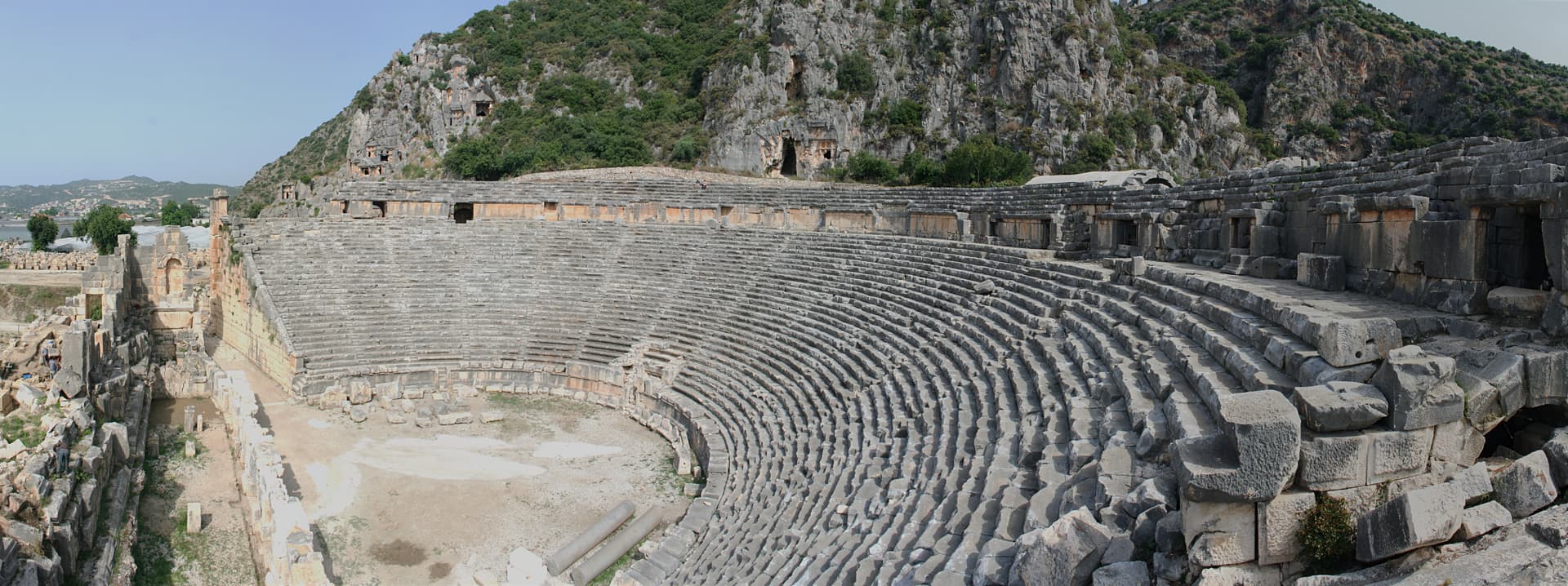
The Heroon of Pericles, built for the Lycian king who made Limyra the regional capital, combines Athenian architectural elegance with Persian imperial iconography to place a mortal king among heroes. More than 400 Lycian rock tombs line the cliffs, many inscribed in Lycian with sacred genealogies, forming one of the ancient Mediterranean's largest necropolises. A 6,000-seat theater, a Ptolemaic monument, and the funerary monument of Gaius Caesar—Augustus's grandson, who died here in 4 CE—show continued Hellenistic and Roman importance.
The Zeus temple, cliff tombs, and Heroon are established chapters in an ongoing archaeological story. What the sanctuary will reveal about classical-period religious organization remains unwritten.
Why this place is sacred
Limyra was built on the proposition that death could be made sacred. The 400-plus Lycian rock tombs are not merely burial monuments — they are a comprehensive sacred landscape in which the entire cliff face above the city was converted into a permanent record of ancestral presence. Lycian religious tradition held that the dead were carried to the afterlife by winged supernatural creatures, which is why the tombs were placed high: elevation facilitated the soul's departure.
The inscriptions — in Lycian, one of the Anatolian languages — encode not just names but genealogies, the sacred lineages that gave political authority to the Lycian elite and connected the living city to its founding ancestors.
At the pinnacle of this landscape stands the Heroon of Pericles. Built in the fourth century BCE when Pericles made Limyra the capital of Lycia, the Heroon is a deliberate act of sacred invention: the architecture is Athenian, the iconographic program is Persian imperial, and the purpose is to elevate a Lycian king to heroic-divine status.
This was not unusual in the ancient world — the hero cult of a ruler was a standard form of political-religious legitimation — but the Heroon of Pericles is unusually explicit about its multi-cultural ambitions. It is a monument to the idea that a man of sufficient power could become sacred, and that the right architecture could make that transformation visible.
Below the hero shrine, the city's sacred center was organized around the Temple of Zeus — the king of the gods, whose authority gave divine sanction to the social and political order. That this temple was sought for 43 years and found only in 2025 adds an unexpected contemporary layer to Limyra's sacred history: the city's deepest religious center was hidden in plain sight, waiting for exactly the right excavation season.
Lycian regional capital under King Pericles (4th century BCE); sacred center organized around Zeus worship and royal hero cult; one of the most important funerary landscapes in the Lycian world.
From Lycian capital and ceremonial center through Ptolemaic annexation, Roman provincial life (including the death of Gaius Caesar here in 4 CE), Byzantine episcopal administration, and eventual abandonment — the sacred landscape accumulated layers without erasing its earlier structure. The cliff tombs remain as the dominant physical feature, anchoring all subsequent sacred history in the Lycian funerary tradition.
Experience and orientation
The lower site of Limyra opens easily. The theatre, seating 6,000, is among the largest in Lycia and still conveys the scale of civic ambition that marked the city at its height. The Roman avenue — the main street — leads through the ruins of the city's public core, now partly cleared and partly overgrown, with the occasional inscription-bearing stone visible in context.
The Ptolemaion and the funerary monument of Gaius Caesar are encountered along or near this axis, their monument types indicating the different sacred and dynastic purposes they served.
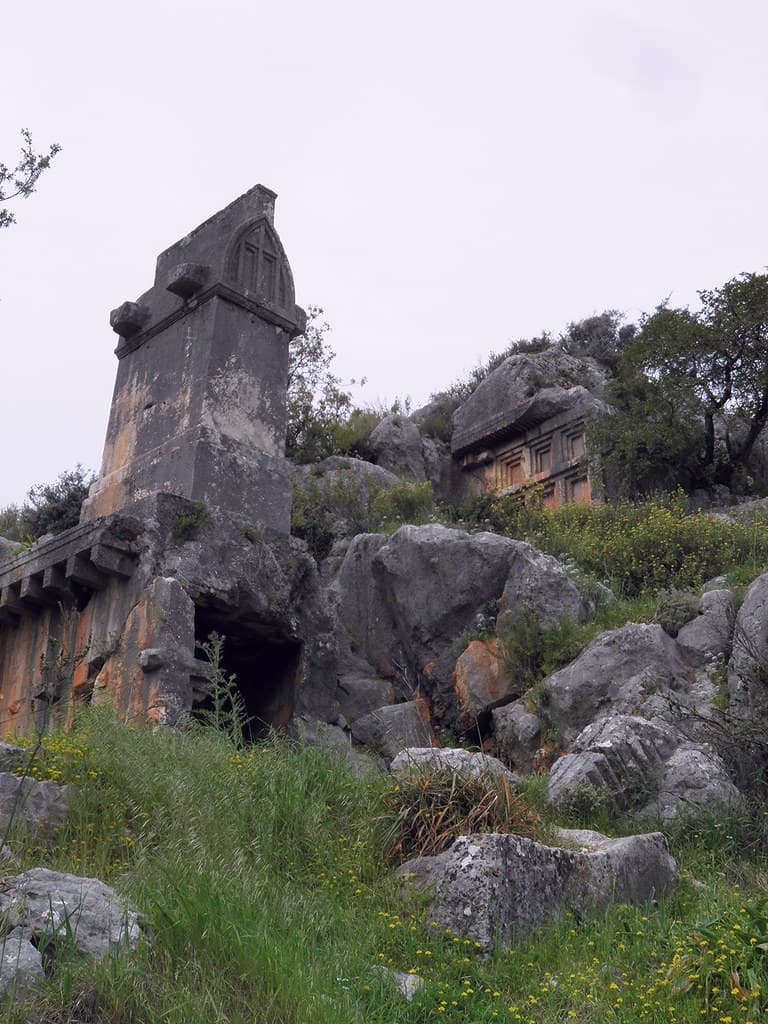
The cliff tombs begin at the lower edges and ascend the rock face above. Walk along the base of the cliff and let the scale accumulate: 400-plus tombs of varying types and periods, many still bearing Lycian-language inscriptions, covering the cliff face in a dense record of the city's elite dead.
The house-type tombs imitating wooden architecture, the pillar tombs with their carved facades, the sarcophagi on elevated podia — each type represents a different period and a different formulation of what it meant to be honored in death.
The Heroon of Pericles requires commitment. The path ascends the hillside for roughly 40 minutes at a steady grade, gaining sufficient elevation to provide panoramic views of the Finike plain, the river valley, and the city below. The Heroon itself, on its high podium, is approached from below — the architectural intention was that the hero-king should be seen from beneath, emphasizing his elevation above the human.
The sculptural reliefs that once decorated the frieze are mostly in museums; what remains is the structural shell, but it is enough. Stand at the base of the podium and look up. The intention is legible across 2,400 years.
Free admission. The lower site is accessible directly from the main road near Yuvalılar village; the Heroon requires a separate uphill walk from within the site. Allow 2–4 hours for the lower site; add 1.5 hours for the Heroon climb. The Zeus temple excavation site is the newest addition to the archaeological landscape and may be cordoned off during active field seasons.
Context and lineage
Ceramic evidence places occupation at Limyra as early as 3000 BCE, though the city's classical development — the theatre, the street grid, the major sacred monuments — belongs to the fifth through fourth centuries BCE. The decisive moment came when Pericles, king of Lycia, chose Limyra as his capital and commissioned the Heroon. This single act transformed the city from a significant Lycian settlement into the political and sacred center of the entire region.
The Heroon's sculptural program tells the story of Pericles's sacred ambitions. The architectural form is a Greek pteron (a building surrounded by columns), the roofline borrows from Lycian house-tomb design, and the frieze iconography draws on Persian royal imagery — riders, hunting scenes, and tribute-bearing processions that echo Achaemenid palatial relief traditions.
The combination was deliberate: Pericles was positioning himself within multiple legitimating traditions simultaneously, claiming the authority of the Persian Great King while presenting himself in the architectural vocabulary of Athenian civic excellence. The result was a hero shrine that translated mortal power into sacred status through accumulated symbolic weight.
Gaius Caesar, the grandson and intended successor of Augustus, died at Limyra in 4 CE while returning from a military campaign in the East. His funerary monument — a cenotaph marking the place of his death — adds a poignant imperial note to the city's sacred topography: the most powerful family in the world lost its heir in this Lycian city.
Bronze Age occupation (c. 3000 BCE ceramic evidence) → Lycian urban development (5th–4th century BCE) → Capital of Lycia under King Pericles (4th century BCE) → Ptolemaic rule → Roman provincial city (death of Gaius Caesar 4 CE) → Byzantine episcopal center (through 6th century CE) → abandoned → Austrian archaeological excavations (1969–present) → Zeus temple discovered (2025)
King Pericles of Lycia
4th century BCE ruler who made Limyra the capital of Lycia and commissioned the Heroon — the royal hero shrine that attempted to establish his sacred status alongside the gods
Gaius Caesar
Grandson of Augustus and designated heir to the Roman Empire; died at Limyra in 4 CE returning from Eastern campaigns; commemorated with a cenotaph at the site
Austrian Archaeological Institute / University of Vienna
Conducting continuous excavations at Limyra since 1969–1970; responsible for documenting the site's multi-period occupation and announcing the 2025 discovery of the Zeus temple
Traditions and practice
The Temple of Zeus was the city's primary civic sanctuary — the seat of the god whose authority underwrote political and social order. Its 43-year archaeological absence did not reduce its ancient importance; inscriptions attest to major festivals and sacrificial ceremonies at the Zeus sanctuary throughout the classical and Hellenistic periods. The Heroon of Pericles received commemorative rites appropriate to a heroized ruler — the boundary between divine worship and ancestor commemoration was deliberately blurred in the Lycian tradition.
The cliff-tomb necropolis required periodic visits, the recitation of genealogical inscriptions, and offerings at the tomb facades; these maintained the bond between the living community and its sacred ancestors. The Ptolemaion served a different function — Ptolemaic royal cult required formal sacrificial rites honoring the Ptolemaic kings as divine.
No formal religious practices are conducted at Limyra. The Austrian archaeological team works in seasonal campaigns, typically spring and autumn. The site attracts heritage visitors, primarily those following the archaeology of Lycia systematically. The Zeus temple's recent discovery means that the 2025–2030 field seasons are particularly significant for those interested in the site's ongoing scholarly transformation.
Enter the cliff-tomb zone with genuine attention to the inscriptions. Even if you cannot read Lycian script, the carved letters have the character of intentional language — each tomb face is a communication directed toward posterity. Move slowly along the base of the cliff. The house-type tombs, imitating domestic architecture in stone, speak to a culture that understood the afterlife as a continuation of lived domestic existence.
For the Heroon, begin the uphill walk in the cooler part of the day. The 40-minute ascent is not difficult, but the path gains significant elevation and should not be rushed. At the top, face the podium from below — the angle the monument was designed for. Consider what it means to construct a building whose function is to convert a mortal into a sacred figure.
The question is not historically remote: every culture attempts some version of this transformation with its most revered dead.
If you are present during an Austrian field season, it may be possible to observe the excavation from a respectful distance. The experience of watching archaeology in progress at a site where a major discovery was made just months earlier is its own form of sacred encounter with the process of historical revelation.
Lycian Royal Religion and Hero Cult
HistoricalThe Heroon of Pericles (4th century BCE) is one of the most significant Lycian royal monuments. Raised on a high podium and decorated with sculptural reliefs blending Athenian architectural form with Persian imperial iconography, it served as a hero shrine for King Pericles of Lycia, establishing a hero cult around the deified king that linked political authority to sacred ancestry.
Sacrifices and commemorative rites at the Heroon; processions through the ceremonial landscape; genealogical invocations at the tomb inscriptions
Zeus Worship
HistoricalZeus was Limyra's chief deity through the classical Greek, Hellenistic, and Roman periods. The Temple of Zeus was known from inscriptions since 1982 but only located archaeologically in 2025 after a 43-year search. Its monumental propylon gate served as the entrance to the sacred precinct.
Major sacrificial festivals, votive offerings, public processions to the Zeus sanctuary
Early Christianity and Byzantine Episcopal Center
HistoricalLimyra became an important episcopal center in the Byzantine period, with churches and Christian structures attesting to a significant Christian community into Late Antiquity.
Christian liturgy; episcopal administration; monastic presence
Archaeological and Heritage
ActiveContinuous Austrian (University of Vienna / Austrian Academy of Sciences) excavations since 1969–1970 have made Limyra one of the best-documented Lycian cities. The 2025 Zeus temple discovery was a landmark archaeological event.
Annual excavation campaigns; international scholarly collaboration; heritage tourism
Perspectives and open questions
Limyra generates scholarly and interpretive interest across multiple disciplines: Lycian language epigraphy, royal cult and hero-shrine studies, Achaemenid-Greek cultural exchange, and the ongoing project of understanding how a Lycian city organized its sacred landscape around the living, the dead, and the divine simultaneously.
Scholarly perspective
Limyra is one of the best-documented Lycian cities due to the sustained Austrian excavation program. The Pericles Heroon is a key monument for understanding the intersection of Athenian architectural influence and Achaemenid royal iconography in fourth-century BCE Lycia — a scholarly debate that touches on the nature of cultural exchange in the eastern Mediterranean. The Lycian-language inscriptions in the necropolis provide significant data for reconstructing the genealogical and political organization of the Lycian elite.
The 2025 Zeus temple discovery resolves a long-standing puzzle about the city's sacred layout and opens new research questions about the relationship between the Zeus sanctuary and the Heroon.
Living and traditional perspectives
Lycian tradition placed the dead in elevated cliff positions to facilitate their journey to the afterlife, carried by winged supernatural beings. The Lycian inscriptions on the Limyra tombs encode sacred genealogies — the lineages that gave the living their authority and connected them to the founding ancestors. The Heroon of Pericles represents the most explicit Lycian statement of the belief that mortal power, properly monumentalized, could achieve sacred status.
Alternative interpretations
The Heroon of Pericles, as a monument deliberately designed to transform a historical king into a divine hero through architectural and iconographic means, resonates with esoteric visitors interested in the mechanics of sacred apotheosis — the process by which the human becomes divine. Some esoteric traditions treat the cliff-tomb landscape as a place of ancestral communion, where the inscribed names of the Lycian dead constitute a living sacred register rather than merely an archaeological record.
Open questions
The full architectural layout of the newly discovered Zeus temple — its orientation, dimensions, sculptural program, and relationship to the city's ceremonial axes — remains under excavation. The relationship between the classical-period Lycian sacred landscape and any Bronze Age religious structures at the site is not documented. The full extent of Byzantine-period religious activity at Limyra, beyond the known episcopal function, has not been studied.
Plan your visit
Access and arrival
Near Yuvalılar village, approximately 9 km northeast of Finike, Antalya province. Follow brown heritage signs from the Kumluca–Finike road. Free admission. Open 08:30–19:30 (summer), 08:30–17:30 (winter). A private car is strongly recommended — no reliable public transport reaches the site. A local guide can sometimes be found in Yuvalılar village; arrange this through local accommodation in Finike if desired.
Mobile phone signal is generally adequate at the lower site but may weaken on the Heroon hillside — inform someone of your itinerary if undertaking the full climb in hot conditions.
Finike (c. 9 km from the site) offers basic hotels and guesthouses and serves as the most practical overnight base. Kumluca (c. 15 km) has additional options. For those combining Limyra with Arykanda or Rhodiapolis, a Finike base allows reasonable access to all three sites. No accommodation is available at or adjacent to the Limyra site itself.
Respectful visit
Comfortable walking shoes for the rocky lower site; sturdier footwear for the Heroon climb. Sun protection is essential — the hillside path provides no shade. Bring extra water.
Photography is permitted throughout. The cliff-tomb facades, with their Lycian inscriptions, make exceptional subjects. The Heroon's high podium platform and the panoramic view from its level provide dramatic compositional opportunities.
None. The site is an archaeological landscape without active religious community.
Do not enter active excavation zones, which will be marked. Do not touch or attempt to trace inscriptions on tomb facades — the carved stone surfaces are fragile. Do not remove any materials from the site. Respect any seasonal closures of specific areas during active field seasons.
The uphill path to the Heroon is not paved and requires sure footing. Do not enter cordoned excavation zones. In summer, the hillside path to the Heroon is fully exposed; bring water and head protection. The Zeus temple excavation area is newly uncovered and may have additional safety barriers.
Location
Map loads as you approach this section.
Pilgrim reflections
A portrait of encounter, not a score
Pilgrims describe what they felt, how present they could become, and whether the place would shape a journey. There are no stars and no ranking of traditions.
No reviewed reflections yet
The first pilgrims can help describe the character of being here.
Share a reflection
Available after an account-backed “Been there.” Every reflection is reviewed before publication.
Nearby sacred places
Explore other sacred places in the region. Proximity does not establish access or travel time; check each place’s guidance.


References
Sources consulted for this page. Source categories describe the publication, not a guarantee that every claim is verified. Traditional accounts and outside interpretations may differ.
- 01Antalya Limyra Archaeological Site — Turkish MuseumsofficialOfficial Turkish cultural authority listing
- 02Hidden for Millennia, Limyra's Long-Lost Temple of Zeus Has Finally Been Found After 43 Years of Searching — Arkeonewsacademic2025 discovery of the Zeus temple; explains urban planning implications
- 03After 43 Years of Searching, the Long-Lost Zeus Temple Emerges at Limyra — Anatolian ArchaeologyacademicDetailed archaeological analysis of the Zeus temple discovery
- 04The sculpture of the Heroon of Perikle at Limyra: the making of a Lycian king — Various scholars via Academia.eduacademicScholarly analysis of the Pericles Heroon sculpture program and political-religious significance
- 05Limyra — Wikipedia — Wikipedia contributorsencyclopediaGeneral historical overview
- 06Zeus Temple finally uncovered in Türkiye's ancient city of Limyra after 43-year search — Türkiye TodaySource contextContextualizes the Zeus temple find
- 07Limyra Ancient City — ArtichaeologyacademicHistorical and architectural overview
- 08Exploring Limyra in Turkey: A Visitor's Guide to the Ancient Lycian City — Memphis ToursguidePractical visitor access and site description
- 09Limyra Ancient Site — Slow Travel GuideguideOpening hours and access details
Share a photo
Help visitors recognize Limyra. Every submission is reviewed before publication.