Orthodox Church of the Nativity of the Theotokos
Where Orthodox faith endured Ottoman prohibition, siege, and war — and still holds its ground
Understand sacred places, explore living traditions, and learn how to engage respectfully with Pilgrim Map.
Access has not been verified. Check current local guidance before planning a visit.
Sarajevo, Sarajevo, Bosnia and Herzegovina
Read the sources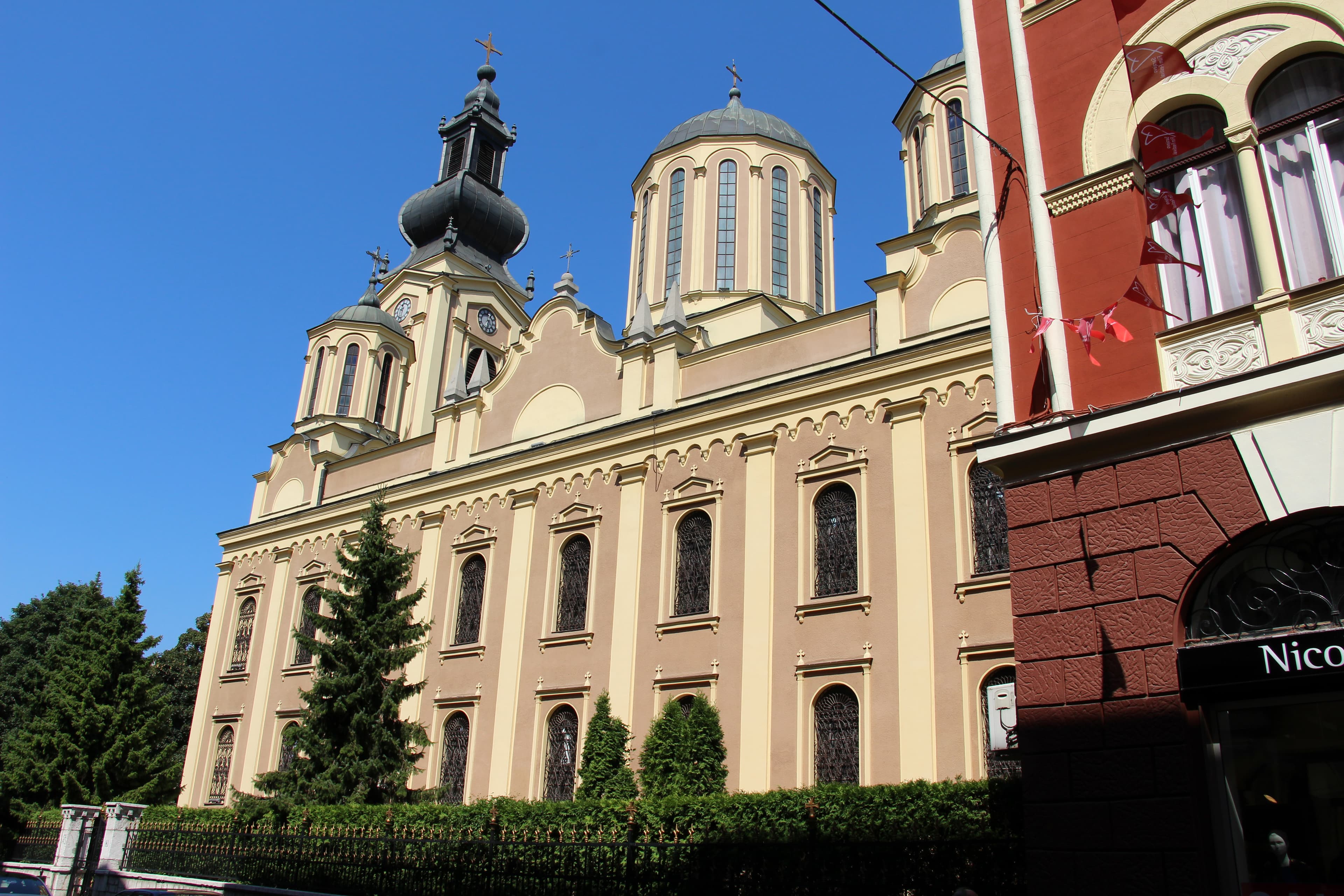
Image of Orthodox Church of the Nativity of the Theotokos. Image source · CC-BY-2.0
Visit essentials
A quick read before you go
- Duration
- Thirty minutes to one hour for a thorough visit outside of service times.
- Access
- Located at Zelenih beretki 1, in the Stari Grad (Old Town) district of Sarajevo.
Overview
The Cathedral of the Nativity of the Theotokos is both a statement of faith and an argument for the right to make one. Built from 1863 to 1868 by a Macedonian master builder for Serbian merchants who pooled their resources, with donations from the Ottoman Sultan himself, it broke Sarajevo's centuries-old prohibition on non-Muslim monumental architecture. Its consecration required over a thousand Ottoman soldiers to keep the peace.
The cathedral survived the anti-Serb riots of 1914, two World Wars, and the siege that nearly erased Sarajevo.
Inside, a gilded iconostasis sent by the Russian Tsar catches light through stained glass. Painted walls simulate marble below and open into ornamental vaults; five domes rise above, the central one reaching thirty-four meters. The space follows Orthodox sacred architecture's movement from earthly weight to vertical aspiration.
In Sarajevo's old town, the cathedral stands minutes from the Gazi Husrev-beg Mosque, Sacred Heart Cathedral, and Old Synagogue. Nowhere else in Europe do four major faiths occupy such close ground. This is not a curated interfaith exhibit but the result of centuries of cohabitation—sometimes peaceful, sometimes catastrophic, always real.
Why this place is sacred
Several forces converge here to thin the boundary between the ordinary and whatever lies beyond it.
The first is sheer endurance. A cathedral that required a thousand soldiers for its consecration, that weathered pogroms and siege, accrues a particular gravity. Worshippers have prayed here through conditions that should have emptied the building. They did not leave. That continuity is legible in the worn stone and the polished wood, in the icons that have watched generations come and go.
The second is the iconostasis. Crafted by Russian artisans sent by Tsar Alexander II, it functions as Orthodox theology made visible — a screen between the nave and the altar that simultaneously separates and connects the earthly and the divine. In Orthodox understanding, this is not decorative but ontological. The icons are windows, not paintings. Standing before them, even without sharing the theology, one encounters a tradition that has spent centuries refining the art of making the invisible present.
The third is Sarajevo itself. Within minutes of the cathedral, the call to prayer sounds from Ottoman-era minarets. Catholic bells ring from the Sacred Heart Cathedral. The Old Synagogue sits quietly nearby. This density of sacred architecture is not a tourist attraction but a lived reality — and it lends each building a context that amplifies its meaning. To pray here is to pray knowing that others are praying differently, just over there.
That awareness, for those who hold it, deepens rather than diminishes the encounter.
The cathedral was built to serve as the seat of the Metropolitanate of Dabar-Bosnia, the spiritual headquarters of the Serbian Orthodox Church in central Bosnia. Its construction was both a practical necessity — the growing Serbian community needed a cathedral — and a political act of the first order. Under Ottoman rule, non-Muslim communities were permitted small, unassuming places of worship, but nothing monumental.
The firman (decree) from Sultan Abdulaziz granting permission for this building's construction marked a turning point under the Tanzimat reforms, which gradually extended greater religious freedom to non-Muslim subjects of the empire.
The cathedral's role has shifted with each political era. Under Ottoman governance, it was an assertion of presence. Under Austro-Hungarian rule, it became a focal point for Serbian identity — and a target during the 1914 anti-Serb riots following the assassination of Archduke Franz Ferdinand. Through two World Wars and the communist period of Yugoslavia, it persisted as a religious anchor in an officially secular state.
The Siege of Sarajevo from 1992 to 1996 brought the cathedral's most recent trial. While the city around it suffered devastating destruction, the cathedral survived without serious structural damage — a fact that has entered local memory as something between fortunate circumstance and quiet providence. Post-war renovation, funded in part by the Greek government, restored what the siege years had weathered.
Today, the cathedral serves simultaneously as an active metropolitan seat, a National Monument of Bosnia and Herzegovina, and one of Sarajevo's most visited landmarks.
Experience and orientation
The exterior prepares you, but incompletely. Five domes and a neo-baroque belfry make a confident statement against the Sarajevo skyline. Inside, the scale shifts. The central dome draws the eye upward through thirty-four meters of painted and ornamented space, creating the vertical pull that Orthodox architecture has refined over centuries — a spatial argument that heaven is above and accessible, if you look.
The iconostasis dominates. Gilded, icon-laden, occupying the full width of the nave, it functions as the cathedral's spiritual center. Even visitors unfamiliar with Orthodox worship pause here. The icons have the stillness of faces that have been looked at, and have looked back, for over a century and a half. The lower walls, painted to simulate marble, ground the space in earthly solidity. Above, ornamental vaults lift toward the domes.
The effect is of being held between weight and aspiration — which is, in a sense, the condition the cathedral was built to address.
Light enters through stained glass, coloring the interior in ways that shift through the day. Morning services carry a different quality than afternoon visits, when the nave empties and the building settles into its own particular silence — not absence of sound, but a listening quality, as though the stone itself is attending.
Many visitors describe the walk afterward as equally significant. To step from the cathedral into the streets of Stari Grad and find yourself passing the Gazi Husrev-beg Mosque within minutes is to understand something about Sarajevo that no textbook conveys. The proximity is not a symbol. It is a fact, lived and contested and maintained across centuries.
Enter through the main doors and allow your eyes to adjust. The transition from Sarajevo's busy streets to the cathedral's interior is abrupt — use it. Stand in the nave before moving anywhere. Let the iconostasis establish itself in your vision.
If you visit outside of service times, the cathedral functions as a contemplative space. Move slowly. The painted walls reward close attention — the trompe l'oeil marble work in the lower registers, the ornamental patterns in the vaults. Stand beneath the central dome and look directly up. The height is felt as much as seen.
If you can attend a service, particularly on a feast day, the experience deepens considerably. The Divine Liturgy fills the space with chant, incense, and movement in ways that activate the architecture as it was designed to be activated. Stand or sit at the back if you are not Orthodox — your presence as a respectful observer is welcome.
Context and lineage
The cathedral arose from a convergence of aspiration and political change. Sarajevo's Serbian Orthodox community, growing in numbers and economic influence through the mid-19th century, needed a cathedral commensurate with the Metropolitanate of Dabar-Bosnia. Under traditional Ottoman governance, this would have been impossible — non-Muslim communities were restricted to modest, inconspicuous places of worship. But the Tanzimat reforms were reshaping the empire, and in 1863, Sultan Abdulaziz issued the firman permitting construction.
Funding came from every direction. Serbian merchants in Sarajevo pooled their resources, led by Manojlo Jeftanovic, who donated two thousand dukats. The Ottoman Sultan contributed approximately five hundred dukats — a symbolic gesture signaling imperial sanction. Serbian Prince Mihailo Obrenovic matched the Sultan's contribution. Russian Tsar Alexander II sent not money but something perhaps more valuable: expert craftsmen to construct the iconostasis that remains the cathedral's centerpiece.
The architect was Andreja Damjanov, a Macedonian master builder from Papradiste near Veles, whose family had been constructing churches across the Balkans for generations. Damjanov designed a five-domed structure that combined Byzantine tradition with contemporary influences — a building confident enough to stand beside the Ottoman mosques that had defined Sarajevo's skyline for centuries.
Construction took five years. The planned consecration in May 1871 was blocked by a group of conservative Muslims led by imam Salih Vilajetovic, known as Hadzi Lojo, who opposed the building's prominence. The ceremony was delayed for over a year. When the consecration finally took place on July 20, 1872, more than a thousand Ottoman soldiers were deployed to ensure it proceeded without violence. Ottoman officials and the Austro-Hungarian ambassador Beni Kallay attended.
The message was clear: the building would stand.
The cathedral has served continuously as the seat of the Metropolitanate of Dabar-Bosnia since its consecration in 1872. The metropolitanate itself is one of the oldest eparchies of the Serbian Orthodox Church, with roots extending back to the medieval Bosnian Church.
Through Ottoman rule, Austro-Hungarian administration, the Kingdom of Yugoslavia, Tito's communist federation, and the post-war Bosnian state, the cathedral has adapted its role while maintaining its core liturgical function. Each era brought pressures — the 1914 riots, wartime occupations, communist-era restrictions on religious expression, the devastation of the 1990s siege — and each time the building and its community persisted.
The post-war renovation, supported by the Greek government, represents the most recent chapter in a pattern of Orthodox solidarity that began with the Russian Tsar's iconostasis craftsmen over a century earlier. The cathedral today serves worshippers, tourists, and history in equal measure.
Andreja Damjanov
architect
Master builder from the Damjanovi-Renzovski family of church architects, based in Papradiste near Veles in present-day North Macedonia. Considered one of the most important Balkan church builders of the 19th century, he designed the cathedral combining Byzantine spatial principles with contemporary neo-baroque elements. He lived from 1813 to 1878.
Manojlo Jeftanovic
patron
Leading Serbian merchant in Sarajevo who donated two thousand dukats and organized the broader fundraising effort among the Serbian community. His financial leadership made the construction possible.
Tsar Alexander II of Russia
patron
Rather than contributing money, the Russian Tsar sent expert craftsmen to construct the iconostasis — a gift that created a direct artistic and spiritual link between this Bosnian cathedral and the broader Orthodox world.
Sultan Abdulaziz
political authority
Issued the firman permitting construction and contributed approximately five hundred dukats. His dual role — granting permission and funding a non-Muslim house of worship — reflects the Tanzimat reforms reshaping the Ottoman Empire.
Salih Vilajetovic (Hadzi Lojo)
historical antagonist
The imam who led opposition to the cathedral's consecration in 1871, delaying the ceremony by over a year. His resistance, and its eventual overcoming, became a foundational chapter in the cathedral's identity.
Traditions and practice
The cathedral follows the liturgical cycle of the Serbian Orthodox Church, which uses the Julian calendar for its feast days. The Divine Liturgy of Saint John Chrysostom is the primary form of worship, celebrated on Sundays and feast days with the full participation of clergy, chanters, and congregation. Great Vespers marks the evening before major celebrations. Matins and the canonical hours structure the daily rhythm of prayer.
The sacraments — baptism, chrismation, marriage, the Eucharist, confession, anointing of the sick, and ordination — are all administered here. As the metropolitan seat, the cathedral also hosts diocesan events and ordinations that carry particular solemnity.
The cathedral's liturgical life continues unbroken. Services are conducted in Church Slavonic with Serbian elements, as is standard in the Serbian Orthodox tradition. The chanting tradition, while not uniquely documented for this cathedral, follows the Serbian Osmoglasnik (eight-tone) system that has shaped Orthodox worship in the region for centuries.
Outside service times, the cathedral functions as both a devotional and a contemplative space. Visitors light candles before icons — a practice open to anyone, regardless of tradition. The act is simple: purchase a thin beeswax candle, light it, and place it in one of the sand-filled stands. Orthodox tradition understands the flame as a prayer that continues after the one who lit it has gone.
The cathedral also serves as a de facto museum of Orthodox sacred art, with the iconostasis and wall paintings constituting a significant collection in their own right.
If you come seeking more than a quick visit, consider timing your arrival for a service. Even without understanding Church Slavonic, the liturgy communicates through movement, chant, incense, and the interplay of light with gold. Stand in the nave and let the sound fill the space above you. The acoustic properties of the five domes were not accidental.
If services are not in session, light a candle. Choose an icon — it need not be one you recognize. The Orthodox understanding is that the icon is a point of contact, not an object of worship. Stand with it for a moment longer than feels comfortable. Notice what arises.
Afterward, walk to the Old Orthodox Church of the Holy Archangels Michael and Gabriel, a few hundred meters east. The contrast between the two buildings — one monumental and 19th-century, the other intimate and 16th-century — illuminates the range of Orthodox sacred space. Then continue to the Gazi Husrev-beg Mosque. Let the proximity of these buildings speak for itself.
Serbian Orthodox Christianity
ActiveThe cathedral is the seat of the Metropolitanate of Dabar-Bosnia, one of the oldest eparchies of the Serbian Orthodox Church. It is considered one of the holiest Orthodox places in the Balkans and serves as the spiritual center for the Serbian Orthodox community in central Bosnia. Its construction during Ottoman rule — the first non-Muslim monumental building in Sarajevo — makes it both a religious and a historical landmark of the first order.
The full liturgical cycle of the Serbian Orthodox Church is celebrated here: the Divine Liturgy of Saint John Chrysostom, Great Vespers, Matins, and the Hours. All seven sacraments are administered. The patronal feast of the Nativity of the Theotokos (September 21 Julian calendar), Orthodox Christmas (January 7), and Pascha are the principal celebrations. As the metropolitan seat, the cathedral also hosts ordinations and major diocesan events.
Interfaith Coexistence (Sarajevo Heritage)
ActiveThe cathedral is one of four major houses of worship from different Abrahamic traditions within a few hundred meters of each other in Sarajevo's old town. This concentration — Orthodox cathedral, Ottoman mosque, Catholic cathedral, and synagogue — represents one of Europe's most concentrated examples of interfaith proximity. The tradition here is not interfaith dialogue in the formal sense but something older and more complex: centuries of living side by side, with all the friction and grace that entails.
No formal interfaith practices take place at the cathedral itself, but the physical act of walking between these buildings — mosque to cathedral to synagogue — has become a form of secular pilgrimage for visitors seeking to understand what religious coexistence looks and feels like in a city that has known both its best and worst expressions.
Perspectives and open questions
The cathedral sits at the intersection of theology, politics, and urban history. To read it only as a church is to miss its political significance. To read it only as a political statement is to miss its spiritual depth. The honest approach holds both — along with the more uncomfortable questions about what religious monuments mean in cities where faith has been entangled with ethnic identity and conflict.
Scholarly perspective
Architectural historians recognize the cathedral as a landmark in the built environment of Ottoman Bosnia. Its construction marked the first time the imperial monopoly on monumental non-Muslim architecture was broken in Sarajevo, reflecting the Tanzimat reforms that were gradually reshaping the empire's relationship with its non-Muslim subjects. Andreja Damjanov is studied as one of the most significant Balkan ecclesiastical architects of the 19th century, and this cathedral is counted among his major works.
The two-year delay between planned and actual consecration — blocked in 1871 by conservative opposition and requiring military intervention in 1872 — is well documented as a pivotal episode in Sarajevo's communal relations. Scholars read it as a case study in the tensions between imperial reform and local resistance, a pattern that would repeat across the Ottoman world.
The cathedral's designation as a National Monument of Bosnia and Herzegovina reflects institutional recognition of its architectural merit and historical importance. Its survival through the 1992-1996 siege, while much of Sarajevo's built heritage was destroyed, has generated scholarly interest in the relationship between sacred buildings and wartime destruction.
Living and traditional perspectives
Within Serbian Orthodox tradition, the cathedral embodies the resilience of Orthodoxy in Bosnia through centuries of governance by other powers. The dedication to the Nativity of the Theotokos connects it to one of the Twelve Great Feasts of the Orthodox calendar — the birth of the Virgin Mary to Saints Joachim and Anna. In Orthodox theology, this event is understood as the beginning of salvation history: without Mary's birth, there is no Annunciation, no Incarnation, no Resurrection.
The cathedral's dedication thus places it within the largest narrative Orthodox Christianity knows.
The iconostasis, crafted by Russian artisans, represents a tangible link to the broader Orthodox world — a reminder that the Serbian community in Sarajevo was never alone, even under Ottoman governance. The persistence of worship through every crisis the building has faced is understood within the tradition not as mere stubbornness but as faithfulness, a participation in the pattern of death and resurrection that Orthodox theology sees as the fundamental structure of reality.
Open questions
Several questions remain open. The exact extent of damage sustained during the 1992-1996 Siege of Sarajevo has not been comprehensively documented in publicly available sources, though the cathedral reportedly survived without major structural damage. The full inventory and provenance of all icons and religious artifacts inside the cathedral is not well documented in accessible English-language sources. Whether the cathedral possesses specific relics, and their history if so, remains unclear from available research.
The particular liturgical music traditions of this cathedral — whether it has developed distinctive chanting practices or relies on standard Serbian Orthodox forms — is another area where documentation is thin.
Plan your visit
Access and arrival
Located at Zelenih beretki 1, in the Stari Grad (Old Town) district of Sarajevo. The cathedral is accessible by tram (Bascarsija stop) or on foot from most central Sarajevo locations. The entrance fee is approximately 2 KM (Convertible Marks). Mobile phone signal is reliable throughout central Sarajevo. The cathedral is located in a well-served urban area with full emergency services access. No advance booking is required for general visits.
For information on current service schedules and access during major feast days, contact the Metropolitanate of Dabar-Bosnia or check with Sarajevo tourism offices.
Extensive accommodation options exist throughout central Sarajevo, from hostels in the Bascarsija area to hotels along the Miljacka River. The cathedral is a standard stop on Sarajevo walking tours and is easily combined with visits to the city's other major religious and cultural landmarks.
Respectful visit
Modest clothing is required. Women should cover their shoulders; head coverings are appreciated by the community, though not strictly enforced for tourists. Men should remove hats upon entering. Shorts and sleeveless tops are discouraged. These are not arbitrary rules but reflections of how the tradition understands sacred space — as a place where the body, too, participates in reverence.
Photography is generally permitted inside the cathedral, but exercise discretion. Avoid flash under all circumstances — it is disruptive and damaging to painted surfaces. During services, put your camera away entirely. The liturgy is not a spectacle; it is worship. If in doubt, ask a staff member or a congregant.
Visitors may light candles, which are available for purchase inside the cathedral. This is the most accessible form of participation for non-Orthodox visitors. Monetary donations are accepted and support the cathedral's maintenance.
Do not touch the icons or the iconostasis. Maintain silence or quiet conversation during services. Turn off mobile phones or set them to silent. Do not eat or drink inside the cathedral. A small entrance fee of approximately 2 KM (Convertible Marks) applies.
Active participation in the sacraments, particularly the Eucharist, is reserved for Orthodox Christians. Visitors of other traditions or none are welcome to observe but should not approach for communion. If uncertain about any aspect of protocol during a service, remain at the back of the nave and follow the lead of regular congregants.
Current practical details
Address
Zelenih beretki 1, Sarajevo 71000, Bosnia and Herzegovina
Phone
Hours
Hours, fees, and access can change — verify on the official source before you travel. Practical details last checked Jun 2026.
Location
Map loads as you approach this section.
Pilgrim reflections
A portrait of encounter, not a score
Pilgrims describe what they felt, how present they could become, and whether the place would shape a journey. There are no stars and no ranking of traditions.
No reviewed reflections yet
The first pilgrims can help describe the character of being here.
Share a reflection
Available after an account-backed “Been there.” Every reflection is reviewed before publication.
Nearby sacred places
Explore other sacred places in the region. Proximity does not establish access or travel time; check each place’s guidance.

Sacred Heart Cathedral
Sarajevo, Sarajevo, Bosnia and Herzegovina
0.1 km away

Sarajevo Old Orthodox Church
Sarajevo, Sarajevo, Sarajevo Canton, Bosnia and Herzegovina
0.3 km away
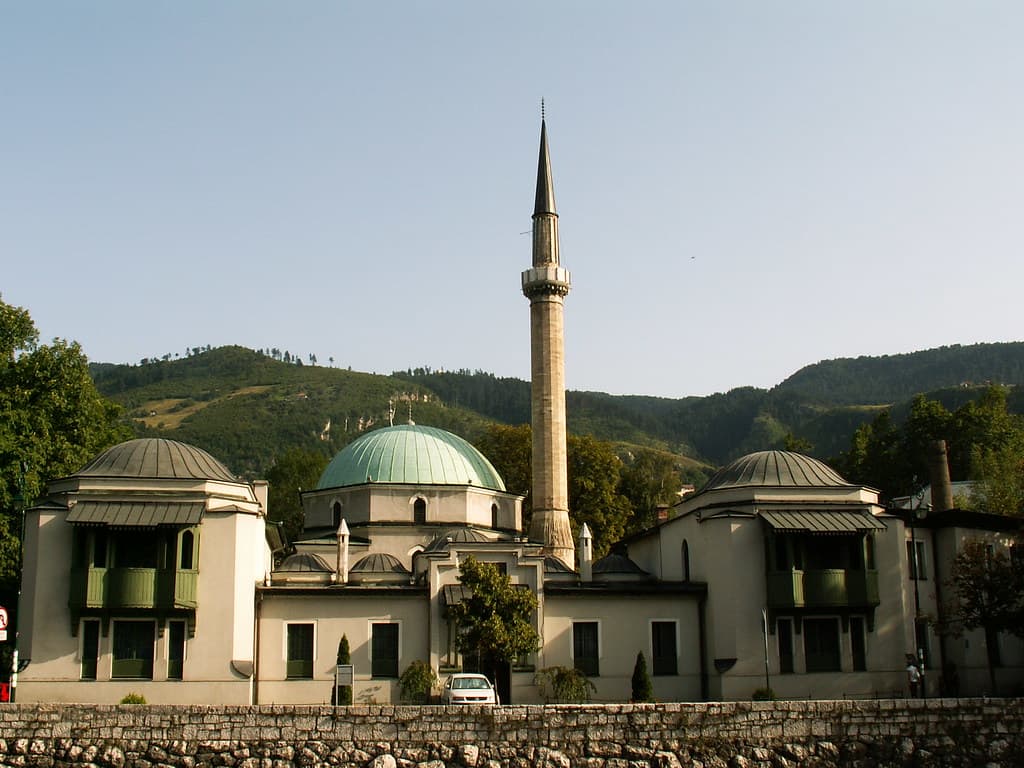
Emperor's Mosque, Sarajevo
Sarajevo, Sarajevo, Bosnia and Herzegovina
0.3 km away
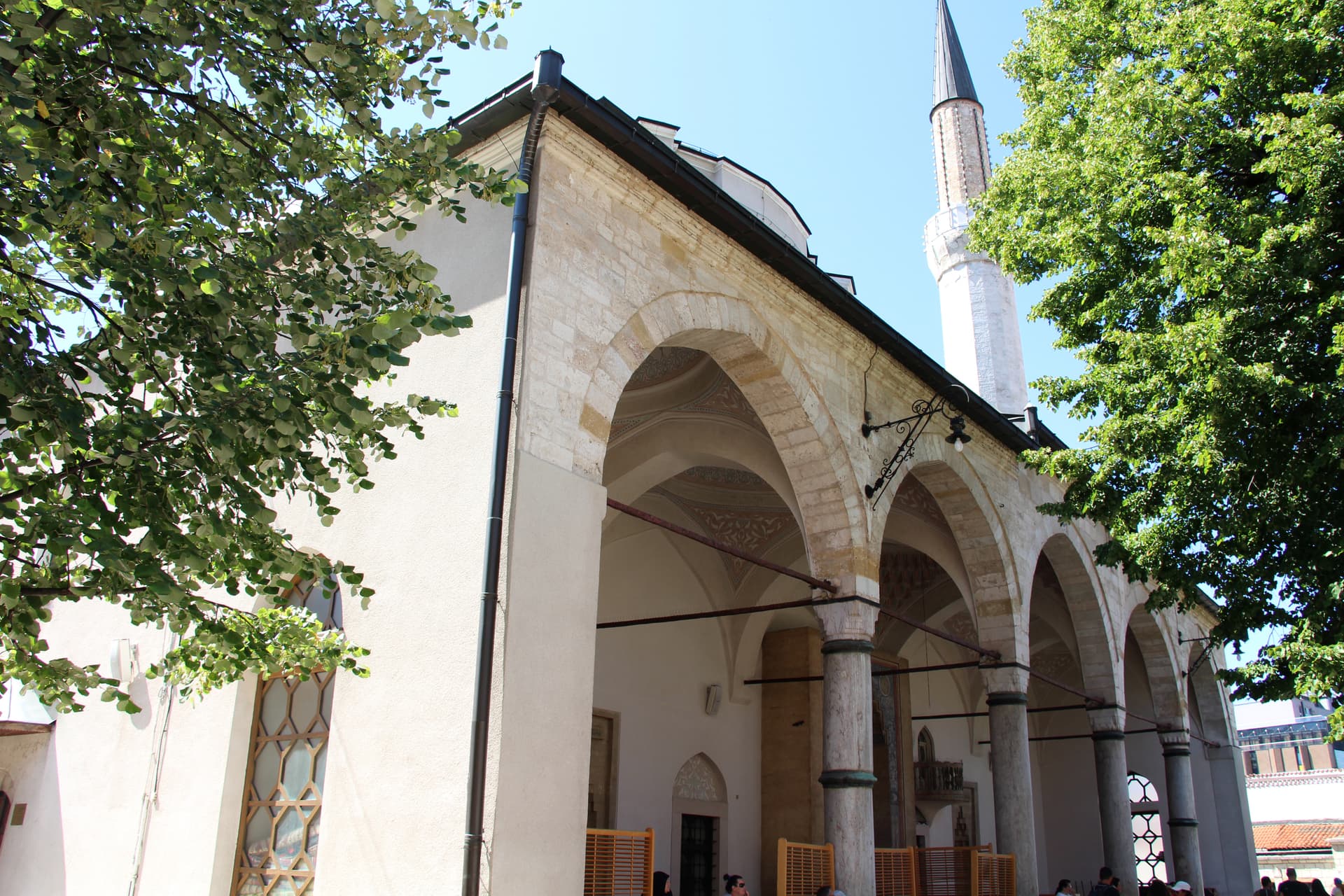
Gazi Husrev-beg Mosque
Sarajevo, Sarajevo, Bosnia and Herzegovina
0.4 km away
References
Sources consulted for this page. Source categories describe the publication, not a guarantee that every claim is verified. Traditional accounts and outside interpretations may differ.
- 01Nativity of the Theotokos - Greek Orthodox Archdiocese of America — Greek Orthodox Archdiocese of AmericaofficialAuthoritative Orthodox source on the theological significance of the Nativity of the Theotokos feast
- 02Nativity of the Theotokos - Orthodox Church in America — Orthodox Church in AmericaofficialTheological explanation of the feast day and its liturgical significance
- 03Sarajevo Saborna crkva - Commission to Preserve National Monuments (KONS) — Commission to Preserve National Monuments of Bosnia and HerzegovinaofficialOfficial national monument designation document
- 04Cathedral of the Nativity of the Theotokos, Sarajevo - Wikipedia — Wikipedia contributorsencyclopediaComprehensive overview of cathedral history, construction, architecture, and historical events
- 05Cathedral Church of the Nativity of the Theotokos - SpottingHistory — SpottingHistoryofficialHistorical context and visitor-oriented information
- 06Church of the Nativity of the Theotokos - Discover Bosnia & Herzegovina — Discover Bosnia & Herzegovina (lll.ba)guideLocal tourism portal with practical visitor information
- 07Serb Orthodox Cathedral, Sarajevo - GPSmyCity — GPSmyCityguideVisitor guide with GPS coordinates and practical details
- 08The Orthodox Church in Sarajevo is one of the holiest Orthodox Places in the Balkans - Sarajevo Times — Sarajevo TimesacademicLocal news coverage of the cathedral's significance within the broader Balkan Orthodox world
- 09Sarajevo Serbian Orthodox Cathedral - Cultural Inventory (Kulturenvanteri) — KulturenvanteriofficialCultural inventory entry with architectural and heritage details
- 10The Congregational Church of the Holy Mother in Sarajevo - Destination Sarajevo — Destination Sarajevo (sarajevo.travel)officialOfficial Sarajevo tourism portal with local designation and context
Share a photo
Help visitors recognize Orthodox Church of the Nativity of the Theotokos. Every submission is reviewed before publication.