Ōmori Katsuyama Stone Circle
Where Jomon peoples aligned their stone circle to watch the winter solstice sun set behind a sacred mountain
Understand sacred places, explore living traditions, and learn how to engage respectfully with Pilgrim Map.
Access has not been verified. Check current local guidance before planning a visit.
Hirosaki, Aomori Prefecture, Japan
Read the sources
Visit essentials
A quick read before you go
- Duration
- 1-2 hours for the site.
- Access
- By car: Approximately 20-30 minutes from central Hirosaki City.
Overview
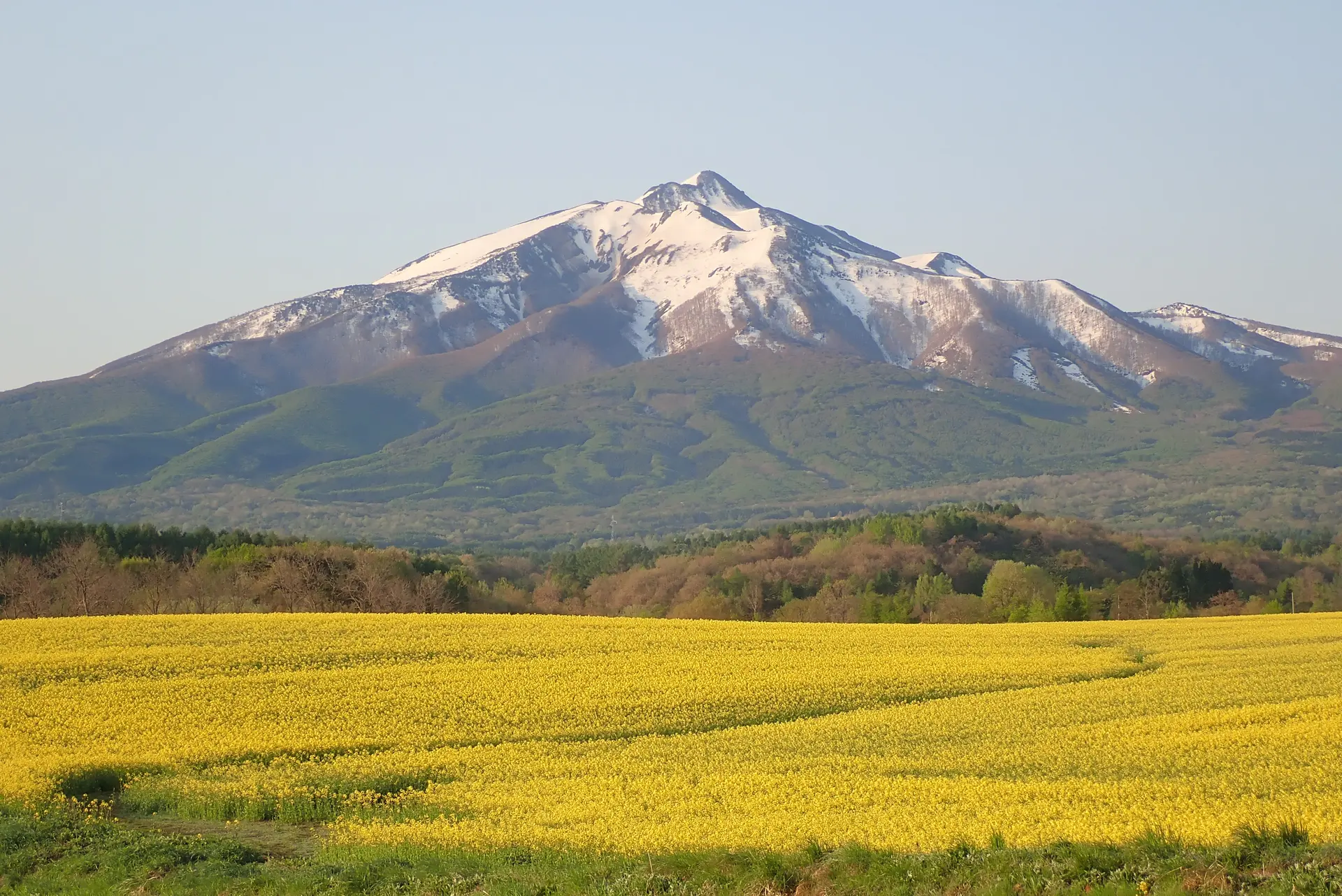
At the foot of Mount Iwaki in western Aomori, the Jomon people built a monument to the winter solstice. On the year's darkest day, the sun sets directly behind the mountain's summit as viewed from this stone circle—an alignment achieved through observation sustained across generations.
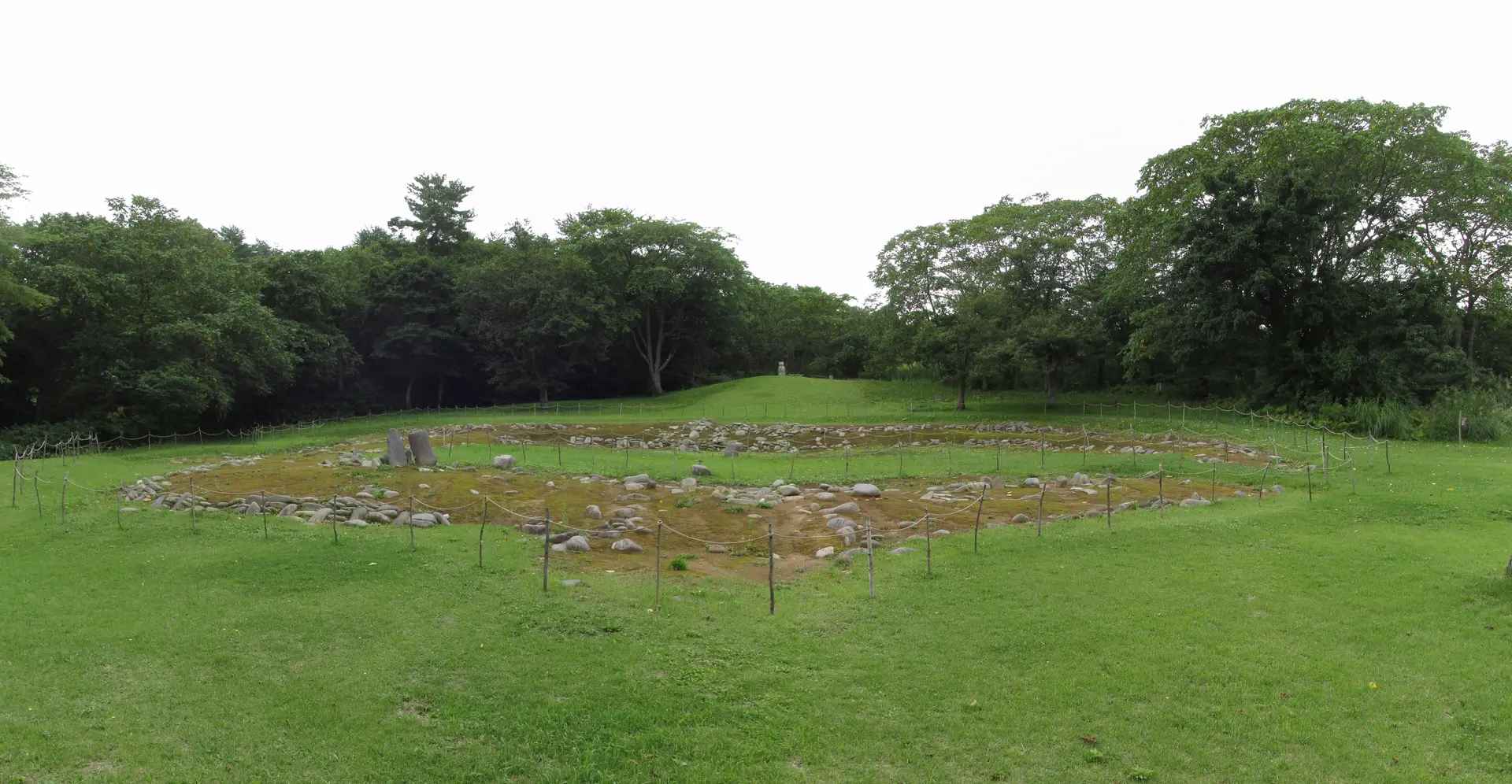
The Omori Katsuyama stone circle is the only Final Jomon period (approximately 1000 BCE) stone circle whose complete structure has been fully excavated and documented. The elliptical arrangement—48.5 meters by 39.1 meters—comprises 77 distinct stone assemblages containing approximately 1,200 individual stones. Unlike the random scatter one might expect from natural accumulation, these groupings show deliberate placement.
Mount Iwaki rises to the southwest, its conical profile reminiscent of Mount Fuji. This was not coincidental beauty but sacred geography. The mountain remains venerated today; an active Shinto shrine crowns its summit. The Jomon peoples who built this circle three millennia ago appear to have shared the intuition that has drawn worshippers to this peak ever since.
The site yielded over 250 disc-shaped stone objects of unknown purpose, along with stone staffs and clay figurines. A large pit dwelling was constructed precisely on the axis connecting the stone circle to the mountain summit—too precisely for coincidence. Whatever ceremonies occurred here, they were calibrated to this specific alignment between built monument, celestial event, and sacred mountain.
Omori Katsuyama is currently closed for construction of a new guidance facility, scheduled to reopen in April 2026.
Why this place is sacred
What marked this hilltop as thin—permeable to forces beyond ordinary experience? At Omori Katsuyama, the evidence points to deliberate calibration of built environment with celestial and landscape features.
The winter solstice alignment is foundational. This astronomical phenomenon—the moment when the year's shortest day tips toward returning light—occurs at a specific point on the horizon as viewed from any given location. The Jomon builders positioned their stone circle so that this point coincides exactly with the summit of Mount Iwaki. Achieving such precision required sustained observation across years, possibly generations, and the transmission of that knowledge to those who would build the monument.
Mount Iwaki itself commands attention. The mountain's conical profile suggests a volcano, though it has been dormant throughout human memory. Its Fuji-like shape has drawn religious veneration continuously into the present day. The Shinto shrine at its summit maintains traditions of mountain worship that, while not directly descended from Jomon practice, echo the intuition that elevated this peak to sacred status millennia ago.
The large pit dwelling discovered 100 meters southwest of the stone circle sits precisely on the alignment axis—the line connecting circle center to mountain summit. This cannot be accidental. Whatever activities occurred in this structure were intended to participate in the relationship between stone circle and sacred mountain.
The disc-shaped stones—over 250 of them—suggest intensive ritual activity whose nature we cannot reconstruct. Were they tools? Offerings? Symbolic objects? Each possibility points toward a site designed for ceremony, not habitation.
Archaeological evidence indicates Omori Katsuyama was constructed as a ceremonial site oriented toward Mount Iwaki and calibrated to the winter solstice. The absence of extensive residential remains suggests this was a place visited for specific sacred purposes rather than continuously inhabited.
The site was used during the Final Jomon period, approximately 1000 BCE. After falling into disuse, it remained undisturbed until initial excavation in 1959-1961. Systematic study in 2006-2008 revealed the winter solstice alignment and the relationship between stone circle, pit dwelling, and mountain. Designated a National Historic Site in 2012, Omori Katsuyama was inscribed as part of the UNESCO World Heritage 'Jomon Prehistoric Sites in Northern Japan' in 2021.
Experience and orientation
The experience of Omori Katsuyama is shaped by what rises above the horizon.
Mount Iwaki dominates the southwestern skyline. From the stone circle site, the mountain's conical profile is unmistakable—a presence that commanded attention three thousand years ago and commands it still. Simply standing here and facing the peak begins to explain why Jomon peoples chose this particular location for their most significant ceremonies.
The stone circle itself occupies a tongue-shaped hill at 145 meters elevation, offering views across the landscape below. The elliptical arrangement—77 assemblages of approximately 1,200 stones—spreads across the hilltop in a pattern whose full logic reveals itself slowly. Walking among the groupings, visitors begin to perceive the intentionality of placement.
The winter solstice alignment cannot be directly experienced except on that single day—and even then, the site is typically closed for winter. Yet knowing about this alignment transforms the view of Mount Iwaki. That distant summit, currently visible, will become the exact point where the solstice sun disappears on the shortest day. The mountain is not merely beautiful; it is celestially calibrated. The Jomon builders understood something about this relationship that we can now perceive but cannot fully recover.
The large pit dwelling site, precisely aligned between the stone circle and the mountain, suggests a ceremonial structure whose occupants participated directly in whatever rituals addressed the peak. Walking the alignment axis—from stone circle across the dwelling site toward the mountain—is to trace a line the Jomon people drew across their sacred landscape.
Note: The site is currently closed (November 2024 through March 2026) for construction of a new guidance facility, which will enhance the visitor experience when it opens.
When the site reopens, approach with the mountain vista in mind. The alignment between stone circle, pit dwelling, and Mount Iwaki summit is the organizing principle of this place. Face the mountain. Consider that on the winter solstice, the setting sun would descend precisely behind that peak. This is what the Jomon builders knew and what they encoded in stone.
Context and lineage
No written record preserves the founding of Omori Katsuyama. What archaeology reveals is a community that understood the winter solstice—the moment when the sun's decline reverses toward returning light—and marked it with permanent construction.
The precision of the alignment suggests sustained observation across years. Someone noticed that from this hilltop, the winter solstice sun set behind Mount Iwaki's summit. This observation was transmitted, refined, and eventually monumentalized in stone. The result was not a simple circle but an ellipse—48.5 by 39.1 meters—whose shape may itself encode astronomical relationships not yet fully understood.
The disc-shaped stones, the stone staffs, the clay figurines—these were tools of ceremonies we cannot reconstruct. But their presence in such quantity indicates intensive ritual use, not casual visitation.
No continuous tradition connects Omori Katsuyama to contemporary practice. The site fell silent three thousand years ago.
Yet the reverence for Mount Iwaki persists. The mountain's summit hosts an active Shinto shrine where worship continues today. While no direct lineage links modern Shinto practice to Jomon ceremony, the pattern is suggestive: the same mountain that drew Jomon builders three millennia ago still draws worshippers.
Scholar William Gowland, a British metallurgist working in Japan in the late 19th century, noted parallels between Japanese stone circles and British megaliths. His observation that sun worship appeared in prehistoric Japan as in prehistoric Britain invites reflection on how widespread such patterns may have been—and how the winter solstice, that moment of solar return, commanded attention across cultures.
Traditions and practice
Archaeological evidence allows partial reconstruction of Final Jomon practices at Omori Katsuyama. The winter solstice alignment indicates ceremonies timed to this astronomical moment—the shortest day, the turning point toward returning light. The sight of the sun setting behind Mount Iwaki's summit on this day was almost certainly the occasion for ritual activity.
The large pit dwelling aligned between the stone circle and the mountain may have housed ceremonial specialists or served as a gathering place for solstice observances. Its precise position on the alignment axis suggests it was integral to the site's sacred function.
The disc-shaped stones—over 250 of them—were likely ritual objects, though their specific use cannot be determined. Stone staffs and clay figurines found at the site suggest a repertoire of ceremonial tools serving purposes we can name (ritual, ceremony, offering) but cannot specify.
Mountain worship appears central. The deliberate orientation toward Mount Iwaki, the alignment calibrated to the point where the peak meets the solstice sun, the placement of the pit dwelling on this axis—all indicate that the mountain was not background scenery but the focal point of whatever occurred here.
No religious practice continues at Omori Katsuyama. The site serves educational and heritage preservation purposes.
When the site reopens, visitors can engage with its essential character through landscape observation. Stand at the stone circle and face Mount Iwaki. Notice the profile of the summit against the sky. Consider that the Jomon builders positioned their monument so that the most significant astronomical event of the year—the winter solstice sunset—would occur at exactly that point.
Walk the alignment axis from the stone circle toward the pit dwelling site and beyond toward the mountain. This line organized the entire sacred complex.
The winter solstice itself (approximately December 21-22) represents the moment for which the site was designed. While access is typically restricted during winter, understanding this astronomical focus adds meaning to visits at any time of year.
Jomon spirituality
HistoricalOmori Katsuyama represents the most sophisticated known expression of Jomon astronomical knowledge integrated with mountain worship. The precise alignment between stone circle, ceremonial dwelling, Mount Iwaki summit, and winter solstice sunset reveals a cosmology that understood human ceremony as participating in celestial-terrestrial relationships. The mountain veneration visible here anticipates traditions that persist in Japanese spirituality today.
Winter solstice observances centered on the sunset behind Mount Iwaki. Ceremonial activities using disc-shaped stone objects (over 250 found), stone staffs, and clay figurines. Use of the large pit dwelling on the alignment axis for purposes likely connected to mountain-directed ritual. Gatherings at the stone circle for ceremonies whose timing was calibrated to astronomical events.
Perspectives and open questions
Omori Katsuyama can be approached as an astronomical observatory, a mountain worship site, evidence of Jomon cosmological knowledge, or all three simultaneously. The precision of its alignments invites interpretations that span archaeology, archaeoastronomy, and the history of religion.
Scholarly perspective
Archaeological consensus recognizes Omori Katsuyama as the only Final Jomon stone circle whose complete structure has been fully excavated and documented. The winter solstice alignment with Mount Iwaki demonstrates that Jomon peoples possessed sophisticated astronomical knowledge and integrated this knowledge with mountain worship traditions.
The site's elliptical shape, the distribution of 77 stone assemblages, and the presence of over 250 disc-shaped ritual objects indicate complex ceremonial activity. The precise alignment of the large pit dwelling on the axis between stone circle and mountain summit confirms the intentionality of the site's orientation.
UNESCO inscription in 2021 confirms the site's Outstanding Universal Value as evidence of Jomon cultural sophistication. The inscription particularly notes how Jomon peoples developed complex societies and spiritual practices while maintaining a hunter-gatherer-fisher economy over 10,000 years—a pattern rare in human prehistory.
Living and traditional perspectives
No living tradition preserves memory of ceremonies at Omori Katsuyama. The site fell silent three thousand years ago.
Yet Mount Iwaki remains sacred. The Shinto shrine at its summit maintains traditions of mountain worship that, while not directly descended from Jomon practice, honor the same peak the stone circle addresses. The continuity of reverence—if not specific practice—across three millennia invites reflection on how certain landscapes accumulate sacred significance over time.
Alternative interpretations
William Gowland, a 19th-century British observer of Japanese archaeology, drew connections between Japanese stone circles and European megaliths. His observation that sun worship appeared in prehistoric Japan as in prehistoric Britain suggests possible universal patterns in how ancient peoples related to celestial cycles.
The winter solstice—the moment of solar return after the year's longest darkness—commanded attention across cultures worldwide. That the Jomon peoples of northern Honshu calibrated their most significant ceremonial site to this moment places them within a global pattern of solstice recognition.
Open questions
The specific purpose of the 250+ disc-shaped stones remains undetermined. Whether additional astronomical alignments beyond the winter solstice sunset are encoded in the site has not been conclusively established.
Why Final Jomon stone circles are relatively rare compared to earlier periods remains debated. The ceremonies conducted here—their words, their movements, their meanings—cannot be recovered from material evidence alone. The stones mark something significant; they do not explain it.
Plan your visit
Access and arrival
By car: Approximately 20-30 minutes from central Hirosaki City. The site is located in the northeastern foothills of Mount Iwaki.
Public transport options are limited. Check with Hirosaki City tourism information for current access details when the new facility opens.
The new guidance facility, scheduled for April 2026, will provide enhanced visitor amenities and interpretive exhibits.
Accommodations are available in Hirosaki City, which offers a range of hotels and traditional ryokan. Hirosaki is also known for its castle and spring cherry blossoms.
Respectful visit
No specific requirements. Comfortable walking shoes are recommended for the hilltop terrain.
Photography is permitted.
No tradition governs offerings at this archaeological site.
The site is currently closed (November 2024 through March 2026) for construction of a new guidance facility. Normal seasonal closure extends from late November through late April due to winter conditions.
The site is currently closed for construction through March 2026. When it reopens, respect posted guidelines and stay on designated paths.
Current practical details
Address
Katsuyama Omori, Hirosaki, Aomori 036-1203, Japan
Hours
Hours, fees, and access can change — verify on the official source before you travel. Practical details last checked Jun 2026.
Location
Map loads as you approach this section.
Pilgrim reflections
A portrait of encounter, not a score
Pilgrims describe what they felt, how present they could become, and whether the place would shape a journey. There are no stars and no ranking of traditions.
No reviewed reflections yet
The first pilgrims can help describe the character of being here.
Share a reflection
Available after an account-backed “Been there.” Every reflection is reviewed before publication.
Nearby sacred places
Explore other sacred places in the region. Proximity does not establish access or travel time; check each place’s guidance.


References
Sources consulted for this page. Source categories describe the publication, not a guarantee that every claim is verified. Traditional accounts and outside interpretations may differ.
- 01Omori Katsuyama Stone Circle - World Heritage Jomon Sites — Jomon Japan OfficialofficialOfficial World Heritage information
- 02大森勝山遺跡 - 弘前市 — Hirosaki CityofficialOfficial city heritage information
- 03大森勝山遺跡 - Amazing AOMORI — Aomori Prefecture TourismSource contextOfficial tourism information
- 04Circles of stone: exploring the monuments of Jomon Japan — The Past MagazineacademicArchaeological analysis
- 05Circles of stone - World Archaeology — World Archaeology MagazineacademicScholarly comparison with other stone circles
- 06Ōmori Katsuyama Site - Wikipedia — Wikipedia contributorsencyclopediaGood overview with archaeological details
Share a photo
Help visitors recognize Ōmori Katsuyama Stone Circle. Every submission is reviewed before publication.