Numancia
A windswept hillfort where a people chose death over surrender
Understand sacred places, explore living traditions, and learn how to engage respectfully with Pilgrim Map.
Access has not been verified. Check current local guidance before planning a visit.
Garray, Soria, Spain
Read the sources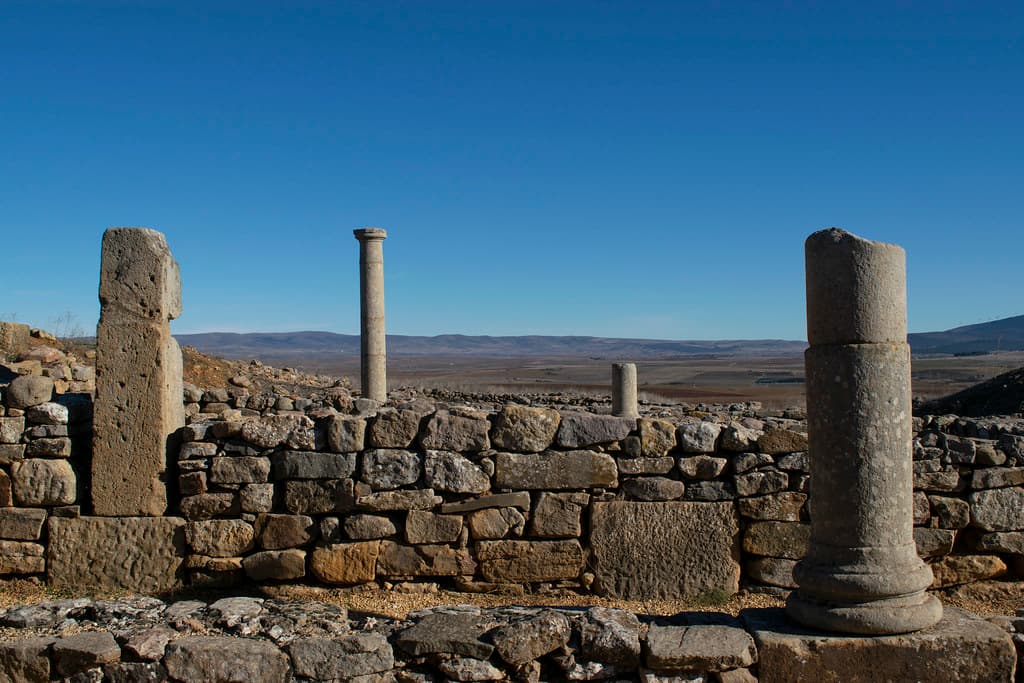
Image of Numancia. Image source
Visit essentials
A quick read before you go
- Duration
- Free guided tours last about 75 minutes.
- Access
- Numantia sits on the Cerro de la Muela, about 8 km from the city of Soria, within the…
Overview
Numantia occupies Cerro de la Muela above the Duero-Tera confluence near Garray in Soria. An Arevaci Iron Age hillfort, it resisted Roman armies for roughly twenty years until Scipio Aemilianus encircled and starved it in 134-133 BCE. Ancient historians say most defenders chose death over enslavement.
It is an excavated settlement, not a shrine: wall foundations, house platforms, wells, and faint Roman siege works lie beneath stark mountains and open sky. Numantia has no living cult or pilgrimage. Its afterlife is civic and literary: Cervantes dramatized the fall in 1582; Spanish uses 'defensa numantina' for resistance to the last; and Soria holds late-summer public commemoration rather than religious rite. Visitors confront the scale of a community's decision and the silence afterward.
Why this place is sacred
Numantia is not a thin place in the sense of ceremonial or cosmological significance; its gravity is historical and civic. Since Cervantes wrote 'El cerco de Numancia' in 1582, the site's fall has functioned as a durable Spanish and Iberian metaphor for resistance carried to its absolute limit, giving the language the phrase 'defensa numantina' — a Numantine-style defense — for any last-ditch stand against overwhelming odds.
The metaphor has been reactivated at moments of national crisis, most notably during the Napoleonic Sieges of Zaragoza in 1808-1809, when Numantia's example was invoked to frame Spanish resistance to French occupation. In Soria province today, the 'Caballo de Numancia,' the Horse of Numantia, functions as a regional emblem of identity and resilience, and the annual La Vulcanalia festival keeps the memory in public, secular circulation through parade, spectacle, and a solemn tribute rather than worship.
What makes the site feel weighted on the ground is less any single monument than the accumulation of these afterlives layered onto a landscape that has changed little: an exposed hilltop, wide views to distant ranges, and excavated foundations that make a vanished community's scale legible underfoot.
The hillfort was a defensive and residential settlement — an oppidum — built by the Arevaci for shelter, storage, and control of the surrounding Duero valley routes, not for ceremonial or cultic use. Its walls, wells, cisterns, and house platforms served the practical needs of a fortified Celtiberian town under sustained military pressure.
From an Iron Age hillfort settled around the sixth century BCE, Numantia became the Arevaci's principal stronghold and the focal point of two decades of resistance to Rome, ending in its destruction in 133 BCE. It was resettled and destroyed again during the Sertorian War in the first century BCE, then rebuilt as a Roman settlement under Augustus along Roman Road XXVII.
Centuries later, its ruins were identified by the scholar Eduardo Saavedra in 1860 and systematically excavated by Adolf Schulten between 1905 and 1912, work that shifted the site from forgotten hillside to a formally protected national monument — first declared as such in 1882 and redefined as the 'Zona Arqueológica de Numancia y Cerco Romano' under a 1998 decree.
It now exists primarily as a managed archaeological park and interpretive site, with an active conservation program (the Plan Director de Numancia) overseen by regional heritage authorities.
Experience and orientation
Arriving at Numantia means climbing a paved track from Garray onto an open hilltop with little shelter from wind or weather; even in summer, layered clothing is commonly advised.
What meets the visitor is not a ruin in the picturesque sense but a legible plan: stretches of wall foundation, the outlines of house platforms and storage pits, reconstructed Celtiberian and Roman dwellings furnished to suggest daily life, and, at a distance, the faint trace of the roughly nine-kilometer line of fortifications Scipio Aemilianus built to seal the town off from the surrounding plain.
Visitors often note that the site's most affecting quality is not any single structure but the atmosphere of the plateau itself — the sense of exposure, the long views toward the Sierra de Cebollera, Moncayo, and Pico de Urbión, and a quiet that many connect, whether accurately or by projection, to the desperation of the final siege.
The reconstructed houses tend to draw the most attention for making the ordinary textures of Celtiberian and Roman life concrete, while the guided tours — led by staff trained by the site's archaeological research team — are widely credited with giving the eleven-point self-guided itinerary its context. Most visitors leave describing the experience as one of sober reflection on collective sacrifice and the long half-life of trauma as national symbol, rather than aesthetic pleasure or spiritual uplift.
The site is organized around an eleven- or twelve-point marked itinerary that can be walked independently with an audio guide or joined as part of a free guided tour lasting about 75 minutes. Reconstructed house interiors sit near the visitor entrance; wall foundations, wells, and the wider defensive perimeter extend across the plateau beyond them. Most visitors pair the on-site walk with the Museo Numantino in Soria city, where the excavated finds and fuller interpretive material are held.
Context and lineage
Numantia began as an Iron Age hillfort raised by the Arevaci, a Celtiberian people formed through generations of contact between indigenous Iberians and Celtic migrants, on the Cerro de la Muela above the Duero valley from around the sixth century BCE onward. Strabo counted the Arevaci among the strongest of the Celtiberian tribes, and Numantia became their principal stronghold.
From 153 BCE, Rome pressed a long campaign to subdue the settlement, sending a succession of commanders over roughly two decades of intermittent war; in 137 BCE the Numantines are recorded as having defeated a Roman force of about 20,000. Rome's final effort came under Scipio Aemilianus, who arrived in 134 BCE and abandoned direct assault in favor of encirclement, building a line of fortifications roughly nine kilometers long around the city to cut off food and reinforcement.
The siege lasted, by most accounts, somewhere between eight months and about a year, ending in the summer of 133 BCE. Ancient historians — chiefly Appian, writing generations later, whose account Cervantes later drew on for his 1582 play — record that starvation drove most of the besieged to take their own lives rather than accept enslavement, and that the remaining survivors set fire to the city before Roman troops could take its people or stores intact.
The precise numbers and the exact balance between suicide, death in the fire, and eventual capture are not fully settled across ancient and modern sources, and no indigenous account of the city's final days survives independent of Roman historiography. The site was resettled and then destroyed again during the Sertorian War (75-72 BCE), before being rebuilt as a Roman settlement under Augustus along Roman Road XXVII.
There is no unbroken cultic or institutional lineage at Numantia; its continuity runs instead through scholarship and civic memory. Eduardo Saavedra identified the site in 1860; Adolf Schulten's excavations of 1905-1912 established its modern archaeological profile; later teams, including one led by Alfredo Jimeno Martínez, have continued excavation and reinterpretation.
In parallel, a literary and civic lineage runs from Cervantes' 1582 play through the invocation of Numantia's example during the Napoleonic Sieges of Zaragoza (1808-1809) to today's Plan Director de Numancia, a heritage-management program led by the Diputación de Soria and the Junta de Castilla y León.
Scipio Aemilianus
Roman general who commanded the final siege of Numantia (134-133 BCE), choosing encirclement and starvation over direct assault.
Appian
Roman-era historian whose later account of the siege is the primary ancient source for its ending, and the account Cervantes drew on for his 1582 play; his details, written generations after the event, are treated by modern historians with some caution.
Adolf Schulten
German archaeologist who conducted the first systematic excavations of Numantia and the surrounding Roman siege camps between 1905 and 1912, work whose removal of finds to Germany remains a point of historiographical discussion.
Alfredo Jimeno Martínez
Archaeologist who has led more recent excavation and research campaigns at Numantia, building on Schulten's work to clarify the site's successive occupation phases.
Miguel de Cervantes
Author of the 1582 tragedy 'El cerco de Numancia,' which dramatized the siege's ending and did much to fix Numantia in Spanish literary and civic memory.
Traditions and practice
No Celtiberian ritual practice specific to Numantia survives in documented detail. What is recorded is the broader Arevaci and Celtiberian warrior culture that likely shaped the defenders' final choices: a belief that dying honorably by the sword in battle secured passage to an afterlife with the gods, and a corresponding dishonor attached to losing the right hand, which was thought to bar a warrior from ever achieving that honorable death.
These beliefs are attested for Celtiberian culture generally rather than confirmed specifically for Numantia's last defenders.
The site's living traditions are civic rather than ritual. Each late summer, the city of Soria and local cultural associations stage historical reenactments of the Numantine Wars (an annual practice since 1999), the La Vulcanalia festival — combining a parade, a videomapping spectacle, and a solemn brazier tribute to the 'Heroes of Numancia' — and, on September 2, a torch-lit 'Nocturnal Siege of Numancia' procession around the site's perimeter.
A 'Numantian Spirit' prize is also awarded to individuals or institutions seen as embodying resistance and heritage-defense values. Visitors attend these events as spectators of open public commemoration, not as participants in restricted rite.
Walking the eleven-point itinerary slowly, rather than rushing between the reconstructed houses, is the practice most likely to reward attention: pausing at the wall foundations to register the settlement's scale, tracing the faint line of Scipio's siege works against the surrounding plain, and taking in the exposure of the plateau itself — the wind, the distance to the mountains, the absence of shelter — before turning to the interpretive material.
Many visitors find it worthwhile to follow the on-site visit with time at the Museo Numantino in Soria, where the excavated objects give the empty foundations a fuller human texture.
Celtiberian (Arevaci) culture and religion
HistoricalNumantia was the principal stronghold of the Arevaci, described by Strabo as the strongest of the Celtiberian tribes. Celtiberian warrior culture held that dying honorably by the sword secured passage to an afterlife among the gods, while losing the right hand was considered a fate that permanently barred a warrior from that honorable death.
Spanish national memory and civic commemoration
ActiveSince Cervantes' 1582 play 'El cerco de Numancia,' the site's fall has served as an enduring symbol of Iberian resistance to invasion and oppression, re-invoked notably during the Napoleonic Sieges of Zaragoza (1808-1809). The idiom 'defensa numantina' derives directly from this history, and Soria province uses the 'Caballo de Numancia' as an emblem of local identity and resilience.
Archaeological research and heritage stewardship
ActiveFrom Eduardo Saavedra's 1860 identification of the site through Adolf Schulten's excavations of 1905-1912 to ongoing work by teams such as Alfredo Jimeno Martínez's, sustained archaeological research has shaped Numantia's identity as a protected national monument and interpretive heritage park, most recently through the Plan Director de Numancia conservation program.
Perspectives and open questions
Numantia is read through at least three lenses that rarely fully align: the scholarly reconstruction built from excavation and Roman texts, the traditional account that survives only through the voice of the conquerors, and the civic-symbolic reading that has given the site its afterlife in Spanish culture.
Scholarly perspective
Historians and archaeologists broadly agree that Numantia was the last major stronghold of Celtiberian resistance to Roman conquest in Hispania, and that Scipio Aemilianus' siege of 134-133 BCE relied on systematic encirclement — a line of fortifications roughly nine kilometers long — to starve the city rather than storm it.
The consensus account holds that famine eventually drove most defenders to suicide, with survivors burning the settlement before Roman troops could take its people or stores intact, though the exact proportions involved remain unresolved.
Modern excavation has layered in considerable detail: Eduardo Saavedra's 1860 identification of the site, Adolf Schulten's systematic digs of 1905-1912, and later work by teams including one led by Alfredo Jimeno Martínez have together confirmed multiple superimposed occupation phases — the Celtiberian city, the Roman siege camps ringing it, and a Roman resettlement under Augustus.
Living and traditional perspectives
No indigenous Celtiberian account of the siege's final days survives; what is known comes entirely through Roman historiography, chiefly Appian, writing generations after the events he describes.
Broader Celtiberian warrior-culture values — the belief that dying honorably by the sword secured a place among the gods, and the shame attached to losing the sword-hand — are documented for the wider culture rather than confirmed specifically for Numantia's last defenders, so their bearing on the city's final decisions can be inferred but not established.
Open questions
Several questions remain genuinely open. The exact proportion of Numantia's population who died by suicide, died in the final fire, or were captured and enslaved is not precisely established and varies between ancient sources and modern retellings. What, if any, indigenous religious or ritual practice accompanied the defenders' collective decision to destroy the city rather than surrender is not recorded anywhere outside Roman narration.
And the full extent of the finds Adolf Schulten removed to Germany during his 1905-1912 excavations, along with their current disposition, remains a point of ongoing historiographical interest.
Plan your visit
Access and arrival
Numantia sits on the Cerro de la Muela, about 8 km from the city of Soria, within the municipality of Garray. It is reachable via the N-111 road, with a paved track climbing from the center of Garray to the site entrance — roughly a 20-minute walk from the village. A Monday-to-Friday bus service runs the Garray-Soria route, and a parking area sits beside the visitor welcome center. Large-group visits should be booked in advance through reservas@numantinos.com or by phone.
The nearby Archaeology Teaching Centre in Garray offers models and reconstructions for further orientation. No mobile-signal or on-site emergency-contact information was available at time of writing; visitors planning a visit outside guided-tour hours should check with Turismo Soria or the Junta de Castilla y León for current details, and note that the seasonal closure dates above (Mondays, and January 1, December 24, 25, and 31) are the only confirmed closures on record.
No accommodation information specific to the site itself was available at time of writing; the nearest lodging is in Soria city, about 8 km away. Check Turismo Soria for current listings and availability.
Respectful visit
No specific dress requirements apply. Because the site sits on an exposed, wind-swept plateau with fast-changing mountain weather, layered clothing and sturdy footwear suited to uneven excavated terrain are advisable in any season.
Photography is permitted throughout the open-air site for personal, non-commercial use; no restrictions have been reported.
Stay on the marked paths and respect excavated structures and reconstructed houses rather than climbing on or touching them | Approach the site with a tone of reflection given its history as a place of mass death, rather than as a purely recreational stop
Given the site's history as a place of mass death, visitors are asked to hold a tone of reflection rather than treat the plateau as a purely recreational stop, and to stay on marked paths so as not to disturb excavated and reconstructed structures.
Location
Map loads as you approach this section.
Pilgrim reflections
A portrait of encounter, not a score
Pilgrims describe what they felt, how present they could become, and whether the place would shape a journey. There are no stars and no ranking of traditions.
No reviewed reflections yet
The first pilgrims can help describe the character of being here.
Share a reflection
Available after an account-backed “Been there.” Every reflection is reviewed before publication.
Nearby sacred places
Explore other sacred places in the region. Proximity does not establish access or travel time; check each place’s guidance.

Monastery of Valvanera
Anguiano, La Rioja, Spain
64.7 km away

Monastery of Santa María la Real de Nájera
Nájera, La Rioja, Spain
71.6 km away
Iglesia de Santiago el Real, Logroño
Logroño, Logroño, La Rioja, Spain
73.3 km away
Santo Domingo de la Calzada Cathedral
Santo Domingo de la Calzada, La Rioja, Spain
81.9 km away
References
Sources consulted for this page. Source categories describe the publication, not a guarantee that every claim is verified. Traditional accounts and outside interpretations may differ.
- 01Numantia — Wikipedia — Wikipedia contributorsacademicCoordinates, founding as Arevaci oppidum, siege chronology, Schulten excavations, Cervantes reference
- 02Siege of Numantia — Wikipedia — Wikipedia contributorsacademicDetail on the final siege, Scipio Aemilianus' 9km barrier, mass suicide/self-destruction
- 03Numantia | Roman Siege, Celtiberian War, Battle of Numantia — Encyclopaedia BritannicaacademicConfirms location on Cerro de la Muela, sequence of Roman commanders (Cato, Nobilior, Marcellus, Pompeius, Laenas), post-destruction rebuilding under Augustus
- 04Numantia, Historical City and Symbol of Resistance — Numantia: archaeology and history (numanciamultimedia.com, official research/interpretation project)academicSymbolic status of Numantia in Spanish memory, expression 'defensa numantina'
- 05History of the Research — Numantia: archaeology and history (numanciamultimedia.com)academicExcavation history, guided trail development, conservation campaigns
- 06Schulten, the Roman camps and the siege of Scipio (1905-1912) — Numancia Soria (official site interpretation portal, Junta de Castilla y León / Diputación de Soria)officialAdolf Schulten excavations 1905-1912, controversy over finds taken to Germany
- 07Adolf Schulten — Wikipedia — Wikipedia contributorsacademicBiographical detail on the archaeologist central to Numantia excavation history
- 08Siege as Spectacle in Cervantes's La Numancia — Shifra Armon, University of Florida (Dept. of Spanish and Portuguese Studies)academicScholarly analysis of Cervantes' sources (Appian, Florus) and dramatic treatment of the siege
- 09Guided tours of the Numancia archaeological site, Garray, Soria — Portal de Turismo de Castilla y LeónofficialVisitor logistics, guided tour lengths, booking
- 10Numancia Archaeological Site in Garray — spain.info (Turespaña, official Spanish tourism board)officialOfficial visitor information, site itinerary of eleven points, house reconstructions
- 11Numancia — Turismo Soria — Turismo Soria (Diputación de Soria)officialAccess details, opening hours by season, location description (Duero/Tera confluence, view of Iberian System mountains)
- 12Numancia — World Monuments FundacademicInternational heritage-conservation body profile of the site, conservation context
- 13El cerco de Numancia — Simple English Wikipedia — Wikipedia contributorsacademicOverview of Cervantes' 1582 play dramatizing the siege
- 14La Vulcanalia llena Soria de historia con su desfile, videomapping y homenaje a Numancia — SoriaNoticiasSource contextContemporary commemorative festival (La Vulcanalia) honoring Numantine resistance, brazier tribute ceremony, 'Numantian Spirit' prize
- 15Patrimonio informa el Plan Director de Numancia 2026, que promueve Diputación — El Mirón de SoriaSource contextMaster Plan for Numancia 2026, BIC protection status, proposed buffer zone under Law 7/2024 of Cultural Heritage of Castilla y León
Share a photo
Help visitors recognize Numancia. Every submission is reviewed before publication.