Santo Domingo de la Calzada Cathedral
A cathedral built on a saint's engineering, with a living rooster and hen inside
Understand sacred places, explore living traditions, and learn how to engage respectfully with Pilgrim Map.
Access has not been verified. Check current local guidance before planning a visit.
Santo Domingo de la Calzada, La Rioja, Spain
Read the sources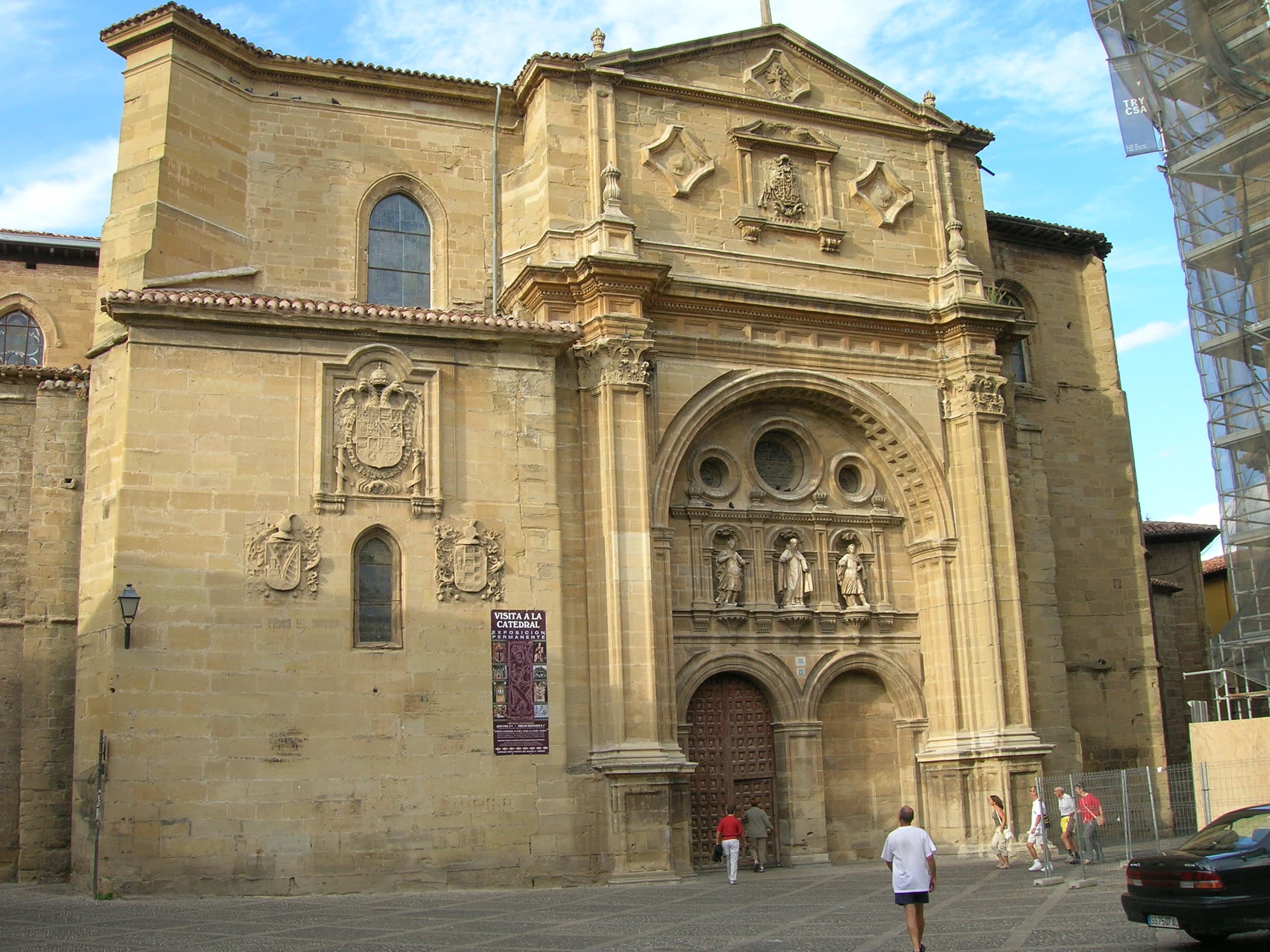
Image of Santo Domingo de la Calzada Cathedral. Image source
On this pilgrimage
Camino de Santiago — Selected Sacred SitesVisit essentials
A quick read before you go
- Duration
- 45 minutes to 1.5 hours for a typical visit including nave, henhouse, retable, and cloister;…
- Access
- Located in Plaza del Santo, s/n, 26250 Santo Domingo de la Calzada, La Rioja, directly on the…
Overview
Santo Domingo de la Calzada is an active Camino Francés cathedral shaped by the practical holiness of its founding saint. Domingo García cleared forest and built a stone causeway, bridge, hospital, and church for strangers on the road; the settlement that grew around that work became a cathedral town.
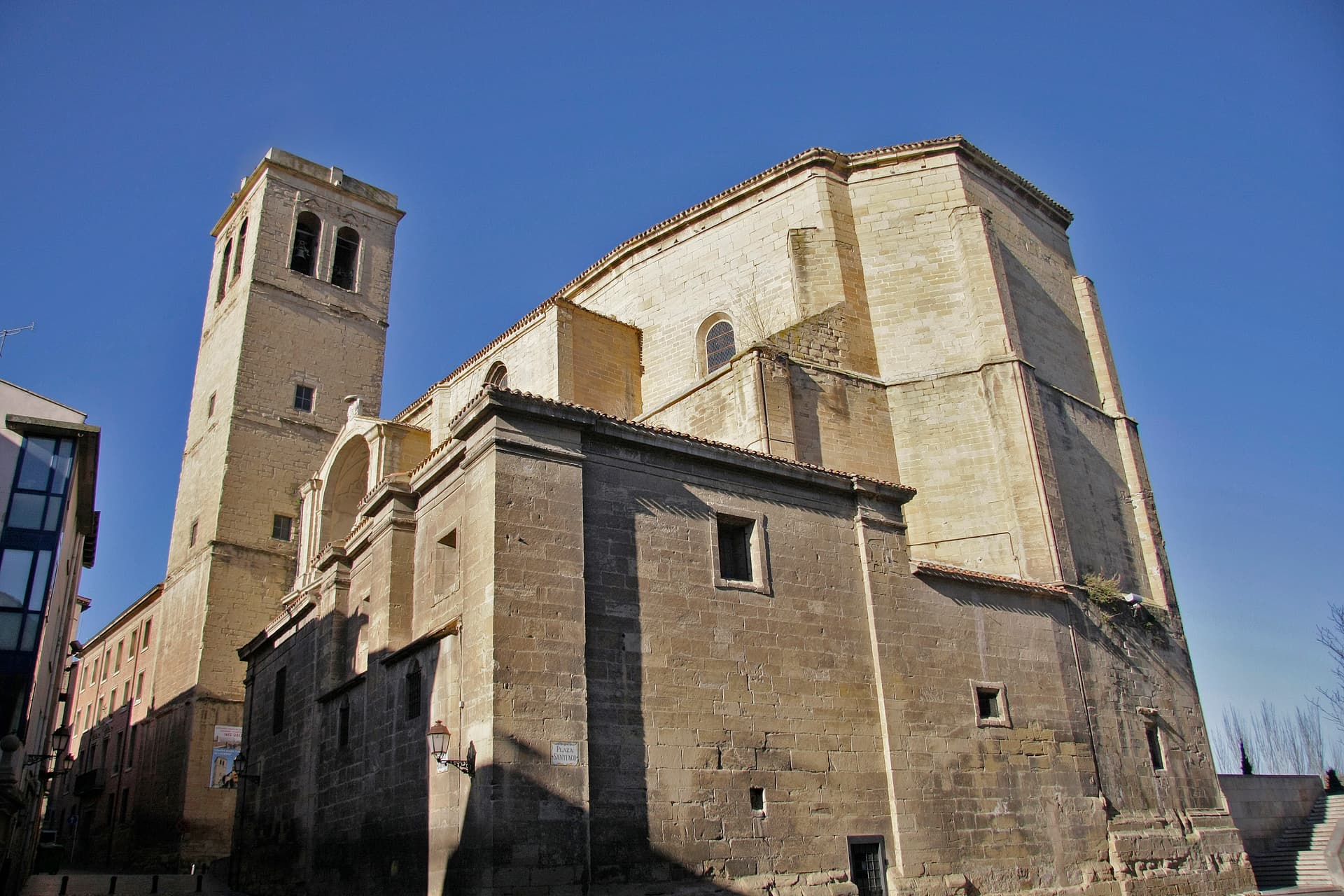
The building layers a Romanesque church consecrated in 1106, collegiate status around 1158, thirteenth-century cathedral status, and a detached Baroque bell tower added from 1762 because unstable ground could not support it beside the main structure. Its most memorable feature is a mid-fifteenth-century Gothic henhouse holding a live rooster and hen in continuous rotation as a memorial to the legendary Hugonell miracle.
Pilgrims collect their stamp, pause at Domingo's tomb, and encounter an unusually concrete sacred vocabulary: road, bridge, hospitality, and living birds inside a Gothic cathedral.
Why this place is sacred
Most sacred sites separate the miraculous from the mundane. Santo Domingo de la Calzada does the opposite: its founding saint's holiness is expressed almost entirely through engineering and hospitality rather than vision or ecstasy. Domingo García cleared forest, laid stone, built a bridge, and founded a hospital, and it is these acts — not any recorded mystical experience — that made him a saint pilgrims still venerate as they walk the same stage of the Camino Francés he built.
The rooster-and-hen miracle extends this logic rather than departing from it. A hanged pilgrim, Hugonell, is found alive and sustained on the gallows by the saint's continued intervention; when a skeptical magistrate dismisses the report by gesturing at his dinner, the roasted birds come back to life.
The miracle is bodily and immediate, not visionary, and the cathedral's response to it has been equally concrete: it has kept a live rooster and hen in a purpose-built Gothic henhouse, inside the nave, for over five centuries.
This embodied, hands-on quality of holiness is what visitors most often name as the site's distinguishing feature. There is little abstraction here — a road, a bridge, a tomb, and two clucking birds — and that concreteness is precisely what pilgrims report finding moving after days of walking the same physical road the saint once built.
A hermit's hospital, causeway, and bridge built to protect pilgrims traveling the Camino Francés, with an attached church that became the saint's burial place and, over centuries, a collegiate church and then a cathedral.
Hermit settlement and infrastructure building from c. 1039 → church consecrated 1106 → collegiate status c. 1158 with major rebuilding under master builder Garçion → cathedral status in the 13th century → Renaissance retable (1537–40) → detached Baroque bell tower (1762–1765) → continuous active parish and pilgrim waypoint use through the present.
Experience and orientation
Santo Domingo de la Calzada sits directly on the Camino Francés between Nájera and Redecilla del Camino, and most visitors arrive on foot as part of a day's stage rather than as a dedicated destination.
The town itself grew from the saint's hospital, and the cathedral at its center still carries that practical, road-worker's sanctity in its architecture: a Romanesque core, later Gothic and Renaissance additions, and a detached bell tower built apart from the main structure because the ground beneath the cathedral proved too unstable to support it.
Inside, the nave holds two things pilgrims come specifically to see. The first is the Renaissance retable by Damián Forment, a major artistic highlight and the visual centerpiece of the church. The second, and by most accounts the more startling, is the Gothic stone henhouse — an architectural feature built into the cathedral itself — holding a live rooster and hen.
Visitors consistently describe the surprise of hearing or seeing live, clucking chickens inside a Gothic cathedral as one of the most memorable moments of the entire Camino Francés.
The saint's tomb lies in the crypt beneath, and many pilgrims pause there to reflect before continuing the day's stage — a quieter counterpart to the henhouse's surprise, and the place where the site's practical, engineering-based sanctity is most directly felt.
Located at Plaza del Santo, s/n, 26250 Santo Domingo de la Calzada, La Rioja. The town sits directly on the Camino Francés and is reachable by regional bus or car from Logroño and Burgos. Entrance ticket covers the cloister; guided and tower-access tickets are available at a supplement.
Context and lineage
Domingo García was born in 1019 in Viloria de Rioja and was twice refused entry to Benedictine monastic life, at Valvanera and San Millán de la Cogolla, before becoming a hermit in the forest near the Río Oja around 1039.
With the support of Bishop Gregory of Ostia, he was ordained and dedicated himself from 1039 onward to clearing forest, building a stone causeway between Nájera and Redecilla del Camino, constructing a bridge over the Oja, and establishing a hospital and church for pilgrims. He died in 1109 and was buried in the church he had founded; the settlement that grew around his hospital was later elevated to an episcopal see.
The rooster-and-hen miracle attached to his cult tells of a young German pilgrim, Hugonell, traveling with his parents to Santiago, who rejected the advances of an innkeeper's daughter. She planted a silver cup in his belongings and accused him of theft; under the Fuero de Alfonso X, he was hanged. His parents, returning from Santiago, found him alive on the gallows, sustained by Santo Domingo.
When they told the local magistrate — who was about to eat a roasted rooster and hen — he dismissed the miracle, saying their son was 'as alive as this rooster and hen,' at which point the cooked birds are said to have stood up, grown feathers again, and crowed. The cathedral has kept a live rooster and hen in a Gothic stone henhouse, built in the mid-fifteenth century, ever since.
This is treated by all sources as legend rather than verified history, following a recognizable medieval pattern of miracle narratives attached to saints associated with pilgrim welfare and justice.
Institutionally, land was granted by King Alfonso VI in 1098; a primitive Romanesque church dedicated to El Salvador and Santa María was consecrated in 1106; the church was elevated to collegiate status around 1158, with major rebuilding beginning that year under master builder Garçion; and it was raised to cathedral status in the thirteenth century.
Hermit settlement and infrastructure building (from c. 1039) → church consecrated 1106 → collegiate church c. 1158 under master builder Garçion → cathedral status in the 13th century → Renaissance retable (1537–40) → detached Baroque bell tower (1762–1765) → active cathedral and Camino Francés waypoint through the present
Santo Domingo de la Calzada (Domingo García)
Founding saint
Bishop Gregory of Ostia (Gregorio IV)
Patron and ordaining bishop
Garçion
Master builder
Damián Forment
Sculptor
Traditions and practice
The rotation and care of the live rooster and hen in the Gothic henhouse, maintained by designated local families and periodically exchanged, has continued for centuries as a living memorial to the Hugonell miracle. The annual Procession of the Wheel and Saint's Procession, and the communal 'Almuerzo del Santo' meal on May 12, mark the patron saint's feast.
Regular Catholic Mass and sacraments continue at the cathedral. Pilgrims collect their credential stamp here as part of the Camino Francés route. Guided and self-guided tours, including night visits and tower climbs, are available for a supplement. The annual fiesta runs May 1–15, peaking May 10–13 around the May 12 feast day, and has been declared of National Tourist Interest in Spain.
Pause at the henhouse deliberately rather than glancing past it — it is not incidental decoration but the cathedral's clearest expression of how this site understands miracle: as something ongoing and tended, not a one-time event commemorated only in stone. Visit the crypt and the saint's tomb before or after, to hold the practical (the road, the bridge, the birds) alongside the devotional (the man who built them, now buried beneath the causeway).
Roman Catholicism (Camino de Santiago pilgrimage tradition)
ActiveThe cathedral is a major waypoint on the Camino Francés, holding the tomb of an 11th-century hermit venerated for building the roads, bridge, and hospital that made this stretch of the pilgrim route safe, and for the miracle associated with the hanged pilgrim Hugonell.
Pilgrim Mass and blessing, veneration at the saint's tomb/crypt, viewing and feeding of the live rooster and hen, collecting the pilgrim's stamp as part of the Camino credential.
Local civic/religious festival tradition (Cofradía del Santo)
ActiveThe town's identity is deeply tied to its patron saint; the annual fiesta, declared of National Tourist Interest in Spain, commemorates his life and miracles through communal ritual, food-sharing, and procession.
Almuerzo del Santo (communal chickpea-and-lamb stew, bread, and wine on May 12), Procession of the Saint, Procession of the Wheel commemorating one of Santo Domingo's miracles, traditional dances (el palo, el árbol, los arcos), pelota matches and folk festivities.
Perspectives and open questions
Santo Domingo de la Calzada is read consistently across scholarly and devotional sources as a saint whose sanctity is expressed through practical works, with the rooster-and-hen miracle treated everywhere as hagiographic legend rather than verified event.
Scholarly perspective
Historians treat Santo Domingo de la Calzada as a genuine, historically attested eleventh-century figure whose engineering works — causeway, bridge, hospital — are well documented as founding the town. His hagiography, including the rooster-and-hen miracle, follows a recognizable medieval pattern of miracle narratives attached to saints associated with pilgrim welfare and justice.
Living and traditional perspectives
Within Catholic and Camino pilgrim tradition, the saint is venerated for his hands-on charity as much as any doctrinal significance, and the live rooster and hen are understood as an ongoing, tended memorial rather than a static symbol — a miracle kept alive rather than merely commemorated.
Alternative interpretations
No significant esoteric or New Age reinterpretation of this site was found; its meaning remains closely tied to its Catholic and Camino-pilgrimage context.
Open questions
The precise historical kernel behind the Hugonell hanging story — whether it reflects an actual documented case or is a later hagiographic composite — is not established by primary medieval sources; all sources treat it as legend rather than verified history.
Plan your visit
Access and arrival
Located in Plaza del Santo, s/n, 26250 Santo Domingo de la Calzada, La Rioja, directly on the Camino Francés between Nájera and Belorado/Redecilla del Camino. Reachable by regional bus or car from Logroño and Burgos. Entrance ticket also covers the cloister, with guided and tower-access tickets available at a supplement.
Standard pilgrim lodging (albergues, hotels) available in the town, which functions as a regular overnight stage on the Camino Francés.
Respectful visit
Standard modest dress expected for active Catholic churches in Spain — shoulders and knees generally covered; no specific published rule beyond general cathedral norms.
Photography is generally permitted in the nave and cloister for personal use; flash photography and photography during Mass or in private devotional areas may be restricted, as is typical for active Spanish cathedrals. No cathedral-specific published policy was located.
No specific offering ritual documented beyond standard church donation boxes and paid entry supporting the cathedral's upkeep.
Silence and respectful behavior expected during services; entry to the crypt, tower, and cloister may require a separate ticket or timed guided visit.
Silence and respectful behavior are expected during services; entry to certain areas such as the crypt, tower, and cloister may require a separate ticket or timed guided visit. The live-animal tradition occasionally draws animal-welfare commentary from visitors.
Location
Map loads as you approach this section.
Pilgrim reflections
A portrait of encounter, not a score
Pilgrims describe what they felt, how present they could become, and whether the place would shape a journey. There are no stars and no ranking of traditions.
No reviewed reflections yet
The first pilgrims can help describe the character of being here.
Share a reflection
Available after an account-backed “Been there.” Every reflection is reviewed before publication.
Nearby sacred places
Explore other sacred places in the region. Proximity does not establish access or travel time; check each place’s guidance.



References
Sources consulted for this page. Source categories describe the publication, not a guarantee that every claim is verified. Traditional accounts and outside interpretations may differ.
- 01Santo Domingo de la Calzada Cathedral — Wikipedia contributorsSource contextWell-cited overview of construction phases, retable, tower, henhouse.
- 02Dominic de la Calzada — Wikipedia contributorsSource contextBiographical detail on birth/death, hermit years, engineering works, patronage, feast day.
- 03Cathedral of Santo Domingo de la Calzada in Santo Domingo de la Calzada — spain.info (Turespaña, official Spanish tourism board)officialOfficial national tourism body; general visitor and heritage description.
- 04How to visit the Santo Domingo de la Calzada Cathedral (Rioja); opening hours, prices — guias-viajar.comSource contextPractical visitor information including ticketing and cloister/tower access.
- 05Santo Domingo de la Calzada | Camino Frances — Wise PilgrimSource contextCamino guidebook publisher; pilgrimage-route context and stage information.
- 06Where the Rooster Crowed: The Legend of Santo Domingo de la Calzada — PilgrimapsSource contextLegend narrative consistent with other independent retellings.
- 07Legends on the Camino Frances: the rooster in Santo Domingo de la Calzada — Camino Travel CenterSource contextCorroborates the Hugonell/hanged-pilgrim legend details.
- 08Santo Domingo de la Calzada | The Miracle of the Hen — CaminoWays.comSource contextFactually consistent with other sources on the legend and henhouse tradition.
- 09TRADITIONS AND CEREMONIES — Cofradía del Santo / Albergue Santo Domingo de la CalzadaofficialLocal religious brotherhood describing the May fiesta traditions, processions, and ceremonies firsthand.
- 10Santo Domingo patron saint's day fiesta — spain.info (Turespaña)officialOfficial tourism calendar entry confirming fiesta period and National Tourist Interest designation.
Share a photo
Help visitors recognize Santo Domingo de la Calzada Cathedral. Every submission is reviewed before publication.