Notre-Dame de Sous-Terre (Our Lady Under the Earth)
InsideChartres Cathedral
In Chartres' deepest crypt, a Black Madonna guards the threshold where druids allegedly awaited the Virgin's coming
Chartres, Eure-et-Loir, France
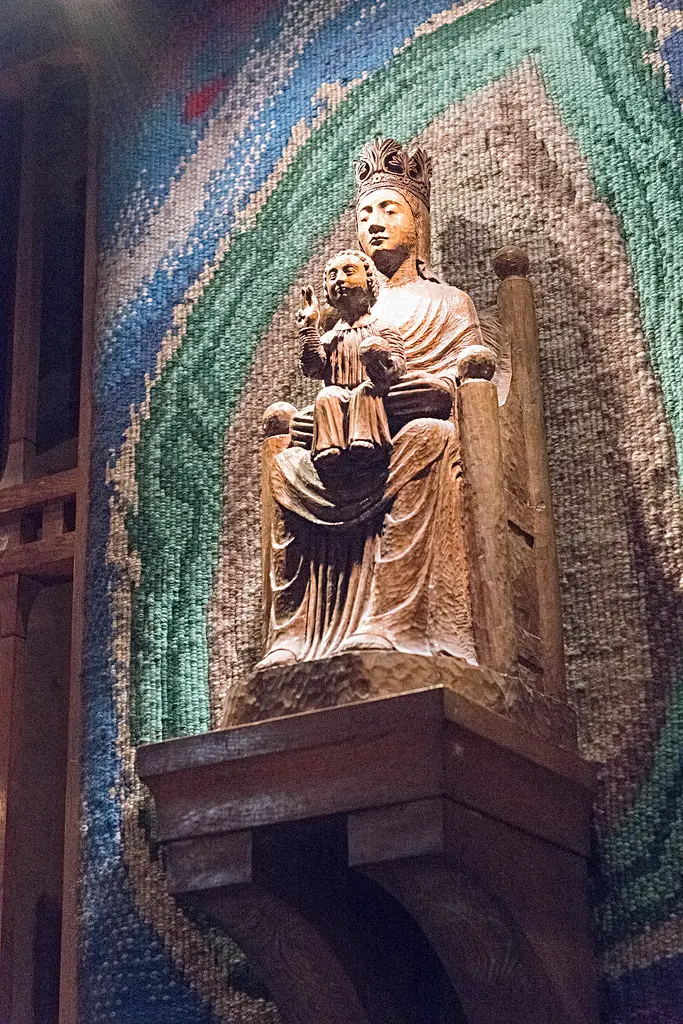
Image of Notre-Dame de Sous-Terre (Our Lady Under the Earth). Image source
Visit essentials
Before you go
- Access
- The crypt is located beneath Chartres Cathedral, 16 Cloître Notre Dame, 28000 Chartres, France.
- Address
- 16 Cloître Notre Dame, 28000 Chartres, France
- Duration
- A contemplative visit to the crypt takes 30 to 60 minutes.
- Etiquette
- The crypt is a space of prayer and pilgrimage, not casual tourism.
Overview
To descend into the crypt of Chartres is to move from light into shadow, from soaring Gothic achievement to Romanesque weight, from the triumphant proclamation of faith to something older and less certain.
Here, in what is reputedly the oldest Marian shrine in Christendom, the Black Madonna called Notre-Dame de Sous-Terre—Our Lady Under the Earth—awaits in a chapel that has held some form of veneration for at least a thousand years, and possibly far longer. The current statue dates only to 1976, replacing one destroyed in the Revolution, which itself replaced earlier versions stretching back into the early centuries of Christianity.
But the controversy—and the fascination—centers on claims that reach further still. According to medieval tradition, Celtic druids received miraculous warning of the Virgin's coming and erected an altar here inscribed 'virgini pariturae': to the virgin who will give birth. Whether this represents historical memory, theological elaboration, or wishful thinking has been debated for centuries. The scholarly consensus doubts the druid connection; the tradition persists regardless.
What is undeniable is the power of the space itself. The crypt stretches 220 meters—the longest in France—its Romanesque vaulting creating an atmosphere utterly different from the cathedral above. Near the chapel of Notre-Dame de Sous-Terre lies the Puits des Saints-Forts, the Well of the Strong Saints, rediscovered in 1902 after being filled in during the 17th century.
The conjunction of Black Madonna, sacred well, and underground chamber creates a pattern that appears at sacred sites across Europe—a pattern suggesting that certain places hold power regardless of the specific traditions that have venerated them.
For pilgrims seeking the deepest Chartres, this is where the journey leads: beneath the famous labyrinth, beneath the rose windows, beneath the soaring stone, to the Virgin who waits in the dark.
Why this place is sacred
The thinness of this place emerges from its depth—both literal and temporal. This is the bottom of Chartres, the foundation upon which everything else was built. Whatever power drew the first builders to this site still resides here, concentrated by centuries of human attention.
The druid tradition, whether historical or legendary, shapes how pilgrims encounter the space. According to medieval accounts, Celtic priests received miraculous foreknowledge that a virgin in a distant land would give birth to the Savior. They carved a statue and inscribed their altar 'virgini pariturae'—to the virgin who will give birth. The inscription reportedly remained visible until the 17th century, when the altar was demolished and the well filled in.
Scholars debate whether this represents genuine pre-Christian worship, a medieval elaboration designed to link Chartres to the earliest possible origins, or something between. The 9th-century Carolingian crypt is the oldest structure that can be archaeologically confirmed. But the site may have been sacred before Christianity arrived—sacred wells and goddess worship were common in Celtic Gaul, and the later construction of a major Christian shrine atop an earlier sacred site would fit a well-documented pattern.
The Black Madonna herself participates in a phenomenon that spans Europe. Dark-skinned Virgin images cluster at sites with documented or suspected pre-Christian sacredness. Whatever the darkness signifies—Eastern iconography, accumulated candle smoke, or deliberate artistic choice—Black Madonnas tend to mark places of particular power.
The well adds another dimension. Sacred wells are among the oldest objects of veneration, predating temples and images. The Puits des Saints-Forts was apparently significant enough to be filled in during the Counter-Reformation period—perhaps because its associations with pre-Christian practice made church authorities uncomfortable. Its rediscovery in 1902 restored a piece of the site's identity that had been deliberately suppressed.
Most fundamentally, the crypt's power derives from its position in the architecture of the sacred. Chartres Cathedral presents three cosmic realms through its three Madonnas: Notre-Dame de Sous-Terre in the underworld crypt, Notre-Dame du Pilier (Our Lady of the Pillar) in the middle realm of the nave, and Notre-Dame de la Belle Verrière (Our Lady of the Beautiful Window) in the heavenly realm of stained glass light.
The crypt Madonna guards the threshold between worlds, the place where what is below meets what is above.
The earliest church on this site was a wooden structure from the early centuries of Christianity, built over what may have been a pre-existing sacred space. The crypt in its current form dates to successive constructions: the 9th-century Carolingian St. Lubin crypt, then the 11th-century Romanesque St. Fulbert crypt. Throughout, the site appears to have served as a place of Marian veneration, with the 'virgini pariturae' tradition claiming continuity even into pre-Christian times.
The site's history is one of destruction and rebuilding, concealment and rediscovery. The original wooden church gave way to stone. Fire destroyed and reconstruction followed. The Revolution burned the Black Madonna; replacement statues were installed in 1857 and 1976. The sacred well was filled in around 1650 and rediscovered in 1902. Through it all, something has persisted—a quality of the place that human intention alone cannot explain.
Today, access to the crypt is reserved for prayer and pilgrimage rather than general tourism. This restriction itself speaks to the site's continuing sacred function. Notre-Dame de Sous-Terre is not a museum piece but an object of living devotion, encountered within a context of prayer rather than curiosity.
Experience and orientation
The descent begins with stone stairs that lead away from the cathedral's light. With each step, the Gothic exuberance above recedes and something older asserts itself. The crypt's Romanesque vaulting creates an atmosphere of weight and enclosure utterly different from the soaring nave. Light here is scarce; the walls press closer; the air carries the chill of earth.
Pilgrims consistently describe a quality of stillness that differs from mere quiet. The space seems to demand something—presence, attention, perhaps willingness to encounter what waits in darkness. The busy mind that can persist through a cathedral visit often falls silent here, as though the crypt will not allow distraction.
Notre-Dame de Sous-Terre awaits in her chapel. The current statue, installed in 1976, is a darker and more accurate copy of the original than the lighter 1857 replacement. Mother and Child sit in frontal stillness, their dark faces impossible to fully read. Some pilgrims report a sense of being seen, evaluated, perhaps welcomed by something that knows what lies in the depths of those who come.
Near the chapel, the Well of the Strong Saints adds another element. The well was filled in during the 17th century—perhaps because its pagan associations made church authorities uncomfortable—and rediscovered in 1902 in the exact location described in period documents. Sacred wells predate Christianity; their inclusion in Christian sites often marks places where earlier traditions were absorbed rather than erased.
The experience of the crypt is fundamentally one of descent—not only physical but psychic. Pilgrims speak of encountering aspects of themselves that the light above does not reach. The Black Madonna, guardian of the underworld, meets seekers in whatever darkness they bring. This is not comfortable, necessarily, but it is often transformative.
Approach the crypt as a threshold. You are descending not only physically but symbolically—moving from the light of ordinary consciousness into something older and less known. Let the descent itself work on you; do not rush.
In the chapel of Notre-Dame de Sous-Terre, sit or kneel according to your inclination. The space is for prayer; even if your form of prayer is simply presence, offer your attention. The Black Madonna has been receiving pilgrims for a very long time; you are part of a chain that extends back centuries.
If the well is accessible during your visit, spend time with it. Sacred wells carry their own power, independent of the Marian tradition. Water from the depths of earth has been venerated since before memory. Let your attention settle into the well's darkness.
Remember that access to the crypt is reserved for prayer and pilgrimage. Come in that spirit, even if your prayer takes no conventional form. The space knows the difference between tourist and seeker.
Context and lineage
The founding narrative is extraordinary in its claims. According to medieval tradition, Celtic druids received divine revelation of the Virgin's coming before the birth of Christ. They carved a statue of a virgin holding a child and inscribed their altar 'virgini pariturae'—to the virgin who will give birth. When Christianity arrived, it found Marian devotion already established—the druids had been venerating Mary before they knew her name.
This tradition, whatever its historical status, has shaped understanding of the site for centuries. It makes Chartres not merely an important medieval pilgrimage but the site of the oldest Marian shrine in existence—older than Christianity itself. The claim is unprovable but persistent; it speaks to something about the place that resists ordinary explanation.
The documented history is more modest but still impressive. The 9th-century Carolingian crypt of St. Lubin is the oldest surviving structure. The great 11th-century St. Fulbert crypt—220 meters long, the largest in France—was built after fire destroyed an earlier wooden church. The various reconstructions that culminated in the current Gothic cathedral were built atop these foundations, but the crypt itself has remained essentially unchanged since the Romanesque period.
The lineage here is both documented and disputed. The documented chain includes the 9th-century Carolingian construction, the 11th-century Fulbert expansion, the Gothic cathedral above, and the series of Black Madonnas ending with the current 1976 statue. The disputed chain reaches back to the druids—figures who left no writing and whose practices are known only through Roman observers and medieval speculation.
What is undeniable is that pilgrims have been descending into this crypt for at least a thousand years, and that something about the place has consistently drawn them. Royal pilgrims, including multiple French kings, have knelt before Notre-Dame de Sous-Terre. Popes have granted indulgences. The site has been, and remains, one of the major Marian shrines of Christendom.
Notre-Dame de Sous-Terre
sacred image
The Black Madonna of Chartres crypt, representing Mary as guardian of the underworld and threshold between realms. The current statue (1976) is a copy of the original destroyed in 1793.
Virgin Pariturae
legendary figure
According to medieval tradition, the 'virgin who will give birth' was venerated by druids before Christ. An altar bearing this inscription allegedly stood in the crypt until the 17th century.
Fulbert of Chartres
historical
Bishop of Chartres (1006-1028) who oversaw construction of the great Romanesque crypt after fire destroyed the earlier wooden church. The crypt bearing his name is the largest in France.
Traditions and practice
Historical practices included processions through the crypt, prayer before Notre-Dame de Sous-Terre, and veneration at the sacred well (before it was filled in). The crypt served as a station on the pilgrimage circuit that made Chartres one of medieval Europe's great destinations. Royal pilgrims left offerings; ordinary pilgrims sought intercession for healing and other needs.
Today, access to the crypt is controlled, reserved for those coming for prayer and pilgrimage rather than casual tourism. This restriction maintains the contemplative atmosphere and distinguishes the crypt from the more accessible cathedral above. Pilgrims may join organized pilgrimage groups or arrange individual access by contacting the cathedral. Silent prayer before the Black Madonna is the primary practice.
The crypt also serves as a space for small group pilgrimages, with guided processions that move through the Romanesque passages, pausing at significant points including Notre-Dame de Sous-Terre and the Well of the Strong Saints. These processions maintain the ambulatory tradition of pilgrimage within the crypt's enclosed space.
If you are granted access to the crypt, approach it as a journey into depth. The physical descent mirrors a psychic one. Move slowly; let the weight of the Romanesque stone settle your awareness.
In the presence of Notre-Dame de Sous-Terre, simply be. You need not know how to pray formally. The Black Madonna has been receiving seekers in whatever state they arrive for a very long time. Bring what you carry—grief, confusion, longing, gratitude—and offer it to her attention.
Spend time also at the Well of the Strong Saints if accessible. Sacred wells carry their own ancient power. Let your awareness descend into the darkness below the water's surface.
Remember that you are walking where countless pilgrims have walked before you. Add your presence to the accumulated weight of human seeking that this crypt has held for a millennium or more.
Roman Catholicism
ActiveNotre-Dame de Sous-Terre is one of the most ancient Marian shrines in Christendom. The crypt has held some form of veneration for at least a thousand years. The site is part of Chartres Cathedral, itself one of the supreme achievements of Christian sacred architecture. The Black Madonna represents Mary as guardian of the threshold between worlds.
Pilgrimage to the crypt, reserved for those coming for prayer. Veneration before Notre-Dame de Sous-Terre through silent prayer, candle lighting, and contemplation. Participation in organized pilgrimages with procession through the crypt.
Pre-Christian Tradition (Claimed)
HistoricalAccording to medieval accounts, Celtic druids received miraculous foreknowledge of the Virgin's birth and established veneration at this site before Christianity arrived. They allegedly inscribed an altar 'virgini pariturae'—to the virgin who will give birth. This tradition, whether historical memory or theological elaboration, has shaped understanding of the site for centuries.
Historical tradition claims the druids carved a statue of a virgin with child and venerated her before any Christian teaching reached them. No current practices descend from this claimed tradition; its significance is in shaping how the site is understood.
Perspectives and open questions
Notre-Dame de Sous-Terre invites interpretations that range from orthodox Catholic devotion through academic skepticism to esoteric speculation. The druid origin claim, in particular, divides scholarly and popular understanding. What is undeniable is the power that pilgrims of all perspectives have reported for centuries.
Scholarly perspective
Academic consensus approaches the druid tradition with skepticism. The earliest documentary evidence for Marian worship at Chartres dates to the 9th century; the druid story appears in medieval sources that may reflect theological elaboration rather than historical memory. The 'virgini pariturae' inscription cannot be independently confirmed; the claim rests on accounts that may be apologetic rather than historical.
Archaeology confirms the 9th-century Carolingian crypt and the 11th-century Fulbert crypt as the oldest surviving structures. Whether earlier sacred use existed cannot be determined from physical evidence. The sacred well, rediscovered in 1902, is consistent with pre-Christian veneration patterns but does not prove them.
The Black Madonna phenomenon is well documented across Europe, with various explanations for the darkness (Eastern iconography, candle soot, deliberate choice). The current Notre-Dame de Sous-Terre is a 1976 replacement, itself following an 1857 replacement of the Revolution-destroyed original.
Living and traditional perspectives
For Catholic pilgrims, Notre-Dame de Sous-Terre is the Virgin Mary in her aspect as guardian of the threshold between realms. The druid tradition, whether historically accurate or not, expresses a theological truth: that the world was prepared for Mary's coming, that even before her birth something in creation awaited her.
The crypt preserves the oldest layer of devotion at one of Christianity's great Marian shrines. Pilgrims have descended here for a thousand years seeking the Virgin's intercession. The power of the place is confirmed by centuries of reported experience, regardless of uncertainties about origins.
Alternative interpretations
Esoteric and goddess spirituality perspectives emphasize the chthonic dimensions of the site. The Black Madonna as 'Our Lady Under the Earth' represents the dark goddess, the feminine divine in her underworld aspect. The sacred well connects to pre-Christian water veneration. The druid tradition, whether historical or not, points to something genuine: that this site carries power older than Christianity.
From this perspective, the crypt of Chartres is a place where the goddess persists beneath Christian overlay. The three Madonnas of Chartres—Under the Earth, of the Pillar, of the Beautiful Window—represent the triple goddess in Christian dress: underworld, earth, and heaven.
Some see the site as an earth energy center, a node on planetary grid lines. The cathedral's labyrinth above and the well below are read as technologies for accessing altered states of consciousness.
Open questions
Genuine mysteries remain. The historical accuracy of the druid tradition cannot be determined from available evidence. The original function of the sacred well is unknown. Whether pre-Christian veneration actually occurred at this site is a matter of inference rather than proof.
Even the original appearance of the Black Madonna is uncertain; the 1976 statue is a reconstruction based on descriptions, not an exact copy. What the space felt like before the 17th century alterations—before the well was filled in and the 'virgini pariturae' altar demolished—we can only imagine.
These unknowns are not failures of research but features of the place. Some things resist knowing. Notre-Dame de Sous-Terre guards her secrets.
Plan your visit
Access and arrival
The crypt is located beneath Chartres Cathedral, 16 Cloître Notre Dame, 28000 Chartres, France. Access is reserved for prayer and pilgrimage. Contact the cathedral office to arrange a visit. Chartres is 90 kilometers southwest of Paris, accessible by train in about one hour from Gare Montparnasse.
Chartres offers hotels and guesthouses in various price ranges. Some pilgrimage organizations offer accommodation arrangements as part of organized visits. The proximity to Paris makes day visits possible, though overnight stays allow for multiple visits and deeper encounter.
Respectful visit
Modest dress appropriate for sacred space. Shoulders and knees covered. Nothing that would distract from the contemplative atmosphere.
Photography restrictions may apply in the crypt. Check current policies with the cathedral. If permitted, photograph only with great discretion and never when others are engaged in prayer.
Candles may be available for lighting. Donations support the cathedral's maintenance and ministry.
Access by arrangement only. Silent demeanor throughout. The well may have specific access restrictions; follow guidance provided.
Access to the crypt is not automatic. Contact the cathedral in advance to arrange a visit for prayer. Do not attempt to access the crypt without proper arrangements. Respect that this is a space of active devotion, not tourism. Photography restrictions may apply; check current policies.
Current practical details
Address
16 Cloître Notre Dame, 28000 Chartres, France
Phone
Hours
Hours, fees, and access can change — verify on the official source before you travel. Practical details last checked Jun 2026.
Location
Map loads as you approach this section.
Pilgrim reflections
A portrait of encounter, not a score
Pilgrims describe what they felt, how present they could become, and whether the place would shape a journey. There are no stars and no ranking of traditions.
No reviewed reflections yet
The first pilgrims can help describe the character of being here.
Share a reflection
Available after an account-backed “Been there.” Every reflection is reviewed before publication.
Nearby sacred places
Explore other sacred places in the region. Proximity does not establish access or travel time; check each place’s guidance.
Chartres Cathedral
Chartres, Eure-et-Loir, France
0.0 km away

Church of St. Aignan, Chartres
Chartres, Eure-et-Loir, France
0.2 km away

Sanctuary of Notre-Dame de Montligeon
La Chapelle-Montligeon, La Chapelle-Montligeon, Orne / Normandy, France
61.5 km away

Chapelle Notre-Dame de Bonne Délivrance
Neuilly-sur-Seine, Hauts-de-Seine, France
75.4 km away
References
Sources consulted for this page. Source categories describe the publication, not a guarantee that every claim is verified. Traditional accounts and outside interpretations may differ.
- 01The Crypt - Cathédrale de Chartres — Chartres CathedralofficialOfficial cathedral information
- 02Our Lady under the Earth - Interfaith Mary Page — Interfaith Mary PageacademicBlack Madonna traditions and history
- 03Notre Dame de Sous-Terre - Catholicism Pure & Simple — Catholicism Pure & SimpleblogCatholic perspective on the shrine
- 04Pilgrim Procession Through the Crypt — Jill GeoffrionguidePilgrimage practice information
Share a photo
Help visitors recognize Notre-Dame de Sous-Terre (Our Lady Under the Earth). Every submission is reviewed before publication.