Our Lady of Good Deliverance, Paris
InsideChapelle Notre-Dame de Bonne Délivrance
The Black Madonna who healed a future saint's despair
Understand sacred places, explore living traditions, and learn how to engage respectfully with Pilgrim Map.
Access has not been verified. Check current local guidance before planning a visit.
Neuilly-sur-Seine, Hauts-de-Seine, France
Read the sources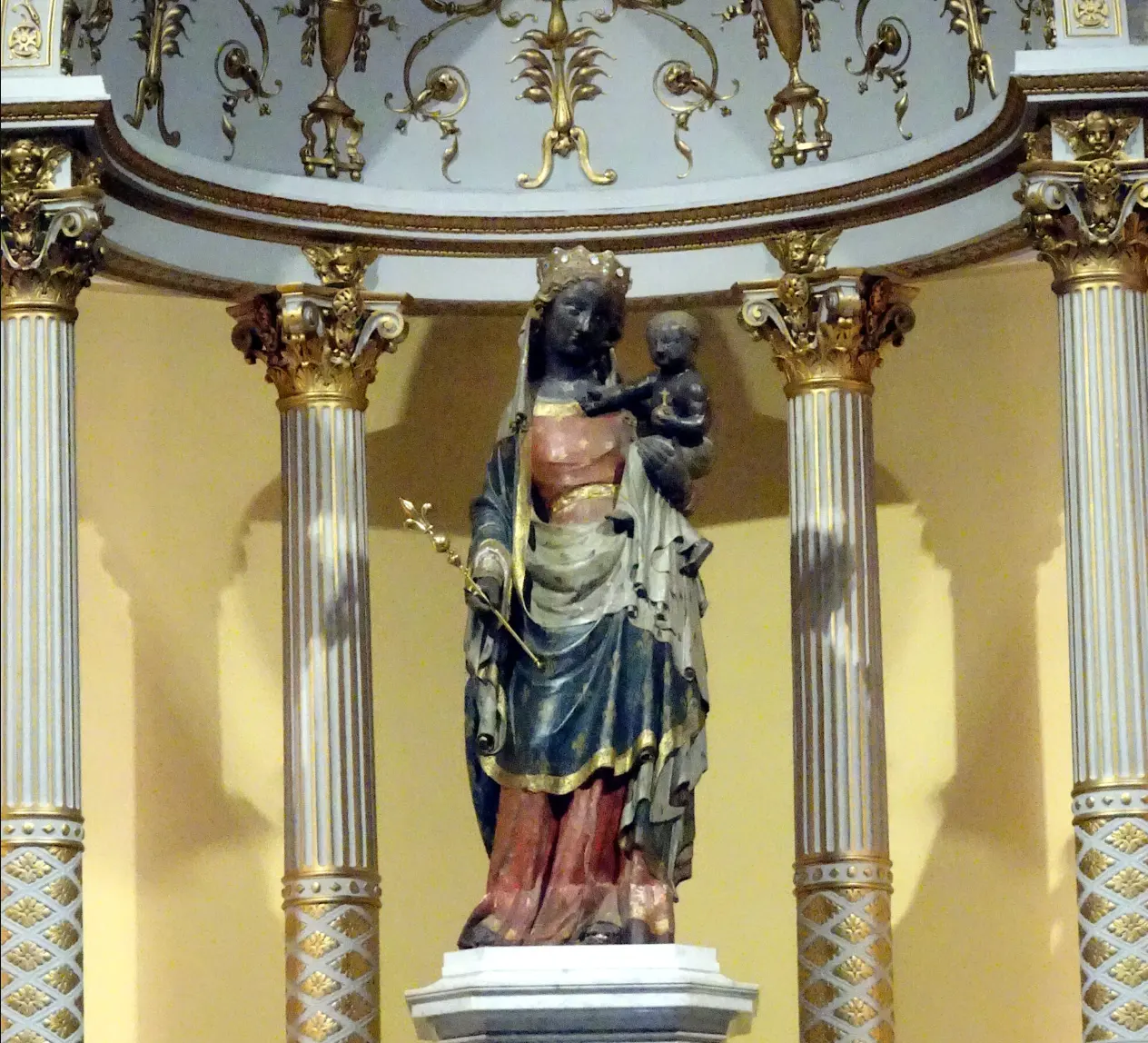
Visit essentials
A quick read before you go
- Duration
- Incorporated into chapel visit; thirty minutes to one hour.
- Etiquette
- Approach the Madonna with the reverence due a sacred image that has received prayers for nearly…
Overview
The 150-centimeter limestone statue retains centuries-old color. The dark-faced Black Madonna wears a white veil and fleur-de-lis-patterned dark blue mantle over a red robe; her listening presence has drawn pilgrims for nearly a thousand years.
She has been Notre-Dame de la Bonne-Délivrance since the eleventh century, when pilgrims sought her intercession at Paris's Saint-Étienne-des-Grès. The name first meant 'safe delivery': the Madonna of childbirth protecting mothers and infants. It later encompassed deliverance from illness, bondage, or whatever imprisons body or soul.
The Royal Confraternity founded in her honor in 1533 had twelve thousand members, including French royalty. When the Revolution destroyed her church, Madame de Carignan purchased and hid the statue. Since 1910 it has resided in the Sisters of Saint Thomas of Villeneuve chapel in Neuilly-sur-Seine.
In 1586, young Francis de Sales despaired for six weeks, convinced by Calvinist teaching that he was predestined for damnation. He knelt before the Madonna and recited the Memorare; relief was immediate and complete. He became a bishop, Doctor of the Church, and saint.
Why this place is sacred
What happens when the same image receives prayers across ten centuries? Whatever theology one holds about statues and intercession, the phenomenological reality is undeniable: concentrated intention, sustained over generations, creates a field of presence. This Madonna has been the focus of such intention longer than most buildings have stood.
The association with childbirth grounds the devotion in fundamental human experience. The moment of delivery is a threshold—life or death, continuation or ending. Medieval women facing that passage without modern medicine knew the stakes. Their prayers before this Madonna were not abstract; they were urgent requests for physical survival.
That urgency extended to the spiritual realm. Francis de Sales' crisis was as lethal to his soul as obstructed labor to a mother's body. His despair was not sadness but conviction of eternal doom—a black pit from which he could see no exit. The Memorare, recited before this Madonna, opened the exit. The prayer acknowledges what pilgrims have always intuited: this Madonna has never refused anyone who sought her help.
The statue's darkness adds to its power. Black Madonnas evoke earth, depth, mystery—the darkness from which life emerges, the darkness that holds seeds until spring. Whether the coloring is original, the result of age, or both, it sets this Madonna apart from pastel prettiness, suggesting something older and more primal.
The devotion began as patronage for childbirth—'good deliverance' in its most literal sense. The Madonna was understood to have particular power to bring mothers and infants safely through labor.
The meaning of 'deliverance' expanded over centuries to include spiritual liberation. The statue survived the destruction of its original church, exile during the Revolution, and multiple relocations, finally finding a permanent home in Neuilly in 1910.
Experience and orientation
Seek her in the Chapelle Notre-Dame de Bonne Délivrance in Neuilly-sur-Seine. The setting is modest: a convent chapel, not a grand church. This intimacy serves the encounter. You do not lose yourself in architectural vastness; you come face to face with the Madonna.
She stands behind the main altar, visible from the nave. The painting has softened but not disappeared; the dark face retains its character. Light filters through windows; candles flicker in their holders. Sisters of Saint Thomas of Villeneuve may be at prayer, adding living devotion to the accumulated devotion of centuries.
Approach as a pilgrim, not a tourist. Consider what form of deliverance you seek. The Memorare—the prayer that healed Francis de Sales—remains particularly associated with this Madonna. Its confident opening establishes the relationship: 'Remember, O most gracious Virgin Mary, that never was it known that anyone who fled to thy protection, implored thy help, or sought thy intercession was left unaided.'
Speak your need silently or aloud. Light a candle if you wish. The chapel asks nothing elaborate; honest intention is sufficient.
The statue is located behind the main altar in the Chapelle Notre-Dame de Bonne Délivrance, 52 boulevard d'Argenson, Neuilly-sur-Seine. The chapel is accessible during published visiting hours.
Context and lineage
The devotion began in the eleventh century at Saint-Étienne-des-Grès, a church on the Montagne Sainte-Geneviève in Paris. A Black Madonna there became known for granting safe deliveries, earning the title Notre-Dame de la Bonne-Délivrance. The cult grew; the Royal Confraternity established in 1533 eventually counted twelve thousand members.
In 1587, the young Francis de Sales—brilliant, devout, and convinced he was damned—knelt before this Madonna in desperation. His prayer, the Memorare, brought immediate relief. The experience shaped his life: he became a priest, then bishop of Geneva, then a Doctor of the Church, finally a canonized saint.
The French Revolution destroyed Saint-Étienne-des-Grès but not the Madonna. Madame de Carignan Saint Maurice purchased and concealed the statue. In 1806, she gave it to the Sisters of Saint Thomas of Villeneuve. When the Sisters moved to Neuilly in 1908, the Madonna came with them. The chapel built to receive her was blessed in 1910.
The Sisters of Saint Thomas of Villeneuve have been the statue's custodians since 1806, continuing the devotion that originated at Saint-Étienne-des-Grès in medieval Paris.
Saint Francis de Sales
Famous pilgrim
Madame de Carignan Saint Maurice
Savior of the statue
Traditions and practice
Medieval pilgrims sought the Madonna's protection during pregnancy and childbirth. The Memorare became associated with the devotion after Francis de Sales' healing. Novenas to Our Lady of Good Deliverance were common practice.
Pilgrims visit to pray before the statue, bringing whatever need they carry. The association with childbirth continues, but the meaning has expanded to include all forms of deliverance.
Approach honestly, without pretense. Speak your need. Consider reciting the Memorare, linking your prayer to Francis de Sales' transformative moment. Light a candle if the gesture feels meaningful.
Roman Catholicism
ActiveOne of France's most historically significant Black Madonnas, with nearly a millennium of continuous veneration and association with the healing of Saint Francis de Sales.
Veneration for deliverance from suffering, Memorare recitation, prayers for safe childbirth, pilgrimage visits, lighting candles.
Perspectives and open questions
For the faithful, this is a miraculous image with proven intercessory power. For students of religion, she represents one of France's most important Black Madonnas. For seekers, she offers a place to bring honest need.
Scholarly perspective
The statue represents one of France's most significant Black Madonnas with documented continuous veneration since the medieval period. The phenomenon of Black Madonnas in European Christianity remains a subject of scholarly interest.
Living and traditional perspectives
Within Catholic devotion, the Black Madonna is understood as a miraculous image of the Virgin Mary with particular intercessory power for those seeking deliverance. The healing of Francis de Sales demonstrates her efficacy.
Alternative interpretations
Some researchers connect Black Madonnas to pre-Christian goddess worship, particularly earth mother and fertility goddesses. The original association with childbirth supports such interpretations.
Open questions
The reason for the statue's dark coloring remains debated: darkening over time, original paint, or intentional symbolism. The full historical record of attributed miracles is not publicly documented.
Plan your visit
Access and arrival
Accommodations in central Paris with easy Metro access to Neuilly.
Respectful visit
Modest dress appropriate for a sacred space.
Ask permission; photography is likely restricted.
Candles may be lit. Prayer intentions may be left before the statue.
Do not touch the statue.
This is a sacred object within an active convent; approach with appropriate reverence. Photography may be restricted.
Current practical details
Address
5 Bd de la Saussaye, 92200 Neuilly-sur-Seine, France
Phone
Hours
Hours, fees, and access can change — verify on the official source before you travel. Practical details last checked Jun 2026.
Location
Map loads as you approach this section.
Pilgrim reflections
A portrait of encounter, not a score
Pilgrims describe what they felt, how present they could become, and whether the place would shape a journey. There are no stars and no ranking of traditions.
No reviewed reflections yet
The first pilgrims can help describe the character of being here.
Share a reflection
Available after an account-backed “Been there.” Every reflection is reviewed before publication.
Nearby sacred places
Explore other sacred places in the region. Proximity does not establish access or travel time; check each place’s guidance.

Chapelle Notre-Dame de Bonne Délivrance
Neuilly-sur-Seine, Hauts-de-Seine, France
0.0 km away
La Madeleine (Church of Saint Mary Magdalene)
Paris, Paris, France
4.4 km away
Relic of Mary Magdalene at La Madeleine
Paris, Paris, France
4.4 km away

Basilica of the Sacré-Cœur, Montmartre
Paris, Paris, Paris / Île-de-France, France
5.4 km away
References
Sources consulted for this page. Source categories describe the publication, not a guarantee that every claim is verified. Traditional accounts and outside interpretations may differ.
- 01Notre-Dame de Bonne Délivrance — Congregation of Sisters of Saint Thomas of VilleneuveofficialOfficial custodians of the statue
- 02Saint-Étienne-des-Grès, Paris - Wikipedia — Wikipedia contributorsencyclopediaHistorical background on original site
- 03The Black Virgin of Paris - Seraphim — SeraphimacademicDetailed devotional article
- 04Notre-Dame de Bonne Délivrance - Feast Day — AnaStpaulofficialDevotional calendar resource
Share a photo
Help visitors recognize Our Lady of Good Deliverance, Paris. Every submission is reviewed before publication.