Chartres Cathedral
Where medieval pilgrims came for Mary's veil and seekers still walk the labyrinth toward the center
Understand sacred places, explore living traditions, and learn how to engage respectfully with Pilgrim Map.
Access has not been verified. Check current local guidance before planning a visit.
Chartres, Eure-et-Loir, France
Read the sources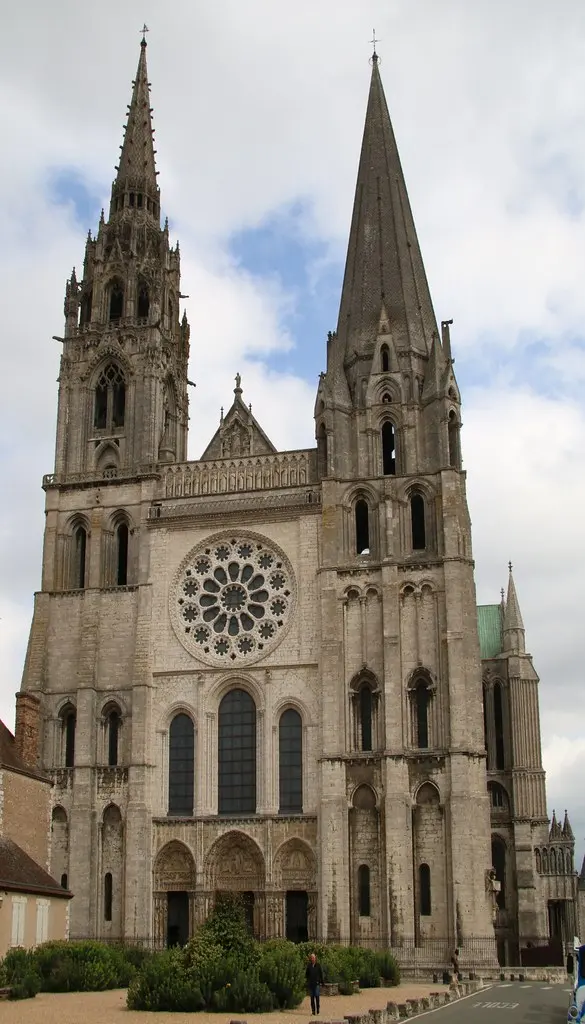
Visit essentials
A quick read before you go
- Duration
- 2-3 hours for the cathedral and stained glass.
- Etiquette
- As an active Catholic cathedral, modest dress, quiet behavior, and respect for worship are…
Overview
Across the Beauce plains, Chartres Cathedral's twin spires form a beacon visible for miles: the south tower Romanesque, the north Flamboyant Gothic, their architectural conversation spanning three centuries. Pilgrims have approached the place where the Virgin Mary's traditional veil or tunic, the Sancta Camisia, has rested since 876.
Chartres preserves nearly all 173 original stained-glass windows, the Royal Portal sculptures of the 1140s, the floor labyrinth walked since 1200, and the flying buttresses that made its Gothic vision possible — architecture as theology, light as divine presence, stone as scripture. After the 1194 fire left the relic unharmed, medieval devotion interpreted its survival as Mary's instruction to build greater; the current cathedral rose in only twenty-six years.
Pilgrimage remains active: every Friday from Lent through All Saints' Day the nave chairs are removed for labyrinth walking, and each Pentecost fifteen thousand pilgrims walk from Notre-Dame de Paris to Notre-Dame de Chartres.
Why this place is sacred
The thinness of Chartres accumulates through layers of time. The site was sacred before Christianity: Druids venerated a well here as early as 100 BCE, and that well still exists beneath the cathedral crypt. Early Christians did not abandon the sacred site but baptized it—throwing martyrs' bodies into the well, transforming pagan sanctuary into Christian shrine.
The arrival of the Sancta Camisia in 876 added another layer. This piece of silk—traditionally Mary's tunic worn at Christ's birth, tested in the twentieth century and found to contain pollen from first-century Palestine—drew pilgrims from across Europe. Chartres became second only to Santiago de Compostela as a pilgrimage destination. When the cathedral burned in 1194 and the relic survived unharmed in the crypt, medieval interpretation was certain: Mary herself had preserved her relic and demanded a greater church.
The Gothic cathedral that rose from the ashes embodies a theological vision. The flying buttresses—first cathedral to use them as a complete structural system—allowed walls of glass where stone walls once stood. Light poured through 173 stained glass windows, each telling stories: the lives of saints, the prophets of Israel, the labors of the months, the life of Christ. This was not decoration but education—the Bible in glass for pilgrims who could not read.
The famous 'Chartres blue' has no modern equivalent; the precise formula was lost to history, yet the color remains in these windows, testimony to what medieval glassmakers achieved.
The labyrinth completes the sacred geography. Set into the cathedral floor around 1200, its single path winds through eleven concentric rings to a six-petaled rose at the center. Medieval pilgrims called it 'The Road to Jerusalem'—a symbolic pilgrimage within the physical pilgrimage to Chartres. To walk the labyrinth is not to solve a maze but to follow a path: the only question is whether you will continue to the center.
The preservation is itself sacred significance. Fire, revolution, and war have damaged or destroyed much of medieval Europe's sacred art. Chartres survived, its glass intact through the Reformation and Revolution, its sculptures unsmashed, its labyrinth unburied. To enter is to enter what medieval pilgrims entered—not a reconstruction but the thing itself.
The current Gothic cathedral was built as the fitting home for the Sancta Camisia and as testimony to Mary's miraculous preservation of that relic through the 1194 fire. Cardinal Melior of Pisa, present when the relic was found unharmed, declared that Mary demanded a greater church. The community responded with unprecedented speed, completing the main structure in only 26 years. The cathedral was dedicated in 1260.
The site has been sacred continuously for over two thousand years—Druidic, then Christian. The current Gothic structure replaced Romanesque predecessors, though the Royal Portal and crypt survive from the earlier church. Major construction was completed by 1220; formal dedication occurred in 1260. Unlike many cathedrals, Chartres has seen relatively little modification since. Restoration work continues, but the essential medieval character remains intact.
The labyrinth, covered by chairs for most of the twentieth century, was restored to liturgical use in the 1990s when Friday labyrinth walks resumed.
Experience and orientation
The approach to Chartres prepares for encounter. From the surrounding plains, the spires are visible for miles—asymmetric partners, the south Romanesque and austere, the north Flamboyant Gothic and ornate. Medieval pilgrims approaching on foot would have seen this skyline for a full day's walk before arrival. The cathedral grows slowly, asserting its presence against the flat landscape.
The Royal Portal commands the west entrance. These sculptures, carved in the 1140s, survived both the 1194 fire and the Revolution. Elongated column figures represent kings and queens of Israel, prophets who foretold Christ. Above them, Christ sits in Majesty surrounded by the symbols of the four evangelists. The style is Romanesque—these figures precede the Gothic cathedral they now adorn—but the gravity is timeless. To enter through this portal is to pass through the witnesses.
Inside, light defines everything. The stained glass windows—173 of them, covering 2,600 square meters—filter sunlight into color. The famous 'Chartres blue' dominates, a pigment whose precise formula has been lost. The windows tell stories: the life of Christ, the lives of saints, the labors of the months, the guilds that funded the construction. Medieval pilgrims who could not read Latin could read these windows. Contemporary visitors can too: the narratives remain legible after eight centuries.
The labyrinth occupies the nave floor. On most days, chairs cover it—the cathedral remains an active church, not a museum. But on Fridays from Lent through All Saints' Day, the chairs are removed and the labyrinth opens. Walking it takes perhaps thirty minutes: a single path winding through eleven concentric rings to a six-petaled rose at the center. There are no wrong turns, no decisions to make except whether to continue.
Medieval pilgrims called it 'The Road to Jerusalem'—for those who could not make the physical pilgrimage to the Holy Land, the labyrinth offered spiritual equivalent.
The Sancta Camisia rests in the treasury. This piece of silk—traditionally Mary's tunic or veil—has been at Chartres since 876. When tested in the twentieth century, pollen analysis suggested origins in first-century Palestine. Whether relic or medieval artifact, it has drawn pilgrims for over a thousand years.
The crypt offers another dimension. Dating from the 1020s, it survived the 1194 fire that destroyed the Romanesque cathedral above. Here the well of the Saints-Forts preserves memory of the site's pre-Christian sacredness. The Romanesque architecture—simpler, heavier than the Gothic above—demonstrates what the 1194 fire interrupted and what the Gothic builders chose to transcend.
Enter through the Royal Portal on the west front to pass through the medieval threshold. Allow time for your eyes to adjust; the light reveals itself gradually. The labyrinth is in the center of the nave—on Fridays (Lent through All Saints), it is open for walking. The Sancta Camisia is displayed in the treasury. Crypt tours depart from the south entrance at scheduled times. The north and south porches have additional sculptural programs worth attention.
Context and lineage
The Sancta Camisia—traditionally Mary's tunic worn at Christ's birth—came to Chartres through imperial gift. Charlemagne reportedly received it from the Byzantine Empress Irene. In 876, his grandson Charles the Bald gave it to Chartres Cathedral. The relic transformed a regional church into a major pilgrimage destination. When fire destroyed most of the Romanesque cathedral in 1194, priests emerged three days later from the crypt carrying the unharmed relic.
Cardinal Melior of Pisa declared this a sign from Mary that a greater cathedral should be built. The community responded with extraordinary devotion, completing the current Gothic structure in only 26 years.
Chartres represents the mainstream of French Catholic tradition with particular emphasis on Marian devotion. The cathedral is dedicated to Notre-Dame (Our Lady). The site's pre-Christian sacredness was incorporated rather than erased—the well of the Saints-Forts preserves Druidic memory within the Christian crypt. The labyrinth tradition, possibly influenced by earlier practices, was Christianized as 'The Road to Jerusalem.' The annual Paris-Chartres pilgrimage continues medieval tradition in contemporary form.
Charles the Bald
Donor of the Sancta Camisia (876)
Cardinal Melior of Pisa
Papal legate present at the 1194 fire
Malcolm Miller
Scholar and guide (since 1958)
Traditions and practice
Medieval pilgrims came specifically to venerate the Sancta Camisia, often walking from Paris or beyond. The labyrinth was walked as a symbolic pilgrimage to Jerusalem—some accounts suggest pilgrims walked it on their knees. Marian feast days drew enormous crowds. The cathedral served as setting for royal ceremonies including the 1594 coronation of Henry IV.
Regular masses follow the liturgical calendar. The labyrinth is uncovered for walking every Friday from Lent (after Ash Wednesday) through All Saints' Day (November 1). The annual Pentecost pilgrimage from Notre-Dame de Paris to Notre-Dame de Chartres, organized since 1982 by Notre-Dame de Chrétienté, brings approximately 15,000 pilgrims walking 100 km over three days. The Sancta Camisia remains on display for veneration.
If possible, visit on a Friday during the labyrinth season (Lent through All Saints) to walk the medieval path. Allow time for the light: the windows change through the day as the sun moves. Attend mass to experience the cathedral in its liturgical function. Malcolm Miller's tours (when available) provide unparalleled scholarly depth. The crypt tour reveals the site's earlier history.
Roman Catholicism (Marian devotion)
ActiveChartres has been a major center of Marian devotion since 876, when Charles the Bald gave the Sancta Camisia—traditionally Mary's tunic worn at Christ's birth—to the cathedral. This relic transformed Chartres into one of medieval Europe's most important pilgrimage destinations. The survival of the relic through the 1194 fire was interpreted as a miraculous sign, inspiring construction of the current Gothic cathedral. The dedication to Notre-Dame (Our Lady) continues: Marian feast days receive special celebration, and the annual Paris-Chartres pilgrimage at Pentecost draws approximately 15,000 participants.
Pilgrimage to venerate the Sancta Camisia. Walking meditation on the labyrinth (Fridays, Lent through All Saints). Annual Paris-Chartres pilgrimage at Pentecost (100 km on foot over three days). Regular masses and liturgical services. Celebration of Marian feast days, particularly the Assumption (August 15). The cathedral serves as parish church for the local community while receiving pilgrims from across the world.
Perspectives and open questions
Chartres Cathedral stands at the intersection of medieval devotion, architectural innovation, and contemporary spiritual seeking. Its meaning shifts depending on the lens through which it is viewed.
Scholarly perspective
Art historians consider Chartres among the supreme achievements of Gothic architecture, ranking with Amiens and Reims as the three great French Gothic cathedrals. Its innovations—particularly the systematic use of flying buttresses—influenced cathedral construction across Europe. The nearly complete survival of original stained glass (the world's largest medieval collection) and sculpture makes Chartres invaluable for understanding medieval art and iconography. UNESCO inscription (1979, first French cathedral) emphasizes its 'considerable influence on the development of Gothic art.'
Living and traditional perspectives
For Catholic faithful, Chartres is one of Europe's great Marian shrines, home of the Sancta Camisia since 876. The miraculous survival of the relic through the 1194 fire confirms Mary's special protection. The annual Paris-Chartres pilgrimage continues a thousand-year tradition. The cathedral is dedicated to Notre-Dame (Our Lady), and Marian feast days receive particular celebration. The labyrinth offers a form of walking prayer within the larger pilgrimage.
Alternative interpretations
Chartres has attracted esoteric and spiritual interest beyond its Catholic significance. The labyrinth, re-popularized in the late twentieth century, is now walked by seekers of various traditions as a tool for meditation and insight. The cathedral's proportions have been analyzed for sacred geometry. The pre-Christian Druidic associations suggest continuity of sacred site across traditions. Some experience the space as a 'thin place' regardless of specific belief—the accumulated devotion of centuries perceptible in the stones.
Open questions
Mysteries remain. Who were the master architects who built the Gothic cathedral in only 26 years—their names are not recorded? How was 'Chartres blue' produced—the precise formula is lost? What was the original liturgical use of the labyrinth—the medieval sources are ambiguous? What Druidic practices occurred at the site before Christianity?
Plan your visit
Access and arrival
Hotels and guesthouses throughout Chartres, many within walking distance of the cathedral. The town itself merits exploration: medieval streets, the old town along the Eure River, additional churches. Day trips from Paris are common but overnight stays allow for evening light shows and morning visits.
Respectful visit
Modest dress covering shoulders and knees. Remove hats except for religious reasons. The interior can be cool; bring a layer.
Permitted without flash. Be discreet. Do not photograph worshippers. Professional equipment and tripods may require permission.
Donations appreciated and support ongoing preservation. Candles may be lit at side altars. The treasury can be visited.
No tourist activities during religious services. Labyrinth walking Fridays only, Lent through All Saints' Day. Crypt tours at scheduled times, not available Sundays or holidays. Tower access requires physical fitness.
The labyrinth is only accessible Fridays, Lent through All Saints—check dates before planning. Religious services take precedence over tourism; parts of the cathedral may be closed during mass. The crypt requires a guided tour and is not always available. Tower access is physically demanding.
Current practical details
Address
16 Cloître Notre Dame, 28000 Chartres, France
Phone
Hours
Hours, fees, and access can change — verify on the official source before you travel. Practical details last checked Jun 2026.
Location
Map loads as you approach this section.
Pilgrim reflections
A portrait of encounter, not a score
Pilgrims describe what they felt, how present they could become, and whether the place would shape a journey. There are no stars and no ranking of traditions.
No reviewed reflections yet
The first pilgrims can help describe the character of being here.
Share a reflection
Available after an account-backed “Been there.” Every reflection is reviewed before publication.
Nearby sacred places
Explore other sacred places in the region. Proximity does not establish access or travel time; check each place’s guidance.
Notre-Dame de Sous-Terre (Our Lady Under the Earth)
Chartres, Eure-et-Loir, France
0.0 km away

Church of St. Aignan, Chartres
Chartres, Eure-et-Loir, France
0.2 km away

Sanctuary of Notre-Dame de Montligeon
La Chapelle-Montligeon, La Chapelle-Montligeon, Orne / Normandy, France
61.5 km away

Chapelle Notre-Dame de Bonne Délivrance
Neuilly-sur-Seine, Hauts-de-Seine, France
75.4 km away
References
Sources consulted for this page. Source categories describe the publication, not a guarantee that every claim is verified. Traditional accounts and outside interpretations may differ.
- 01Chartres Cathedral — UNESCO World Heritage CentreofficialOfficial UNESCO documentation
- 02Chartres Cathedral — BritannicaencyclopediaAcademic overview
- 03Cathédrale de Chartres — Official Cathedral WebsiteofficialOfficial cathedral information
- 04Chartres Cathedral — Wikipedia contributorsencyclopediaComprehensive historical overview
- 05Chartres Cathedral — Sacred DestinationsSource contextPilgrimage perspective
Photo gallery
3 curated photos
Share a photo
Help visitors recognize Chartres Cathedral. Every submission is reviewed before publication.