Norton Mound Group
Perhaps the best-preserved Hopewell mounds in North America, connecting modern tribes to continent-spanning ancestors
Understand sacred places, explore living traditions, and learn how to engage respectfully with Pilgrim Map.
Access has not been verified. Check current local guidance before planning a visit.
Grand Rapids, Michigan, United States
Read the sources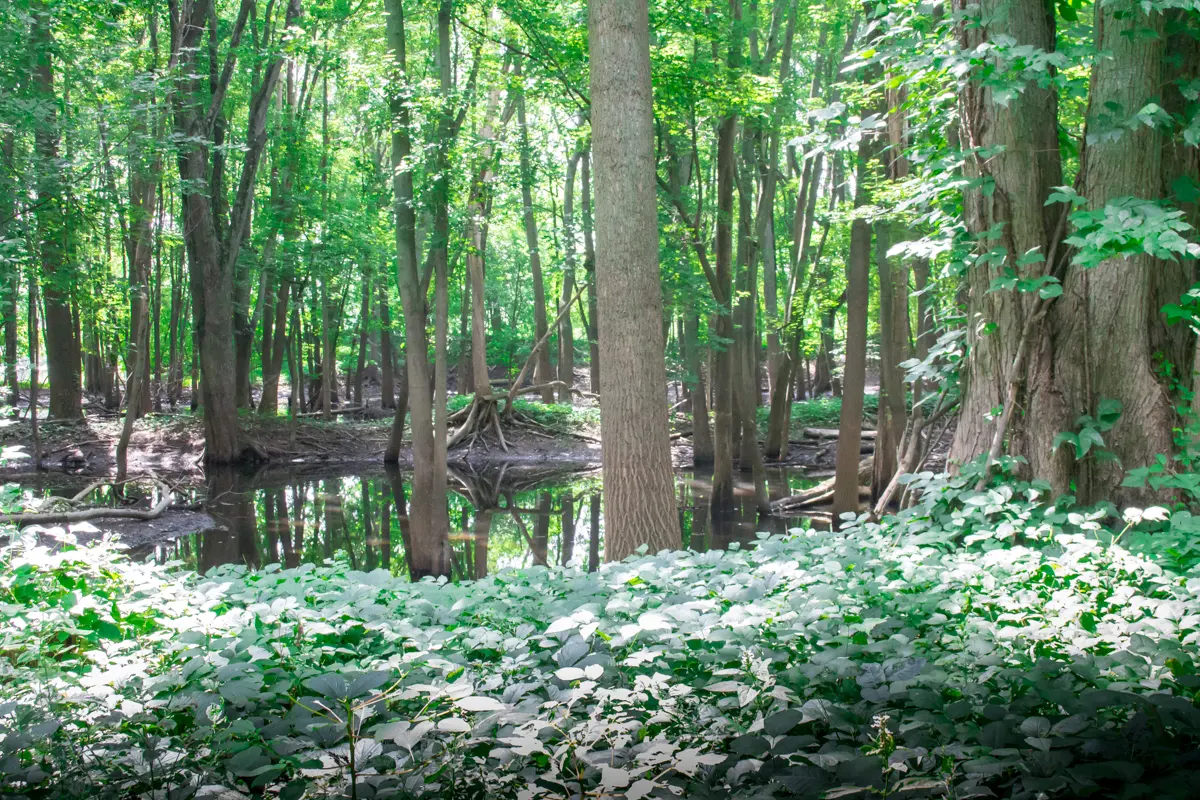
Visit essentials
A quick read before you go
- Duration
- A site visit, if access is available, takes 30 minutes to an hour.
- Etiquette
- The Norton Mounds are sacred burial sites.
Overview
During the Middle Woodland Period, roughly 450 BCE to 450 CE, the Hopewell built burial mounds, developed sophisticated art, and maintained a cultural and trade network linking the Gulf of Mexico and Great Lakes, Atlantic coast and Rocky Mountains. Beside the Grand River in suburban Grand Rapids, Michigan, eleven Norton mounds survive from an original seventeen to forty; the largest is one hundred feet across and fifteen feet high. Their burials and grave goods reveal that continent-spanning world.
Excavations from W.L. Coffinberry in 1874 through Richard Flanders in 1964 documented Gulf shells, Rocky Mountain obsidian, Atlantic shark's teeth, northern Michigan Upper Peninsula copper, distinctive pottery, and the Norton-style projectile points named for this site. Michigan State University researchers consider these perhaps the best-preserved Hopewell mounds in North America. Indigenous activist Debra Muller and others helped protect them from development, including rerouting Interstate 196 in the 1960s.
For the Anishinaabek Council of Three Fires—the Chippewa (Ojibwe), Odawa, and Potawatomi—the Hopewell are ancestors and the mounds are sacred family burial grounds. They are archaeological evidence and ancestral heritage deserving protection and respect: family history written in earth.
Why this place is sacred
Stand near a mound at Norton and consider what lies beneath. Human remains, laid to rest over 1,500 years ago. Grave goods placed with care: pottery, tools, ornaments. Objects that traveled hundreds or thousands of miles to reach this place. These are not anonymous remains but specific people, honored by their communities with elaborate burial practices.
The mounds themselves required enormous effort to construct. Earth was carried basket by basket, shaped and layered according to specific protocols. Subfloor tombs and crypts were built before the mound fill covered them. This was not casual disposal of the dead but deliberate, ceremonial interment. The labor involved suggests that those buried here were important, their burial a community event.
The trade goods amplify this significance. Not everyone was buried with Gulf shells, Rocky Mountain obsidian, Atlantic shark's teeth. These exotic materials marked status, connection, perhaps religious or political authority. The trade networks that brought them required organization, negotiation, transport over distances that modern Americans struggle to comprehend without highways.
For the Anishinaabek who recognize the Hopewell as ancestors, the mounds hold living significance. These are family burial grounds, places where the bones of those who came before rest in earth shaped by their communities. The relationship is not merely historical but ongoing. Ancestors matter. Their resting places deserve protection.
The thinness at Norton is the thinness of burial grounds: the veil between the living and the dead, between present and deep past, between modern understanding and traditional relationship. The ancestors are not gone. They are here, in these mounds, waiting for those who remember them.
The Norton Mounds served as burial grounds for the Hopewell peoples during the Middle Woodland Period. The construction methods, including layered earthworks with subfloor tombs, indicate sophisticated ceremonial practices. Burials included grave goods suggesting status differentiation: some individuals were interred with exotic trade items, others with local materials.
Beyond burial, the mound complex likely served as a gathering place for the broader community. Construction of the mounds required coordinated labor, bringing people together for shared purpose. The site's location near the Grand River provided access via the water routes that connected Hopewell communities across the region.
The Hopewell cultural tradition declined around 400-500 CE for reasons that remain debated. Climate change, social reorganization, the arrival of new ideas or peoples: scholars propose various explanations. What is certain is that mound building at Norton ceased, and the site was eventually abandoned.
The centuries between Hopewell abandonment and European arrival remain poorly documented. The Anishinaabek who came to dominate the region recognized the mounds as ancestral, but the specific chain of cultural transmission is not fully understood.
European arrival brought new threats. Agriculture, development, and construction destroyed mounds across the region. Wisconsin, which once contained perhaps 20,000 effigy mounds, retains about 4,000. The Norton Mounds survived in part through luck, in part through advocacy.
The 1960s brought the greatest threat: Interstate 196 was originally planned to pass directly through the site. Preservation efforts, including work by Indigenous activist Debra Muller, succeeded in rerouting the highway. The 1965 National Historic Landmark designation provided additional protection.
Today, the Grand Rapids Public Museum manages the site and houses artifacts from the excavations. The relationship between the museum and affiliated tribes continues to evolve, with NAGPRA (Native American Graves Protection and Repatriation Act) shaping discussions about appropriate stewardship of ancestral remains and grave goods.
Experience and orientation
The Norton Mound Group sits in an unexpected location: a suburb of Grand Rapids, Michigan, near Indian Mounds Drive and Interstate 196. The highway that once threatened to destroy the site now passes nearby, a reminder of how close the mounds came to obliteration.
The setting is not dramatic. This is not a remote wilderness but an area of suburban development, the mounds preserved as a pocket of protected landscape amid contemporary Michigan. The contrast can be jarring: ancient burial grounds beside modern infrastructure.
Approach with awareness that access may be limited. The site is managed by the Grand Rapids Public Museum, and public access conditions vary. Check current information before visiting. The mounds are not always open for casual visitation.
If access is available, walk the grounds slowly. The mounds are not massive monuments like those at Cahokia. The largest reaches fifteen feet in height and one hundred feet in diameter, but most are smaller. Under tree cover, they can blend into the landscape. You must learn to see them.
Consider what is beneath. These are burial mounds. Human remains rest in the earth you walk near. The grave goods, now housed in the Grand Rapids Public Museum, speak to continent-spanning connections. Shells traveled from the Gulf of Mexico. Obsidian came from the Rocky Mountains. Shark's teeth from the Atlantic. Copper from northern Michigan. Each object represents relationships, trade, connection.
The museum experience complements the site visit. Artifacts from the Norton Mounds excavations are displayed and interpreted. The context that the grounds cannot provide, the museum does: chronology, culture, significance. The museum also provides information about current site access and conditions.
The Norton Mound Group occupies a 55-acre National Historic Landmark site in Wyoming, Michigan, a suburb of Grand Rapids. The mounds are located near Indian Mounds Drive and Interstate 196. The Grand River flows nearby, its presence essential to understanding why the Hopewell built here.
Eleven mounds survive from an original count of seventeen to forty. The mounds range in size from 30 feet in diameter and 1.5 feet high to 100 feet in diameter and 15 feet high. Construction involved layered earthworks: subfloor tombs, raised areas, and mound fill caps.
The Grand Rapids Public Museum manages the site and houses artifacts from excavations. The museum is located in downtown Grand Rapids, separate from the mound site itself.
Context and lineage
The Hopewell peoples built the Norton Mounds as part of a broader cultural tradition that flourished across eastern North America for nearly a thousand years. The Middle Woodland Period, from roughly 450 BCE to 450 CE, saw the development of elaborate burial practices, distinctive art styles, and trade networks spanning the continent.
Why the Hopewell built mounds in this location beside the Grand River remains a matter of interpretation. Access to water routes, proximity to resources, and spiritual significance all likely played roles. The river connected Norton to other Hopewell communities, facilitating the trade that brought exotic materials from across North America.
The construction of each mound was itself a significant undertaking. Workers shaped the earth into specific forms, built subfloor tombs and crypts, and deposited mound fill to cover the burials. The labor required suggests community coordination and shared purpose. Building the mounds was likely ceremonial as well as practical.
The Norton Mounds belong to the Hopewell cultural tradition, named for earthworks in Ross County, Ohio, where the culture was first identified. Hopewell is not a tribe but a cultural complex, a set of shared practices and trade connections that linked communities across eastern North America.
The Hopewell succeeded the earlier Adena culture and preceded the Mississippian culture that would build Cahokia. The Norton site represents the Hopewell at its height in the Great Lakes region, with artifacts indicating participation in continent-wide exchange networks.
For the Anishinaabek, the lineage is more direct. The Chippewa (Ojibwe), Odawa, and Potawatomi recognize the Hopewell as ancestors. The specific chain of cultural transmission across 1,500 years is not fully documented, but the relationship is acknowledged. These are family burial grounds.
The site is the type location for Norton-style projectile points and Norton-phase pottery, meaning that artifacts from this site define the categories used to classify similar finds elsewhere.
W.L. Coffinberry
First archaeological excavator
Richard E. Flanders
Archaeologist
Debra Muller
Indigenous activist
Traditions and practice
Hopewell burial practices at Norton were elaborate and multi-stage. Bodies were prepared and placed in subfloor tombs or crypts, often with grave goods indicating status and connection. Earth was then deposited to create the mound itself, covering the burial and marking the location.
The grave goods reveal the range of Hopewell practice. Pottery, including the distinctive Norton-style vessels. Tools and weapons, including the Norton projectile points that give the site its name. Exotic materials from across the continent: shells, obsidian, shark's teeth, copper. The inclusion of these items suggests rituals of offering and the importance of maintaining connections even in death.
Construction of the mounds required coordinated labor, likely with ceremonial observance. The shaping of earth into specific forms, the creation of internal structures, the placement of burials: all suggest protocols that guided the process. Mound building was religious practice as well as construction.
No traditional practices are currently conducted at the Norton Mounds, in the sense that the Hopewell burial tradition ceased over 1,500 years ago. However, the site retains significance for the Anishinaabek who recognize the Hopewell as ancestors.
The Grand Rapids Public Museum manages the site and houses artifacts from the excavations. The museum works with affiliated tribes on questions of access, interpretation, and appropriate treatment of ancestral remains and grave goods.
Cultural landscape management planning addresses the site's physical preservation. Ongoing threats include erosion, flooding, and nearby development. The 55-acre National Historic Landmark requires ongoing attention to maintain its integrity.
For visitors who have access to the site, the appropriate practice is quiet contemplation. These are burial grounds. Human remains rest in the earth you walk near. Approach with the reverence you would bring to any cemetery.
Learn about the Hopewell before visiting. Understanding that the grave goods represent continent-spanning connections transforms the experience. These were not isolated people but participants in a vast network of trade, culture, and relationship.
Consider visiting the Grand Rapids Public Museum to see artifacts from the site. The museum provides context that the grounds cannot: chronology, cultural interpretation, the full range of materials recovered. The combination of site visit and museum visit offers the most complete experience.
Hopewell Culture
HistoricalThe Hopewell cultural tradition flourished from approximately 450 BCE to 450 CE across eastern North America. The Norton Mounds represent one of the finest surviving examples of Hopewell burial practice in the Great Lakes region. Grave goods from across the continent document participation in vast trade networks.
Burial mound construction with layered earthworks. Mortuary rituals with grave goods including pottery, tools, jewelry, and trade items. Creation of distinctive Norton-style projectile points and pottery. Participation in continent-spanning trade networks.
Anishinaabek Ancestral Connection
ActiveThe Anishinaabek, the Council of Three Fires comprising the Chippewa (Ojibwe), Odawa, and Potawatomi peoples, recognize the Hopewell as ancestors. The Norton Mounds represent ancestral heritage, sacred burial grounds deserving of protection and respect.
Recognition of ancestral heritage. Advocacy for preservation and respect. Engagement with institutions managing the site. The specific traditional practices of contemporary tribal members at the site are not publicly documented.
Perspectives and open questions
The Norton Mounds are understood through archaeological and Indigenous frameworks. Archaeologically, they represent one of the best-preserved Hopewell sites in North America. For the Anishinaabek, they are ancestral burial grounds. These perspectives complement rather than contradict each other.
Scholarly perspective
Archaeological research has established the Norton Mounds as a significant Hopewell site, perhaps the best-preserved in North America according to Michigan State University researchers. The site is the type location for Norton-style projectile points and Norton-phase pottery.
Excavations from 1874 to 1964 documented construction methods, burial practices, and trade connections. Grave goods from across North America demonstrate the Hopewell's participation in continent-wide exchange networks. The presence of Gulf shells, Rocky Mountain obsidian, Atlantic shark's teeth, and Upper Peninsula copper at a site in western Michigan challenges assumptions about pre-Columbian isolation.
The National Historic Landmark designation (1965) recognizes the site's archaeological significance. Research continues through the Grand Rapids Public Museum's curation of excavated materials.
Living and traditional perspectives
The Anishinaabek, the Council of Three Fires comprising the Chippewa (Ojibwe), Odawa, and Potawatomi peoples, recognize the Hopewell as ancestors. The Norton Mounds are not merely archaeological sites but family burial grounds, places where the bones of those who came before rest in shaped earth.
This perspective does not contradict archaeological understanding but adds a dimension that archaeology cannot fully address. The question of what the mounds mean to those who descend from their builders is distinct from questions of construction date or artifact type. Both perspectives are valid.
Indigenous activist Debra Muller, among others, has worked to protect the mounds and ensure that tribal perspectives inform site management.
Alternative interpretations
No significant alternative or esoteric interpretations attach to the Norton Mounds. The site is understood straightforwardly through archaeological and Indigenous frameworks.
Open questions
Significant mysteries remain about the Norton Mounds and Hopewell culture generally. The specific ceremonial practices conducted at the site are unknown. The social and political organization that enabled continent-spanning trade is not fully understood. The reasons for Hopewell cultural decline around 400-500 CE remain debated.
The full count of original mounds at Norton is uncertain, with estimates ranging from seventeen to forty. What was lost before archaeological attention arrived cannot be recovered.
The specific chain of cultural transmission from the Hopewell to the modern Anishinaabek is not fully documented. That a relationship exists is acknowledged; its exact nature remains a matter of traditional knowledge and ongoing research.
Plan your visit
Access and arrival
Hotels in Grand Rapids provide lodging options. The city offers full tourist infrastructure.
Respectful visit
Appropriate outdoor clothing for Michigan weather. The site is outdoors with uneven terrain. Good walking shoes are recommended.
Check current policies with the Grand Rapids Public Museum. If photography is permitted, use respectfully. Consider whether photographing burial mounds is appropriate given their sacred nature.
Not applicable for general visitors. If you are a member of an affiliated tribe with traditional relationship to the site, consult with tribal elders about appropriate practices.
{"Check access conditions with Grand Rapids Public Museum before visiting","Stay on designated paths","Do not walk on, climb on, or disturb the mounds","Do not dig, probe, or excavate","Do not remove any objects from the site","Respect the site as sacred burial ground"}
Access to the Norton Mounds may be limited. Check current conditions with the Grand Rapids Public Museum before visiting.
These are sacred burial grounds. Do not attempt to dig, probe, or disturb the mounds in any way. Do not remove any objects from the site. Federal law protects the site, and ethical conduct demands respect for ancestral remains.
The history of archaeology at Indigenous burial sites is troubled. Early excavations often proceeded without tribal consultation, and removed remains and grave goods are subject to NAGPRA repatriation claims. Visitors should understand that their presence at such sites is not neutral but occurs within this context.
Location
Map loads as you approach this section.
Pilgrim reflections
A portrait of encounter, not a score
Pilgrims describe what they felt, how present they could become, and whether the place would shape a journey. There are no stars and no ranking of traditions.
No reviewed reflections yet
The first pilgrims can help describe the character of being here.
Share a reflection
Available after an account-backed “Been there.” Every reflection is reviewed before publication.
Nearby sacred places
Explore other sacred places in the region. Proximity does not establish access or travel time; check each place’s guidance.



References
Sources consulted for this page. Source categories describe the publication, not a guarantee that every claim is verified. Traditional accounts and outside interpretations may differ.
- 01Norton Mound Group — Michigan State Historic Preservation OfficeofficialState historic preservation documentation
- 02Norton Mound group — WikipediaencyclopediaGeneral reference
- 03Recovering the Indigenous Roots of Michigan's Norton Mounds — Belt MagazinenewsIn-depth cultural reporting
- 04Mounds of Evidence — Grand Rapids MagazinenewsLocal coverage
Share a photo
Help visitors recognize Norton Mound Group. Every submission is reviewed before publication.