National Shrine of the Cross in the Woods, Indian River, Michigan
The world's largest crucifix carved from a single tree, rising from the northern Michigan woods
Understand sacred places, explore living traditions, and learn how to engage respectfully with Pilgrim Map.
Access has not been verified. Check current local guidance before planning a visit.
Indian River, Michigan, United States
Read the sources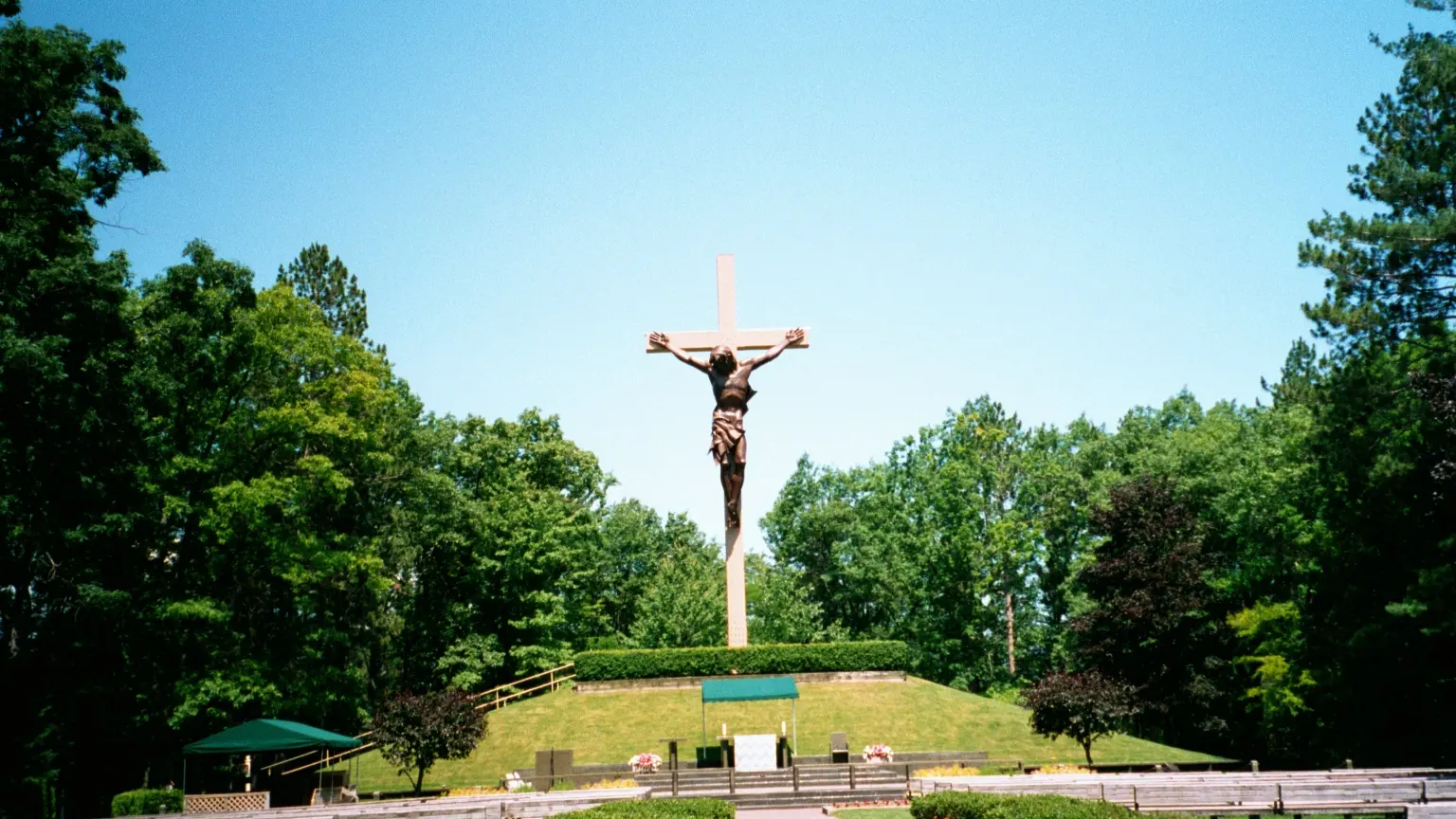
Image of National Shrine of the Cross in the Woods, Indian River, Michigan. Image source · CC-BY-SA-4.0
Visit essentials
A quick read before you go
- Duration
- Thirty minutes allows seeing the crucifix.
- Etiquette
- Standard Catholic church etiquette applies at Cross in the Woods.
Overview
Cross in the Woods exists because of scale. Its 55-foot-tall, 22-foot-wide cross was carved from a single redwood; Marshall Fredericks's Christ, cast in Oslo, Norway, stands 28 feet tall and weighs seven tons, among the largest bronze castings ever shipped across the Atlantic. The Crucifixion is Christianity's central event, familiar to billions through countless media, yet here its size makes the familiar newly strange and powerful: the death Christians believe redeemed the world becomes too large to ignore.
Bishop Francis Haas of Grand Rapids began seeking land in 1946 for Indian River Catholics traveling great distances to Mass. The parish became a pilgrimage destination after the crucifix's dedication on August 16, 1959. Fredericks, among the twentieth century's most celebrated American artists, also created the Spirit of Detroit, Cleveland War Memorial, and other public monuments. He spent four years combining anatomical precision with spiritual expression in this figure. In 2006 the U.S.
Conference of Catholic Bishops designated the site a national shrine—one of two in Michigan and approximately 120 nationwide. Its 275,000–325,000 annual visitors make it one of the Midwest's most visited religious sites. The grounds extend the story through the Resurrected Christ; travelers' protector Our Lady of the Highway; St.
Peregrine's intercession for cancer; Blessed Kateri Tekakwitha and Indigenous Christianity; a museum of over 500 dolls preserving women's religious life; and Alden Dow's original church, where the Frank Lloyd Wright student's modernism serves sacred purpose.
Why this place is sacred
Walk the path toward the crucifix for the first time and watch it grow. The approach is designed to build toward revelation. The cross emerges through the trees, its scale becoming apparent gradually, then suddenly, as you enter the clearing where it stands.
The figure of Christ hangs at a height that requires you to look up, to crane your neck, to take in what you are seeing. The arms spread wide. The head inclines. The body shows the marks of suffering. Marshall Fredericks sculpted with anatomical precision while conveying something beyond anatomy: the moment of death that Christians believe changed everything.
The scale is the message. The crucifixion story is so familiar that it can slide past without impact. Two thousand years of representation have made the cross a symbol, an icon, a piece of jewelry. Cross in the Woods reclaims the story from familiarity by presenting it at a size that refuses to be ignored. You cannot glance at a 55-foot crucifix and move on. The monument demands attention.
The bronze corpus weighs seven tons. Fredericks worked on it for four years. It was cast at a foundry in Oslo, Norway, and shipped across the Atlantic in pieces for assembly on site. The logistics alone suggest something significant: someone thought this worth the effort, worth the expense, worth the years of labor. The investment of care is part of the message.
The woodland setting amplifies the effect. Northern Michigan's forests are not merely backdrop but participant in the experience. The quiet, the green, the sense of being away from ordinary life: all contribute to the contemplative atmosphere. The crucifix rises from this natural setting as if it belongs there, as if Christ died not in Jerusalem but here, in these woods, for you.
Visitors of various faiths report being moved by Cross in the Woods. The power of the monument does not depend on prior belief, though believers may find their faith confirmed. Something about the scale, the artistry, the setting, the accumulated weight of millions of previous visitors creates an atmosphere that transcends ordinary experience.
Bishop Francis Haas sought land for a church to serve Catholics in the Indian River area, who were traveling great distances for Mass. The shrine began as a practical pastoral solution. The vision expanded to include the monumental crucifix, which would make Indian River a destination rather than just a parish. The purpose was to create a place where the sacrifice of Christ could be contemplated in an environment conducive to prayer.
The shrine has grown since the original crucifix was dedicated in 1959. Additional sculptures have been added: the Resurrected Christ, Our Lady of the Highway, St. Peregrine, St. Francis, Blessed Kateri Tekakwitha, the Holy Family. Each addition expands the devotional possibilities while maintaining the crucifix as the central focus.
The nun doll museum, with over 500 dolls representing women's religious orders in traditional attire, was added to preserve memory of a form of religious life that has changed dramatically since Vatican II. The dolls are not whimsy but documentation of a world that existed within living memory.
The national shrine designation in 2006 represented formal recognition of what millions of visitors already knew: this was a site of more than local significance. The designation brought additional attention and resources for maintenance and expansion.
The shrine continues to evolve. Facilities have been improved. Programming has expanded. The basic purpose remains what it was in 1959: to offer encounter with the crucified Christ at a scale that makes the encounter memorable.
Experience and orientation
The grounds are open 365 days a year during daylight hours. This availability is itself a statement: the cross is always there, always waiting, always offering its message to whoever comes.
Most visitors begin at the crucifix itself. The path leads through the woods toward the clearing where the cross stands. The approach builds anticipation. The first full view of the monument typically stops visitors in their tracks. The scale exceeds expectation.
Spend time with the crucifix before moving on. The figure rewards extended looking. Notice the position of the arms, the inclination of the head, the expression on the face. Fredericks sculpted not just a body but a moment: the moment of death, the completion of sacrifice. The bronze has acquired patina over the decades, adding to its gravity.
The grounds invite walking meditation. From the crucifix, paths lead to other devotional sites. The Resurrected Christ shows the end of the story: Christ triumphant, death overcome. Our Lady of the Highway offers protection to travelers. St. Peregrine, patron of cancer patients, invites the prayers of those facing illness. Blessed Kateri Tekakwitha, the first Native American saint, honors Indigenous Christianity. St. Francis represents the contemplative tradition.
The nun doll museum, housed in its own building, offers a different kind of experience. Over 500 dolls represent women's religious orders in their traditional habits, each identified by order and date. The museum preserves memory of a form of religious life that has largely disappeared since Vatican II. For those who remember sisters in habits, the museum evokes nostalgia. For those who do not, it documents a vanished world.
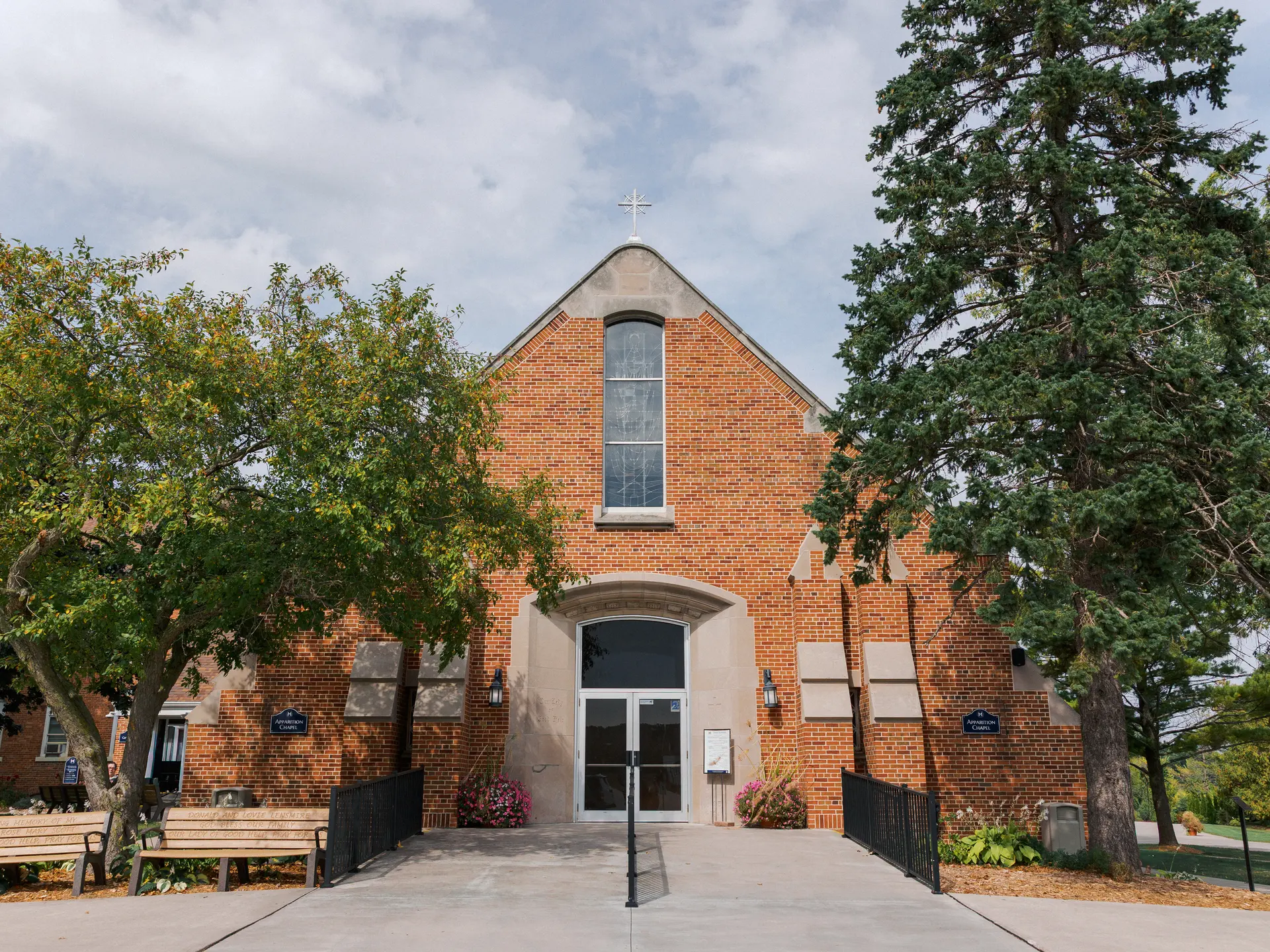
The church, designed by Alden Dow, a student of Frank Lloyd Wright, integrates modernist architecture with sacred purpose. Daily Mass is offered here. The Blessed Sacrament is present for adoration. Those who wish to receive the sacraments, to confess and receive communion, can do so within yards of the monumental crucifix.
The gift shop offers religious items and souvenirs. The facilities include restrooms and picnic areas. The grounds accommodate families and groups as well as individual pilgrims.
Cross in the Woods occupies a wooded site in Indian River, Michigan, in the northern Lower Peninsula. The shrine is located off Interstate 75, making it accessible to travelers passing through the region. The setting is rural, surrounded by the forests that give the shrine its name.
The main approach leads to parking areas near the crucifix. From parking, paths lead to the cross, the church, and other devotional sites. The grounds are designed for walking, with paved paths connecting major features.
Indian River itself is a small town oriented toward tourism and outdoor recreation. The shrine is the town's major attraction but exists within a broader recreational context.
Context and lineage
The story begins with a pastoral need. Catholics in the Indian River area of northern Michigan had to travel long distances to attend Mass. In 1946, Bishop Francis Haas of Grand Rapids searched for land to establish a new parish church. He found a site in the woods near Indian River.
The vision expanded beyond a parish. Bishop Haas imagined a crucifix that would draw pilgrims from beyond the local area, a monument to Christ's sacrifice that would serve the entire region. He commissioned a cross carved from a single redwood tree and engaged Marshall Fredericks, already a sculptor of national reputation, to create the bronze corpus.
Fredericks worked on the figure for four years. The casting was done at Kristians-Kunst Metalstobori Foundry in Oslo, Norway, requiring transport of the massive bronze sections across the Atlantic. The cross was raised into place on August 9, 1959, and formally dedicated a week later.
What began as a solution to a pastoral problem became one of the most visited religious sites in the Midwest. Bishop Haas's vision created a destination that has drawn millions of pilgrims over more than six decades.
Cross in the Woods belongs to the Catholic tradition of pilgrimage sites centered on devotional images or relics. The monumental crucifix follows centuries of Christian practice in creating sacred art that invites contemplation and prayer.
The national shrine designation places Cross in the Woods within a network of approximately 120 American sites recognized by the U.S. Conference of Catholic Bishops for their spiritual significance. It is one of two national shrines in Michigan, the other being the National Shrine of the Little Flower in Royal Oak.
Marshall Fredericks's sculptural legacy extends far beyond this site, but Cross in the Woods represents his most significant engagement with religious subject matter. The corpus of Christ stands as one of the major works of American religious art of the twentieth century.
Bishop Francis J. Haas
Founder
Marshall Fredericks
Sculptor
Alden Dow
Architect
Traditions and practice
Catholic devotional practice centers the experience at Cross in the Woods. The crucifix invites meditation on Christ's passion and death. The Stations of the Cross, available on the grounds, offer structured reflection on the events of Good Friday. The rosary can be prayed while walking the paths. Traditional Catholic spirituality finds full expression in this setting.
The sacraments are available. Daily Mass is celebrated in the church. Confession is offered. Those who wish to receive communion can do so. The presence of the Blessed Sacrament in the church allows for adoration. The shrine functions not just as a destination but as a parish with full sacramental life.
Pilgrimage remains the primary practice at Cross in the Woods. The journey to the shrine, often part of a longer trip through northern Michigan, creates the conditions for encounter. Arrival at the crucifix represents culmination of the pilgrimage.
Meditation before the crucifix is the most common visitor practice. People sit, stand, or kneel in the clearing, looking up at the figure of Christ. The scale of the monument creates the conditions for contemplation that smaller images cannot achieve.
Candle lighting is available as a devotional practice. Prayer intentions can be left. The gift shop offers religious items that serve as reminders of the visit.
The nun doll museum attracts visitors interested in the history of women's religious life. The dolls preserve memory of orders and habits that have largely disappeared, connecting contemporary Catholics to earlier generations of religious.
For Catholic visitors, attending Mass at the shrine integrates liturgical and devotional experience. Receiving communion in the shadow of the monumental crucifix connects sacrament and symbol. Confession before or after the visit deepens the encounter.
For visitors of other faiths or no faith, the crucifix remains powerful as art and as human achievement. The investment of care, the years of labor, the transport of bronze across an ocean: all speak to the seriousness with which the shrine's creators approached their task. One need not believe to be moved.
Take time. The shrine is not a museum to be surveyed but a place to be inhabited. Sit before the crucifix until the scale becomes normal, then notice what remains when scale is normalized. Walk the grounds slowly, pausing at each devotional site. Let the woods contribute their silence.
Consider visiting in different seasons or different light conditions. The crucifix appears differently at dawn and dusk, in summer and winter. Repeat visits reveal what single visits cannot.
Catholic Devotion to the Crucifixion
ActiveThe crucifix invites meditation on the central event of Christian faith: Christ's death on the cross for the redemption of humanity. At Cross in the Woods, this meditation is enabled by scale that exceeds normal comprehension, making the familiar story newly powerful.
Meditation before the crucifix. Stations of the Cross. Rosary. Attendance at Mass. Confession and communion. Candle lighting. Prayer intentions.
American Catholic Pilgrimage
ActiveCross in the Woods functions as a pilgrimage destination within American Catholicism. The national shrine designation recognizes this role. The journey to the shrine, the encounter with the crucifix, and the return home follow the classic pilgrimage pattern of departure, arrival, and integration.
Pilgrimage visits from across the region and country. Group pilgrimages organized by parishes and Catholic organizations. Individual pilgrimages as part of spiritual practice or during life transitions.
Perspectives and open questions
Cross in the Woods is understood primarily through Catholic devotional and artistic frameworks. The monumental crucifix represents both religious expression and significant achievement in American sculpture. Marshall Fredericks's work stands as one of the major pieces of twentieth-century American religious art.
Scholarly perspective
Art historians recognize Marshall Fredericks as one of the most significant American sculptors of the twentieth century. His works are found in public spaces across the United States and internationally. The corpus of Christ at Cross in the Woods represents his most substantial engagement with religious subject matter.
The sculpture demonstrates Fredericks's characteristic combination of anatomical precision and emotional expression. The scale demanded technical solutions that pushed the limits of bronze casting. The work's survival and continued impact confirm its significance.
Architectural interest attaches to the original church designed by Alden Dow, a student of Frank Lloyd Wright. The building integrates modernist principles with sacred function.
Living and traditional perspectives
For the Catholic Church, Cross in the Woods is a national shrine, one of approximately 120 in the United States recognized by the U.S. Conference of Catholic Bishops. The designation acknowledges the site's spiritual significance and drawing power.
The devotional tradition that Cross in the Woods serves is meditation on Christ's passion and death. The crucifix, in Catholic understanding, is not merely reminder but invitation: invitation to contemplate what Christ suffered, invitation to thanksgiving for the redemption that suffering achieved, invitation to unite one's own sufferings with Christ's.
The inclusion of Blessed Kateri Tekakwitha among the site's sculptures connects the shrine to Indigenous Christianity and to the ongoing process of recognizing saints from diverse backgrounds.
Alternative interpretations
No significant alternative or esoteric interpretations attach to Cross in the Woods. The site is understood straightforwardly through Catholic devotional and artistic frameworks.
Open questions
The shrine's significance is well documented. Questions that remain are personal rather than historical: what does encounter with the crucified Christ at this scale mean for each visitor?
Plan your visit
Access and arrival
Hotels, motels, and lodges are available in Indian River and surrounding communities. The area caters to tourists and outdoor recreationists.
Respectful visit
Modest attire appropriate for a place of worship. Avoid shorts, tank tops, revealing clothing, or anything with offensive imagery. The grounds are outdoors, so comfortable walking shoes are appropriate, but overall presentation should be suitable for church.
Photography is permitted on the grounds. Use respectfully. No photography during Mass in the church. Consider whether your photographs honor the subject or trivialize it.
Candle lighting, prayer intentions, and donations are welcomed. The shrine depends on visitor generosity for its maintenance and operation.
{"Modest attire required","Quiet, respectful behavior throughout","No photography during Mass","Respect those at prayer","Supervise children"}
Cross in the Woods is a Catholic shrine. The imagery, the devotions, and the practices are specifically Catholic. Visitors of other faiths are welcomed but should understand that they are guests in a Catholic space.
The site is not primarily historical or artistic, though it has historical and artistic dimensions. It is primarily religious. Those who approach it only as art or history may miss what it offers. Those who approach it as sacred space, whatever their personal beliefs, may find something worth encountering.
Current practical details
Address
7078 M-68, Indian River, MI 49749, USA
Phone
Hours
Hours, fees, and access can change — verify on the official source before you travel. Practical details last checked Jun 2026.
Location
Map loads as you approach this section.
Pilgrim reflections
A portrait of encounter, not a score
Pilgrims describe what they felt, how present they could become, and whether the place would shape a journey. There are no stars and no ranking of traditions.
No reviewed reflections yet
The first pilgrims can help describe the character of being here.
Share a reflection
Available after an account-backed “Been there.” Every reflection is reviewed before publication.
Nearby sacred places
Explore other sacred places in the region. Proximity does not establish access or travel time; check each place’s guidance.

References
Sources consulted for this page. Source categories describe the publication, not a guarantee that every claim is verified. Traditional accounts and outside interpretations may differ.
- 01Cross in the Woods Catholic Shrine of Indian River — Cross in the WoodsSource contextOfficial shrine website
- 02Cross in the Woods — WikipediaencyclopediaGeneral reference
- 03The Cross in the Woods Shrine — Atlas ObscuraguideCultural tourism coverage
Share a photo
Help visitors recognize National Shrine of the Cross in the Woods, Indian River, Michigan. Every submission is reviewed before publication.