Nasca - El Araña
Part ofLíneas de Nazca
Forty-seven metres of anatomical precision — one of the first geoglyphs ever observed from the air
Understand sacred places, explore living traditions, and learn how to engage respectfully with Pilgrim Map.
Access has not been verified. Check current local guidance before planning a visit.
Nazca, Ica, Peru
Read the sources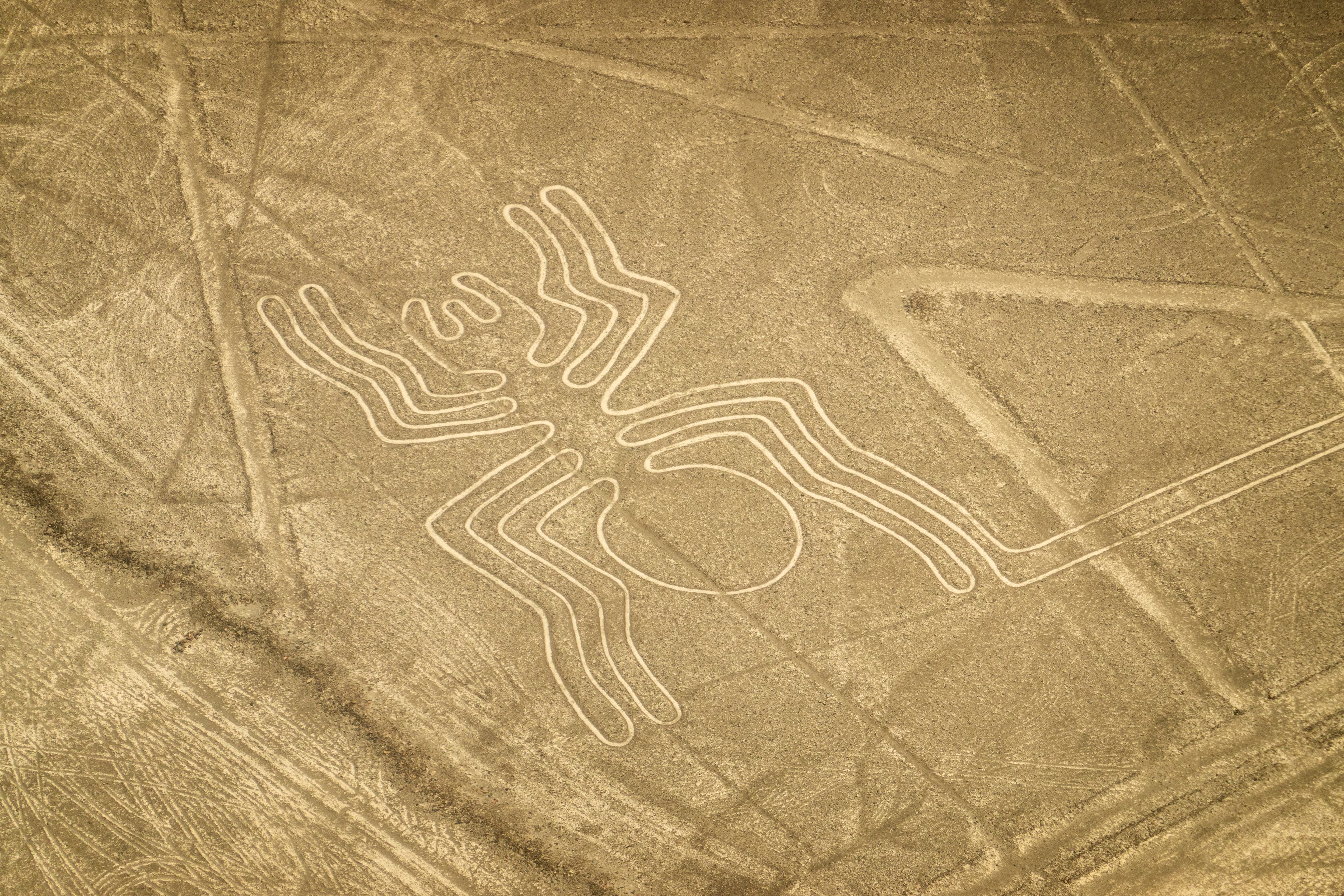
Image of Nasca - El Araña. Image source · CC-BY-SA-4.0
Visit essentials
A quick read before you go
- Duration
- Part of 30-35 minute flight.
- Access
- Nazca airport.
Overview
The Spider geoglyph measures forty-seven metres in length and is rendered with remarkable anatomical detail. It was one of the first geoglyphs observed by Paul Kosok during his pioneering aerial studies. The spider's legs and body are drawn with a clarity that has led some researchers to identify it as a specific genus — possibly Ricinulei, a rare arachnid found only in the Amazon.
Spiders in Andean cosmology are associated with rain, fertility, and the weaving of time. The possible identification as a Ricinulei — a creature from the distant Amazon jungle — suggests connections between the coastal Nazca people and the rainforest interior, possibly through trade routes or shared cosmological traditions. The spider's web-like qualities also resonate with the lines themselves, which weave across the desert like threads on a loom.
Why this place is sacred
A spider drawn in a desert — a creature of patience rendered in a landscape that demanded patience of everyone who lived there. The Nazca spider sits alone on its patch of cleared ground, its legs extended in every direction like the lines that radiate across the pampa. There is something of the web in the Nazca Lines themselves: a network of connections, invisible until the light catches them at the right angle.
Created as part of Nazca sacred landscape connected to water worship and fertility.
Created between 500 BC and 500 AD. One of the first geoglyphs identified during Kosok's aerial surveys. Now part of the UNESCO World Heritage Site.
Experience and orientation
The Spider is typically visible during scenic flights, its compact form and extended legs making it one of the more immediately recognisable geoglyphs from the air. Its relatively small size compared to the Hummingbird or Condor gives it an intimacy that the larger figures lack. The detail is remarkable — individual leg segments are distinguishable, and the body is rendered with anatomical specificity that suggests close observation of the living creature.
The Spider rewards close attention to detail rather than awe at scale. Notice the segmentation of the legs, the proportions of the body. This is not a stylised symbol — it is a portrait of a specific creature, drawn by someone who had studied it closely.
Context and lineage
Part of Nazca water worship practices.
Created by Nazca and Paracas cultures.
Paul Kosok
First observed the Spider from the air (1940-41)
Maria Reiche
Conservator and researcher (1946-1998)
Traditions and practice
Ritual processions and offerings.
Conservation and academic research.
Attend to the detail rather than the scale.
Nazca culture religion
HistoricalSpiders associated with rain, fertility, and the weaving of time.
Ritual processions and offerings.
Archaeoastronomy
ActiveOngoing research.
Academic study.
Perspectives and open questions
The Spider invites contemplation about patience, precision, and the web of connections across landscapes.
Scholarly perspective
Part of water worship sacred landscape. Possible Amazon connection.
Living and traditional perspectives
No living Nazca tradition.
Alternative interpretations
Alternative theories reflect wonder.
Open questions
Species identification and cultural meaning debated.
Plan your visit
Access and arrival
Nazca airport.
Nazca town.
Respectful visit
Sun protection.
Permitted from aircraft.
Do not disturb surface.
Walking prohibited | No drones
Ground access prohibited.
Current practical details
Address
PE-1S, 11350, Peru
Hours
Hours, fees, and access can change — verify on the official source before you travel. Practical details last checked Jun 2026.
Location
Map loads as you approach this section.
Pilgrim reflections
A portrait of encounter, not a score
Pilgrims describe what they felt, how present they could become, and whether the place would shape a journey. There are no stars and no ranking of traditions.
No reviewed reflections yet
The first pilgrims can help describe the character of being here.
Share a reflection
Available after an account-backed “Been there.” Every reflection is reviewed before publication.
Nearby sacred places
Explore other sacred places in the region. Proximity does not establish access or travel time; check each place’s guidance.


References
Sources consulted for this page. Source categories describe the publication, not a guarantee that every claim is verified. Traditional accounts and outside interpretations may differ.
- 01UNESCO Nasca and Palpa — UNESCOofficialOfficial listing
- 02Nazca Lines | Britannica — BritannicaencyclopediaAuthoritative reference
- 03Nazca lines - Wikipedia — Wikipedia contributorsencyclopedia47m measurement
Share a photo
Help visitors recognize Nasca - El Araña. Every submission is reviewed before publication.