Líneas de Nazca
A desert transformed into sacred ground, where shallow marks in gravel have spoken to the sky for two thousand years
Understand sacred places, explore living traditions, and learn how to engage respectfully with Pilgrim Map.
Access has not been verified. Check current local guidance before planning a visit.
Nazca, Ica, Peru
Read the sources
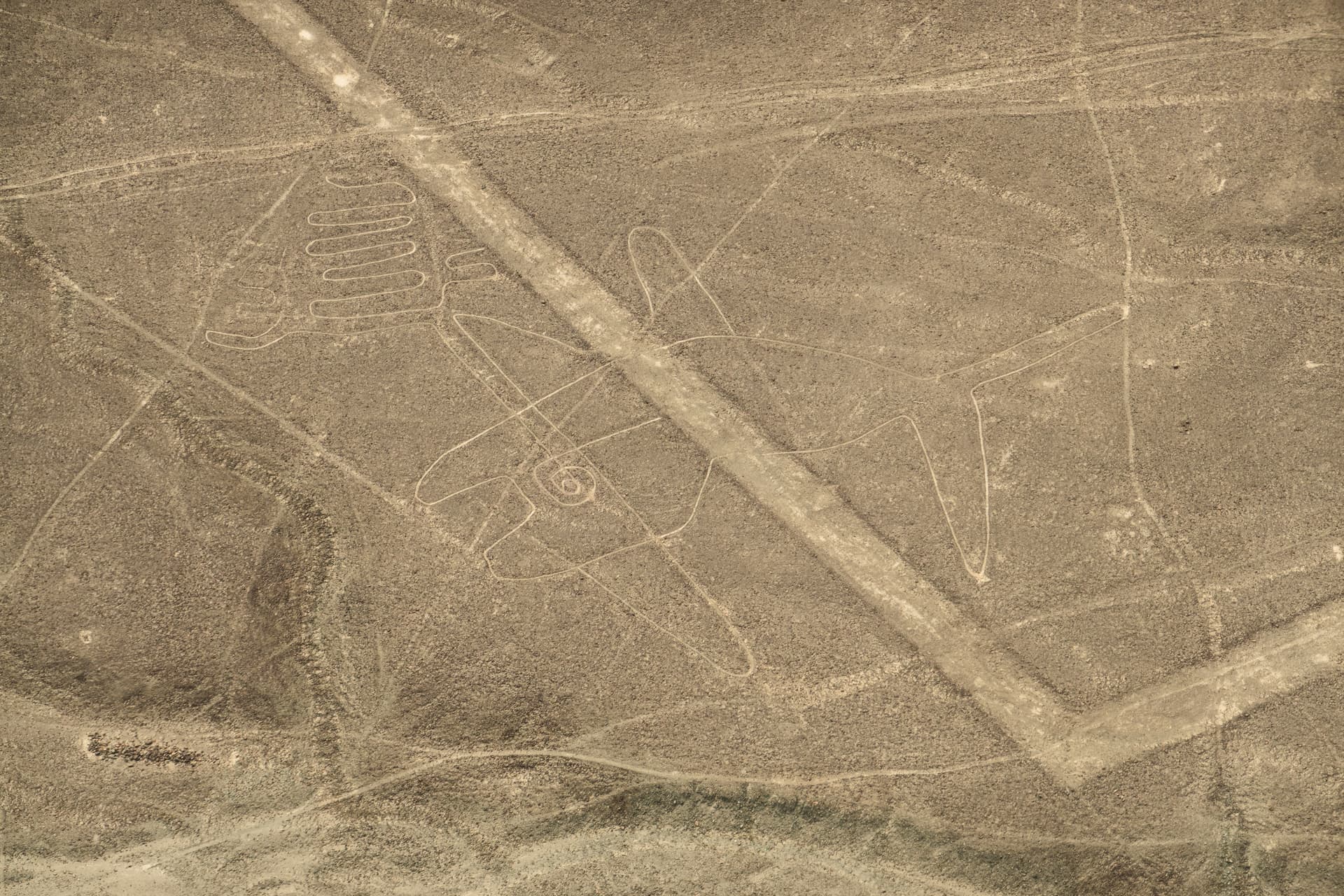
Image of Líneas de Nazca. Image source · CC-BY-SA-4.0
Visit essentials
A quick read before you go
- Duration
- Scenic flights last 30 to 35 minutes.
- Access
- Nazca is located on the Panamericana Sur, approximately 400 km south of Lima.
Overview
The Líneas de Nazca cross a high arid plateau between Nazca and Palpa in southern Peru, roughly four hundred kilometres south of Lima. Rather than raising conventional monuments, Nazca and Paracas peoples removed dark, iron-oxide-coated desert pebbles to expose lighter earth. Straight lines run for kilometres, trapezoids cross ridges, and figurative geoglyphs depict beings from coast, mountains, and jungle.
Famous figures include the hummingbird with its ninety-three-metre wingspan, the condor at one hundred and thirty-four metres, the spider, and the monkey with its spiralling tail, yet these are only a fraction. In 2024, a Yamagata University AI-assisted survey identified three hundred and three previously unknown figurative geoglyphs, nearly doubling the corpus and revealing far denser inscription than understood.
Over nearly a thousand years, an entire civilization wrote devotion into the ground in a language addressed not to other humans but to whatever looked down from above. The lines are thought to have been sacred processional paths for rituals of water, fertility, and mountain gods controlling rain in this parched landscape. Animal, plant, and human geoglyphs were offerings visible only to the sky. UNESCO inscribed them in 1994 as one of the ancient world's most remarkable achievements.
Places within this site
- Nasca - La BallenaPart of
- Nasca - El LoroPart of
- Nasca - La LagartijaPart of
- Nasca - El PerroPart of
- Nasca - El ManosPart of
- Nasca - El CaracolPart of
- Nasca - El ArañaPart of
- Nasca - El ColibríPart of
- Nasca - El AstronautaPart of
- Nasca - La FlorPart of
- Nasca - El GarzaPart of
- Nasca - El ÁrbolPart of
- Nasca - El MonoPart of
- Nasca - El PelícanoPart of
- Nasca - El CóndorPart of
Why this place is sacred
There is a particular quality to a place where the sacred was made by subtraction rather than addition. The Nazca people did not build upward. They removed a thin layer of dark pebbles to expose the lighter soil beneath. The gesture is almost impossibly delicate — ten centimetres of depth, stretching for kilometres. And yet the desert held it. The same aridity that made water worship necessary also preserved the evidence of that worship across two thousand years.
The thinness here is literal. The membrane between the dark surface and the light ground below is the entire medium. But it is also conceptual. The Nazca Lines exist at the threshold between human scale and a scale that exceeds human perception. You cannot see what you are walking on. The hummingbird is ninety-three metres long; to the person who made it, it was a path of cleared stones. Only from above does it resolve into a form.
This implies a cosmology in which the audience for human devotion was not human — in which the most important observer occupied the sky.
The lines converge on the horizon. They point toward mountains. They follow watercourses that are dry most of the year. The sacred geography they describe is one of longing — for water, for the attention of the gods, for the fertility that would sustain life in a landscape that offered almost nothing on its surface. The offering was the surface itself, rearranged.
The geoglyphs were created as part of a sacred landscape connected to water worship, agricultural fertility, and ritual procession. Johan Reinhard's widely accepted theory holds that the lines were sacred paths leading to places where mountain and water deities could be worshipped. The figurative designs may have served as offerings visible to those deities from above.
The lines were created over nearly a millennium, with the Paracas phase (400-200 BC) producing earlier designs and the Nazca phase (200 BC - 500 AD) adding the famous figurative geoglyphs. After the Nazca civilisation declined, the lines were largely forgotten until the twentieth century. Paul Kosok's aerial observations in 1940-41 brought them to international attention. Maria Reiche devoted her life from 1946 to 1998 to their study and preservation. UNESCO inscription in 1994 formalised their global significance.
The 2024 AI survey revealed the desert holds far more figures than previously known.
Experience and orientation
From the air, the desert opens slowly. The first thing visible from the small Cessna is geometry — long straight lines converging on points, trapezoids running along ridges, cleared areas that suggest gathering places. Then the figurative designs begin to appear, and the scale becomes disorienting. The hummingbird is larger than a football pitch. The pelican's zigzagging neck extends for nearly three hundred metres. The monkey's spiralling tail could contain a house within its coils.
The pilot banks and circles, and each geoglyph emerges from the landscape as though surfacing from water — unmistakable once seen, invisible the moment before.
The experience from the Mirador is different in kind. The metal observation tower stands beside the Panamericana Sur highway, roughly twenty kilometres north of Nazca. From its twelve-metre height, two geoglyphs are clearly visible: the Tree, with its thick trunk splitting into branches that spread in a lush, flourishing pattern, and the Hands — a pair of reaching human hands, one with four fingers, one with five.
A partial view of the Lizard is also possible, though the highway bisects its body. The encounter is quieter than the flight. The desert wind. The stillness of the plateau. The knowledge that these marks have been here for two thousand years, seen by every traveller on this road without knowing what lay beneath their wheels.
Both experiences share a common revelation: the Nazca Lines are not art in the sense of objects made for viewing. They are acts of devotion inscribed on the earth, addressed to an audience above. Standing on the tower or leaning from the aircraft window, the visitor briefly occupies the position of that audience.
If flying, book a morning flight when visibility is clearest and turbulence lowest. Sit on both sides of the aircraft if possible — the pilot will bank to show each geoglyph. If visiting the Mirador, arrive in late afternoon when the angle of light creates the strongest contrast between the cleared lines and the dark desert surface. In either case, allow silence to do its work. The desert's stillness is part of what preserved these marks.
It is also part of what they mean.
Context and lineage
The Nazca people inhabited one of the driest regions on Earth and worshipped the forces that controlled water — mountains, rivers, the sky. According to the most widely accepted archaeological interpretation, the lines were sacred paths walked during rituals addressed to these deities. The figurative geoglyphs were offerings meant to be seen from above. Broken pottery found at line intersections suggests that ritual processions paused at these points to make offerings.
The nearby ceremonial centre of Cahuachi, one of the few places in Nazca territory with permanent water, served as the focal point of religious life.
The Nazca Lines were created by two successive cultures — the Paracas (400-200 BC) and the Nazca (200 BC - 500 AD) — as part of a polytheistic religious system centred on nature worship and the critical need for water in an arid environment. After the Nazca civilisation's decline around 600 AD, the lines lay largely unnoticed until the twentieth century, when aerial observation revealed their true nature.
No direct cultural continuity connects the ancient Nazca to present-day communities, but the lines remain a profound part of Peru's national heritage.
Paul Kosok
American historian who first studied the lines from the air in 1940-41, calling them 'the largest astronomy book in the world'
Maria Reiche
German mathematician and archaeologist who devoted her life (1946-1998) to studying and preserving the Nazca Lines. She proposed the astronomical calendar theory and personally swept and maintained the lines for decades.
Johan Reinhard
Archaeologist who published the widely accepted water worship theory in 1985, arguing the lines were sacred paths connected to mountain and water deities
Masato Sakai
Lead researcher at Yamagata University's Nazca Institute, whose team used AI to identify 303 new figurative geoglyphs in 2024
Traditions and practice
The Nazca people conducted ritual processions along the lines, which functioned as sacred paths rather than images to be viewed. Broken pottery at intersections suggests offerings were made at specific points. The creation of the geoglyphs was itself a ritual act — the slow, communal removal of stones as a form of devotion. Ceremonies at Cahuachi, the nearby ceremonial centre, connected these practices to agriculture, water, and fertility.
The site is maintained and protected by Peru's Ministry of Culture. Academic research continues actively, with the 2024 AI-assisted survey dramatically expanding knowledge of the site. Scenic flights and the observation tower provide visitor access within strictly controlled parameters.
Approach the Nazca Lines as you would any place where an entire civilisation inscribed its deepest concerns into the earth. Whether from the air or the tower, allow time for the scale to register. The lines are not spectacles — they are the residue of sustained devotion across a thousand years. Silence and patience serve the experience better than any commentary.
Nazca culture religion
HistoricalThe Nazca people (200 BC - 600 AD) created a sacred landscape of extraordinary ambition, transforming fifty square kilometres of desert into a ritual space over nearly a millennium. Their polytheistic, nature-centred religion focused on the forces that controlled water — mountains, sky, earth — and the lines represent the physical expression of that devotion.
Ritual processions along the lines, offerings of broken pottery at intersections, ceremonies at the ceremonial centre of Cahuachi connected to agriculture, water, and fertility. The creation of geoglyphs was itself a communal ritual act.
Archaeoastronomy
ActiveThe study of the Nazca Lines has been central to the development of archaeoastronomy as a discipline. Paul Kosok and Maria Reiche's astronomical theories, though partially superseded, established the framework for studying ancient peoples' relationships to celestial phenomena through landscape modification.
Ongoing academic research including aerial survey, AI-assisted pattern recognition, archaeological excavation, and comparative cultural analysis. International collaboration between Peruvian institutions, Yamagata University, and technology partners.
Perspectives and open questions
The Nazca Lines have attracted more interpretive frameworks than almost any other archaeological site on Earth. The gap between what is visible and what is understood — between the precision of the marks and the silence of their makers — has made them a canvas for scholarly, spiritual, and speculative projection alike.
Scholarly perspective
The dominant scholarly interpretation, advanced by Johan Reinhard in 1985, holds that the lines were sacred paths connected to the worship of mountain and water deities critical in the arid Nazca environment. This replaced Maria Reiche's earlier astronomical calendar theory, which Gerald Hawkins and Anthony Aveni showed lacked statistical support.
The 2024 AI-assisted survey by Yamagata University added important nuance, suggesting that different types of geoglyphs may have served different social functions — smaller figurative designs possibly linked to individual or small-group ritual, while the larger geometric forms served communal purposes.
Living and traditional perspectives
No living tradition directly descends from the Nazca culture, which declined around 600 AD. Contemporary Andean peoples recognise the lines as part of their ancestral heritage, and Andean concepts of sacred landscape — in which mountains, water sources, and the earth itself hold spiritual agency — provide a cultural framework consonant with what archaeology has revealed about the lines' purpose.
Alternative interpretations
The Nazca Lines have been a magnet for alternative theories, most famously Erich von Däniken's claim that they were landing strips for extraterrestrial spacecraft. While these theories lack archaeological support, they reflect a genuine response to the lines' most unsettling quality: they were made for an audience that could fly. The scholarly answer — that the Nazca addressed their worship to sky-dwelling deities — is no less remarkable.
Open questions
The central mystery persists: why create images that the makers themselves could never see in full? Whether the act of creation — the communal, ritualistic clearing of stones — mattered more than the finished form remains an open question. The relationship between the geometric lines and the figurative geoglyphs is not fully understood. And the 2024 discovery of hundreds of new figures suggests the desert still holds secrets that have not yet surfaced.
Plan your visit
Access and arrival
Nazca is located on the Panamericana Sur, approximately 400 km south of Lima. Regular bus services connect Lima to Nazca (7 hours). The Mirador observation tower is on the highway 20 km north of town, accessible by taxi or colectivo (approximately 30 minutes, S/ 2-3). Scenic flights depart from Nazca's María Reiche Neuman Airport. The observation tower entrance fee is approximately S/ 2.
Nazca town offers a range of accommodations from budget hostels to mid-range hotels. Ica, 140 km to the north, provides additional options and serves as a base for the broader region.
Respectful visit
No specific requirements. Sun protection is essential: hat, sunscreen, light long sleeves. Comfortable shoes for the observation tower.
Photography from aircraft and observation tower is welcomed. Long lenses are useful from the tower. Do not attempt to access the desert surface for photographs.
Do not leave anything on the desert surface. The Nazca people's offerings are archaeological evidence; modern offerings would be contamination.
Walking on or near the lines is strictly prohibited and prosecutable under Peruvian law | No vehicles on the desert surface | No drone flights without special government permission | No littering — the desert preserves everything
Walking on or near the geoglyphs is strictly prohibited and can result in criminal prosecution. The marks are extraordinarily fragile — footprints and tyre tracks have already damaged portions of the site. Scenic flights can cause motion sickness; consider this before booking. The desert heat is intense; bring water, sunscreen, and a hat for the observation tower.
Current practical details
Address
Peru
Hours, fees, and access can change — verify on the official source before you travel. Practical details last checked Jun 2026.
Location
Map loads as you approach this section.
Pilgrim reflections
A portrait of encounter, not a score
Pilgrims describe what they felt, how present they could become, and whether the place would shape a journey. There are no stars and no ranking of traditions.
No reviewed reflections yet
The first pilgrims can help describe the character of being here.
Share a reflection
Available after an account-backed “Been there.” Every reflection is reviewed before publication.
Nearby sacred places
Explore other sacred places in the region. Proximity does not establish access or travel time; check each place’s guidance.



References
Sources consulted for this page. Source categories describe the publication, not a guarantee that every claim is verified. Traditional accounts and outside interpretations may differ.
- 01Lines and Geoglyphs of Nasca and Palpa - UNESCO World Heritage Centre — UNESCOofficialOfficial UNESCO listing with criteria for inscription
- 02Nazca Lines | Britannica — Encyclopaedia BritannicaencyclopediaAuthoritative reference with historical context and measurements
- 03AI-accelerated Nazca survey nearly doubles the number of known figurative geoglyphs — Sakai et al., PNASacademic2024 peer-reviewed study identifying 303 new figurative geoglyphs using AI
- 04How a German Mathematician Took Responsibility for an Ancient Peruvian Artifact — Smithsonian MagazineSource contextDetailed account of Maria Reiche's conservation work
- 05Why the Nasca lines are among Peru's greatest mysteries — National GeographicSource contextIn-depth feature on current archaeological understanding
- 06Nazca lines - Wikipedia — Wikipedia contributorsencyclopediaComprehensive overview of history, theories, and individual geoglyphs with measurements
- 07Maria Reiche - Wikipedia — Wikipedia contributorsencyclopediaBiography of the German mathematician who dedicated her life to Nazca Lines preservation
- 08Nazca Lines Observation Tower — Atlas ObscuraguidePractical visitor information for the mirador
Share a photo
Help visitors recognize Líneas de Nazca. Every submission is reviewed before publication.