Mt. Tabor
A solitary mountain between valley and sky where biblical history and living worship converge
Understand sacred places, explore living traditions, and learn how to engage respectfully with Pilgrim Map.
Access has not been verified. Check current local guidance before planning a visit.
Shibli - Umm el Ghanam, Northern District, Israel
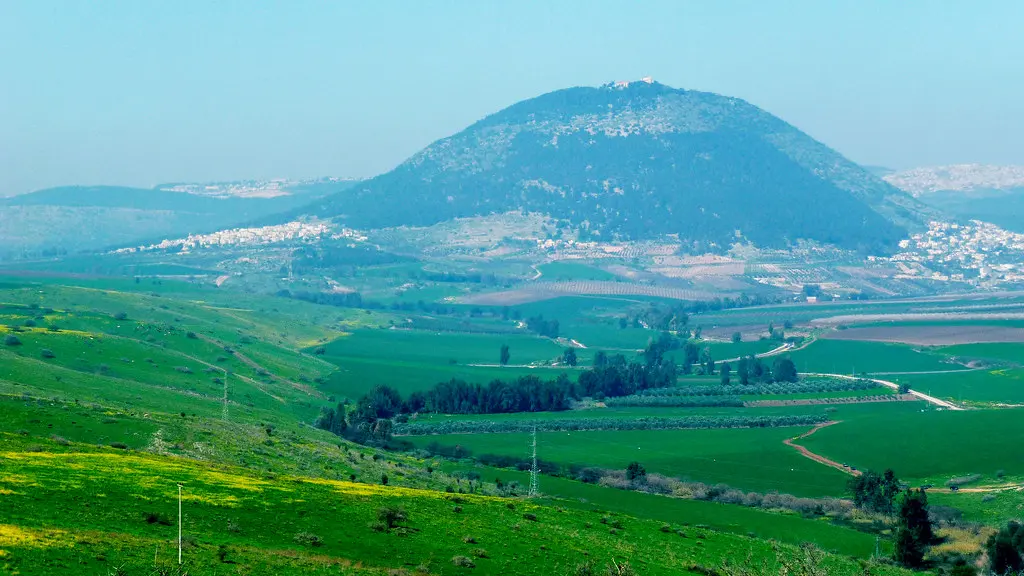
Image of Mt. Tabor. Image source
Visit essentials
A quick read before you go
- Duration
- Allow 2-3 hours for a comprehensive visit including the drive, the Franciscan basilica,…
- Access
- Mount Tabor is located at the eastern end of the Jezreel Valley, between the villages of…
Overview
Mount Tabor's symmetrical dome rises 400 meters above the valley floor, isolated from any ridge or range like a geological singularity placed rather than formed. The Psalmist personified Tabor with Hermon as praising God's name; Egyptian pharaohs recorded it; and the prophetess Deborah chose it to stage divine deliverance.
Christian significance centers on the Transfiguration, when Jesus, according to the synoptic Gospels, revealed his divine nature on a high mountain in blazing light. Tabor's identification as that mountain dates to the third century. The Franciscan Basilica of the Transfiguration on the southwest and Greek Orthodox Church of St. Elias on the northeast maintain continuous worship in their respective traditions.
Tabor's oak forests are a protected reserve, declared a national park in 1991. Twelfth-century Crusader-fortress ruins and a thirteenth-century Ayyubid fortification stand among trees, while archaeology reaches the Bronze Age. Worship, natural beauty, and layered human history coexist.
Tabor's intimacy distinguishes it from remote, vast Sinai and alpine, imposing Hermon. Its forests are gentle and its summit compact enough for one morning. Sacredness is approachable, close enough to touch.
Places within this site
Why this place is sacred
Mount Tabor's thin-place quality begins with its form. The mountain is a near-symmetrical dome, rising abruptly from the flat Jezreel Valley without connecting ridges or foothills. This isolation gives it the quality of a threshold: to ascend Tabor is to leave one world and enter another. The transition is physical before it is spiritual, but the physical prepares the way.
The panoramic view from the summit amplifies this quality. Looking south and west, the entire Jezreel Valley spreads below, the plain where armies from Pharaoh Thutmose III to Napoleon fought their battles. Looking north, the Galilee hills roll toward the distant peak of Mount Hermon. Looking east, the hills descend toward the Jordan Valley and the Sea of Galilee.
From this vantage, the landscape in which so much of biblical history unfolded becomes legible as a whole, and the visitor stands at its center.
The spiritual layering is equally dense. The prophetess Deborah sent Barak to gather 10,000 men on this mountain before God delivered the Canaanite army into their hands through a divine storm. During the Second Temple period, fire beacons blazed on the summit to announce new months and festivals. The Transfiguration narrative placed the most luminous moment of Christ's earthly ministry here. Byzantine Christians built three churches on the summit. Crusaders fortified it. Muslims defended it.
Through every transformation, the mountain's character as a place of encounter between the human and the divine persisted.
The oak forests add an ecological dimension. Tabor oaks, a species native to the eastern Mediterranean, create a canopy that filters light and muffles sound. Walking through this forest on the approach to the summit produces a quality of attention, a slowing down, that resembles preparation. The forest does not merely surround the sacred. It participates in it.
Mount Tabor's sacred history predates written records. The earliest documented reference appears in Egyptian inscriptions of Pharaoh Ramses II in the thirteenth century BCE. In the Hebrew Bible, the mountain served as a tribal boundary marker between Zebulun, Issachar, and Naphtali, and as the gathering point for the Israelite army under Deborah and Barak.
The mountain's sacred identity has been continuously reinterpreted. From a Canaanite high place (suggested by Hosea's warning against the mountain), it became a site of Israelite military and liturgical significance. Christian identification of Tabor as the Mount of Transfiguration, beginning in the third century, layered a new narrative over the older one. Byzantine churches gave way to Crusader fortifications, which gave way to Ayyubid military use.
The return of religious communities in the nineteenth century, with the Greek Orthodox church completed in 1862 and the Franciscan basilica inaugurated in 1924, restored the mountain's character as a place of living worship. Its designation as a national park in 1991 added a conservation dimension to its identity.
Experience and orientation
The road to the summit begins at the junction between Daburiyya and Shibli, and its character sets the terms. Narrow, steep, and winding, it demands attention from drivers and rewards pedestrians with a gradual deepening of quiet. The oak forest closes in as the road climbs, dappling the light, absorbing traffic noise from the valley. By the third switchback, the everyday world has receded.
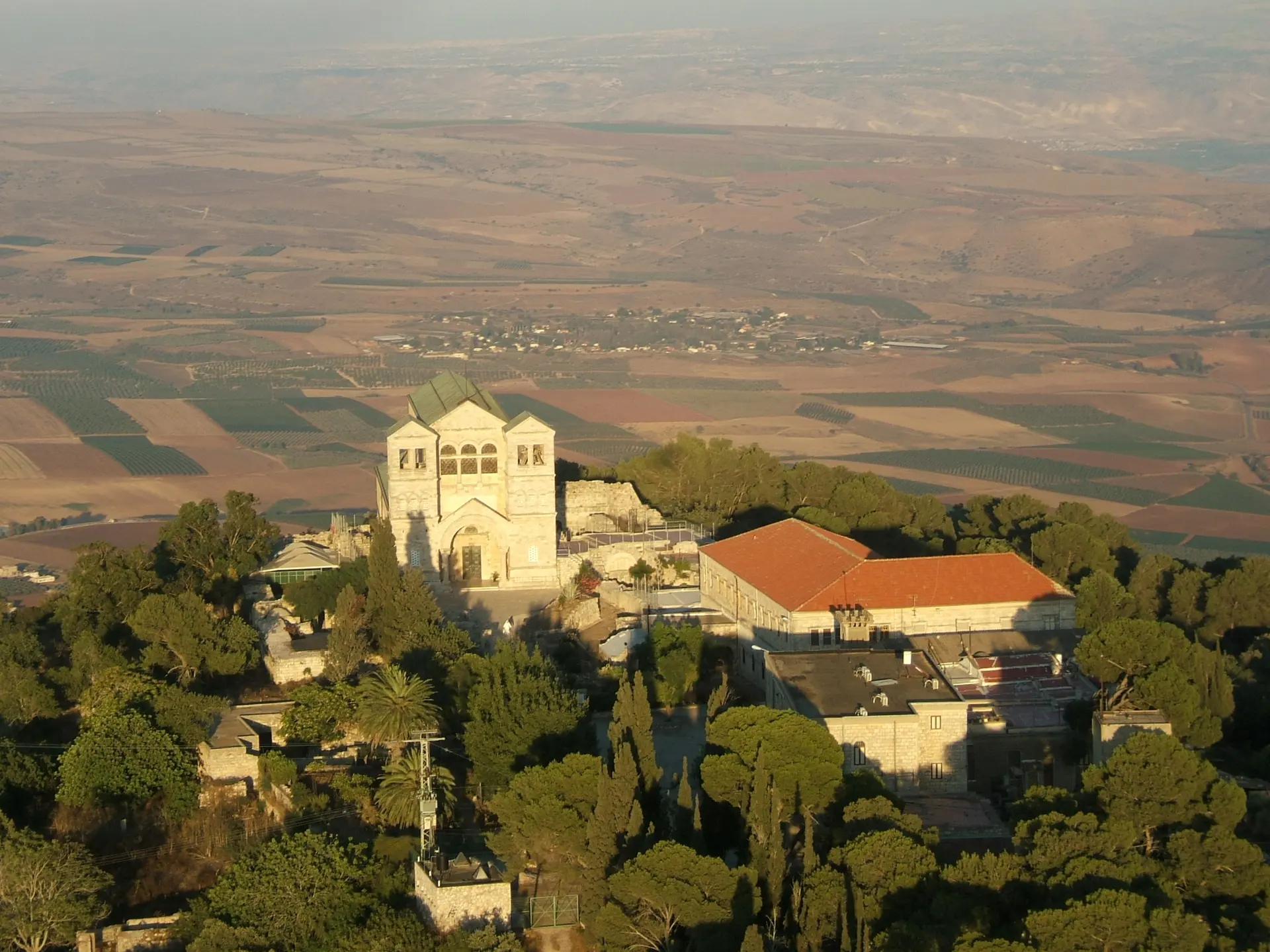
At the summit, two parking areas and a stone gateway mark the transition to the sacred compound. The Franciscan basilica occupies the southwestern portion, its twin towers and stone facade visible through the trees. The Greek Orthodox compound, including the Church of St. Elias, sits on the northeastern side, generally closed to visitors except during the Orthodox Feast of the Transfiguration.
Between them, the ruins of Crusader walls and the Ayyubid Gate of the Wind offer evidence of the mountain's military history.
The Franciscan basilica deserves unhurried attention. The golden apse mosaic of the Transfiguration draws the eye immediately upon entering. The three chapels, dedicated to Christ, Moses, and Elijah, offer quieter spaces. The crypt beneath the main altar reveals Byzantine mosaics and Crusader-era walls, visible through glass floor panels. Outside, the terrace provides the panoramic view that contextualizes everything: the Jezreel Valley below, the hills of Galilee, and on clear days, the Mediterranean coast.
For hikers, the ascent on foot from the base adds a contemplative dimension that driving cannot replicate. The trail through the oak forest takes one to two hours, passing through terrain that shifts from cultivated olives at the base to wild forest on the slopes. The physical effort mirrors the scriptural narrative of ascending a mountain apart from the world.
Those who time their visit to coincide with the Feast of the Transfiguration, August 6 for Catholics or August 19 for Orthodox, will experience the mountain at its most alive. The Catholic celebration includes solemn Mass and procession. The Orthodox celebration begins with an all-night vigil presided over by the Patriarch of Jerusalem, followed by morning Divine Liturgy and the traditional blessing of grapes.
Christian families from the Galilee camp overnight on the mountain, a tradition dating to the Ottoman era.
Arrive early for the quietest experience and the best light. Begin with the panoramic view from the terrace to orient yourself within the biblical landscape. Visit the Franciscan basilica, including the crypt. Walk the paths around the summit to see the Crusader ruins and the Gate of the Wind. If time permits and the Greek Orthodox compound is open, visit the Church of St. Elias. The nature trails through the oak forest offer a reflective descent.
Context and lineage
The mountain's earliest documented sacred association appears in the Book of Judges, where God commands Barak to gather 10,000 men from the tribes of Naphtali and Zebulun on Mount Tabor before delivering the Canaanite general Sisera into their hands. The divine storm that flooded the Kishon River and destroyed Sisera's chariots established Tabor as a place of God's direct intervention. The Song of Deborah, one of the oldest passages in the Hebrew Bible, celebrates this victory.
The Christian narrative transforms the mountain's identity. The Transfiguration account describes Jesus leading three disciples up a high mountain where his face shone like the sun and Moses and Elijah appeared. Origen proposed the identification with Tabor in the third century, and St. Cyril of Jerusalem and St. Jerome reinforced it. By the fourth century, Queen Helena had built the first church on the summit, and the identification was settled for Christian tradition.
The mountain's name itself resists translation. Scholars have proposed connections to a Semitic root meaning to break or purify, to a concept of height or navel, and even to an unknown pre-Israelite deity. The uncertainty suits a mountain whose meaning has been continuously rewritten.
Mount Tabor belongs to the ancient Near Eastern tradition of sacred mountains, places understood as meeting points between heaven and earth. In the Judeo-Christian tradition, it stands alongside Sinai, Carmel, Moriah, and Hermon as a mountain where the divine and human intersect. Its dual Christian presence, Catholic and Orthodox, reflects the division of Eastern and Western Christianity and the competing claims that have shaped the Holy Land's religious geography.
Deborah
Prophetess and judge of Israel who commanded Barak to gather his forces on Mount Tabor before the battle against Sisera's Canaanite army. Her leadership and the subsequent victory established the mountain as a site of divine deliverance in Jewish tradition.
Queen Helena (c. 250-330 CE)
Mother of Emperor Constantine who built the first church on Mount Tabor's summit around 326 CE, initiating the tradition of Christian worship at the site.
Antonio Barluzzi (1884-1960)
Architect of the Franciscan Basilica of the Transfiguration (1919-1924), whose light-centered design sought to make the Transfiguration experientially present through architecture.
Irinarh Rosetti and Nectarie Banul
Romanian monks who built the Greek Orthodox Church of St. Elias (1859-1862) on the northeast summit, establishing the Orthodox presence that continues today.
Traditions and practice
The tradition of ascending Mount Tabor as a devotional act dates to the fourth century, when the first churches drew pilgrims to reenact the disciples' climb with Jesus. The Feast of the Transfiguration has been celebrated on the mountain since the Byzantine period. The three chapels within the Franciscan basilica, and the historical presence of three separate churches on the summit, reflect Peter's proposal to build three tabernacles at the moment of revelation.
The Greek Orthodox all-night vigil on the eve of the Transfiguration follows centuries of Eastern liturgical tradition. The blessing of grapes or first fruits on the feast day connects the Transfiguration to harvest gratitude and the transformation of earthly things. During the Second Temple period, fire beacons were lit on Tabor to announce new months and festivals, a practice that made the mountain a node in a network of sacred communication.
Daily Mass is celebrated in the Franciscan basilica. The Feast of the Transfiguration is observed on August 6 in the Catholic calendar and August 19 in the Orthodox calendar. The Catholic celebration includes solemn Mass followed by a procession to the Church of the Descent. The Orthodox celebration features an all-night vigil presided over by the Patriarch of Jerusalem, morning Divine Liturgy, and the blessing of fruits.
Christian families from the Galilee camp on the mountain the night before the feast, maintaining a tradition from the Ottoman era.
If the churches are the formal expression of the mountain's sanctity, the forest is its informal one. Walking the trails through the Tabor oak canopy offers a contemplative approach to the summit that the winding road cannot replicate. The physical effort of climbing mirrors the scriptural ascent, and the gradual deepening of quiet within the forest creates a natural transition from the everyday to the attentive.
At the summit, the terrace in front of the Franciscan basilica serves as a natural meditation platform. The view encompasses the landscape of biblical narrative: the Jezreel Valley where Gideon fought, the hills where Jesus walked, the distant shore of the Sea of Galilee. Simply standing here, attending to what is visible, is itself a practice.
Inside the basilica, the golden Transfiguration mosaic repays sustained attention. The interplay of light and gold changes through the day. Sitting quietly in one of the pews, allowing the image to work on you rather than consuming it quickly, recovers something of the contemplative intent that Barluzzi built into the architecture.
Roman Catholic Christianity
ActiveMount Tabor is venerated as the site of the Transfiguration of Jesus Christ. The earliest identification with Tabor dates to Origen in the third century, and Queen Helena built the first church here in 326 CE. The Franciscan Custody of the Holy Land has maintained a presence since 1631, and the current Basilica of the Transfiguration was inaugurated in 1924.
Daily Mass at the Franciscan basilica. Annual Feast of the Transfiguration on August 6 with solemn Mass and procession. Pilgrimage groups celebrate Mass year-round. After the feast day Mass, worshippers process to the Church of the Descent. Christian families camp overnight before the feast, a tradition dating to the Ottoman era.
Greek Orthodox Christianity
ActiveThe Greek Orthodox tradition reveres Mount Tabor with equal intensity as the Transfiguration site. The Feast of the Transfiguration is among the Twelve Great Feasts of the Byzantine liturgical calendar. The monastery of St. Elias occupies the northeastern summit. The Patriarchate of Jerusalem maintains a monastic presence.
The Orthodox Feast of the Transfiguration (August 19) features an all-night vigil presided over by the Patriarch of Jerusalem, followed by morning Divine Liturgy. Grapes or other seasonal fruits are blessed after the liturgy. A fasting banquet of fish follows for clergy and faithful.
Judaism (historical)
HistoricalIn the Hebrew Bible, Mount Tabor is the gathering point for the Israelite army under Barak before the battle against Sisera's Canaanite forces, as directed by the prophetess Deborah. The mountain also served as a tribal boundary marker and the site of fire beacons announcing new months during the Second Temple period. Psalm 89 personifies Tabor alongside Hermon as praising God's name.
Fire beacons on the summit announced the new moon and Jewish festivals during the Second Temple period. The mountain functioned as a border sanctuary and likely site of tribal assemblies. No active Jewish practices are conducted on the mountain today.
Perspectives and open questions
Mount Tabor has been understood as a site of divine encounter across millennia, its meaning rewritten by each tradition that has claimed its summit while retaining a continuity that transcends any single interpretation.
Scholarly perspective
Scholars recognize Mount Tabor as a site of religious significance reaching back to the Bronze Age, with the earliest written reference in Egyptian inscriptions of Ramses II. The identification as the Mount of Transfiguration is widely attested from the third century but not universally accepted: some scholars argue for Mount Hermon based on its proximity to Caesarea Philippi, mentioned in the Gospel narrative just before the Transfiguration account.
Others question whether the summit was populated during Jesus's time, which would complicate the description of a remote mountain. However, the weight of early Christian tradition and the continuous presence of churches since the fourth century have made the Tabor identification dominant.
Living and traditional perspectives
In Jewish tradition, Mount Tabor is associated primarily with Deborah and Barak's victory over the Canaanites, representing God's power to deliver Israel through faith and courage. The Psalmist's personification of Tabor and Hermon as praising God's name reflects the mountain's iconic status in Jewish sacred geography. In Christian tradition, the Transfiguration revealed Jesus's divine nature, connected the Law and Prophets with the fulfillment in Christ, and prefigured the Resurrection.
The Eastern Orthodox theology of Tabor Light, the uncreated divine energy that shone from Christ, is central to hesychast spirituality, where the light is understood as the same divine energy accessible through contemplative prayer.
Alternative interpretations
Some interpreters view Mount Tabor as an energy vortex or spiritual power point, citing its dramatic geological formation as evidence of concentrated earth energy. The mountain's dome shape has been compared to a natural altar or sacred mound. The convergence of multiple religious traditions on this single peak is sometimes read as evidence of a universal recognition of the mountain's inherent spiritual properties.
The Transfiguration itself is occasionally reinterpreted as describing an experience of illumination or awakening accessible to seekers of any tradition.
Open questions
The exact nature of pre-Israelite religious activity on Mount Tabor remains poorly understood. Hosea's warning against the mountain suggests it may have been a center of syncretistic worship, but the specific practices are unknown. The archaeological record on the summit has been heavily disturbed by centuries of construction and destruction. Whether a settlement existed on the summit during Jesus's time remains debated.
The mountain's name has no agreed-upon etymology, with proposed connections to Semitic roots meaning to break, to purify, or to an unknown deity.
Plan your visit
Access and arrival
Mount Tabor is located at the eastern end of the Jezreel Valley, between the villages of Daburiyya and Shibli. The access road begins at the northwest corner of the mountain. The road is narrow, winding, and steep. Two free parking lots at the summit. Minibus taxis operate from the base for those who prefer not to drive. From major cities: approximately 30 minutes from Nazareth, 30 minutes from Tiberias, 1.5 hours from Haifa, 2 hours from Tel Aviv.
No entrance fee. Mobile phone signal is generally available at the summit.
Nazareth (20 km) offers the nearest accommodations, from hostels to guesthouses. Tiberias (30 minutes) provides options near the Sea of Galilee. There are no accommodations on Mount Tabor itself.
Respectful visit
Modest dress is required at both churches. Shoulders and knees should be covered for both men and women. Comfortable walking shoes are essential for the rocky summit paths and the national park trails.
Photography is permitted on the mountain's trails and viewing points. Inside the Franciscan basilica, photography is typically allowed without flash when services are not in progress. The Greek Orthodox monastery may have stricter restrictions. Do not photograph worshippers without consent.
Candles can be lit in the Franciscan basilica. Donations to the Franciscan Custody of the Holy Land are welcomed. No specific offerings are required.
Modest dress at both churches. Respectful silence inside worship spaces. Greek Orthodox monastery generally closed to the public. Stay on marked trails in the national park. Do not disturb archaeological remains. No entrance fee.
The access road is steep and narrow with sharp switchbacks. Drive slowly. Summer temperatures on the exposed summit can exceed 35 degrees Celsius. Carry water. The Franciscan basilica closes midday. The Greek Orthodox monastery is generally closed to visitors except during the Feast of the Transfiguration.
Current practical details
Address
Mount Tabor, Israel
Hours, fees, and access can change — verify on the official source before you travel. Practical details last checked Jun 2026.
Location
Map loads as you approach this section.
Pilgrim reflections
A portrait of encounter, not a score
Pilgrims describe what they felt, how present they could become, and whether the place would shape a journey. There are no stars and no ranking of traditions.
No reviewed reflections yet
The first pilgrims can help describe the character of being here.
Share a reflection
Available after an account-backed “Been there.” Every reflection is reviewed before publication.
Nearby sacred places
Explore other sacred places in the region. Proximity does not establish access or travel time; check each place’s guidance.
Church of the Transfiguration Mount Tabor
Shibli - Umm el Ghanam, Northern District, Israel
0.0 km away

Mary’s Spring at St Gabriel’s Church
Nazareth, Northern District, Israel
8.8 km away
Shrine of Nabi Shuʿayb, near Kfar Zeitim, not far from Tiberias, Israel
Galil Tachton Regional Council, Northern District, Israel
14.3 km away

Magdala Archaeological Park
Migdal, Israel
19.3 km away
Share a photo
Help visitors recognize Mt. Tabor. Every submission is reviewed before publication.