Church of the Transfiguration Mount Tabor
Part ofMt. Tabor
A basilica of gold and light on the mountain where tradition places Christ's Transfiguration
Understand sacred places, explore living traditions, and learn how to engage respectfully with Pilgrim Map.
Access has not been verified. Check current local guidance before planning a visit.
Shibli - Umm el Ghanam, Northern District, Israel
Visit essentials
A quick read before you go
- Duration
- Allow 45 minutes to 1.5 hours for the basilica alone, including the main nave, side chapels,…
- Access
- The church is located at the summit of Mount Tabor.
Overview
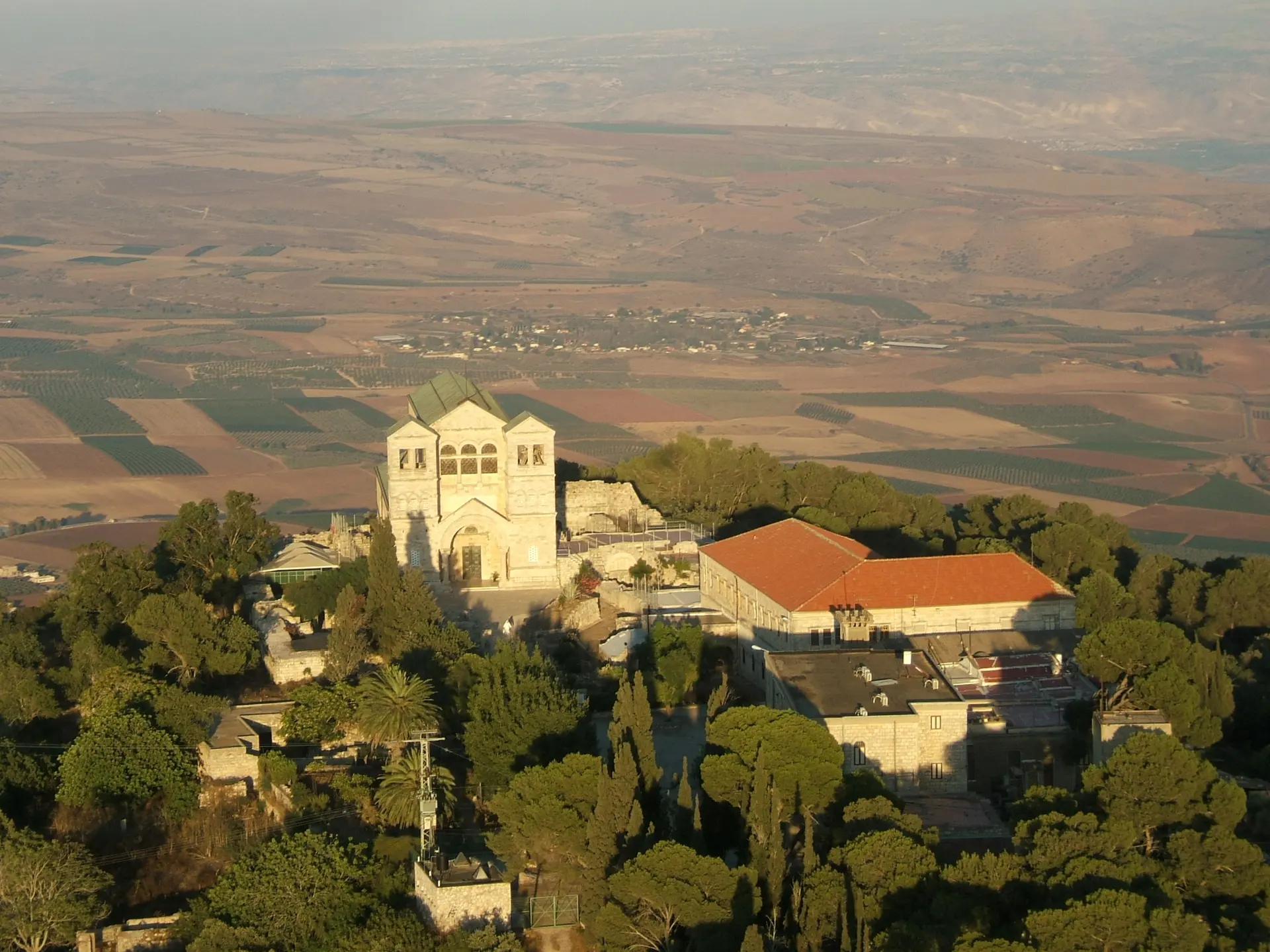
Sharp switchbacks through oak forest lead to Mount Tabor's summit, where the Franciscan terrace overlooks the Jezreel Valley and twin towers mark the place where the synoptic Gospels say Jesus was transfigured before Peter, James, and John: his face radiant, garments white beyond earthly bleaching, Moses and Elijah beside him, and a cloud-voice declaring him the beloved Son.
Italian architect Antonio Barluzzi designed the church in the early 1920s around the event's light. He envisioned translucent alabaster roof panels flooding the interior with warm, diffused glow, a meditation on divine illumination. Weatherproofing later covered them, but the intent survives in the golden apse mosaic of the Transfigured Christ, luminous in natural and artificial light.
Three chapels extend from the main nave, dedicated to Christ, Moses, and Elijah in answer to Peter's impulse to build three tabernacles. Beneath the nave, glass floor panels reveal a crypt with a Byzantine mosaic of white, black, and red tesserae, Crusader walls and altar fragments, and the intimate prayer space where the mountain's earliest Christians worshipped. The basilica's 2024 centenary marked a hundred years of daily Mass, Franciscan stewardship, and continuous pilgrimage joined to seventeen earlier centuries of devotion.
Why this place is sacred
The thinness of the Church of the Transfiguration operates through several registers simultaneously.
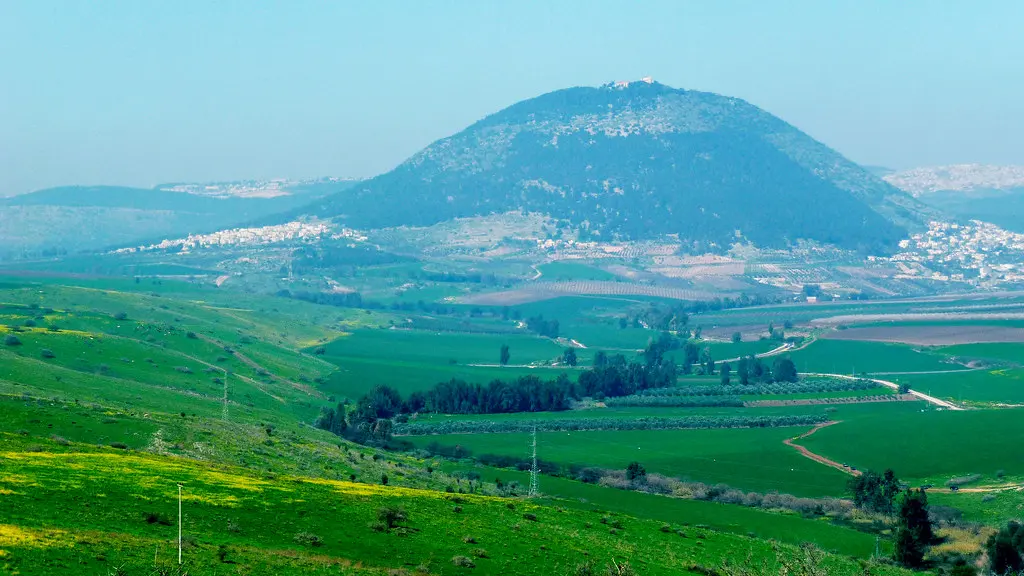
The first is altitude. Mount Tabor rises 575 meters above the Jezreel Valley, its dome-shaped summit visible from a great distance. The Gospels describe Jesus leading his disciples up a high mountain, apart. The physical act of ascending Tabor, whether by the winding road or on foot through the forest, replicates that separation from the everyday.
By the time you reach the summit, the valley below has receded into abstraction, and the air carries a quality of openness that the lowlands do not possess.
The second is architectural intention. Barluzzi designed this church not to commemorate the Transfiguration but to enact it. The golden mosaic in the apse, depicting Christ radiant between Moses and Elijah with the three disciples below, is positioned to catch light from the east-facing windows. On the Feast of the Transfiguration, August 6, sunlight enters at a particular angle, illuminating the mosaic with a quality that pilgrims describe as uncanny. The effect is not accidental.
The architect studied the angle, the gold leaf, the relationship between window and image, and designed a building that would use natural phenomena to produce spiritual resonance.
The third is archaeological depth. The crypt beneath the main altar contains visible remains of Byzantine-era churches dating to the fourth through sixth centuries, including mosaic fragments that were already ancient when the Crusaders restored them. Walking on the glass floor panels that reveal these layers, a visitor stands simultaneously in the twenty-first century and the fourth, connected across time by the continuity of worship on this precise spot.
The fourth is the sustained human presence. Franciscan friars have lived on this mountain since 1631. Daily Mass has been celebrated in the basilica since its inauguration in 1924. The church is not a monument to something that once happened. It is a place where something is understood to still be happening.
The earliest church on Mount Tabor's summit was built by Queen Helena, mother of Emperor Constantine, in approximately 326 CE, to mark the traditional site of Christ's Transfiguration. By the sixth century, three churches stood on the summit, reflecting Peter's proposal to build three tabernacles.
The Byzantine churches were succeeded by a Crusader basilica built by Benedictine monks in 1101, which was destroyed by the Ayyubid sultan Al-Adil in 1211 and further demolished by Baibars in 1263. The mountain was fortified as an Ayyubid military position. Franciscans returned in 1631 and slowly rebuilt their presence. The current basilica, designed by Barluzzi, was built between 1919 and 1924, incorporating ruins of the earlier structures into its foundations and crypt.
The church celebrated its centenary in 2024 with special liturgical observances and an exhibition at the Terra Sancta Museum.
Experience and orientation
The approach is part of the experience. From the junction between the villages of Daburiyya and Shibli, the road climbs in tight switchbacks through evergreen oak forest, each turn revealing a different angle of the valley below and narrowing the world to road, trees, and sky. If you walk rather than drive, the ascent takes an hour or more, and the physical effort transforms the arrival from a destination into an achievement.
At the summit, the Franciscan compound's stone walls and garden terraces create a sense of enclosure and arrival. The terrace before the basilica offers a panoramic view: the Jezreel Valley stretches south and west, the Galilee hills rise to the north, and on clear days Mount Hermon is visible, snow-capped and distant. The landscape from which so much of biblical narrative emerged lies open beneath you.
Entering the basilica, the transition from bright exterior to interior shadow takes a moment. Then the golden mosaic resolves: Christ transfigured, radiant, flanked by Moses and Elijah, the three disciples below in attitudes of awe. The gold catches whatever light is available and amplifies it. The effect is neither subtle nor overwhelming but steady, a continuous assertion of luminosity that fills the apse and draws the eye back again and again.
The side chapels, dedicated to Moses and Elijah, offer quieter spaces. Smaller in scale, often empty of other visitors, they provide the intimacy that the main nave, with its tour groups and their guides, sometimes lacks. These are places for sitting, for silence, for the kind of unhurried attention that a sacred space rewards.
The crypt descends below the main altar into a different register entirely. Here, the walls show their age. Byzantine masonry is visible. The mosaic floor, with its simple geometric patterns in white, black, and red, dates to a time when the Transfiguration was a recent memory rather than a distant tradition. An altar stands in the low space, and Mass is sometimes celebrated here for small groups.
The compression of the ceiling, the coolness of the air, and the visible antiquity of the stone create a contemplative density that contrasts with the expansive golden vision above.
Arrive in the morning, when the light enters the east-facing apse and the mosaic is at its most alive. Begin at the exterior terrace for the panoramic view that contextualizes the mountain's sacred geography. Enter the basilica and allow your eyes to adjust before focusing on the Transfiguration mosaic. Visit the side chapels for quiet contemplation. Descend to the crypt last, moving from the expansive to the intimate, from light to enclosure.
Context and lineage
The Gospel accounts of the Transfiguration describe Jesus leading Peter, James, and John up a high mountain where his face shone like the sun and his garments became dazzling white. Moses and Elijah appeared conversing with him, and a voice from a cloud declared: 'This is my beloved Son, with whom I am well pleased; listen to him.' The identification of Mount Tabor as this mountain was proposed by Origen in the third century and confirmed by St.
Cyril of Jerusalem and St. Jerome in the fourth. Queen Helena built the first church here around 326 CE.
The current basilica was Barluzzi's response to a commission that demanded more than competence. The architect, who would also design the Church of All Nations at Gethsemane and the Church of the Visitation in Ein Karem, conceived the Tabor church as an experience of light. His original alabaster roof would have made the interior glow.
Though the roof was later modified for practical reasons, the golden apse mosaic and the calculated fenestration preserve his central insight: that to commemorate the Transfiguration, one must build with light as the primary material.
The basilica belongs to the long tradition of Holy Land memorial churches built at sites associated with events in the life of Christ. It also belongs to Barluzzi's specific legacy of early twentieth-century sacred architecture in the Holy Land, a body of work that sought to make biblical events experientially present through innovative use of light, material, and space. The Franciscan Custody's stewardship continues the mission that St. Francis of Assisi initiated during his 1219-1220 pilgrimage to the Holy Land.
Antonio Barluzzi (1884-1960)
Italian architect known as the Architect of the Holy Land, who designed the current basilica. His innovative use of light as a theological and architectural element created a church that does not merely depict the Transfiguration but attempts to make it experientially present.
Queen Helena
Mother of Emperor Constantine, traditionally credited with building the first church on Mount Tabor's summit around 326 CE, establishing the site as a place of Christian pilgrimage.
Franciscan Custody of the Holy Land
The Catholic religious order that has maintained a presence on Mount Tabor since 1631, funded and built the current basilica, and continues to administer the site with daily Mass and hospitality to pilgrims.
Origen of Alexandria (c. 185-254 CE)
Early Church father who first proposed the identification of Mount Tabor as the site of the Transfiguration, establishing a tradition that was reinforced by St. Cyril of Jerusalem and St. Jerome.
Traditions and practice
Christian veneration of this site dates to the fourth century. The Feast of the Transfiguration has been celebrated on the mountain for over 1,500 years, making it one of the longest-continuously-observed liturgical celebrations at any specific Holy Land location. The tradition of building three memorial structures on the summit, referencing Peter's proposal to build three tabernacles, was established in the Byzantine period. During the sixth century, three separate churches stood on the summit.
Pilgrimage to the mountain as a physical reenactment of the disciples' ascent with Jesus has been practiced since the earliest centuries of Christianity.
Daily Mass is celebrated in the basilica by the resident Franciscan community. The annual Feast of the Transfiguration on August 6 draws pilgrims from across the world for solemn Mass, processions, and special prayers. In 2024, a double celebration marked both the feast and the basilica's centenary. Pilgrimage groups regularly arrange to celebrate Mass in the basilica or in the side chapels.
After the feast day Mass, a procession moves to the nearby Church of the Descent, connecting the Transfiguration to the Paschal mystery. Individual visitors pray before the golden mosaic, light candles, and spend time in contemplation in the crypt.
Allow the ascent to serve as preparation. Whether you drive or walk, the act of climbing separates you from the routine of the lowlands. Once inside the basilica, resist the impulse to photograph immediately. Sit in one of the pews and let the golden mosaic do its work. The interplay of light and gold is not a single moment but an evolving relationship that changes as clouds pass, as the sun moves, as your eyes adjust.
The side chapels of Moses and Elijah often stand empty while tour groups gather in the main nave. These smaller spaces reward patience. The crypt, with its Byzantine mosaics and low ceiling, offers a different quality of attention, more inward, more compressed. If possible, visit when Mass is being celebrated. The sound of liturgy in a space designed for it creates a resonance that transcends language.
Roman Catholic Christianity
ActiveThe Church of the Transfiguration is the principal Catholic shrine commemorating the Transfiguration of Jesus, one of the most theologically significant events in the Gospels. The three chapels dedicated to Christ, Moses, and Elijah directly reference Peter's proposal to build three tabernacles at the moment of divine revelation. The Franciscan Custody of the Holy Land has maintained this shrine since 1631.
Daily Mass celebrated by the resident Franciscan community. Annual Feast of the Transfiguration on August 6 with solemn Mass, processions, and special prayers. Pilgrimage groups regularly celebrate Mass in the basilica or side chapels. Individual pilgrims pray before the Transfiguration mosaic and light candles. Procession to the Church of the Descent on the feast day.
Byzantine Christianity (historical)
HistoricalThe earliest churches on Mount Tabor's summit were built during the Byzantine period, beginning with Queen Helena's construction around 326 CE. By the sixth century, three churches and a monastery stood at the summit. The Byzantine mosaic floor survives within the current basilica, and the Feast of the Transfiguration was established as a major liturgical celebration during this period.
Byzantine liturgical celebrations of the Transfiguration established the continuous Christian worship that has persisted, with interruptions, for over 1,700 years.
Crusader-era Latin Christianity (historical)
HistoricalBenedictine monks rebuilt a basilica on the Byzantine ruins in 1101 and established a fortified abbey. The Crusader structures were destroyed in 1211 and 1263 but survive as archaeological remains within the current building.
Regular liturgical services and pilgrimage hospitality during the Crusader period maintained the tradition of worship on the summit.
Perspectives and open questions
The Church of the Transfiguration has been understood as an architectural achievement, a theological statement, a pilgrim's destination, and a meeting point between the biblical past and the present day.
Scholarly perspective
Art historians recognize the basilica as one of Barluzzi's masterworks, a landmark of early twentieth-century sacred architecture that deliberately uses light as a theological element. The original alabaster roof concept, though never fully realized, represents an innovative approach to making a biblical event experientially present. Archaeological scholars confirm the presence of Byzantine and Crusader remains beneath the current structure, validating the site's ancient claim.
The identification of Tabor as the Mount of Transfiguration, while not universally accepted by scholars who argue for Mount Hermon as an alternative, has overwhelming patristic and archaeological support from the third century onward.
Living and traditional perspectives
In Catholic tradition, the church enshrines one of the most luminous mysteries of Christ's earthly ministry. The Transfiguration strengthened the disciples before the Passion, connected Old and New Testaments through the presence of Moses and Elijah, and prefigured both the Resurrection and the ultimate glorification promised to all believers. The three chapels directly reference Peter's impulse to build three tabernacles, understood as the desire to remain in the moment of divine encounter.
The Eastern Orthodox tradition emphasizes the theology of Tabor Light, the uncreated divine energy that shone from Christ and remains accessible through contemplative prayer.
Alternative interpretations
Some mystical interpretations view the Transfiguration as a universal teaching about the potential for human consciousness to be illuminated by divine light, a reading that extends beyond exclusively Christian frameworks. The ascent of Mount Tabor has been interpreted as a metaphor for the stages of mystical ascent described in contemplative traditions: from the active life in the valley through purification on the winding road to illumination at the summit.
The archaeological layering of the site is sometimes read as reflecting the progressive unveiling of spiritual truth across ages.
Open questions
The exact configuration of the earliest Byzantine churches on the summit remains imperfectly understood. Whether the summit was settled during the first century, which would affect the Gospel description of a remote mountain, is debated. The full extent of Crusader-era structures beneath the current basilica has not been completely excavated. The mechanism by which sunlight illuminates the golden mosaic on August 6 has not been fully documented or analyzed.
Plan your visit
Access and arrival
The church is located at the summit of Mount Tabor. The access road begins between the villages of Daburiyya and Shibli. The road is narrow, winding, and steep. Vehicle access policies vary: some periods require shared taxis or minibuses from the base. Two free parking lots at the summit when vehicle access is permitted. No entrance fee. Opening hours generally 8:00-12:00 and 14:00-17:00 (18:00 in summer).
Approximately 8 km from Nazareth, 18 km from the Sea of Galilee, 30 minutes from Tiberias, 1.5 hours from Haifa, 2 hours from Tel Aviv. Mobile phone signal is generally available at the summit.
Nazareth (8 km) offers the nearest accommodations, ranging from hostels to guesthouses. Tiberias (30 minutes) provides additional options near the Sea of Galilee. There are no accommodations on Mount Tabor itself.
Respectful visit
Modest dress is strictly required. Shoulders and knees must be covered for both men and women. No sleeveless tops, shorts, or short skirts. Wraps may be available at the entrance, but visitors should come prepared. Comfortable shoes are recommended for the walk around the summit compound.
Photography is generally permitted inside the basilica when services are not in progress. Flash photography should be avoided to protect the mosaics and maintain the contemplative atmosphere. Photography during Mass or other worship services is not permitted. The exterior and terrace views may be freely photographed.
Candles can be lit inside the basilica. Donations to the Franciscan Custody of the Holy Land are welcomed and support the maintenance of the basilica and the Franciscan presence in the Holy Land.
Modest dress required. Church closed midday, typically 12:00-14:00. Quiet and respectful behavior at all times. No eating or drinking inside the church. Do not touch or lean on mosaics, frescoes, or archaeological remains. Flash photography not permitted. Groups wishing to celebrate Mass must arrange in advance with the Franciscan Custody.
The church closes midday, typically between 12:00 and 14:00. Plan accordingly. The marble terrace can be extremely hot underfoot in summer. Bring water, as there are no facilities on the summit.
Current practical details
Address
Israel
Hours
Hours, fees, and access can change — verify on the official source before you travel. Practical details last checked Jun 2026.
Location
Map loads as you approach this section.
Pilgrim reflections
A portrait of encounter, not a score
Pilgrims describe what they felt, how present they could become, and whether the place would shape a journey. There are no stars and no ranking of traditions.
No reviewed reflections yet
The first pilgrims can help describe the character of being here.
Share a reflection
Available after an account-backed “Been there.” Every reflection is reviewed before publication.
Nearby sacred places
Explore other sacred places in the region. Proximity does not establish access or travel time; check each place’s guidance.
Mt. Tabor
Shibli - Umm el Ghanam, Northern District, Israel
0.0 km away

Mary’s Spring at St Gabriel’s Church
Nazareth, Northern District, Israel
8.8 km away
Shrine of Nabi Shuʿayb, near Kfar Zeitim, not far from Tiberias, Israel
Galil Tachton Regional Council, Northern District, Israel
14.3 km away

Magdala Archaeological Park
Migdal, Israel
19.3 km away
Photo gallery
4 curated photos
Share a photo
Help visitors recognize Church of the Transfiguration Mount Tabor. Every submission is reviewed before publication.