Mizuma-dera
A Tendai mountain temple founded by Gyōki where a dragon-elder gave a thumb-sized golden Kannon
Understand sacred places, explore living traditions, and learn how to engage respectfully with Pilgrim Map.
Access has not been verified. Check current local guidance before planning a visit.
Osaka Prefecture, Japan
Read the sources
Station 4 of 33
New Saigoku Kannon PilgrimageVisit essentials
A quick read before you go
- Duration
- 1 to 1.5 hours.
- Access
- Take the Nankai Main Line to Kaizuka Station, transfer to the Mizuma Railway local line and ride…
Overview
Mizuma-dera's 744 CE origin tradition joins Emperor Shōmu's illness at age 42, a dream of Kannon southwest of Nara, Gyōki's search, and a white-haired elder who gives him a six-centimeter golden Shō Kannon before becoming a dragon. Shōmu's cure leads to the temple's foundation at the encounter site. That dragon identity continues in Ryūkokusan, 'Dragon Valley Mountain', the preserved dragon's-wrist relic, and the river valley read as the dragon's body.
Why this place is sacred
Mizuma-dera's thin-place character is genuinely topographic. The temple sits at the confluence of two streams in the Mizuma valley — water-between — and the small golden Shō Kannon image at its heart has been continuously enshrined here for nearly 1,300 years. The 'dragon's wrist relic' kept in the main hall is the material trace of the founding encounter, treated by devotees as a continuing presence of the dragon-elder rather than as an artifact.
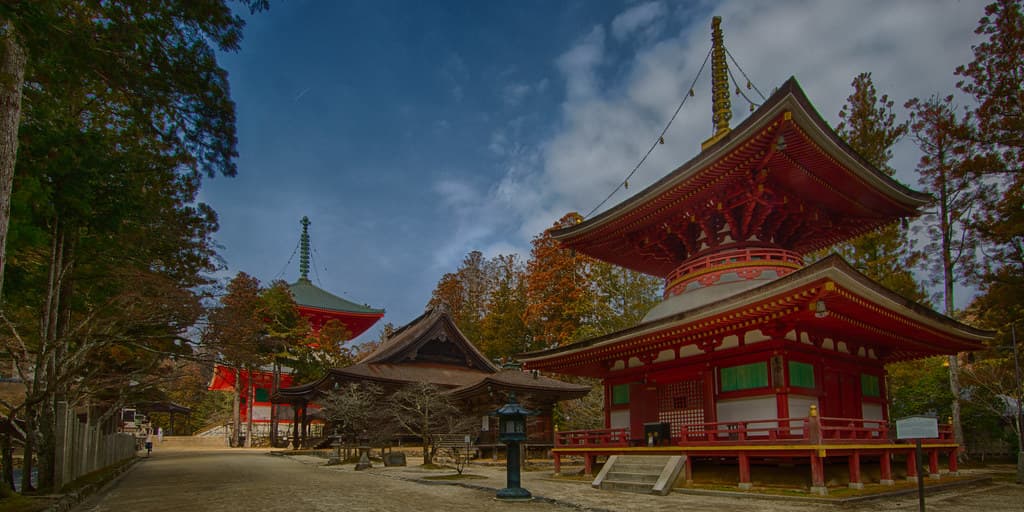
The three-storied pagoda above the river is the most-photographed feature and the visual signature of the temple. While the 1585 Toyotomi-era destruction means very little physical fabric pre-dates the Edo period, the small golden Kannon, the relic, and the river-valley topography form a continuous sacred narrative across centuries.
The route's first 'real travel' from central Osaka takes pilgrims through a charming small local rail line — the Mizuma Railway terminating at Mizuma-Kannon Station — which itself becomes part of the experience.
An imperially commissioned Tendai temple to enshrine the Kannon image that, by tradition, healed Emperor Shōmu and was given by a dragon-elder.
Founded 744 CE under Emperor Shōmu and Gyōki; medieval Negoro-ji affiliation; destroyed 1585 by Toyotomi forces; rebuilt over the early Edo period (current main hall 1827, three-storied pagoda 1834); elevated to Tendai-shū bekkaku-honzan in 1977.
Experience and orientation
Visitors describe Mizuma-dera as much greener and more 'mountain temple' in feel than its short distance from Osaka would suggest. The Mizuma Railway from Kaizuka — a small charming local line — terminates at Mizuma-Kannon Station, a seven-minute walk to the temple. The three-storied pagoda above the river is the most-photographed feature. The Aizen-dō is busy with younger visitors seeking partner blessings; ema slips dense with hopeful names hang in clusters.
The spring equinox mochi-throwing from the three-storied pagoda is a joyful, communal family event, while the New Year Senbon-tsuki Mochi-tsuki — a thousand pestles pounding rice cakes around the New Year — has been designated an Intangible Folk Cultural Property. The pilgrim's journey here, on a slow rail line winding through Sennan farmland, often becomes part of the spiritual rhythm of the visit.
From Mizuma-Kannon Station, the temple is about a 7-minute walk.
Context and lineage
Emperor Shōmu, ill at age 42, dreamed that the bodhisattva of compassion would appear southwest of Nara. He commanded the priest Gyōki to find the figure. Gyōki travelled southwest until he reached a river valley where two streams met. On a great riverside rock with beautiful flowing water, a white-haired elder appeared and presented him with a six-centimeter golden Shō Kannon image. The elder then transformed into a dragon and ascended into the heavens.
Gyōki returned the image to the emperor, whose illness was cured; Shōmu commanded a hall to be built at the dragon-encounter site, and Mizuma-dera was founded in 744 CE. The temple was burned in 1585 during Toyotomi Hideyoshi's campaign against the Negoro-ji-affiliated temple network, and was rebuilt over the early Edo period, with the current main hall completed in 1827 and the three-storied pagoda in 1834. In 1977 the temple was elevated to bekkaku-honzan (special head temple) status within Tendai-shū.
Tendai-shū bekkaku-honzan (special head temple) — elevated 1977; medieval Negoro-ji-network affiliation in the Shingon-Shintō fusion era prior to the 1585 destruction.
Traditions and practice
The Mizuma Senbon-tsuki Mochi-tsuki (千本搗餅つき) is the temple's signature New Year rite — communal rice-cake pounding with a thousand pestles, designated an Intangible Folk Cultural Property. The spring equinox brings mochi-throwing from the three-storied pagoda, a popular family event. The mid-summer Aizen Festival at the Aizen-dō draws couples and singles seeking love and marriage blessings, making the temple one of the most popular love-prayer sites in southern Osaka. Yaku-yoke prayer services are offered for those entering unlucky-age years (yakudoshi).
Goma fire ceremonies are held on calendar dates.
Daily Tendai sūtra recitation continues. Pilgrim nōkyō stamping is offered for the New Saigoku no. 4, the Izumi Saigoku no. 26, and other Kansai circuits. Public access to the dragon's wrist relic display in the main hall corridor is part of the visit. New Year hatsumōde fills the temple with regional pilgrim traffic.
If walking the New Saigoku, time the visit for the spring equinox mochi-throwing or the New Year Senbon-tsuki Mochi-tsuki for the most communally vivid experience. The Aizen-dō is appropriate for partner-prayer regardless of the visitor's relationship status. The route's transition out of central Osaka into the Sennan countryside is part of the practice — let the slow Mizuma Railway journey become part of the contemplative rhythm.
Buddhism (Tendai-shū bekkaku-honzan)
ActiveMizuma-dera is one of the largest and most actively visited temples in southern Osaka Prefecture. Founded 744 CE according to tradition by Gyōki at the imperial command of Emperor Shōmu, the temple's small golden Shō Kannon — six centimeters tall, said to have been received from a white-haired elder who became a dragon — has been continuously enshrined for nearly 1,300 years. The temple was destroyed in 1585 during Toyotomi Hideyoshi's anti-Negoro-ji campaigns and rebuilt in the Edo period. In 1977 it was elevated to bekkaku-honzan (special head temple) status within Tendai. The temple is a major regional site for yaku-yoke (luck-protection) and Aizen-dō love-prayer devotion.
Perspectives and open questions
Mizuma-dera is read across three frames: as a documented Tendai bekkaku-honzan with a clear Edo-period architectural record, as a living dragon-water-Kannon legend, and as a popular contemporary site of life-passage prayer (yakudoshi, marriage, family).
Scholarly perspective
Mizuma-dera is documented as a 1977 Tendai-shū bekkaku-honzan, with a long pre-Edo Tendai history and a documented 1585 destruction during Toyotomi anti-Negoro-ji campaigns. Current main hall (1827) and three-storied pagoda (1834) are confirmed Edo-period reconstructions designated as Kaizuka City Important Cultural Properties. The Gyōki / Emperor Shōmu founding tradition (744 CE) is consistent with broader Gyōki-attributed temple narratives across Kansai.
Living and traditional perspectives
Within Tendai devotion and local Sennan folklore, Mizuma-dera is the dragon-water-Kannon temple par excellence: the ascending dragon-elder, the small golden image, and the river-valley topography form a continuous sacred narrative. The yaku-yoke tradition makes the temple one of the most personally important sites in southern Osaka for life-passage prayer.
Alternative interpretations
The 'wrist relic' of the dragon-elder is treated by some as a residual material trace of a non-human presence in the river valley — a physical bridge between the human and the dragon-world. The Aizen-dō's mid-summer rite is, in popular consciousness, a major Kansai locus of love-prayer.
Open questions
Whether any pre-1585 fabric survives at the present site is uncertain. The chronology of the Negoro-ji-period medieval institutional life is poorly documented in English. Some New Saigoku materials reference Senju Kannon at this temple; the canonical primary tradition names a small Shō Kannon as the principal honzon.
Plan your visit
Access and arrival
Take the Nankai Main Line to Kaizuka Station, transfer to the Mizuma Railway local line and ride to its terminus, Mizuma-Kannon Station — about a 7-minute walk to the temple. Address: 638 Mizuma, Kaizuka, Osaka 597-0104.
Limited lodging in Kaizuka itself; many pilgrims base in Osaka or Wakayama City and visit by rail. No on-site lodging at this temple.
Respectful visit
Modest dress; pilgrim white welcomed.
Permitted in outer grounds; avoid flash inside halls and during ritual.
Coin offerings; candles, incense, ema available; goshuin issued at the nōkyō desk.
Quiet behaviour during ritual services.
New Year and equinox mochi-throwing bring heavy crowds; move patiently and keep ritual services quiet.
Current practical details
Address
638 Mizuma, Kaizuka, Osaka 597-0104, Japan
Phone
Hours
Hours, fees, and access can change — verify on the official source before you travel. Practical details last checked Jun 2026.
Location
Map loads as you approach this section.
Pilgrim reflections
A portrait of encounter, not a score
Pilgrims describe what they felt, how present they could become, and whether the place would shape a journey. There are no stars and no ranking of traditions.
No reviewed reflections yet
The first pilgrims can help describe the character of being here.
Share a reflection
Available after an account-backed “Been there.” Every reflection is reviewed before publication.
Nearby sacred places
Explore other sacred places in the region. Proximity does not establish access or travel time; check each place’s guidance.


References
Sources consulted for this page. Source categories describe the publication, not a guarantee that every claim is verified. Traditional accounts and outside interpretations may differ.
- 01水間寺 — 貝塚市 (Kaizuka City) — Kaizuka City GovernmentofficialMunicipal heritage description
- 02水間寺三重塔 — 貝塚市 — Kaizuka City Cultural Property SectionofficialThree-storied pagoda rebuilt 1834; designated city Important Cultural Property
- 03Mizumadera Temple — OSAKA-INFO — Osaka Convention & Tourism BureauofficialEnglish overview; founding by Gyōki; pilgrimage status; mochi-pounding festival
- 04Mizuma-dera entry — Shin-Saigoku Reijōkai — New Saigoku Pilgrimage AssociationofficialOfficial pilgrimage association — site no. 4
- 05水間寺 — Wikipedia (Japanese) — Wikipedia contributorsofficialCoordinates 34.398858°N, 135.385606°E; Tendai-shū bekkaku-honzan; mountain name 龍谷山; honzon Shō Kannon; founded 744 by Gyōki under Emperor Shōmu; elevated to bekkaku-honzan 1977
- 06Ryukokuzan Mizuma Temple — MATCHA — MATCHA Japan Travel Web MagazineguideVisitor information and access via Mizuma Railway
Pilgrim glossary
- Kannon
- The bodhisattva of compassion, central to many East Asian pilgrimage routes.
- Bodhisattva
- An enlightened being who postpones full nirvana to help others toward awakening.
- Sutra
- A canonical Buddhist scripture, often chanted as part of practice.
- Shingon
- An esoteric Japanese Buddhist school emphasizing ritual, mantra, and mandala practice.
- Tendai
- A Japanese Buddhist school based on the Lotus Sutra, foundational to many later traditions.
Share a photo
Help visitors recognize Mizuma-dera. Every submission is reviewed before publication.