Kongo-ji
Amano-san Kongō-ji — head temple of the Shingon Omuro branch and the historic Women's Kōyasan
Understand sacred places, explore living traditions, and learn how to engage respectfully with Pilgrim Map.
Access has not been verified. Check current local guidance before planning a visit.
Osaka Prefecture, Japan
Read the sources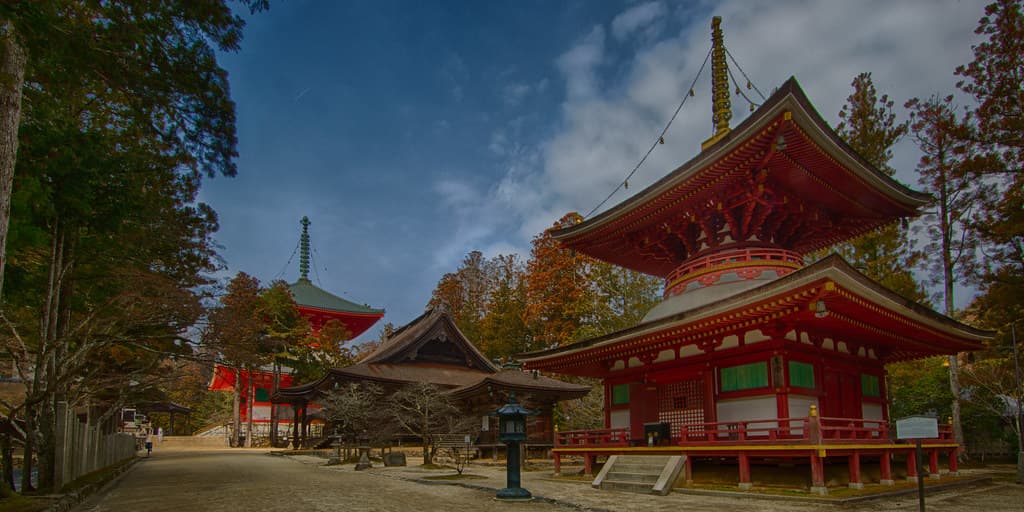
Image of Kongo-ji. Image source
Station 7 of 33
New Saigoku Kannon PilgrimageVisit essentials
A quick read before you go
- Duration
- 1.5 to 2 hours for a full circuit including treasure hall when open.
- Access
- From Nankai Kōya Line Kawachinagano Station, take a Nankai bus to the Amano-san stop (about 30…
Overview
Amano-san Kongō-ji is one of the most architecturally significant medieval Shingon complexes in Kansai outside Mt. Kōya itself. Founded according to tradition during the Tenpyō era (729–749) by the priest Gyōki under imperial decree of Emperor Shōmu — recognizing Mount Amano as a place of esoteric power — the temple was rediscovered in a dilapidated state in the late Heian period by the monk Akan, who led its revival.
Akan's restoration drew patronage from aristocratic women who were barred from the head Kōyasan monastery, and the temple became known as Nyonin Kōya, Women's Kōyasan: a place that held space for female monastic practice for nearly a millennium when many other Shingon centers refused it. During the Nanboku-chō wars of the 14th century, three Northern Court emperors were held here while the Southern Court used the temple as a base of operations, layering imperial-political memory atop ritual sanctity.
Today Kongō-ji is the sōhonzan (head temple) of the Shingon Omuro sect's Amano lineage, with five National Treasures including the Kondō and the Heian-period sculptural triad enshrined within it: a central Dainichi Nyorai flanked by Fudō Myō-ō and Gōzanze Myō-ō. The pilgrimage honzon for the New Saigoku Kannon route is a Nyoirin Kannon (Cintāmaṇi-cakra Avalokiteśvara), housed at the Mieidō rather than the Kondō — both enshrinements are accurate to different halls within the same complex.
The precincts were designated a National Historic Site in 1934 and expanded in 2011. Among the temple's lesser-known continuities is its tradition of Amano sake brewing — a long-standing monastic craft. As station 7 of the New Saigoku Kannon Pilgrimage, Kongō-ji's wooded valley setting and medieval halls offer a different texture from the urban Osaka temples earlier on the route.
Why this place is sacred
What gives Kongō-ji its devotional weight is layered continuity of an unusual kind. The valley setting on the slopes of Mount Amano was already a place of esoteric power before the temple's founding, by tradition recognized as such by Gyōki himself. The continuous Heian-through-medieval ritual record — over 1,200 years of esoteric practice — is documented through inscriptions, manuscripts, and the preserved sculpture and architecture.
The National Treasure tahōtō pagoda preserves Heian-era sacred geometry; the Kondō and its triad sculptural ensemble form one of the rarer surviving major medieval Shingon altar complexes. Layered onto the ritual continuity is the Nyonin Kōya identity — Akan's late-Heian revival drew aristocratic women patrons, and the temple became, for a long stretch of Japanese religious history, one of the few places where female monastic practice was institutionally welcomed.
Over this is layered the Nanboku-chō imperial-martyrological memory: three Northern Court emperors held here, the Southern Court using the temple as a base. The valley itself is read in esoteric Shingon as a Womb-Realm mandalic space.
Founded by Gyōki in the Tenpyō era as a Shingon esoteric Buddhist center on Mount Amano under imperial decree of Emperor Shōmu.
Founded Tenpyō era (729–749); revived late Heian period under the monk Akan; gained Nyonin Kōya identity through aristocratic women's patronage; site of Northern Court detention and Southern Court refuge during the Nanboku-chō wars; today the head temple (sōhonzan) of the Shingon Omuro branch's Amano lineage.
Experience and orientation
Visitors describe a sense of stillness in the wooded grounds, the unexpected scale of the medieval halls, and the contemplative power of the early Heian sculptures when the treasure hall is open. The Kondō, with its National Treasure Dainichi Nyorai-Fudō-Gōzanze triad, is the architectural and devotional centre. The Mieidō houses the Nyoirin Kannon used as the New Saigoku honzon. The tahōtō pagoda preserves Heian sacred geometry.
For women pilgrims and feminist Buddhist practitioners, the Nyonin Kōya identity carries particular resonance — the temple has held space for female practice for nearly a millennium when many monastic centers refused it. Treasure hall openings in spring (April–May) and autumn (October–November) expand the visit substantially; outside those windows, several halls and treasures remain closed.
From Nankai Kōya Line Kawachinagano Station, take a Nankai bus to the Amano-san stop (about 30 minutes), then walk a short distance to the temple.
Context and lineage
Tradition holds that Gyōki, traveling through Kawachi during the Tenpyō era (729–749), recognized Mount Amano as a place of esoteric power and founded the temple at Emperor Shōmu's request. The temple fell into disrepair in subsequent centuries. In the late Heian period, the monk Akan (also written Akkan) rediscovered the dilapidated site and led its revival, drawing patronage from aristocratic women who were barred from the head Kōyasan monastery.
The temple thereafter became known as Nyonin Kōya — Women's Kōyasan — and served as an institutional refuge for female Shingon practice. During the 14th-century Nanboku-chō wars, three Northern Court emperors were detained at Kongō-ji while the Southern Court used the temple as a base; the temple's persistence through these political disruptions is itself part of its history.
Shingon Buddhism (Omuro branch) — head temple (sōhonzan) of the Shingon Omuro sect's Amano lineage; medieval revival drew on eclectic Tendai-influenced practice and Sanron studies.
Traditions and practice
Goma fire ceremonies in the esoteric Shingon style anchor the temple's ritual life. Pilgrims commonly recite the Heart Sutra and Kannon mantras at the Mieidō before the Nyoirin Kannon. Seasonal unveilings of normally hidden sculptures occur during the spring and autumn treasure-hall openings.
Daily monastic services continue. The pilgrim stamp office (nōkyōjo) issues stamps for the New Saigoku Kannon (no. 7), the Kawachi Kannon circuit, and the historic Kongō-bu pilgrimage. Spring and autumn treasure-hall openings allow lay visitors to see normally hidden images. Lay visitors may join goma rituals on scheduled days and participate in seasonal Kannon services.
Time the visit to the spring (April–May) or autumn (October–November) treasure-hall openings if possible — the Kondō, tahōtō, and main triad are most fully accessible then, and spring cherry and autumn maples enhance the wooded grounds. If walking the New Saigoku, Kongō-ji and Kanshin-ji (the route's bangai-2) can be paired in a single Kawachinagano day.
Buddhism (Shingon Omuro branch)
ActiveHead temple (sōhonzan) of the Shingon Omuro sect's Amano lineage, a major Esoteric Buddhist center in Kawachi province since the 8th century. Its medieval revival under the monk Akan made it influential as Nyonin Kōya — Women's Kōyasan — admitting women pilgrims when the head Mt. Kōya monastery did not. Five National Treasures, multiple Important Cultural Properties, and National Historic Site designation mark the temple's standing. The pilgrimage honzon for the New Saigoku Kannon route is a Nyoirin Kannon at the Mieidō; the Kondō's National Treasure triad of Dainichi Nyorai with Fudō Myō-ō and Gōzanze Myō-ō is the temple's broader iconographic centre.
Perspectives and open questions
Kongō-ji is read across at least four frames: as a Heian-medieval Shingon institutional and architectural treasury, as the historic Nyonin Kōya welcoming women's practice, as a site of Nanboku-chō imperial drama, and as one of station 7 of the New Saigoku Kannon route.
Scholarly perspective
Kongō-ji is documented as one of the most architecturally significant and best-preserved medieval Shingon complexes in Kansai outside Kōyasan itself, with a continuous Heian-through-medieval ritual record. Five National Treasures including the Kondō and its sculptural triad, multiple Important Cultural Properties, and National Historic Site designation (1934, expanded 2011) mark its standing.
Living and traditional perspectives
Within the Shingon tradition, Amanosan is regarded as a manifestation of esoteric mandalic geography, the valley itself read as a Womb-Realm space. The Nyonin Kōya identity is held as a defining institutional virtue — a Shingon center that welcomed women when others refused.
Alternative interpretations
Some practitioners associate Mount Amano's waters with healing and read the temple's persistence through wars and fires as evidence of protective deities (kami and Buddhist guardians) embedded in the landscape.
Open questions
The exact ritual program of the medieval Akan revival, the original siting choice by Gyōki, and the full circumstances of Southern Court refuge here remain partially obscure. The Wikipedia listing of the Kondō Dainichi Nyorai as 'honzon' and the New Saigoku register's specification of Nyoirin Kannon are both accurate to different halls within the same complex.
Plan your visit
Access and arrival
From Nankai Kōya Line Kawachinagano Station, take a Nankai bus to the Amano-san stop (about 30 minutes), then a short walk to the temple. Parking available for drivers.
No on-site lodging at Kongō-ji itself; nearby Kawachinagano and the Mt. Kōya shukubo are options for pilgrims continuing on the New Saigoku route.
Respectful visit
Modest dress; shoes off when entering halls.
Permitted outdoors; prohibited inside the Kondō and treasure hall.
Incense and saisen standard; pilgrims commonly leave an osamefuda before stamping.
Some buildings are closed during ritual hours; treasure hall opens only in spring (April–May) and autumn (October–November).
Some buildings are closed during ritual hours. Treasure hall opens only seasonally — confirm before visiting. Avoid heavy rain — paths through the precincts can be slick.
Current practical details
Address
996 Amanochō, Kawachinagano, Osaka 586-0086, Japan
Phone
Hours
Hours, fees, and access can change — verify on the official source before you travel. Practical details last checked Jun 2026.
Location
Map loads as you approach this section.
Pilgrim reflections
A portrait of encounter, not a score
Pilgrims describe what they felt, how present they could become, and whether the place would shape a journey. There are no stars and no ranking of traditions.
No reviewed reflections yet
The first pilgrims can help describe the character of being here.
Share a reflection
Available after an account-backed “Been there.” Every reflection is reviewed before publication.
Nearby sacred places
Explore other sacred places in the region. Proximity does not establish access or travel time; check each place’s guidance.


References
Sources consulted for this page. Source categories describe the publication, not a guarantee that every claim is verified. Traditional accounts and outside interpretations may differ.
- 01Kongō-ji — Wikipedia (English) — Wikipedia contributorsofficialCoordinates 34.4286°N 135.52935°E; founded by Gyōki under Emperor Shōmu, head of Shingon Omuro sect; 5 National Treasures including the main Kondō sculptural triad.
- 02Special Exhibition Kanshin-ji and Kongō-ji, Two Temples of Kawachinagano: Esoteric Buddhist Art and the Legacy of the Southern Court — Exhibition Guide — Kyoto National MuseumacademicAuthoritative scholarly account of Kongō-ji's history, Heian-period revival, and Southern Court connections.
- 03Amanosan Kongo-ji Temple: A Majestic Ancient Temple That Weaves History — TabiiroguideVisitor-focused overview confirming layout, sake brewing tradition, and pilgrimage role.
- 04Kawachinagano Tourism: Amano-san Kongō-ji — Osaka Convention & Tourism BureauofficialTourism-board confirmation of address, access, festival schedule.
Pilgrim glossary
- Honzon
- The principal Buddhist deity enshrined as a temple's central object of worship.
- Kannon
- The bodhisattva of compassion, central to many East Asian pilgrimage routes.
- Sutra
- A canonical Buddhist scripture, often chanted as part of practice.
- Mantra
- A sound, word, or phrase repeated as part of meditation or ritual.
- Shingon
- An esoteric Japanese Buddhist school emphasizing ritual, mantra, and mandala practice.
- Tendai
- A Japanese Buddhist school based on the Lotus Sutra, foundational to many later traditions.
Share a photo
Help visitors recognize Kongo-ji. Every submission is reviewed before publication.