Mitsumine Jingu (Mitsumine Grand Shrine)
Where Japan's creator deities dwell alongside the spirits of extinct wolves on a sacred mountain above the clouds
Understand sacred places, explore living traditions, and learn how to engage respectfully with Pilgrim Map.
Access has not been verified. Check current local guidance before planning a visit.
Chichibu, Saitama Prefecture, Japan
Read the sources
Visit essentials
A quick read before you go
- Duration
- Half day minimum from Chichibu.
- Access
- From Tokyo: Seibu Railway to Seibu-Chichibu Station (approximately 80 minutes express from…
Overview
After a bus climb of over an hour into the Chichibu mountains, Mitsumine Shrine stands 1,100 meters above sea level. A rare triple torii and wolf guardians mark separation from ordinary life.
The shrine enshrines Izanagi and Izanami, Shinto's creators of the Japanese islands, but many pilgrims seek their wolf messengers. Tradition says wolves guided the lost Prince Yamato Takeru to safety nearly two thousand years ago, prompting his grateful dedication. In 1720, wolves appeared to a meditating priest as divine omens, and he began distributing protective amulets.
Although the last confirmed Japanese wolf sighting was in 1905, Mitsumine venerates wolves as Oguchi-no-makami, 'true god of the great mouth.' Stone guardians, pilgrimage seals, and amulets protecting against fire, theft, and misfortune continue a practice once drawing village delegations across Kanto.
Two 800-year-old cedars flank the carved worship hall. Visitors touch their bark for ki, vital energy said to bring courage, motivation, and vitality. On clear days, a sea of clouds lies below Yohaiden Pavilion; sacred presence survives the wolves' disappearance.
Why this place is sacred
Mountains in Japan have always been understood as dwelling places of kami—not symbols of the divine but actual locations where spirit and matter interpenetrate. Mitsumine Shrine sits within this understanding at 1,100 meters elevation, where the physical ascent mirrors spiritual approach.
The shrine's thinness operates on multiple registers. The primary deities—Izanagi and Izanami—are not minor spirits but the creators of Japan itself. To worship here is to stand before the source. Yet layered onto this foundation is the distinctive wolf tradition: the understanding that wild animals can serve as divine messengers, that the boundary between creature and spirit is permeable.
The extinction of the Japanese wolf in 1905 adds an elegiac dimension; visitors encounter not living wolves but their enduring spiritual presence, maintained through stone statues, amulets, and continuing veneration.
Shugendo practitioners—the mountain ascetics who blend Shinto, Buddhism, and Daoism—recognized Mitsumine's power by the late seventh century. For centuries, yamabushi conducted their ninety-day summer training in these mountains, using physical hardship to break through ordinary consciousness. The waterfall at Seijo, halfway up the traditional approach trail, served as purification site. Though formal Shugendo practice faded after the Meiji Restoration, its influence permeates the site.
The rare triple torii gate marks a clear threshold. Passing through it, visitors enter different space—not metaphorically but experientially. The 800-year-old cedar trees, the wolf guardians, the mountain air, the distance from urban Japan: all contribute to an atmosphere where the veil between worlds seems thin. From the Yohaiden Pavilion, when clouds gather below, the shrine appears to float above the mundane world entirely.
The shrine was founded to honor Izanagi and Izanami, Japan's creator deities, at a site where Prince Yamato Takeru experienced divine protection through wolves. It later became a center for Shugendo mountain asceticism and wolf deity worship.
From traditional foundation around 150 CE through Shugendo development in the seventh century to wolf amulet distribution from 1720, Mitsumine has accumulated layers of spiritual practice. The Meiji Restoration separated its Buddhist and Shinto elements, designating it purely Shinto. The extinction of Japanese wolves shifted veneration from living creatures to spiritual presences. Today's shrine integrates these layers while remaining an active place of worship.
Experience and orientation
The journey to Mitsumine begins before the shrine. Whether riding the bus through winding mountain roads or hiking the traditional Omotesando trail, visitors experience gradual ascent—leaving behind the familiar, climbing toward the sacred. The elevation change is physical and tangible; the air grows cooler, the trees change, ordinary Japan falls away.
The first striking feature is the mitsu-torii—the rare triple torii gate that marks the entrance. Most torii consist of two uprights and two crossbars; Mitsumine's elaborate structure announces that this is no ordinary shrine. Flanking it, wolf statues stand guard. Their presence, where other shrines place lion-dogs, signals the distinctive character of this place.
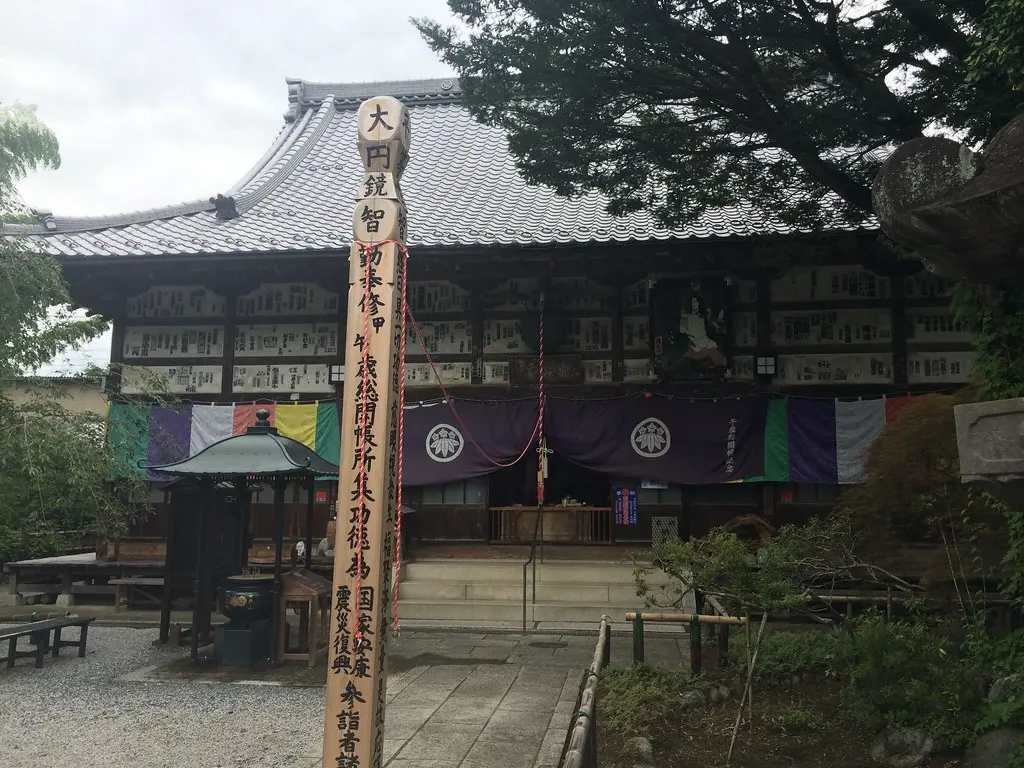
Beyond the gate, the shrine unfolds through multiple buildings and spaces. The haiden (worship hall) is decorated with vivid carvings; even visitors uninterested in religious practice find themselves studying the detailed artistry. Beside it, two enormous cedar trees rise—800 years old, regarded as living conduits of spiritual energy. Many visitors stand with palms pressed against the bark, receiving ki.
The Yohaiden Pavilion offers expansive views across the Chichibu mountains. On certain days—particularly autumn and winter mornings—clouds gather below, creating the phenomenon of unkai: a sea of clouds with the shrine floating above. This visual experience encapsulates the shrine's spiritual geography: elevation not merely physical but ontological.
Throughout the grounds, wolf imagery appears: statues, carvings, amulets for sale. The shrine shop offers the famous Ki no Omamori, amulets containing wood from the sacred cedars, said to transmit courage, motivation, and vitality. The goshuin (pilgrimage seal) features wolf imagery and the inscription 'tohai'—ascent and worship—acknowledging that reaching this mountaintop shrine is itself a spiritual act.
Approach Mitsumine as pilgrimage, not tourism. The journey matters as much as the destination. Plan to arrive early to allow unhurried exploration. At the shrine, follow standard etiquette: purify at the water basin, approach the worship hall with respect, bow and clap in the traditional manner. Touch the sacred cedars if you seek their energy. Allow time at the Yohaiden Pavilion, especially if weather permits views of the cloud sea.
Context and lineage
Prince Yamato Takeru, son of the legendary twelfth Emperor Keiko, was returning from his mission to subdue the eastern clans when he became lost in the mountains. As he wandered, wolves appeared and guided him safely through the wilderness. Moved by the beauty of the peaks and grateful for the wolves' protection, he dedicated this site as a shrine to Izanagi and Izanami, the divine couple who had created Japan.
The wolves became understood as divine messengers, a belief formalized centuries later when wolves appeared to the meditating priest Nikko Hoin in 1720, leading him to distribute wolf amulets that spread the shrine's fame throughout the Kanto region.
Mitsumine Shrine is one of the Chichibu Sanja—the Three Shrines of Chichibu—alongside Chichibu Shrine and Hodosan Shrine. This triad anchors the region's ancient tradition of mountain worship. The shrine also connects to the broader Chichibu 34 Kannon Pilgrimage, placing it within a landscape understood as inherently sacred. Its designation as a Beppyo Shrine under the Association of Shinto Shrines confirms its continuing importance within Japan's religious hierarchy.
Yamato Takeru
Legendary prince who traditionally founded the shrine around 150 CE after wolves guided him to safety in the mountains
En no Gyoja
Founder of Shugendo who established formal mountain ascetic practice at Mitsumine in the late 7th century
Kukai
Renowned Buddhist monk who carved a statue of Eleven-Headed Kannon at the shrine in the 8th-9th century
Gekkan Doman
Shugendo priest who spent 27 years raising funds to rebuild the shrine, achieving his goal in 1533
Nikko Hoin
Priest who formalized wolf worship in 1720 after wolves appeared during his mountaintop meditation
Traditions and practice
The Edo period saw Mitsumine become a major pilgrimage destination as urban Japanese sought protection against fire and theft—constant dangers in wood-built cities. Villages pooled resources to send delegations who would bring back wolf amulets for communal protection. During cholera epidemics in the 1800s, wolf talismans were sought as protection against the disease; shrine records document the reach of this belief across the Kanto region and along the Tokaido road.
Mountain ascetics (yamabushi) conducted ninety-day summer training involving fasting, cold water immersion, and other austerities. Pilgrims purified themselves at Seijo Falls before approaching the shrine.
Today's visitors engage through multiple forms. Standard Shinto worship remains central: purification at the temizuya (water basin), approach to the haiden (worship hall), the sequence of bows and claps, silent prayer. Many visitors touch the bark of the 800-year-old cedar trees to receive spiritual energy (ki). The shrine shop offers wolf amulets for protection and Ki no Omamori containing sacred cedar wood. The goshuin office provides pilgrimage seals with wolf imagery. The Annual Festival on April 14th brings traditional ceremonies.
New Year celebrations include a fire festival and midnight bell-ringing.
Begin with purification at the water basin near the entrance. Approach the haiden, toss a small offering, bow twice, clap twice, offer silent prayer, bow once more. Spend time with the sacred cedar trees—touch their bark if you wish to receive their energy. Visit the Yohaiden Pavilion for mountain views. Consider acquiring a wolf amulet or Ki no Omamori as tangible connection to the shrine's protective traditions.
If time permits and conditions allow, the traditional Omotesando hiking trail from Mitsumineguchi Station offers the full pilgrimage experience.
Shinto Mountain Worship
ActiveMitsumine Shrine embodies the Japanese understanding of mountains as dwelling places of kami. The shrine honors Izanagi and Izanami, the creator deities who made Japan, at a site of profound natural beauty 1,100 meters above sea level.
Worship at the haiden (main hall), prayer to creator deities, receiving energy from sacred cedar trees, pilgrimage ascent as spiritual practice
Wolf Deity Worship (Okami)
ActiveMitsumine is one of Japan's most important sites for wolf spirit veneration. The now-extinct Japanese wolf is honored as Oguchi-no-makami, divine messenger and protector, continuing traditions that once brought pilgrims from across the Kanto region.
Veneration at wolf guardian statues, acquisition of wolf amulets for protection against fire and theft, prayers to wolf spirits, receiving goshuin with wolf imagery
Shugendo (Mountain Asceticism)
HistoricalFrom the 7th century, Mitsumine served as a center for Shugendo practice—the mountain ascetic tradition blending Shinto, Buddhism, and Daoism. Yamabushi trained here for centuries.
Historical: ninety-day summer training, waterfall purification, physical austerities, meditation in mountain wilderness
Perspectives and open questions
Mitsumine Shrine can be understood through Shinto theology, historical pilgrimage studies, ecological spirituality, and contemporary power spot culture—perspectives that complement rather than contradict each other.
Scholarly perspective
Religious studies scholars recognize Mitsumine as an important example of sangaku shinko (mountain worship) and the influence of Shugendo on Japanese spirituality. The wolf worship tradition, documented from 1720, reflects broader patterns of animal messenger beliefs in Japanese religion. The shrine's role in Edo-period protection beliefs illustrates how sacred sites responded to urban social anxieties. The extinction of the Japanese wolf in 1905 makes Mitsumine a case study in how spiritual traditions persist beyond the biological existence of their referents.
Living and traditional perspectives
Shinto understanding places Mitsumine within the sacred geography of the Chichibu mountains, where kami dwell in peaks and forests. The wolves are not merely animals but divine messengers (shinshi), manifestations of mountain deity power that guided Yamato Takeru and appeared to Nikko Hoin. The cedar trees contain ki (spiritual energy) transmissible through touch. The pilgrimage seal's inscription 'tohai' (ascent and worship) expresses the understanding that physical elevation is spiritual approach.
Alternative interpretations
Contemporary seekers often frame Mitsumine as a 'power spot' where earth energies concentrate and spiritual receptivity heightens. The wolf spirits are understood as guides accessible through meditation and intention. The shrine's popularity for transmitting yuki (courage), yaruki (motivation), and genki (vitality) aligns with broader interest in energy work and spiritual self-development.
Open questions
The nature of pre-Buddhist mountain worship at this site remains uncertain. Whether the wolf traditions preserve genuinely ancient beliefs or represent 18th-century innovation built on older foundations is debated. The subjective experiences of yamabushi during their ascetic practices were rarely documented. And the wolves themselves—what they experienced, how they lived, why they ultimately perished—remain mysteries that no spiritual tradition fully addresses.
Plan your visit
Access and arrival
From Tokyo: Seibu Railway to Seibu-Chichibu Station (approximately 80 minutes express from Ikebukuro), then bus to Mitsumine-jinja (75 minutes, approximately 950 yen). Alternative: Train to Mitsumineguchi Station, then bus (55 minutes, approximately 690 yen). By car: Mountain roads accessible but winding. Traditional pilgrimage approach: Hike the Omotesando trail from Mitsumineguchi (approximately 3-4 hours).
Kounkaku lodge on shrine grounds offers accommodation. Ryokan and hotels in Chichibu city. Seibu-Chichibu Station area has various options for those arriving late or departing early.
Respectful visit
Modest dress appropriate for shrine visit. Sturdy walking shoes essential. Layers recommended for mountain weather.
Permitted in outdoor areas. Restricted in some indoor spaces. No photography during ceremonies unless explicitly allowed. Respect others' privacy at worship.
Small monetary offerings may be made at the haiden. Wolf amulets, Ki no Omamori, and other items available at shrine shop.
{"Do not walk in center of approach path","Observe quiet, respectful behavior","Photography restricted in some buildings","Do not feed wildlife","Follow instructions during ceremonies"}
This is an active place of worship. Observe quiet, respectful behavior. Follow any instructions during ceremonies or festivals. Photography restrictions apply in some buildings. The mountain location means weather can change; dress appropriately and be prepared for cooler temperatures than lowland areas.
Current practical details
Address
298-1 Mitsumine, Chichibu, Saitama 369-1902, Japan
Phone
Hours
Hours, fees, and access can change — verify on the official source before you travel. Practical details last checked Jun 2026.
Location
Map loads as you approach this section.
Pilgrim reflections
A portrait of encounter, not a score
Pilgrims describe what they felt, how present they could become, and whether the place would shape a journey. There are no stars and no ranking of traditions.
No reviewed reflections yet
The first pilgrims can help describe the character of being here.
Share a reflection
Available after an account-backed “Been there.” Every reflection is reviewed before publication.
Nearby sacred places
Explore other sacred places in the region. Proximity does not establish access or travel time; check each place’s guidance.



References
Sources consulted for this page. Source categories describe the publication, not a guarantee that every claim is verified. Traditional accounts and outside interpretations may differ.
- 01Mitsumine Shrine - Chichibu Travel — Japan-Guide.comguideComprehensive practical and historical information
- 02Mitsumine Shrine — Shinto WikiencyclopediaDetailed Shinto context and religious significance
- 03Mitsumine Jinja Shrine — Chichibu Omotenashi Tourism OrganizationofficialOfficial regional tourism information
- 04Mitsumine Shrine: A Hidden Gem in Chichibu's Mountains — Japan ExperienceguideDetailed visitor and spiritual information
- 05Mitsumine Shrine — Chichibu GeoparkSource contextCultural and geological context
- 06Saitama Support Desk - Mitsumine Shrine — Saitama Prefecture TourismofficialOfficial prefectural tourism information
- 07Throw a God a bone: Wolf Shrine at Mitsumine, Japan — Endangered MetaphorsspiritualDetailed wolf worship traditions
- 08Mitsumine Shrine: a mountaintop sanctuary with a deep connection to wolves — Postcards from JapanguideVisitor experience and wolf spirituality
Pilgrim glossary
- Kannon
- The bodhisattva of compassion, central to many East Asian pilgrimage routes.
- Torii
- The traditional Japanese gate marking the entrance to a Shinto sacred area.
Share a photo
Help visitors recognize Mitsumine Jingu (Mitsumine Grand Shrine). Every submission is reviewed before publication.