Ayazini
Where three civilizations chose the same rock — Phrygian tombs, Roman chambers, and a Byzantine church carved from the living cliff
Understand sacred places, explore living traditions, and learn how to engage respectfully with Pilgrim Map.
Access has not been verified. Check current local guidance before planning a visit.
Afyonkarahisar, Turkey
Read the sources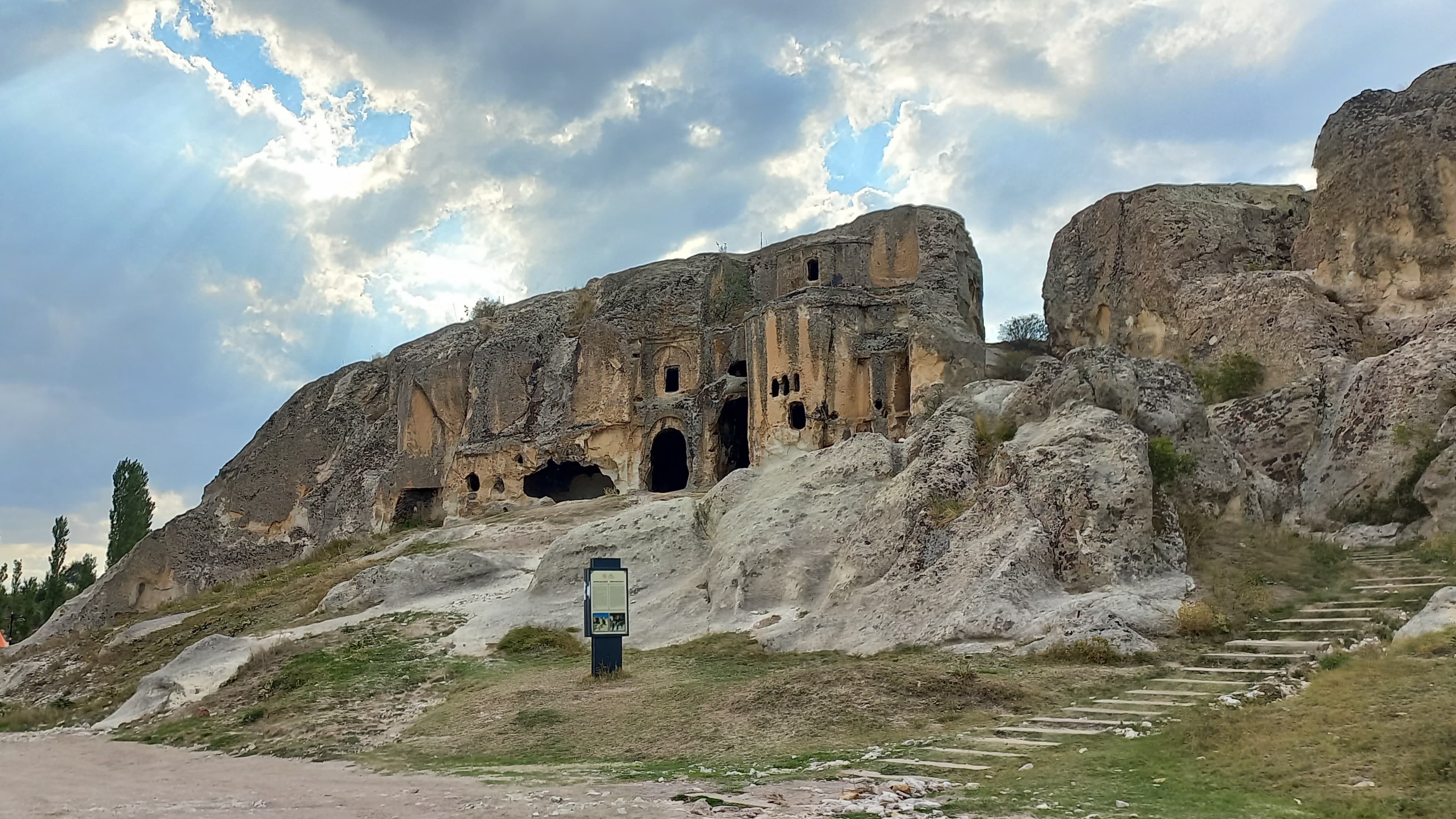
Image of Ayazini. Image source
Visit essentials
A quick read before you go
- Duration
- Allow 1.5–2.5 hours for the church, adjacent dwellings, and cliff tomb sections.
- Access
- Ayazini village is 29 km north of Afyonkarahisar city.
Overview
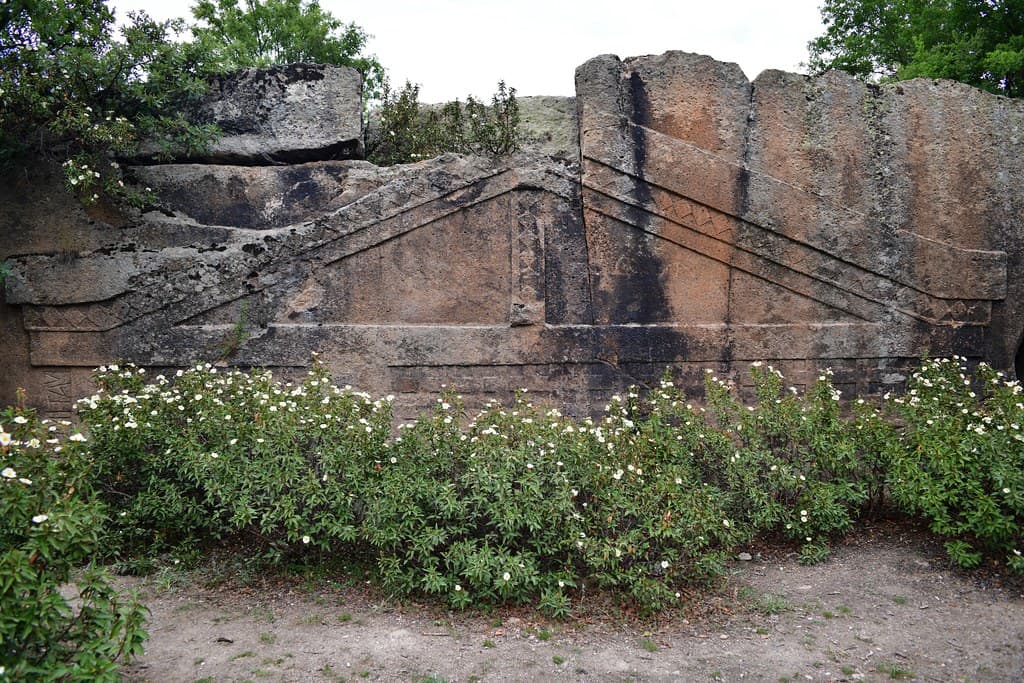
Ayazini in the Phrygian Valley resists a single era: successive communities with different reasons repeatedly chose the same volcanic-tuff cliffs. Phrygians carved tomb chambers, some with lion-column facades characteristic of their funerary art. Roman builders added classical pediments and Medusa-head reliefs. In the seventh century AD, Byzantine Christians carved an entire church from living rock. Its Greek-cross plan, dome, six supporting columns left standing as surrounding stone was removed, and attached baptistery make it a cave church of rare ambition.
Outside the more famous Cappadocian rock-cut tradition, it shares the conviction that earth itself could become sanctuary and worship inside the rock differed from worship above it. Ayazini village still surrounds the formations; residents use some carved chambers for storage, while the church remains preserved and visitable. The place stays alive not through one continuing tradition but through its persistent worth as somewhere to inhabit.
Why this place is sacred
What makes a place consistently chosen? The volcanic tuff geology of Ayazini is workable — it can be carved with relatively simple tools, holds its shape once cut, provides natural thermal regulation, and offers security through the simple fact of being stone. These are practical reasons.
But practical reasons don't explain why each civilization that encountered these cliffs moved beyond simple utility — why the Phrygians added lion columns to their tomb facades, why the Romans carved Medusa heads into the pediments of what might have been simple storage chambers, and why the Byzantines chose to spend the extraordinary effort of carving not just a room but a designed ecclesiastical space with columns, a dome, and a baptistery from solid rock.
Each of these acts was an investment of intention beyond what mere shelter required. The repeated choice of this specific valley, this specific cliff, this specific density of carved forms, suggests something more than practical suitability.
The possibility that Ayazini's name derives from the Byzantine Greek for 'holy water' or 'sacred spring' introduces another dimension: an underground water source, long since dried or diverted, might have been the original drawing factor — the presence of water in what would otherwise be dry volcanic rock, the kind of geological surprise that repeatedly drew sacred attention in this landscape of Cybele and her rivers.
Whether or not this etymology is correct, the quality of accumulated choice is palpable at the site. Standing in the carved church and hearing the acoustics — sound behaving differently inside stone than it does in any constructed space — the sense is of a place that has been prayed in for reasons that outlast any single tradition's explanation.
Multi-period sacred and domestic settlement: Phrygian rock-cut tombs, Roman-period elite chambers, Byzantine Christian rock-cut church and monastic complex. The primary sacred layer is the seventh-century Byzantine church and associated monastery.
Phrygian habitation and burial from the eighth to sixth centuries BC; Roman-period elaboration (date uncertain); Byzantine Christian church and monastic community from the seventh century AD; likely continued use through the Seljuk and early Ottoman periods; now a living village with the church preserved as a heritage site and Phrygian Way waypoint.
Experience and orientation
Arriving in Ayazini is arriving in a village where the ancient is not separated from the present. Houses sit against the cliff face; a doorway that looks residential may open into a rock-cut chamber that has served as storage for a hundred years of different households. The church announces itself before you enter it: the façade carved into the cliff has the proportional gravity of intentional architecture rather than utilitarian excavation. Step inside.
The space is larger than the entrance suggests. The six columns — left standing as the surrounding rock was carefully removed over many working seasons — hold the low dome above an interior of surprising dimensions. Look at the columns carefully: they are not brought in from outside but hewn from the same tuff as the walls and floor, continuous with the mountain.
The cross-plan is clear; the dome meets the arms of the cross at pendentives carved with the rock. Find the baptistery, carved into a recess off the main space. The immersion basin, cut into the floor of the church, gave baptism the quality of a descent — not into water alone but into rock and water together, into the earth. The acoustics of the main space repay any sound you make.
A word spoken in one corner reaches the dome differently than it reaches the floor. Phrygian-period tomb chambers are visible in the cliff above and to the sides of the church — the older layers of the site made legible by their different carving style, the lion columns and triangular pediments of Roman-period facades. The site does not narrate this layering for you; it is simply present, requiring the visitor's attention to organize.
Ayazini village is entered from the main road from Afyonkarahisar. The church is at the village entrance, carved into the cliff face to the right as you enter. The rock-cut dwellings are visible above and behind the church. The Phrygian-period tombs are accessible on foot along the cliff base. Free entry throughout.
Context and lineage
No founding legend is recorded for Ayazini, and no historical figure is specifically associated with its founding. The name may derive from Byzantine Greek — either from 'hagiasmós' (holy water, sacred spring) or from 'hagios' (saint), suggesting either a sacred water source or a saint's dedication that has not been preserved in the historical record.
The earliest human engagement with the site was Phrygian: rock-cut tomb chambers with lion column facades were carved into the tuff during the eighth to sixth centuries BC, placing Ayazini within the same sacred landscape tradition that produced Aslantaş, Yılantaş, and Arslankaya. Roman-era builders followed, adding more elaborate classical facade treatments to some chambers.
The Byzantine presence was the most architecturally ambitious: a church carved entirely from the living rock in the seventh century AD, following the same impulse that produced the rock-cut monastic churches of Cappadocia but outside that better-known tradition. The church's Greek cross plan with a central dome, six columns, and a full rock-cut baptistery represents a level of investment that implies a significant and settled monastic community. Inscriptions featuring the Virgin Mary and crosses confirm its Christian dedication.
The site continued in use through the Seljuk and early Ottoman periods, after which the Christian community departed and the rock chambers passed into secular village use.
Phrygian (8th–6th c. BC) → Roman period (date uncertain) → Byzantine Christian (7th c. AD onward) → Seljuk-era continuation → Ottoman period, gradual Christian community departure → modern Turkish village with heritage designation
Anonymous Byzantine monastic community
The monks who designed and inhabited the rock-cut church and monastery complex, whose identity is not recorded in surviving sources but whose work gives the site its most significant sacred layer
Virgin Mary (as venerated presence)
The church's primary dedication, attested by inscriptions found within the complex — a Byzantine Marian monastery in the Phrygian Valley
Traditions and practice
The Byzantine monastic community that established the church at Ayazini conducted the full liturgical life of Eastern Christianity within this carved space — the Divine Liturgy celebrated in a church whose columns and dome were continuous with the mountain, whose baptistery offered initiates a descent into stone and water, and whose acoustics transformed chant in a way that no surface-built church could replicate.
The rock-cut baptistery, immersive by design, gave baptism the quality that Byzantine theology always attributed to it: a death and resurrection, enacted through a physical descent into the earth and emergence from it. Monastic prayer cycles structured daily life in the adjacent rock-cut dwellings; the community was self-contained within the cliff. The Phrygian tombs already present in the cliff above provided a persistent visual reminder of earlier sacred engagement with the same stone.
No active religious worship is conducted at the site. The church is preserved and visitable. Some rock-cut chambers remain in village use for storage or animal shelter. The Phrygian Way hiking trail passes through Ayazini, and the site receives regular visitors.
Begin with the church. Enter without speaking and let the acoustics register in silence. The quality of sound inside the rock is the most immediately available dimension of the site's character — what liturgical chant sounded like here, how prayer would have resonated in this carved dome, is more accessible to the imagination in silence than in conversation.
Walk the perimeter of the interior slowly, touching the columns only if permitted — they are the same volcanic tuff as the walls, hewn from the rock as the space was created rather than brought in, and their surfaces hold the tool marks of the carvers. Find the baptistery in its recess and look at the immersion basin cut into the floor.
Then leave the church and spend time on the cliff above — the Phrygian tombs with their lion column facades are earlier by a thousand years, built in the same rock, by people who had entirely different reasons for being here. The Roman-period facades with their Medusa head reliefs are visible between the Phrygian and Byzantine layers. The site does not organize these layers for you; the task of holding them simultaneously is yours.
Phrygian Habitation
HistoricalThe volcanic tuff formations at Ayazini were first shaped in the Phrygian period, with tomb chambers featuring lion column facades characteristic of Phrygian funerary art. This places Ayazini within the same sacred landscape as Aslantaş, Yılantaş, and Arslankaya — a tradition of choosing this volcanic geology for its most important dead.
Rock-cut tomb construction; possible domestic habitation in carved chambers; ancestral veneration at tomb facades
Byzantine Christianity
HistoricalThe seventh-century rock-cut church is Ayazini's most architecturally significant sacred layer — a fully realized Byzantine ecclesiastical space with dome, columns, cross-plan, and baptistery, all carved from the living tuff. The Marian inscriptions confirm its Christian dedication.
The Divine Liturgy in the rock-cut church; monastic prayer cycles in the adjacent rock-cut dwellings; baptism in the carved immersion basin; communal life in the cliff settlement
Archaeological Heritage
ActiveAyazini is listed on Turkey's cultural heritage inventory as a multi-period site within the Phrygian Valley protected area. It is a destination on the Phrygian Way cultural hiking route and receives regular heritage visitors.
Archaeological survey; heritage tourism; Phrygian Way trail maintenance and interpretation
Perspectives and open questions
Ayazini has been studied primarily as a Byzantine rock-cut church site, but its layered character — Phrygian, Roman, Byzantine — invites a broader interpretive frame about why this specific valley and this specific cliff drew repeated sacred attention.
Scholarly perspective
The Byzantine church at Ayazini is recognized as a significant example of rock-cut ecclesiastical architecture outside Cappadocia — well-preserved, technically accomplished, and representing a monastic tradition in western Anatolia that is less well-documented than its Cappadocian counterpart. The multi-period character of the site (Phrygian, Roman, Byzantine) is consistent with the pattern seen across the Phrygian Valley, where volcanic tuff formations attracted human settlement and sacred use repeatedly.
The origin of the name 'Ayazini' from a possible sacred water source remains speculative — no spring has been identified at the site — but the etymology is taken seriously by some scholars.
Living and traditional perspectives
For the Byzantine monastic community, carving sacred space from the living rock was simultaneously a practical choice and a profound theological act. The earth itself became sanctuary. The rock church extended downward from the ground where worshippers stood to the bedrock of the mountain, making the congregation's prayer continuous with the geological substrate of the world. The baptistery's immersion basin, cut into the floor, gave the sacrament of baptism a quality of literal descent into the earth.
Alternative interpretations
The possible derivation of 'Ayazini' from 'holy water' (Greek hagiasmós) has led some to propose that an original sacred spring drew the first settlement here — a spring that was later incorporated into the Phrygian, Roman, and Byzantine layers of use before drying or being diverted. This reading would place water, rather than simply rock, at the origin of the site's sacred character, connecting Ayazini to the broader Anatolian tradition of sacred springs that recurred across different religious traditions.
Open questions
The identity of any saint specifically venerated at the site — suggested by the possible 'hagios' etymology — is not established. The full extent of the Phrygian-period use and the nature of any pre-Byzantine sacred practices here remain unclear. Whether there was ever a sacred spring at this location cannot be determined from the current evidence.
Plan your visit
Access and arrival
Ayazini village is 29 km north of Afyonkarahisar city. Drive north on D-665 through Çayırbağ and Gazlıgöl, then turn east toward Ayazini; the church is at the village entrance. Several minibuses daily from Afyonkarahisar provide public transport. Free entry throughout the site. The Phrygian Way long-distance hiking trail passes through the village. Mobile signal is generally available in the village but may be unreliable on the upper cliff sections. For emergency services, Afyonkarahisar (29 km south) is the nearest city.
No accommodation in Ayazini village itself. Afyonkarahisar (29 km south) offers a full range of accommodation options and is the recommended base for visiting multiple Phrygian Valley sites. The D-665 road makes Ayazini convenient for a morning or afternoon visit from Afyonkarahisar.
Respectful visit
Dress modestly for the church — covered shoulders and knees are appropriate, though no strict enforcement is noted. Practical outdoor clothing for the cliff and tomb sections.
Photography is permitted throughout the site. Inside the church, use natural light — the space has no artificial lighting, and flash photography affects the atmosphere for other visitors.
Not applicable at this site.
Do not enter rock-cut sections that appear to be in active village use without permission. Respect the church as a sacred historical space — no loud behavior. Do not disturb any archaeological features.
Respect the church as a sacred historical space — silence and careful movement are appropriate. Do not enter rock-cut chambers that appear to be in private village use without explicit permission. The cliff face has uneven and sometimes unstable terrain — watch your footing on the upper sections.
Location
Map loads as you approach this section.
Pilgrim reflections
A portrait of encounter, not a score
Pilgrims describe what they felt, how present they could become, and whether the place would shape a journey. There are no stars and no ranking of traditions.
No reviewed reflections yet
The first pilgrims can help describe the character of being here.
Share a reflection
Available after an account-backed “Been there.” Every reflection is reviewed before publication.
Nearby sacred places
Explore other sacred places in the region. Proximity does not establish access or travel time; check each place’s guidance.



References
Sources consulted for this page. Source categories describe the publication, not a guarantee that every claim is verified. Traditional accounts and outside interpretations may differ.
- 01Ayazini, İhsaniye - Wikipedia — Wikipedia contributorsencyclopediaOverview of the village and archaeological site
- 02Ayazini - Turkish Archaeological News — Turkish Archaeological NewsacademicDetailed archaeological description of the rock-cut structures
- 03Ayazini Ören Yeri (Metropolis) - Kültür Portalı — Turkish Ministry of CultureofficialOfficial Turkish cultural heritage listing
- 04Ayazini Church: A Rock-Cut Structure Witnessing History — Anatolian SecretsguideFocused description of the Byzantine rock-cut church
- 05Rock-Cut Church and Cave Settlement of Ayazini — Art of WayfaringguideVisitor guide with detailed practical information
- 06Phrygian Valley - Ayazini Ruins - Lonely Planet — Lonely PlanetguideStandard travel guide listing
- 07Afyonkarahisar - Ayazini Village & Ruins — WowCappadocia.comguideTourism guide with settlement history overview
- 08The Phrygian Way Hiking Trail — Art of WayfaringguideContext on Phrygian Way trail passing through Ayazini
Share a photo
Help visitors recognize Ayazini. Every submission is reviewed before publication.