Arslankaya
A volcanic rock carved into the goddess's face — and an inscription, silent for 2,600 years, that finally speaks her name
Understand sacred places, explore living traditions, and learn how to engage respectfully with Pilgrim Map.
Access has not been verified. Check current local guidance before planning a visit.
Afyonkarahisar, Turkey
Read the sources
Visit essentials
A quick read before you go
- Duration
- Allow 1–1.5 hours at the monument itself.
- Access
- Arslankaya is located approximately 4–5 km southeast of Döğer town, İhsaniye district,…
Overview
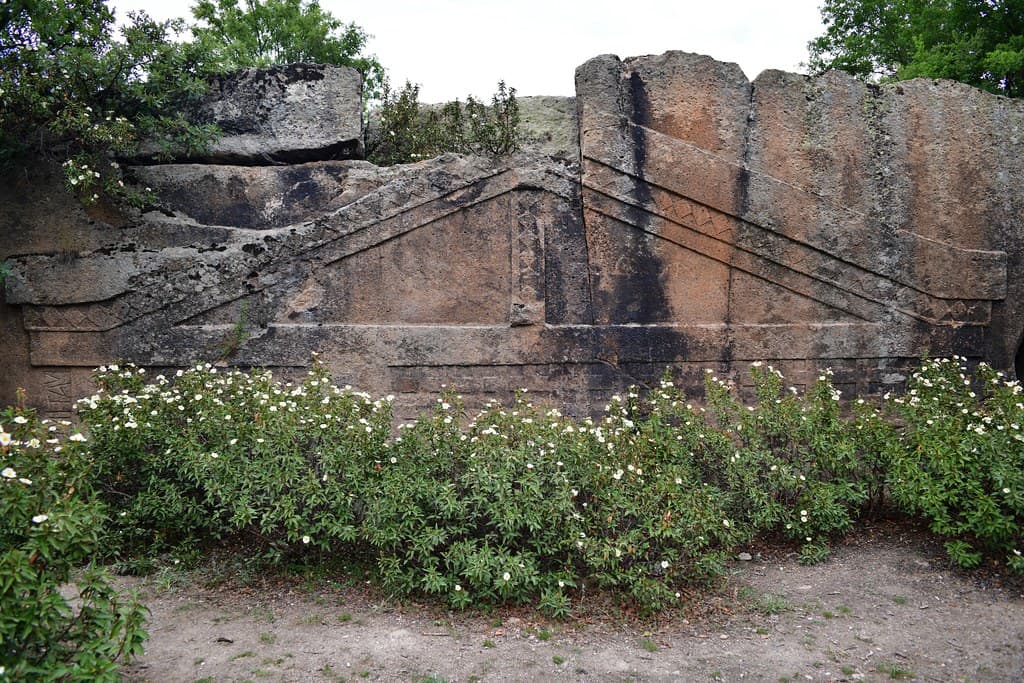
Arslankaya stands alone on the western shore of Emre Lake, a free-standing volcanic rock formation fifteen meters tall, its southeastern face transformed into a sacred façade. The scale of the carving work is immediately apparent: seven meters high and nearly seven wide, the façade carries two rampant lions in high relief, paired sphinxes, geometric patterning, and at the center, a niche where the figure of the goddess Materan once stood — heavily eroded now, barely discernible, but present.
This is not a tomb but a shrine: the rock became an address for Materan, where worshippers could stand before the niche and make offerings in the open air.
Why this place is sacred
There is a specific quality to Phrygian rock shrines that distinguishes them from other ancient sacred architecture: the divine was understood to inhere in the natural formation, not to be brought to it from outside. Temple-building traditions from Greece to Mesopotamia typically involved constructing a house for a deity — a contained space where the god's presence could be housed and approached. The Phrygians understood their goddess differently. Cybele-Materan was in the rock.
She did not need a building because she was the mountain. Carving her image and the imagery of her lions into a natural volcanic outcrop was not importing the divine into a neutral medium but revealing a presence that was already structural to the place. Arslankaya's setting reinforces this.
The volcanic rock rising from the lakeshore was already exceptional before the carvers arrived — its height, its isolation, the reflective surface of Emre Lake below, the way the formation catches light differently at different times of day. The decision to carve here was also a recognition that this particular place already held something. The monument's completion transformed that recognition into a permanent act of address. Offerings were made here.
People came here specifically to stand before the niche and speak to Materan — not in a temple interior but in the open air, the lake at their backs, the carved face of the rock in front.
The recovery of the inscription in 2024 adds a dimension that was not available to earlier visitors: the knowledge that someone, nearly 2,600 years ago, caused these words to be cut into the stone above the goddess's image, and that those words are now readable again.
Free-standing rock shrine dedicated to Materan (the Phrygian Mother Goddess), serving as an active place of votive offering and goddess veneration, possibly also functioning as a processional destination during Cybele cult festivals.
Constructed in the mid-sixth century BC, possibly by Lydian craftsmen, and dedicated by Phrygian worshippers. The monument survived the collapse of Phrygian political culture, though its ritual use ceased. The goddess figure in the niche eroded over centuries; the inscription, though present on the stone, was not read until 2024. Now part of the Phrygian Way cultural route.
Experience and orientation
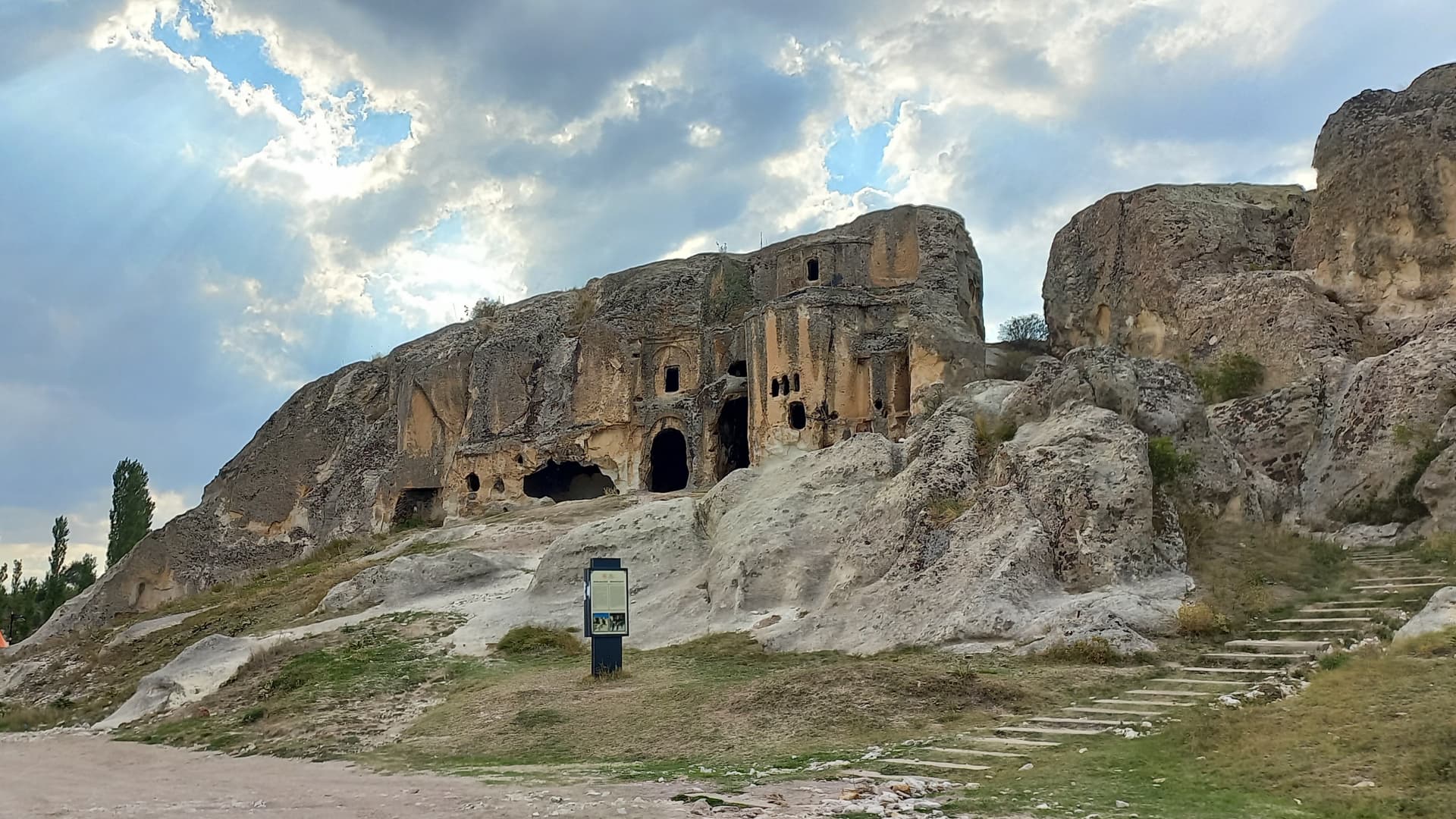
Approach across the open ground from Döğer, with Emre Lake visible to the east. The volcanic rock of Arslankaya rises well before you reach it — fifteen meters is significant at this landscape scale, and the formation has the quality that the Phrygians evidently recognized: it reads as intentional even before you can see the carvings. As you close the distance, the façade clarifies.
The two lions emerge first — rampant, facing each other, their relief work still clear despite nearly 2,600 years of exposure. The sphinxes become visible above them, and then the geometric banding of the frame. The central niche holds the eroded form of the goddess: not absent, but reduced — present enough to indicate where she was, present enough to require something from the viewer's imagination. This is not a flaw.
The erosion itself is part of the encounter with deep time. Stand before the niche at close range and consider the scale of the original carved figure — seven meters of carved surface above and around a central goddess image, flanked by lions, addressed directly by worshippers in the open air. Look up for the inscription band along the upper frame.
It may not be legible to an untrained eye, but knowing it is there — and that it was silent for over a century before being read — changes the quality of what you are seeing. Spend time on the north and south faces of the rock as well. The carved surface is only on the southeast facade; the other faces are natural volcanic stone.
The contrast between the carved face and the raw rock is itself a statement about the Phrygian theology of the divine in stone.
Arslankaya is located approximately 4–5 km southeast of Döğer town, on the western shore of Emre Lake (Emre Gölü), İhsaniye district, Afyonkarahisar Province. It is accessible by car to near the site, with a short walk to the monument. The site is a waypoint on the Phrygian Way long-distance hiking trail.
Context and lineage
The Phrygians held that the Great Mother — Materan, the Mother of the Gods, whom the Greeks would later call Meter Theon and the Romans Magna Mater/Cybele — was born from rock, or more precisely, inhabited rock in a way that made certain formations her dwelling places.
Carving her image into a natural volcanic outcrop was an act of sacred disclosure: the stone already contained the goddess; the carving made the fact visible and created a surface that worshippers could address. Arslankaya was carved in the mid-sixth century BC. For over a century after William Ramsay first documented the monument in 1884, the inscription on its upper frame resisted full decipherment.
In 2024, Professor Mark Munn of Pennsylvania State University published a decipherment that identified the inscription as a dedication to 'Materan' — the Phrygian name for the goddess. Munn's reading also suggested that the monument may have been constructed by Lydians before being adopted or commissioned for Phrygian worship — a remarkable instance of cross-cultural sacred collaboration in ancient Anatolia, where Lydian and Phrygian political and cultural spheres overlapped in exactly this period.
Phrygian / Lydian (mid-6th c. BC) → post-Phrygian abandonment → Western rediscovery (1884) → scholarly documentation → inscription decipherment (2024) → Phrygian Way cultural heritage designation
Unknown dedicant(s)
The person or community who commissioned the monument's construction and caused the dedicatory inscription to be carved — identity unknown, possibly a noble or ruler
Lydian builders (hypothetical)
According to Professor Munn's 2024 inscription analysis, the monument may have been constructed by Lydian craftsmen, representing a cross-cultural sacred collaboration — Lydian construction, Phrygian dedication
William M. Ramsay
British archaeologist who first documented and described the monument in 1884, establishing its place in the scholarly record of Phrygian sacred sites
T. Tüfekçi-Sivas
Conducted detailed study of the monument in 1997, contributing to the typological understanding of Phrygian rock-cut shrines
Mark Munn (Pennsylvania State University)
Deciphered the Arslankaya inscription in 2024, confirming the dedication to Materan and proposing Lydian construction — a breakthrough in understanding Phrygian religious language
Traditions and practice
The monument's niche — designed to hold a sculptural image of Materan — indicates that Arslankaya functioned as a votive shrine where offerings were made to the goddess directly. Comparable Phrygian shrines across the region show evidence of votives placed in or near the niches: small objects, possibly food or drink, presented to the carved goddess.
The location at a natural rock formation overlooking water — Emre Lake — aligns with the Phrygian tradition of associating Cybele with springs, rivers, and wet places as well as rocky heights. The monument may also have been a processional destination during the Cybele festival cycle, when devotees traveled to multiple sacred sites across the landscape.
No religious practices are observed at the site. Arslankaya is accessible to visitors as part of the Phrygian Way cultural hiking route.
Begin from a distance — one hundred meters or more — to take in the full scale of the volcanic formation and its relationship to the lake and the surrounding landscape. The monument's setting was chosen; let that choice register before you approach. Move toward the carved face slowly. When the two lions become readable, stop and look at them independently before moving your attention to the central niche. The niche is the heart of the monument, not the frame.
Once at close range, look up along the inscription band at the top of the façade — knowing that these words stood unread for over a century and were deciphered only in 2024 adds a temporal dimension to what you're seeing that no other Phrygian monument currently offers. Move around the rock to the uncarved faces.
The contrast between worked stone and raw volcanic surface is the key to understanding Phrygian sacred architecture: both are the same rock, but one has been made into an address for the divine.
Phrygian Materan (Mother Goddess) Cult
HistoricalArslankaya is one of the finest Phrygian rock shrines dedicated to Materan — the Great Mother, whose image once occupied the central niche, flanked by lions. The 2024 inscription decipherment confirmed the dedication in the goddess's own Phrygian name.
Votive offerings made in the niche; prayers and supplications to Materan; possibly a destination in processional or pilgrimage journeys during the Cybele festival cycle
Archaeological Heritage
ActiveThe 2024 decipherment represents a breakthrough in Phrygian religious language and in the understanding of Lydian–Phrygian cultural contact. Ongoing scholarly attention makes Arslankaya a live site of academic inquiry.
Ongoing academic study; Phrygian Way cultural route inclusion; conservation monitoring
Perspectives and open questions
Arslankaya has been read as a monument to Phrygian goddess theology, as evidence of Lydian–Phrygian cultural contact, and as one of the most direct surviving expressions of the ancient Anatolian belief that divinity inhabits stone rather than merely being represented there.
Scholarly perspective
The 2024 inscription decipherment by Professor Mark Munn is the most significant recent development in understanding this monument. Prior to this, Arslankaya was classified as a major Phrygian rock-cut goddess shrine of the sixth century BC on typological grounds — the niche, the lion reliefs, and the carved frame are consistent with a well-established Phrygian sacred architecture type.
Munn's reading of the inscription as a dedication to 'Materan' confirms the goddess's Phrygian name at this site and introduces the possibility of Lydian construction — a finding that challenges purely ethnic readings of Phrygian sacred monuments and suggests a more complex cultural landscape in sixth-century BC western Anatolia.
Living and traditional perspectives
For the Phrygians, Arslankaya was not a representation of the goddess but her address — the specific rock where she could be found and approached. The lions that flank her niche were not decorative: they were her companions and guardians, present in the stone as she was present in the stone. Worshippers who came to this place understood themselves to be approaching the goddess directly, not her image.
The erosion of the goddess figure in the niche is, from this perspective, theologically less significant than it might appear to modern visitors — the niche itself, the act of approach, the landscape setting, are all still present.
Alternative interpretations
Some researchers place Arslankaya within a network of Phrygian mother goddess shrines spread across the Anatolian landscape, proposing that these sites formed a sacred geography encoding a systematic understanding of the divine feminine presence in the natural world. In this reading, each site was not independent but part of a linked sacred landscape that worshippers navigated over the course of ritual journeys.
The relationship between Lydian builders and Phrygian dedicants implied by Munn's inscription reading has also attracted speculation about the cultural politics of goddess worship across rival political spheres.
Open questions
The precise rituals performed at the monument and the original appearance of the goddess figure in the niche (now heavily eroded) remain unknown. The relationship between the Lydian builders and Phrygian worshippers implied by the inscription is not yet fully understood. Whether the site formed part of a larger network of sacred journeys, or served a more localized community, cannot currently be determined.
Plan your visit
Access and arrival
Arslankaya is located approximately 4–5 km southeast of Döğer town, İhsaniye district, Afyonkarahisar Province, on the western shore of Emre Lake. Accessible by car from Döğer via a track road, then a short walk to the monument. The site is also reachable on foot as part of the Phrygian Way long-distance hiking trail. No formal entrance fee or facilities. Mobile phone signal may be unreliable near the lake — plan your route before leaving Döğer.
The nearest services are in Döğer (4–5 km northwest).
No accommodation at or near the site. Döğer (4–5 km northwest) has limited options. Afyonkarahisar (approx. 35 km south) provides a full range and is the most practical base for visiting multiple Phrygian Valley sites in sequence.
Respectful visit
No requirements. Practical outdoor clothing appropriate for an exposed lakeshore walk.
Photography is permitted and unrestricted. The southeastern facade is best lit in morning light.
Leaving offerings is not an established current practice. The ancient niche was cleared by time; introducing new material would interfere with the archaeological integrity of the site.
Do not touch the carved surfaces. Do not attempt to climb the rock formation. Leave the site exactly as found.
Do not touch the carved surfaces under any circumstances — the tuff stone is fragile and the inscription carvings are irreplaceable. The site is remote; carry water and inform someone of your plans before hiking from Döğer.
Location
Map loads as you approach this section.
Pilgrim reflections
A portrait of encounter, not a score
Pilgrims describe what they felt, how present they could become, and whether the place would shape a journey. There are no stars and no ranking of traditions.
No reviewed reflections yet
The first pilgrims can help describe the character of being here.
Share a reflection
Available after an account-backed “Been there.” Every reflection is reviewed before publication.
Nearby sacred places
Explore other sacred places in the region. Proximity does not establish access or travel time; check each place’s guidance.


References
Sources consulted for this page. Source categories describe the publication, not a guarantee that every claim is verified. Traditional accounts and outside interpretations may differ.
- 01Aslankaya from the Phrygian Valley — Turkish Archaeological NewsacademicDetailed description of the monument and its Cybele significance
- 02Aslankaya - Phrygian Monuments — PhrygianMonuments.comacademicSpecialist Phrygian monuments database with site description
- 032600-year-old Phrygian inscription in Turkey deciphered — Archaeology MagazineacademicCoverage of Prof. Munn's 2024 inscription decipherment
- 04Lost Phrygian Inscription on Arslan Kaya Monument Deciphered — ArkeonewsacademicDetailed report on inscription and its meaning
- 05Professor Translates 2600-Year-Old Inscription — ArtNet NewsSource contextMainstream news coverage of the decipherment
- 06An Ancient Phrygian Inscription to the Mother of the Gods Deciphered on the Arslan Kaya Monument, Revealing Lydian Construction — La Brujula VerdeacademicReports Lydian construction attribution alongside Phrygian inscription
- 07Arslan Kaya's Lost Inscription Links to Materan, the Great Mother Goddess — Ancient OriginsSource contextSummary of inscription discovery and significance
- 08Historic 2,600-year-old Turkish artifact finally decoded: 'The Mother' goddess revealed — The Brighter Side of NewsSource contextAccessible summary of inscription findings
Share a photo
Help visitors recognize Arslankaya. Every submission is reviewed before publication.