Lourdes Sanctuary
Where water flows from rock at a young girl's touch, and millions come seeking the healing that faith makes possible
Lourdes, Hautes-Pyrénées, France
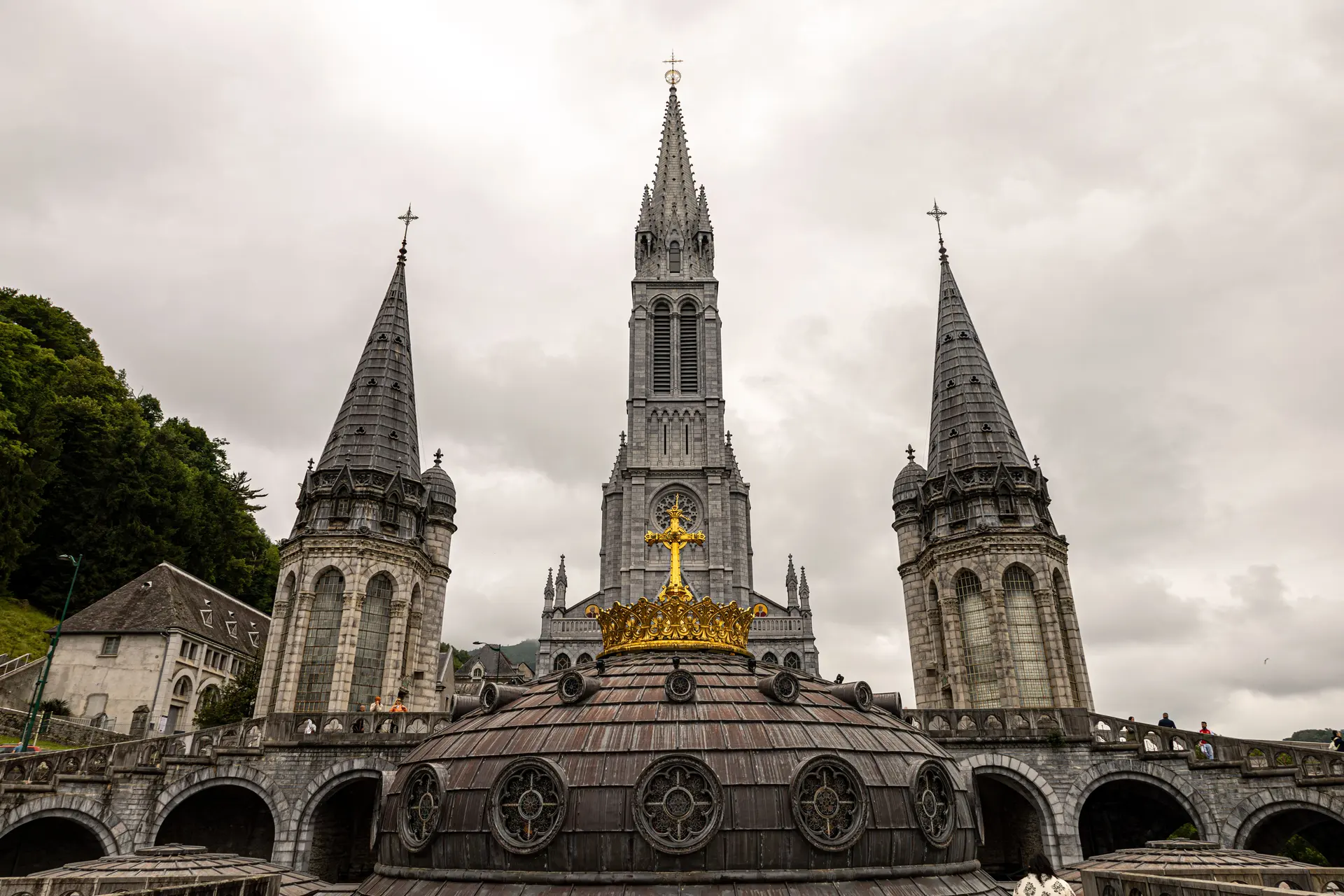
Featured in this guide
Sacred Sites for Life’s Hopes and Goals
The hopes, beliefs and practices behind 50 places of pilgrimage
Featured in this guide
100 Sacred Sites of Healing and Pilgrimage
100 places of healing devotion, sacred water, and ancient sanctuary traditions
Featured in this guide
Marian and Christic Apparitions
Catholic-recognised and disputed sites where Mary is said to have appeared
Visit essentials
Before you go
- Address
- 1 Av.
- Duration
- A half day allows for a visit to the grotto and participation in one or two rituals.
- Etiquette
- Lourdes is an active pilgrimage site where millions come to pray.
Overview
Six million people visit Lourdes each year. Many are sick, many desperate, and all hope for something.
In 1858, a peasant girl named Bernadette saw a white-clad lady at a muddy riverside grotto. She appeared eighteen times and, when asked her name, said: 'I am the Immaculate Conception.' The spring she instructed Bernadette to uncover still flows.
The Church investigated and approved. Basilicas rose, sick people arrived, and the water became a focus of hope for millions who had exhausted medical options or sought something beyond medicine. Seventy-two miracles are officially recognized by the Church and thousands more healings claimed, yet analysis finds no special properties in the water. Bernadette said: 'Just one drop is enough. It is faith that is needed.'
Lourdes promises no cure. It offers a community of suffering people and those who serve them, gathered around waters touched by millions with hope. Whether the result is miracle, psychology, or mystery beyond present categories, it continues drawing those willing to ask.
Places within this site
Why this place is sacred
The grotto of Massabielle was an unpromising place before February 11, 1858. A muddy hollow by the river Gave, used for pig grazing. Nothing marked it as sacred. Nothing suggested that the boundary between worlds might be thin here.
Then Bernadette Soubirous came gathering firewood. What followed changed everything.
Eighteen times over five months, Bernadette saw a lady 'dressed in white with a blue sash, a yellow rose on each foot, and a rosary on her arm.' The visions drew crowds, skeptics, and church authorities. The lady asked for prayer and penance. She spoke in the local dialect. During the ninth apparition, she gave a strange instruction: 'Go and drink from the spring and wash yourself there.'
Bernadette began scratching at the earth and uncovered a trickle of muddy water that soon became a clear spring.
The clinching moment came on March 25, 1858. Asked repeatedly for her name, the lady finally replied: 'I am the Immaculate Conception.' These words, spoken by an uneducated girl who did not understand their theological meaning, echoed the dogma Pope Pius IX had defined just four years earlier. For believers, this was confirmation. For the Church, it was significant enough to warrant official recognition in 1862.
What makes a place thin is not always explicable. At Lourdes, multiple factors converge: the apparitions themselves, witnessed and investigated; the spring that emerged at Mary's instruction; the accumulation of prayer and hope from over 200 million pilgrims; and the presence of the sick and dying, whose vulnerability opens something that ordinary tourism cannot touch. The grotto's rock has been worn smooth by millions of hands. The candles burn continuously.
Something persists here that resists reduction to either credulity or coincidence.
Before Bernadette's visions, the grotto had no particular significance. The apparitions transformed it into a place of Marian devotion, where the Virgin Mary's request for prayer, penance, and a chapel could be honored. The spring was given from the beginning as a sign and a means of grace.
What began as a local phenomenon quickly became international. The first cures were reported within months of the apparitions. The Church's approval in 1862 opened the floodgates. The first basilica was completed in 1871; the Basilica of the Rosary followed in 1889. By 1958, the centenary, an underground basilica seating 25,000 was built to accommodate the crowds.
The Medical Bureau, established in 1883, represents something unusual in the history of miracle claims: an attempt to subject healings to scientific scrutiny. Of the thousands of claims examined, seventy-two have been declared miraculous by the Church after rigorous investigation. The standard is high; the acknowledged miracles are the tip of a much larger iceberg of reported improvements and unexplained recoveries.
Today, Lourdes operates as both pilgrimage site and infrastructure for the sick. Specialized trains and planes bring those in wheelchairs and on stretchers. Volunteer hospitaliers assist with bathing and transport. The grandeur of the basilicas contrasts with the simplicity of Bernadette's story, but both are present: the institutional Church and the peasant girl who saw a lady in white.
Why pilgrims come
Healing and consolation
Pilgrims connect Lourdes with Bernadette’s reported encounters with Mary and the spring at the grotto. The sanctuary places sick and vulnerable people at the center of its mission.
How devotees visit
People come on pilgrimage for prayer, the grotto and the sanctuary’s devotional programme. The water gesture and care offered by volunteers make this a place of accompaniment as well as petitions for healing.
Healing is a religious hope, not a promised cure or substitute for medical care.
These are religious traditions and devotional practices, not promises of an outcome. Follow the community’s current guidance.
Healing traditions
Church-recognized healing account
The Lourdes sanctuary recounts Catherine Latapie's visit on 1 March 1858. After an injury had left her hand impaired, she placed her arm in the spring and reported that movement returned. Her account belongs to the early healing history that grew around Bernadette's encounters at Massabielle. Catholic devotion understands such recoveries as God's action through Mary's intercession; the sanctuary itself distinguishes this from a special medicinal property in the water.
Ways to participate
Bring a particular intention—for yourself, someone ill, or a caregiver—and spend a few quiet minutes at the grotto. The sanctuary's pilgrim way includes prayer, the water gesture, and lighting a candle. Ask the Hospitalité volunteers about the water gesture and current bathing arrangements; assistance and seated participation can be requested. Choose the gestures that fit your health and mobility.
These accounts describe religious traditions and reported experiences. They do not promise a cure or replace medical care.
Experience and orientation
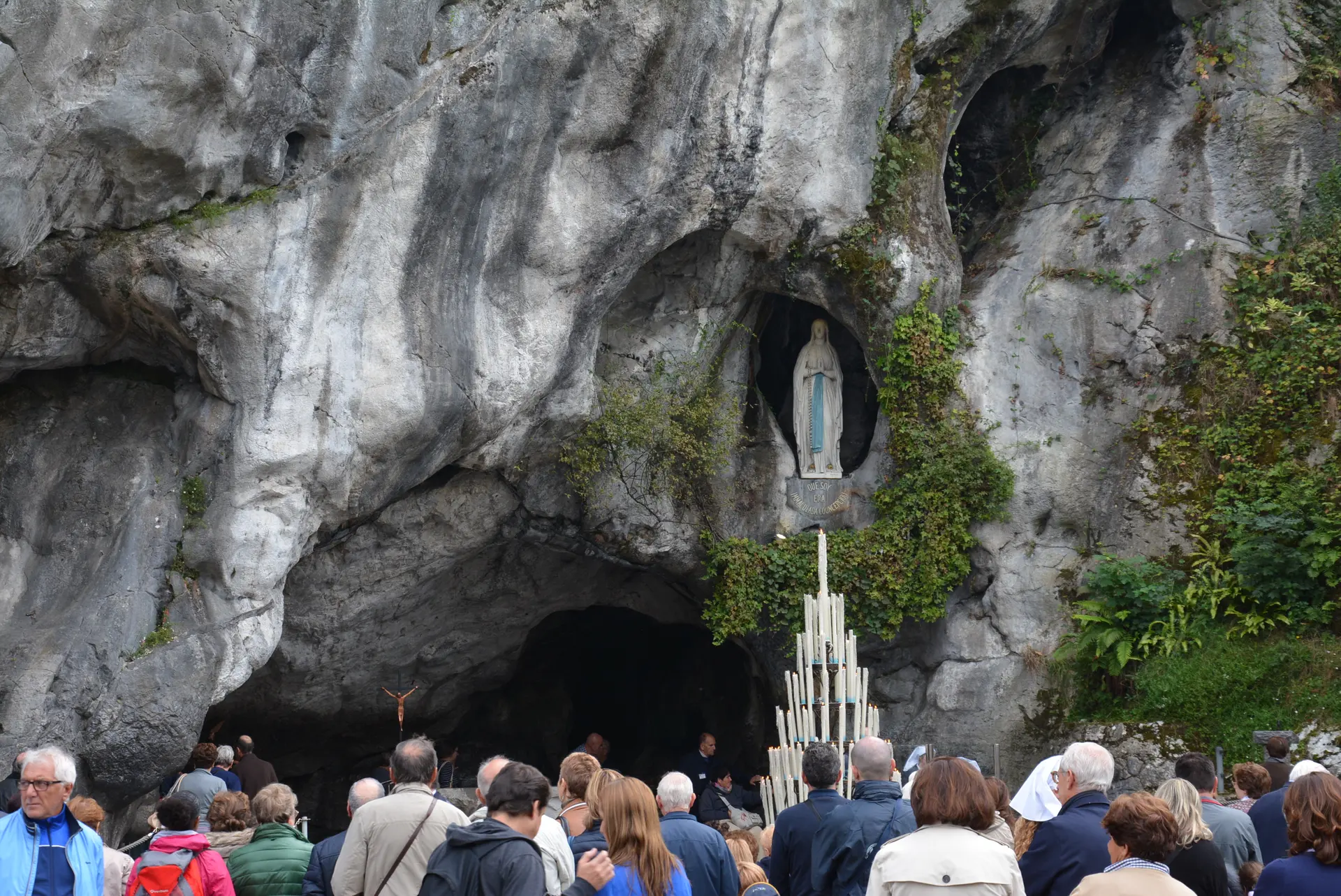
The first thing many pilgrims notice is the presence of the sick. Wheelchairs line the grotto. Stretchers are arranged so the bedridden can see the statue of Our Lady in the niche where Bernadette saw her apparition. This is not hidden or peripheral; it is central. At Lourdes, the sick are not sequestered but honored, attended by thousands of volunteers who have come specifically to serve them.
The grotto itself is smaller than many expect. The rock curves overhead, blackened by decades of candle smoke before the flames were moved. A simple statue marks where the lady appeared. Below, behind glass, the spring water emerges. Pilgrims touch the rock, worn smooth by millions of hands. Some weep. Some stand in silence. The line moves continuously, but there is no rushing—each person is given their moment.
The water gesture is a devotional encounter supported by sanctuary volunteers. Ask them about the arrangements available during your visit, including any bathing opportunities. Prayer and the act of washing carry meaning for pilgrims, but no particular sensation or healing outcome is required.
The candlelight Marian procession transforms the sanctuary each evening. Thousands walk together carrying candles, reciting the rosary and singing the Ave Maria. The effect is oceanic: a river of light and prayer moving through the darkness. For those who have spent the day accompanying the sick, the procession becomes a container for everything witnessed.
What visitors report most consistently is not miracle but something harder to name: a sense of peace, of burden lifted, of being part of something larger than individual suffering. Physical cures are rare and never guaranteed. Spiritual and emotional healing is harder to measure but more commonly described.
You can arrive with hope, uncertainty, grief, or no particular expectation. None of these makes you more or less deserving of care. Begin with quiet observation at the grotto and give yourself time to settle.
If you wish to take part in the water gesture or a public procession, ask the volunteers for guidance. You can also remain seated, pray privately, or simply accompany someone you care about. A visit does not need to produce a particular feeling or medical change to have meaning.
Context and lineage
On February 11, 1858, fourteen-year-old Bernadette Soubirous was gathering firewood with her sister and a friend near the grotto of Massabielle. As she removed her stockings to cross the stream, she heard a rushing wind and looked up to see a young woman dressed in white standing in a niche in the rock. The figure wore a blue sash and held a rosary. Yellow roses adorned her feet.
Over the next five months, the lady appeared seventeen more times. She spoke to Bernadette in the local Occitan dialect, asking for prayers and penance, requesting that a chapel be built, and instructing Bernadette to dig in the ground where a spring would emerge. When Bernadette asked the lady's name, she received no answer for weeks. Finally, on March 25, the lady replied: 'I am the Immaculate Conception.'
Bernadette did not understand these words. The theological concept had been defined as dogma by Pope Pius IX only four years earlier, and an uneducated peasant girl would not have encountered the term. For Church authorities, this became significant evidence of the apparition's authenticity.
The local bishop authorized an investigation. After careful examination of Bernadette's testimony and character, he officially recognized the apparitions in 1862. Construction of the first church began shortly after.
Bernadette herself left Lourdes in 1866, entering the Sisters of Charity at Nevers. She spent the rest of her life as a nun, suffering from poor health and avoiding the fame that followed the apparitions. She died in 1879 at age thirty-five. Her body, when exhumed during the canonization process, showed remarkable preservation. She was beatified in 1925 and canonized in 1933.
The sanctuary has been administered by the Diocese of Tarbes since the apparitions. The Hospitaliers of Our Lady of Lourdes, founded in 1880, coordinate the thousands of volunteers who serve pilgrims. The Medical Bureau, established in 1883 by the physician Dunot de Saint-Maclou, investigates healing claims with scientific rigor.
Popes have visited Lourdes repeatedly. The sanctuary has survived world wars, adapted to mass tourism, and maintained its identity as a place where the sick come seeking what medicine cannot provide. The spring still flows. The baths still receive pilgrims. The candles still burn.
Virgin Mary
deity
The mother of Jesus Christ, who appeared to Bernadette eighteen times and identified herself as 'the Immaculate Conception.' Her request for prayer, penance, and a chapel gave Lourdes its purpose.
Bernadette Soubirous
saint
The fourteen-year-old miller's daughter who received the apparitions. Poor, asthmatic, and uneducated, she maintained her account with remarkable consistency under intense scrutiny. She became a nun at Nevers and died at thirty-five. Canonized in 1933, her incorrupt body lies in a glass reliquary at her convent.
Hippolyte Durand
historical
The architect who designed the Basilica of the Immaculate Conception, the first major church built above the grotto, completed in 1871.
Traditions and practice
The central practices at Lourdes emerged from Mary's instructions to Bernadette: prayer, penance, and use of the spring water. The baths formalize the washing Bernadette performed at the apparition's direction. The rosary, which the lady held in her apparitions, structures much of the prayer life here. The candlelight procession honors Mary under her title of the Immaculate Conception.
Daily masses take place in multiple languages throughout the sanctuary. The Blessing of the Sick gathers the ill and disabled for collective prayer and sacramental blessing. The Eucharistic procession carries the Blessed Sacrament through the sanctuary grounds while the sick line the route.
At the water gesture, sanctuary volunteers guide pilgrims through a devotional use of the spring water. Bathing arrangements can vary; consult the sanctuary before planning around an immersion. Participation expresses prayer and hope rather than a promise of recovery.
Designated drinking-water fountains allow pilgrims to drink and fill bottles. Follow the signs distinguishing these fountains from other water points.
The grotto welcomes visitors during the sanctuary’s posted opening arrangements. Many touch the rock, pray at the statue, or simply sit in the presence of the spring. The atmosphere is one of quiet intensity: wheelchairs and stretchers alongside walking pilgrims, all focused on the same niche in the rock.
The Way of the Cross climbs the hillside above the sanctuary, with life-sized bronze stations depicting Christ's passion. Many pilgrims walk it as a meditative practice complementing their time at the grotto.
If you come seeking healing, physical or otherwise, consider approaching Lourdes as a practice rather than a transaction. There is no magic formula. What seems to help is openness, patience, and willingness to be part of a community larger than your individual petition.
Begin at the grotto. Touch the rock if you wish. Let yourself feel what you feel without judgment. Follow the queue and volunteers’ guidance, then use a designated prayer area if you wish to remain longer.
Ask volunteers about the water gesture and current bathing arrangements. Participation is optional; a quiet prayer at the grotto is also a complete devotional visit.
Participate in the candlelight procession at least once. The collective experience of thousands praying and singing transforms individual intention into something larger.
Drink the water. Fill a bottle to take home. The water has no special properties, but what you do with it—who you share it with, what prayers accompany it—carries weight.
Consider serving as well as seeking. Accompanying the sick as a volunteer, even briefly, changes the experience from petition to participation.
Roman Catholicism - Marian Apparition Site
ActiveLourdes is one of the most important Marian apparition sites in the Catholic world. The Virgin Mary appeared eighteen times to Bernadette Soubirous in 1858, identifying herself as 'the Immaculate Conception'—affirming the dogma Pope Pius IX had defined just four years earlier. The Church officially recognized the apparitions in 1862, and Bernadette was canonized in 1933. Lourdes has become the preeminent destination for Catholic pilgrims seeking Mary's intercession.
Daily masses in multiple languages, praying the rosary at the grotto, candlelight Marian procession each evening, Eucharistic procession, bathing in and drinking the spring water, veneration at the Grotto of Massabielle, Way of the Cross, Blessing of the Sick.
Healing Pilgrimage
ActiveLourdes is renowned worldwide as a destination for the sick and disabled seeking healing. The Church has officially recognized seventy-two miraculous healings, while the Medical Bureau estimates over 7,000 claims have been made. Approximately 350,000 people use the healing baths annually. The sanctuary's entire infrastructure is oriented toward receiving and caring for the sick.
Immersion in the healing baths, drinking spring water, participating in the Blessing of the Sick, prayer at the grotto specifically for healing intentions, bringing water home for sick family members who could not travel.
Perspectives and open questions
Lourdes invites multiple interpretations held in tension. For Catholics, it is a site of authentic apparition and miraculous healing. For skeptics, it represents the power of suggestion and community. For historians, it illustrates the development of modern pilgrimage. For those who suffer, it may simply be a place where hope is taken seriously. These perspectives need not be reconciled to be honestly held.
Scholarly perspective
Historians and sociologists have studied Lourdes extensively. Ruth Harris's work examines how the apparitions were received and contested in nineteenth-century France, where Church and Republic were at odds. She shows how Lourdes became a site of cultural conflict as well as devotion.
The Medical Bureau represents an unusual attempt to bridge science and miracle. It invites physicians of any faith or none to examine healing claims. Cases are evaluated against strict criteria: the disease must be organic, diagnosed precisely, and cured instantaneously and completely without medical explanation. Of over 7,000 claims examined, only seventy-two have been declared miraculous. Scholars note this self-imposed rigor distinguishes Lourdes from sites where healing claims go unexamined.
Sociologists observe the formation of 'communitas' at Lourdes—the dissolution of ordinary social hierarchies among pilgrims. The sick are at the center rather than the margins. Volunteers serve rather than observe. This inversion of normal social roles creates conditions that may themselves be therapeutic, regardless of supernatural intervention.
Living and traditional perspectives
For Catholic teaching, Lourdes is a site of authentic Marian apparition. The spring water, while possessing no special chemical properties, serves as a sign and means of God's grace. Miracles occur through Mary's intercession, but the greater purpose is spiritual: conversion, deepening of faith, and acceptance of suffering in union with Christ.
The Church does not require belief in private apparitions, even those officially approved. Catholics may visit Lourdes without holding that Mary literally appeared. But the sensus fidelium—the collective faith of believers over 160 years—has made Lourdes central to Catholic devotion. It is where the sick turn when medicine offers nothing. It is where Mary is close.
Alternative interpretations
Some researchers note the grotto's location by water and within rock may connect to pre-Christian sacred landscape traditions. Water sources, caves, and feminine divine figures appear in many spiritual traditions, and the Pyrenees region has deep layers of pre-Christian practice. From this perspective, Lourdes taps into something older than Marian devotion—a sacred quality of place that the apparitions reframed in Catholic terms.
Others focus on the psychological and communal dimensions of healing. The power of expectation, the support of community, the permission to hope, the reversal of sick-person status from isolated to central—all may produce effects that are real without being supernatural. This interpretation need not dismiss pilgrim experiences; it simply locates their source differently.
Open questions
What is the nature of the healings at Lourdes? Scientific analysis has found no special properties in the water. Yet something happens here that resists easy explanation. The seventy-two officially recognized miracles represent cases where no medical explanation sufficed. What of the thousands of unreported improvements—the remissions, the pain reductions, the gains in function? Are they placebo? Coincidence? Something else?
Bernadette herself discouraged focusing on physical cures. 'Just one drop is enough. It is faith that is needed.' Perhaps the mystery is not what the water does to bodies but what the practice of coming here does to persons. Perhaps the categories of miracle and psychology are too crude for what actually happens when six million people a year bring their hope to a spring in the Pyrenees.
The question of what Lourdes is remains open. That something happens here is beyond dispute. What that something is may be beyond our current vocabulary to express.
Plan your visit
Access and arrival
Lourdes has over 270 hotels, the second highest concentration in France after Paris, reflecting the pilgrimage economy. Many specialize in organized groups and offer proximity to the sanctuary and accessibility features. Budget options include hostels and the Cite Saint-Pierre, which welcomes pilgrims of limited means. The Grotte Sanctuaires offers immediate proximity to the site. For those seeking quieter settings, accommodations in nearby villages provide easy access while avoiding commercial density.
Respectful visit
Modest dress is required throughout the sanctuary. Shoulders and knees should be covered. For the water gesture or baths, follow the sanctuary volunteers’ current instructions. Comfortable shoes are essential; the sanctuary covers substantial ground and includes both indoor and outdoor spaces.
Photography is permitted in most areas of the sanctuary. Be respectful during services and avoid photographing individuals without permission, especially the sick and those at prayer. Photography is not permitted inside the baths. During the candlelight procession, participate rather than document.
Candles are the traditional offering at Lourdes. They can be purchased throughout the sanctuary and are lit at designated stands. The burning candles represent prayers that continue even after the pilgrim has departed. Monetary offerings support the sanctuary's operations and its service to the sick.
Check the sanctuary’s current opening times and arrangements for the grotto, water gesture, baths, and group services. Ask the welcome service about assistance and an accessible route suited to your visit.
Lourdes does not promise physical healing. Of the millions who have visited, seventy-two miracles have been officially recognized. Hope is appropriate; expectation of cure is not. Many pilgrims experience spiritual consolation without any change in their medical condition. This is not failure.
The baths can be physically demanding for those in frail health. Volunteers are trained to assist, but consult your medical team if you have concerns.
Beware of vendors selling 'blessed' or 'special' water at inflated prices. The spring water is free and available to all at the fountains. What you take home is the same water used in the baths.
Do not come alone if you are seriously ill. The infrastructure exists for the sick, but having companions who can assist with practical matters allows you to focus on why you came.
Current practical details
Address
1 Av. Mgr Théas, 65108 Lourdes, France
Phone
Hours
Hours, fees, and access can change — verify on the official source before you travel. Practical details last checked Jul 2026.
Location
Map loads as you approach this section.
Pilgrim reflections
A portrait of encounter, not a score
Pilgrims describe what they felt, how present they could become, and whether the place would shape a journey. There are no stars and no ranking of traditions.
No reviewed reflections yet
The first pilgrims can help describe the character of being here.
Share a reflection
Available after an account-backed “Been there.” Every reflection is reviewed before publication.
Dates and observances
Upcoming festivals, feast days, and pilgrimages connected to this place. Add any to your calendar, or browse the full observance calendar.
- Add to calendar
Feast of Our Lady of Lourdes
Thu, Feb 11, 2027Feast day
Annual feast commemorating the 1858 Marian apparitions; torchlight processions and the international pilgrimage season at the Sanctuary of Our Lady of Lourdes.
- Add to calendar
Feast of Our Lady of Lourdes
Fri, Feb 11, 2028Feast day
Annual feast commemorating the 1858 Marian apparitions; torchlight processions and the international pilgrimage season at the Sanctuary of Our Lady of Lourdes.
Nearby sacred places
Explore other sacred places in the region. Proximity does not establish access or travel time; check each place’s guidance.
Grotto of Lourdes (Grotto of Massabiell)
Lourdes, Hautes-Pyrénées, France
0.1 km away

Sanctuary of Notre-Dame de Bétharram
Lestelle-Bétharram, Lestelle-Bétharram, Pyrénées-Atlantiques / Nouvelle-Aquitaine, France
12.9 km away

Sanctuary of Our Lady of the End of the Bridge – Refuge of the Mother and Child of Pau
Pyrénées-Atlantiques, France
33.8 km away

Church of L’Hôpital-Saint-Blaise
Pyrénées-Atlantiques, France
60.2 km away
References
Sources consulted for this page. Source categories describe the publication, not a guarantee that every claim is verified. Traditional accounts and outside interpretations may differ.
- 01Sanctuary of Our Lady of Lourdes — WikipediaencyclopediaComprehensive overview of the sanctuary
- 02Going to the Baths — Sanctuaire Notre-Dame de LourdesofficialOfficial sanctuary website
- 03Drinking the water and washing in it — Sanctuaire Notre-Dame de LourdesofficialOfficial information about water rituals
- 04Basilica of the Immaculate Conception - Lourdes — Sacred DestinationsSource contextPilgrimage site reference
- 05Miraculous water from Lourdes — Shrines of EuropeSource contextEuropean shrine network information
- 06The apparitions — Lourdes sanctuaryofficialSupports the attributed account or visitor practice in the healing section; not evidence of clinical efficacy.
- 07The new pilgrim's way — Lourdes sanctuaryofficialSupports the attributed account or visitor practice in the healing section; not evidence of clinical efficacy.
Photo gallery
3 curated photos
Share a photo
Help visitors recognize Lourdes Sanctuary. Every submission is reviewed before publication.