Grotto of Lourdes (Grotto of Massabiell)
Part ofLourdes Sanctuary
Where a peasant girl scraped mud and found a spring that has drawn millions seeking healing
Understand sacred places, explore living traditions, and learn how to engage respectfully with Pilgrim Map.
Access has not been verified. Check current local guidance before planning a visit.
Lourdes, Hautes-Pyrénées, France
Read the sources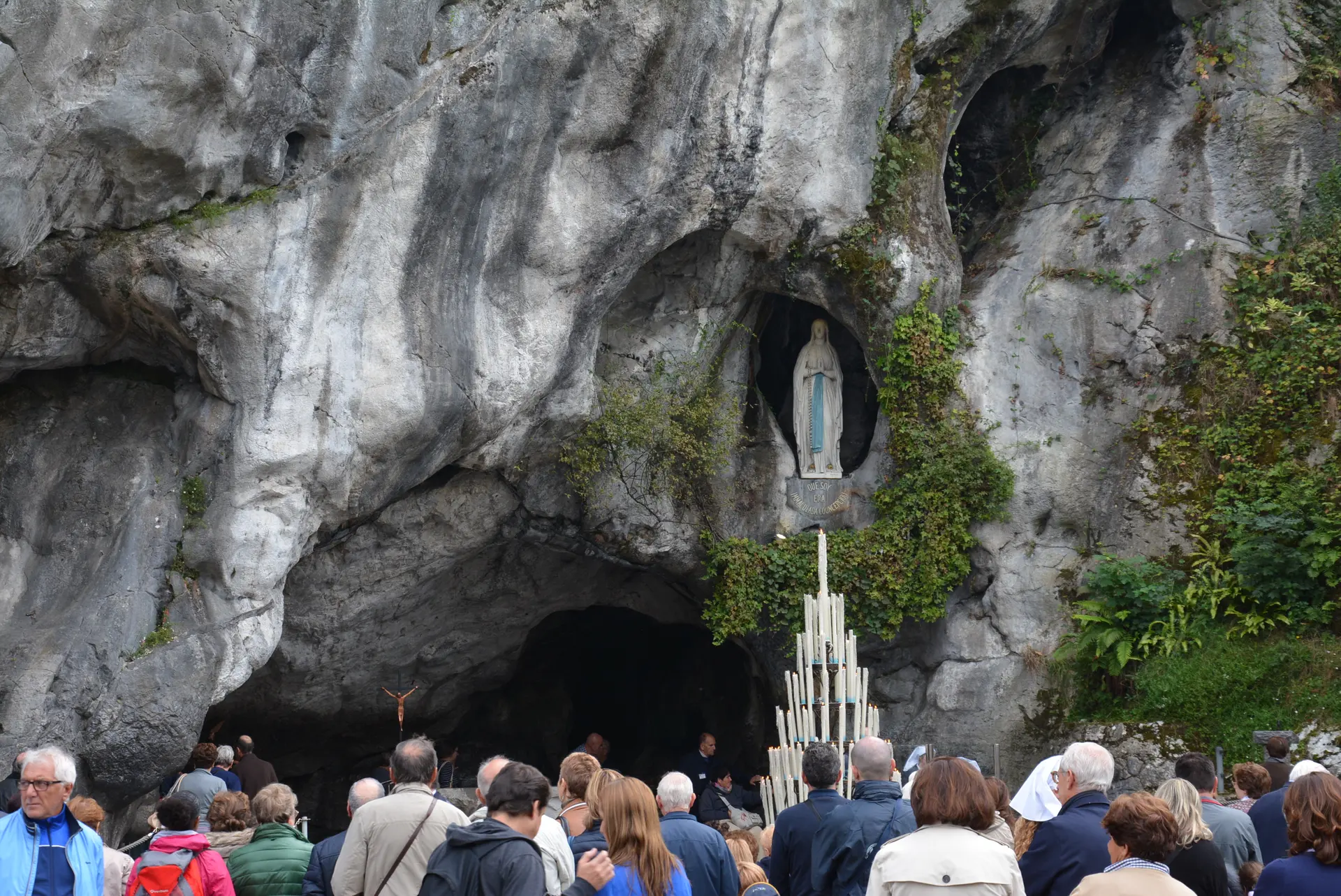
Visit essentials
A quick read before you go
- Duration
- A meaningful visit requires at least a full day.
- Etiquette
- The grotto is a site of active prayer.
Overview
Massabielle is an unremarkable rock cavity below a French Pyrenees cliff, its geology suggesting no holiness, yet over 160 years of pilgrims crossing oceans have worn its stone smooth and dark. What happened in 1858 remains faith; documented is poor, asthmatic Bernadette Soubirous kneeling here eighteen times over five months, apparently speaking with a figure only she saw.
On her ninth visit, February 25, she scraped mud bare-handed and drank dirty seepage while the crowd thought her mad; next day a clear spring flowed. It has never stopped and feeds eighteen fountains, one per apparition, from which pilgrims drink, wash, and take water home. The Church recognizes seventy miracles attributed to Lourdes, though measurable cures are far fewer than healing-seekers.
Reduced to rock, water, prayer, and presence, the grotto joins those kneeling today to a teenage girl told to dig who obeyed.
Why this place is sacred
The concept of the thin place finds unusual expression at Lourdes. This is not a site hallowed by centuries of accumulated practice, nor a landscape that seems to speak of transcendence. The Gave de Pau river flows past, the Pyrenean foothills rise behind, but nothing in the setting prepares you for what it has become.
The thinness here originated in a specific encounter. On February 11, 1858, Bernadette Soubirous—fourteen years old, unable to read, suffering from asthma and cholera aftereffects—came to this cave to gather firewood. A wind moved in the niche above the spring. A light appeared. A young woman in white stood there.
Over the following months, Bernadette returned seventeen more times. The Lady spoke in the local Bigourdan dialect. She asked for prayer and penance. On February 25, she told Bernadette to drink from a spring that did not exist—and Bernadette, scraping mud with her hands under the gaze of hundreds who thought her deluded, uncovered it.
The spring's emergence marks the moment this place shifted from ordinary to sacred. Water from nowhere, at the command of a vision, through the hands of a child. Whatever one believes about the apparitions, the spring is undeniable. It flows at 27,000 gallons per day and has not varied in over 160 years.
The rock face itself has become sacred through touch. Millions of hands have worn it smooth and dark. The stone holds the accumulated intention of every pilgrim who has pressed their palm against it, seeking what cannot be named but might be transmitted through contact. This is not metaphor—the physical transformation of the rock documents the weight of human longing.
The niche above the grotto floor was simply a feature of the rock formation before February 1858. The name Massabielle likely derives from Occitan words meaning 'old rock' or 'old mass.' This was a place where local people gathered wood and their pigs foraged. Its only significance was its marginal uselessness.
That changed when Mary appeared—or when Bernadette believed Mary appeared, depending on one's framework. The Lady identified herself on March 25, 1858, in words Bernadette did not understand: 'Que soy era Immaculada Councepciou'—'I am the Immaculate Conception.' This theological term, which the unschooled Bernadette had never heard, convinced the local priest that something genuine had occurred. The dogma of the Immaculate Conception had been defined by Pope Pius IX just four years earlier.
Within months of the apparitions, pilgrims began arriving. Within years, the grotto had become a destination. The Church investigated cautiously, recognizing the apparitions in 1862. A statue of Our Lady was installed in the niche in 1864, positioned where Bernadette said the Lady stood.
The sanctuary grew around the grotto rather than replacing it. Basilicas rose on the cliff above. Hospitals appeared to receive the sick. The baths were constructed to allow pilgrims to immerse themselves in the spring water. But the grotto remains the heart—the original place, the point of contact.
Today, over six million pilgrims visit annually. The sick are wheeled to the grotto's entrance. Volunteers called hospitaliers assist those who cannot walk. The great processions pass by, but the most profound encounters often happen in silence: a single person, hand pressed to worn stone, asking for something they cannot articulate.
Experience and orientation
The grotto operates on different registers simultaneously. There is the visual: the dark curve of rock, the white statue in the niche, candles flickering at the entrance. There is the auditory: flowing water, murmured prayers in dozens of languages, the occasional sob. There is the tactile: the smoothness of stone worn by 160 years of touching hands.
Pilgrims frequently describe a quality of peace that differs from ordinary calm. Not the absence of tension but its dissolution—as though something that normally holds tight has permission to release. Tears come unexpectedly, often without corresponding emotion, as if the body knows something the mind has not caught up to.
The physical connection seems to matter. Pressing your palm against the rock where millions have pressed theirs creates a link across time that bypasses intellectual understanding. You are doing what Bernadette's neighbors did the week after the apparitions, what your grandmother might have done, what someone will do after you leave. The rock holds this continuity.
Those who come seeking physical healing sometimes receive it; most do not, at least not in medically measurable ways. But many report a different kind of healing—acceptance of illness rather than cure, peace with mortality, reconnection with faith that had gone dormant. The grotto does not promise miracles. It offers presence.
The transformative reports tend to come from those who allow time. A quick visit yields impressions; extended prayer yields encounter. Those who return across multiple days often describe a deepening, as though the grotto reveals itself gradually to those willing to stay.
Come to the grotto not as tourist but as pilgrim—even if you do not believe what pilgrims believe. The posture of seeking opens what the posture of observing closes.
Touch the rock. Let your hand rest where hands have rested for more than a century. Notice what arises without trying to name it.
Drink from the fountains. The water is cold and tastes of mountain springs. Scientific analysis finds it ordinary—no special minerals, no unusual properties. Yet something is transmitted in the drinking, some form of participation in what Bernadette received.
If you are carrying something—grief, illness, fear, a question without answer—bring it here deliberately. The grotto does not fix things. It receives them. There is relief in being received.
The early morning and evening hours offer the quietest access. During peak pilgrimage season, midday brings crowds that make contemplation difficult. But even amid thousands, the grotto maintains its stillness. You may find that others' prayers support your own rather than disturbing it.
Context and lineage
Bernadette Soubirous was born into poverty in 1844. Her family lived in a former prison cell, the only lodging they could afford. Chronic illness had left her small and weak. She could not read. Nothing in her circumstances suggested she would become one of the most famous visionaries in Catholic history.
On February 11, 1858, gathering firewood with her sister and a friend, Bernadette stopped at the Massabielle grotto. The other girls crossed the stream; Bernadette, fearing the cold water would trigger her asthma, stayed behind. Then she heard wind in the niche above, saw a light, and beheld a young woman dressed in white with a blue sash, holding a rosary.
The apparitions continued through July 16, eighteen encounters in all. The Lady asked Bernadette to pray for sinners, to do penance, to have a chapel built. On February 25, she gave the strange instruction: 'Go and drink from the spring and wash yourself there.' There was no spring. Bernadette scraped at the muddy ground until water seeped through. By the next morning, it ran clear.
On March 25, the Lady revealed her identity in the local dialect: 'I am the Immaculate Conception.' Bernadette, who did not know what the words meant, repeated them to the parish priest as she ran from the grotto. He recognized their theological weight. The Church began its investigation.
Bernadette entered a convent in 1866 and died in 1879, at thirty-five, having steadfastly refused to profit from the apparitions or elaborate on what she had seen. She was canonized in 1933.
The lineage at Lourdes is not of succession but of repetition. Each pilgrim who kneels before the grotto reenacts Bernadette's gesture. Each hand that touches the rock joins the chain of hands stretching back to 1858. Each drink from the fountain participates in the moment she scraped mud and found water.
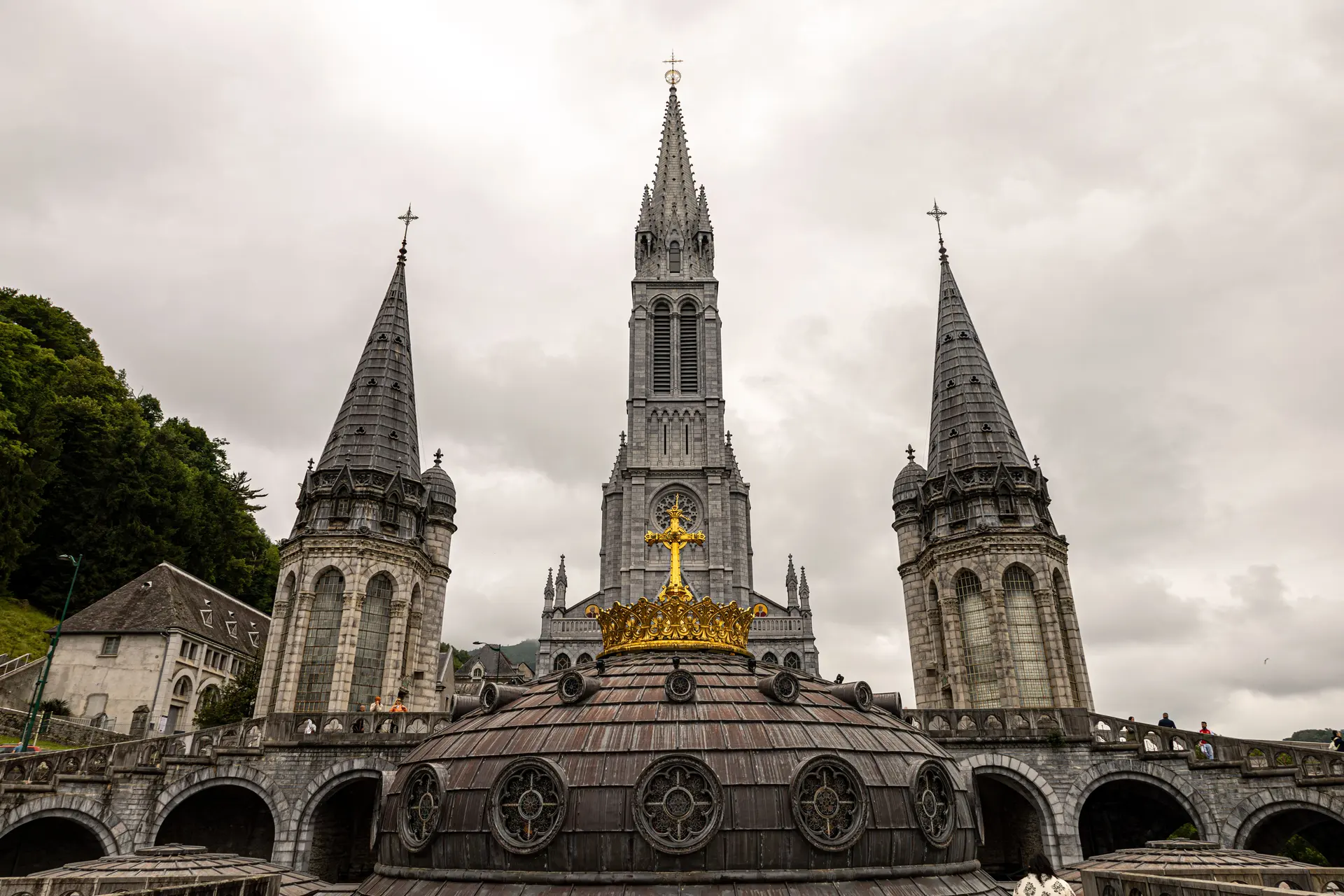
The Sanctuary of Our Lady of Lourdes has grown around the grotto: the Basilica of the Immaculate Conception above, the Basilica of Our Lady of the Rosary below, the massive underground Basilica of St. Pius X capable of holding 25,000. But these are support structures for the essential site, which remains a cave with a spring.
The pilgrimage attracts people of all conditions. The sick come in hope of healing; the hospitaliers volunteer to serve them. The healthy come with intentions they cannot name. Clergy lead organized pilgrimages; individuals arrive alone. The grotto receives all equally. Bernadette was an illiterate peasant girl; the Lady appeared to her, not to bishops. That democratization of access continues.
Bernadette Soubirous
visionary
The fourteen-year-old who received the apparitions in 1858. Uneducated and impoverished, she became the vessel through which the spring was revealed. She spent her remaining years as a nun in Nevers, maintaining simple fidelity to what she had witnessed. Canonized as Saint Bernadette in 1933.
Our Lady of Lourdes
deity
The Virgin Mary as she appeared to Bernadette. The title 'Immaculate Conception' refers to the Catholic doctrine that Mary was conceived without original sin—a dogma defined just four years before she identified herself by this name to an unschooled girl who had never heard the term.
Father Dominique Peyramale
historical
Parish priest of Lourdes who initially doubted Bernadette but became convinced after she reported Mary's self-identification. His recognition of the theological significance of 'Immaculate Conception' from an illiterate child was decisive in the Church's investigation.
Traditions and practice
The practices at Lourdes emerged directly from Mary's instructions to Bernadette. She was told to drink from the spring and wash—pilgrims do the same. She was told to pray for sinners—the rosary is recited continuously. She was told to have a chapel built—the basilicas answer that request.
The touching of the rock developed organically. Bernadette never suggested it, but pilgrims began pressing their hands against the cave wall almost immediately. The gesture persists because it works: physical contact with the site creates connection that prayer alone may not achieve.
Candles have been part of Lourdes from the beginning. During the apparitions, Bernadette often held a blessed candle. Today, pilgrims light candles as offerings and prayers made visible. The racks near the grotto hold thousands at any time, their flames representing intentions carried from around the world.
The grotto remains open for veneration continuously. Pilgrims approach in a slow procession, touching the rock, pausing in prayer, moving on to make room for others. The fountains—eighteen of them, representing the eighteen apparitions—dispense spring water freely. Pilgrims drink, wash their hands and faces, fill containers to take home.
The baths allow full immersion in the spring water. Volunteers assist pilgrims in undressing and entering the cold water. The experience is brief—a few seconds of immersion, during which traditional prayers are recited. Many report the cold as transformative: a shock that clears the mind and creates openness.
The great pilgrimage events include the Blessed Sacrament Procession each afternoon and the torchlight Marian Procession each evening. The sight of thousands carrying candles while singing the Lourdes hymn creates collective intensity that individual practice cannot match.
Mass is celebrated daily in multiple languages. The sick receive special blessings. The International Mass draws pilgrims from every continent. Yet between these structured events, individual pilgrims maintain the grotto's continuous prayer presence. Someone is always there.
Begin at the grotto itself, before exploring the larger sanctuary. Touch the rock. Let your hand rest there long enough to feel the coolness, the smoothness worn by hands before yours. This is not tourism; it is participation.
Drink from the fountains. The water is free and flows continuously. Taste what Bernadette tasted when she scraped the mud away and found what Mary promised.
If you are physically able, consider the baths. The cold is significant—it strips away comfort and creates a moment of pure presence. The brevity matters too; this is not leisure but ritual.
Attend the evening torchlight procession at least once. The collective dimension of Lourdes becomes visible in ways that solitary prayer does not reveal. The singing, the candles, the sense of joining something larger than yourself—these are part of what makes Lourdes what it is.
Return to the grotto multiple times if your visit allows. The first encounter establishes contact; subsequent visits deepen it. The grotto reveals itself gradually.
Roman Catholicism
ActiveThe Grotto of Massabielle is among the most important Marian pilgrimage sites in the Catholic world. The apparitions of 1858 confirmed the recently defined dogma of the Immaculate Conception and established Lourdes as a place where heaven touched earth. The Church has recognized the apparitions as worthy of belief, canonized Bernadette as a saint, and authorized the veneration that continues to draw millions. The grotto represents the accessibility of the sacred: Mary appeared not to theologians but to a poor, sick, illiterate girl, and the spring flows freely for all.
Pilgrims touch the rock, drink and wash with the spring water, pray the rosary before the statue of Our Lady, light candles as offerings, and participate in the daily processions. The sick receive special blessings and may immerse themselves in the baths. Mass is celebrated in multiple languages throughout the sanctuary. The collective practices—torchlight processions, sung Ave Marias, the shared experience of the sick and those who serve them—create a visible church that transcends national and cultural boundaries.
Marian Devotion / Healing Pilgrimage
ActiveBeyond formal Catholic doctrine, Lourdes functions within a broader tradition of Marian devotion and healing pilgrimage that crosses denominational lines. The site draws not only practicing Catholics but people of various Christian backgrounds, other faiths, and no particular religion—all seeking healing, hope, or encounter with something transcendent. The spring water, freely available to all, serves as the material focus for intentions that may or may not use Catholic language.
Drinking and washing with the water, touching the grotto rock, carrying water home for sick loved ones, writing intentions on papers deposited at the sanctuary, making private prayer before the statue. Many who come to Lourdes are not regular churchgoers; they come because they are desperate, because nothing else has helped, because they have heard stories. The grotto receives them regardless of their theological sophistication.
Perspectives and open questions
Lourdes exists at the intersection of faith, skepticism, and experience. The Church affirms the apparitions; science finds no miraculous properties in the water; pilgrims report transformation regardless of what they believe or what can be measured. Honest engagement requires holding these perspectives without forcing them into premature resolution.
Scholarly perspective
The Lourdes phenomenon demonstrates how visionary experience, when authenticated by religious authority, generates enduring pilgrimage traditions. Sociologists and anthropologists note the site's function in providing hope, community, and ritual structure for those facing illness and mortality.
The 'healing' at Lourdes, from this perspective, may be less about miraculous cures—of which the Church has recognized only seventy in over 160 years—than about the psychological and social benefits of pilgrimage: removal from ordinary life, entrance into sacred time, the support of a community of fellow sufferers, and the ritual processing of illness and fear.
Historians situate the apparitions within their context: mid-19th century France, the recent definition of the Immaculate Conception dogma, the tension between secular and religious authority. That an illiterate peasant girl would independently produce the term 'Immaculate Conception' remains, for believers, evidence of supernatural origin; for skeptics, it raises questions about what Bernadette might have overheard or absorbed.
Living and traditional perspectives
Catholic teaching holds that the apparitions were genuine encounters between Bernadette Soubirous and the Virgin Mary. The Church investigated carefully, recognized the apparitions as worthy of belief in 1862, and canonized Bernadette in 1933. The Immaculate Conception's self-identification through an uneducated girl is understood as confirmation of the 1854 dogma by heaven itself.
The spring is seen as a sign and instrument of grace. While the Church does not claim the water has magical properties, it affirms that God works through material creation, and that pilgrims have received healing and conversion through their encounter with the grotto and its water. The seventy officially recognized miracles represent only the most rigorously verified cases; countless other healings and conversions are attributed to Lourdes without formal investigation.
The grotto is understood as a place where the boundary between heaven and earth became momentarily transparent—and where that transparency persists for those who come in faith.
Alternative interpretations
Sacred caves and healing springs appear across cultures and traditions, often associated with the divine feminine, earth energies, and transformation. Some interpret Lourdes within this broader pattern: a place where geological or energetic factors create conditions conducive to healing and vision, which the Catholic framework interprets through its own symbols.
Others note that Bernadette's visions occurred during a period of personal illness and extreme poverty, psychological conditions sometimes associated with visionary experience. This does not necessarily invalidate her experience but situates it within human context.
The persistence of pilgrimage to Lourdes despite modest rates of documented cure suggests that what people seek—and find—may be something other than physical healing. Meaning, community, ritual, hope, and the experience of being received by something larger than oneself may be the real gifts of the grotto.
Open questions
What happened to Bernadette Soubirous in 1858 remains irreducible to either faith or skepticism. She saw something; she conversed with it; she obeyed its instructions; a spring emerged. The Church has never required belief that Mary physically manifested—only that Bernadette's experience was genuine and its fruits authentic.
What do millions of pilgrims experience at the grotto? The reports are consistent enough to take seriously: peace, tears, release, presence. Whether this reflects encounter with the divine, psychological response to ritual and expectation, the accumulated weight of 160 years of prayer, or something we lack vocabulary to describe, remains an open question.
The water has been analyzed repeatedly; it is ordinary spring water, unremarkable in composition. Yet people drink it and report healing. What is the relationship between belief and cure, between ritual and transformation, between the physical and the spiritual? Lourdes sits at this boundary, offering experience rather than answers.
Plan your visit
Access and arrival
Lourdes has hundreds of hotels, ranging from budget hostels to four-star accommodations. Many are designed for pilgrims and include chapel spaces and group dining. The Accueil Notre-Dame and Accueil Marie Saint-Frai provide hospital-like facilities for sick pilgrims requiring medical support. Booking ahead is essential during peak season.
Respectful visit
Modest dress is expected throughout the sanctuary. Shoulders and knees should be covered. This is not strictly enforced, but revealing clothing is conspicuously out of place in an environment of prayer. Comfortable walking shoes are practical; the sanctuary covers significant ground.
Photography is permitted at the grotto but should be practiced with restraint. Do not photograph people in prayer without permission. Do not use flash. Do not position yourself for extended photo sessions in ways that block others' access. Consider whether documenting the experience is more important than having it.
Candles are the traditional offering, available for purchase near the grotto. The water is free and should remain so—do not sell or commercialize water from the fountains. Financial donations support the sanctuary's mission of welcoming all regardless of means.
The grotto is accessible to all visitors regardless of religious affiliation. The baths have separate facilities for men and women and operate on a first-come basis during open hours. Large bags and backpacks should be stored before entering the grotto area. Food and drink (other than spring water) should be consumed elsewhere.
The baths involve complete undressing and require physical mobility; they are not suitable for everyone, and there is no obligation to use them. The spring water is for drinking and washing, not for 'charging' objects or commercial purposes.
Be wary of commercial vendors selling water or objects with exaggerated claims. The sanctuary provides water freely. Blessed medals and objects are available through official channels.
The sick come to Lourdes in hope, but healing cannot be promised. Do not suggest to those who remain ill that their faith was insufficient. The grotto offers presence, not guarantees.
Current practical details
Address
Massabielle Grotto, 65100 Lourdes, France
Hours, fees, and access can change — verify on the official source before you travel. Practical details last checked Jun 2026.
Location
Map loads as you approach this section.
Pilgrim reflections
A portrait of encounter, not a score
Pilgrims describe what they felt, how present they could become, and whether the place would shape a journey. There are no stars and no ranking of traditions.
No reviewed reflections yet
The first pilgrims can help describe the character of being here.
Share a reflection
Available after an account-backed “Been there.” Every reflection is reviewed before publication.
Nearby sacred places
Explore other sacred places in the region. Proximity does not establish access or travel time; check each place’s guidance.
Lourdes Sanctuary
Lourdes, Hautes-Pyrénées, France
0.1 km away

Sanctuary of Notre-Dame de Bétharram
Lestelle-Bétharram, Lestelle-Bétharram, Pyrénées-Atlantiques / Nouvelle-Aquitaine, France
13.0 km away

Sanctuary of Our Lady of the End of the Bridge – Refuge of the Mother and Child of Pau
Pyrénées-Atlantiques, France
33.9 km away

Church of L’Hôpital-Saint-Blaise
Pyrénées-Atlantiques, France
60.2 km away
References
Sources consulted for this page. Source categories describe the publication, not a guarantee that every claim is verified. Traditional accounts and outside interpretations may differ.
- 01Sanctuary of Our Lady of Lourdes — WikipediaencyclopediaInformation about the grotto within the sanctuary
- 02Drinking the water and washing in it — Sanctuaire Notre-Dame de LourdesofficialOfficial information about the spring
- 03Lourdes water — WikipediaencyclopediaInformation about the spring and its significance
Share a photo
Help visitors recognize Grotto of Lourdes (Grotto of Massabiell). Every submission is reviewed before publication.