Leluh Ruins
Kosrae's walled royal city, where certain tombs were once forbidden ground
Understand sacred places, explore living traditions, and learn how to engage respectfully with Pilgrim Map.
Access has not been verified. Check current local guidance before planning a visit.
Lelu, Kosrae State, Kosrae, Federated States of Micronesia
Read the sources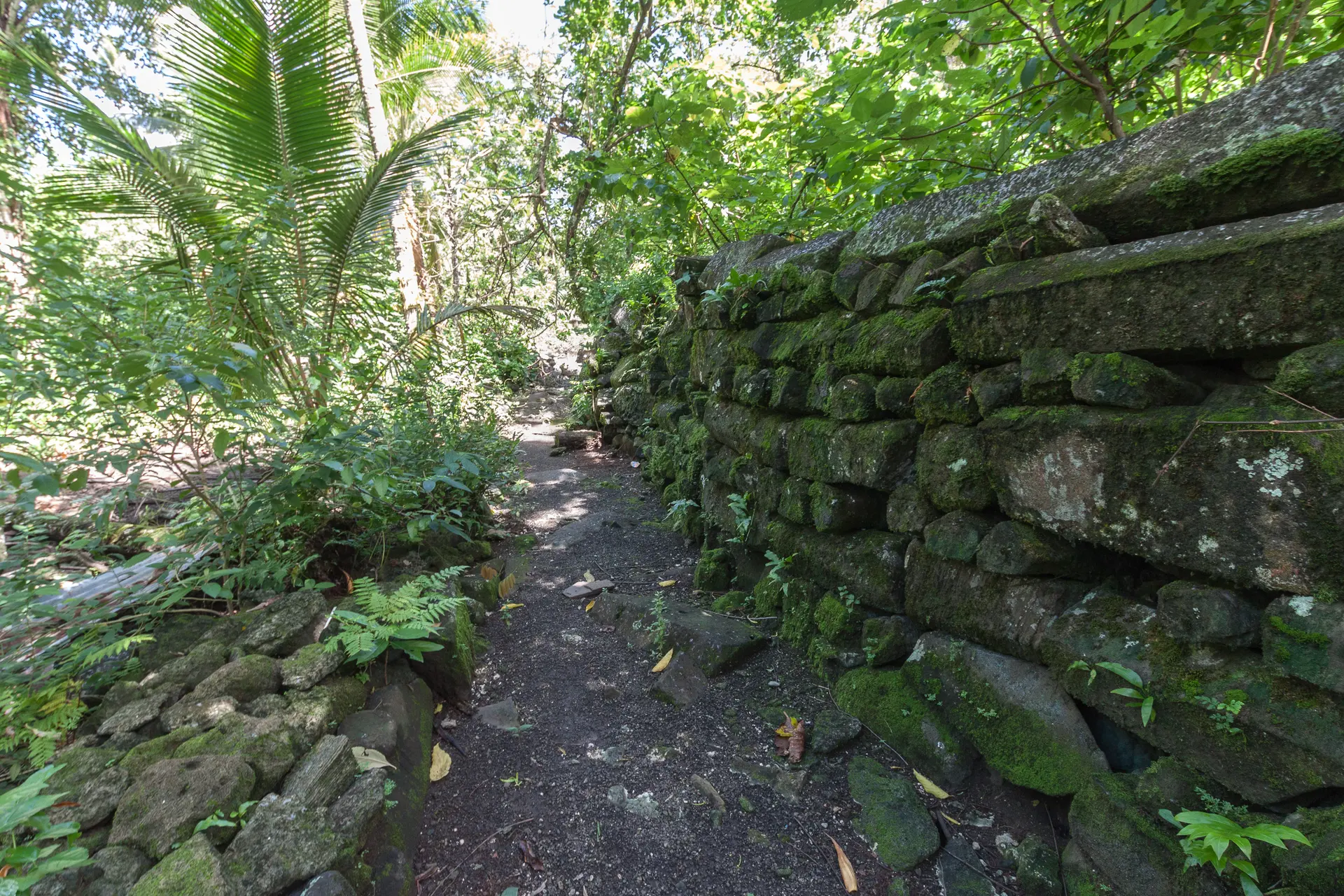
Visit essentials
A quick read before you go
- Duration
- Not explicitly documented in sources; comparable ruin complexes of similar scale are typically…
- Access
- Lelu Island connects to Kosrae's main island by bridge, reachable by car (about ten minutes from…
Overview
A four-tiered society once governed Kosrae from Leluh's basalt walls: ruler, high chiefs, low chiefs, and commoners, with rank differentiated even in death. The walled city arose around AD 1250 and peaked in the fourteenth and fifteenth centuries. A 2015 U-Th study dates its coral pyramidal tombs to roughly seven hundred years ago. They held a paramount chief, or tokosra, under rites so sacred that European visitors were explicitly denied entry to some royal compounds as early as 1824.
Introduced disease and Christian conversion dissolved the feudal order during the nineteenth century. In 1874 the last tokosra abdicated and was buried in a Christian cemetery rather than through the traditional saru-tomb sequence, quietly ending a system governed through sacred architecture for six centuries.
The listed archaeological ruin retains largely intact walled outlines despite overgrowth and partial reuse with modern materials. Its land remains mostly held by local Kosraean families. Local tradition associates powerful spirits, including the ghost Sepos, with the royal tombs—a living cultural memory, not folklore performed for tourists.
Why this place is sacred
What set Leluh apart from an ordinary seat of government was the degree to which political rank and sacred restriction were the same thing.
The tokosra's authority was not merely inherited or enforced; it was ritually confirmed through a mortuary sequence available to no one else on the island — anointing with coconut oil, temporary interment in a pyramidal coral saru tomb, exhumation, and secondary burial in a sacred pit on the reef at Yenasr islet, said to unite the ruler with the sea. High chiefs received an attenuated version of this treatment; commoners were buried simply, in shared family-compound graves.
The city itself held sixteen or seventeen sacred compounds housing spirit-houses for Kosraean deities, meaning religious practice at Leluh was not confined to royal death — it ran through the ordinary agricultural and domestic life of the whole island, with deities invoked for house-building, canoe-building, breadfruit harvesting, and weaving.
The clearest evidence of the site's sacred intensity is negative: European visitors as early as 1824 recorded being explicitly barred from entering certain royal tomb compounds, a restriction unusual enough to be worth an outsider's note.
Local tradition adds a specific guardian to this picture — Sepos, a ghost said to wait to devour a deceased king's body once placed in the tomb, deceived by a decoy of coconut log wrapped in mats while the real body was buried elsewhere in secret.
Whether the Sepos tradition is still actively told and believed today, or survives mainly as recorded historical memory, is not clearly established in available sources — a gap worth naming rather than resolving by assumption.
Political and religious capital of a unified Kosraean kingdom, housing the paramount chief (tokosra), his court, and sixteen to seventeen sacred compounds dedicated to Kosraean deities.
Founded around AD 1250 with peak development in the fourteenth and fifteenth centuries; the sacred coral pyramidal tombs specifically date to roughly the fourteenth century per 2015 U-Th dating, revising earlier estimates by about three centuries. The feudal-religious order dissolved through the nineteenth century under depopulation from disease and the arrival of Christianity, ending definitively with the last tokosra's abdication and Christian burial in 1874.
Experience and orientation
Cross the bridge from Kosrae's main island and the ruins arrive without ceremony, set among coconut groves and contemporary village housing rather than isolated in a preserved historical zone. Massive basalt walls, some largely intact after seven centuries, define compound boundaries that visitors describe as impressive precisely because they were not built for permanence in the way European fortifications were, and yet have held.
Much of the site is overgrown, and original interpretive signage has decayed past legibility, so independent navigation is difficult; travel accounts consistently recommend a local Kosraean guide, not as an enhancement but as the difference between seeing walls and understanding what those walls once separated — who was permitted where, and why.
Walking the compound boundaries slowly rewards attention: the differentiation between commoner spaces, high-chief precincts, and the more restricted royal tomb compounds is legible in the architecture itself if you know what to look for, which is precisely what a guide's oral interpretation supplies. Visit in early morning, both for cooler temperatures and, per repeated visitor guidance, a quieter, less populated encounter with the ruins.
Lelu Island connects to Kosrae's main island by bridge, about ten minutes by car from Tofol; no entry fee applies at the main park area, though other Kosrae historic sites require landowner coordination.
Context and lineage
Archaeological survey attributes Leluh's rise to the ancestors of the Kosraean people, who progressively unified the island under one monarchy over roughly six centuries. Local tradition holds that the massive basalt megaliths — quarried at a distance and transported over land and water — were moved and erected through means best described as 'magic,' since no historical or archaeological record explains the engineering method.
A related Kosraean legend describes Lelu Island as one islet of an atoll shaped like a whale, tied to the story of the Kosrae landform known as the Sleeping Lady.
Leluh's tokosra lineage governed a unified, four-tier stratified Kosraean society for roughly six centuries before depopulation and Christian conversion dissolved the system in the nineteenth century.
Ross Cordy
Lead archaeologist, 1979-1983 surveys
Archaeologist who led the original Trust Territory Historic Preservation Office and Bishop Museum surveys of Leluh, documenting mortuary sequence and social stratification; his 2022 Micronesica journal article remains a key academic source.
Richards and Shen et al.
2015 dating study authors
Research team whose U-Th coral dating of three saru tombs redated their construction to approximately the fourteenth century, roughly three centuries earlier than prior estimates.
The last tokosra
Final paramount chief of Leluh
Abdicated in 1874 and was buried in a Christian cemetery rather than by the traditional saru-tomb sequence, marking the definitive end of Leluh's sacred-political order.
Traditions and practice
Royal mortuary rites involved anointing the deceased tokosra's body with coconut oil, wrapping in mats and cordage, temporary interment in a pyramidal coral saru tomb for up to several months while chiefs mourned, followed by exhumation, ritual rebinding of the bones, and secondary burial in a sacred pit on the reef at Yenasr islet, accompanied by island-wide feasting. High chiefs received an attenuated version of this sequence; commoners were buried more simply within family compounds.
Sixteen to seventeen sacred compounds within the city held spirit-houses where Kosraean deities were venerated for guidance in daily and agricultural life.
No ceremonial or ritual practice continues at the site itself; it functions as an archaeological ruin under informal stewardship, much of the land privately held by local families. Belief in the presence of spirits, including the ghost Sepos associated with the royal tombs, persists informally in local culture, though the extent of active belief versus recorded historical memory is not clearly established.
Walk the compound walls with attention to scale rather than seeking a single photographic vantage — the differentiation in wall height and enclosure between commoner, chief, and royal precincts is where the site's social order becomes legible. Approach the tomb compounds, in particular, with the same restraint early visitors were required to observe by rule; no rule enforces this for you, but the history of restriction here is recent enough to be worth honoring.
A guide's account of the Sepos legend is worth pausing for, rather than treating as incidental color to the ruins.
Kosraean traditional religion and royal cosmology (pre-Christian)
HistoricalLeluh was the political, religious, and ceremonial capital of a unified Kosraean kingdom, housing a paramount chief whose rule and mortuary treatment were bound up with spiritual authority, and sixteen to seventeen sacred compounds dedicated to Kosraean deities.
Veneration of local deities for guidance in daily and agricultural life; royal mortuary rites involving anointing, temporary interment in coral saru tombs, exhumation, and secondary burial at Yenasr islet.
Kosraean feudal social hierarchy
HistoricalLeluh was the seat of a four-tier stratified society governing the whole island from a single walled city, with residence, burial location, and mortuary treatment differentiated sharply by rank.
Differentiated burial rites by class: simple shared graves for commoners, mummification and feasting for high chiefs, and pyramidal saru tomb burial with island-wide feasting for the tokosra alone.
Christianity (post-contact)
ActiveIntroduced by nineteenth-century missionaries, Christianity contributed directly to the dissolution of the traditional order at Leluh; the last tokosra was buried in a Christian graveyard rather than a saru tomb, marking the symbolic end of the old system.
Christian burial replaced the traditional saru/Yenasr mortuary sequence; Christianity remains the dominant faith in contemporary Kosrae, though it is not itself centered on the Leluh site today.
Perspectives and open questions
Leluh is read differently depending on the lens — archaeologists tracing a six-century political unification through mortuary architecture, Kosraean tradition holding certain ground as still spiritually restricted, and an open engineering mystery neither fully resolves.
Scholarly perspective
Archaeologists, notably Ross Cordy's 1979-1983 surveys with the Trust Territory Historic Preservation Office and Bishop Museum, treat Leluh as the capital of a unified, stratified Kosraean kingdom comparable in governance structure to Tongan or Hawaiian chiefdoms. The 2015 Science Advances U-Th dating study refined the chronology of the sacred coral tombs specifically, dating them roughly three centuries earlier than prior indirect estimates and situating Leluh's paramountcy at the forefront of emerging Pacific political systems.
Living and traditional perspectives
Kosraean oral tradition frames Leluh as a place where spiritual and dynastic power were inseparable — the tokosra's authority validated through sacred mortuary rites, and certain royal compounds understood as too sacred for casual or foreign entry, a restriction outside observers documented as early as 1824. The Sepos ghost tradition and continuing local reports of powerful spirits at Kosraean sacred sites, including Leluh, reflect belief that has not fully receded into the past.
Alternative interpretations
Popular and travel-oriented sources repeat the local tradition that Leluh's multi-ton basalt megaliths were moved and erected through magic, a genuine gap in the archaeological record about engineering method rather than a distinct esoteric movement — this research treats it as the local explanation offered for an unresolved technical mystery, not a claim requiring debunking.
Open questions
The precise engineering method used to quarry and transport Leluh's basalt columns remains undocumented in both academic and local-tradition sources. Whether the Sepos ghost legend and related spirit traditions are still actively told and believed by Kosraeans today, or preserved mainly as recorded oral history, is not clearly established in available English-language sources.
Plan your visit
Access and arrival
Lelu Island connects to Kosrae's main island by bridge, reachable by car (about ten minutes from Tofol, the state capital) or local bus/shared van (fifteen to twenty minutes, fare approximately $1-2). No entry fee applies at the main park area. A local guide is strongly recommended given degraded or missing signage.
Kosrae Nautilus Resort and Pacific Treelodge Resort are located in proximity to Lelu Island per Kosrae Visitors Bureau guidance.
Respectful visit
No specific dress code documented; respectful outdoor attire and sturdy walking shoes are recommended for uneven terrain.
No explicit photography restrictions found; standard courtesy at a culturally sensitive site would apply, particularly around royal tomb compounds.
No current offering practice is documented; historical offerings — feasting and food presentation — were part of royal mourning rites and are not continued today.
Much of Lelu Island is privately owned; coordinate access through local landowners or the Kosrae State Historic Preservation Office (ideally two weeks in advance) rather than arriving unannounced. Certain royal tomb compounds were historically off-limits even to foreign visitors, documented as early as 1824.
Much of Lelu Island's ruins sit on privately owned land; visitors are advised to coordinate access through local landowners or the Kosrae State Historic Preservation Office, ideally two weeks ahead of arrival, rather than entering unannounced.
Location
Map loads as you approach this section.
Pilgrim reflections
A portrait of encounter, not a score
Pilgrims describe what they felt, how present they could become, and whether the place would shape a journey. There are no stars and no ranking of traditions.
No reviewed reflections yet
The first pilgrims can help describe the character of being here.
Share a reflection
Available after an account-backed “Been there.” Every reflection is reviewed before publication.
Nearby sacred places
Explore other sacred places in the region. Proximity does not establish access or travel time; check each place’s guidance.

Nan Madol
Temwen Island, Pohnpei State, Pohnpei, Federated States of Micronesia
540.5 km away
House of Taga
San Jose, Tinian, Northern Mariana Islands, Northern Mariana Islands, United States
2177.4 km away

As Nieves Latte Stone Quarry
Songsong / Sinapalo area, Rota, Northern Mariana Islands, Northern Mariana Islands, United States
2180.7 km away

Mangyol Stone Money Bank
Makiy, Gagil, Yap State, Yap, Federated States of Micronesia
2776.9 km away
References
Sources consulted for this page. Source categories describe the publication, not a guarantee that every claim is verified. Traditional accounts and outside interpretations may differ.
- 01Leluh archaeological site — Wikipedia — Wikipedia contributorsacademicCore historical/archaeological overview: dates (A.D. 1250-1850, peak 14th-15th c.), construction materials, social stratification, population figures, NRHP listing (1983, ref #83004524, 173 acres).
- 02Lelu — Kosrae State Historic Preservation Office — Kosrae State Historic Preservation Office / Kosrae Island Resource Management AuthorityofficialOfficial Kosrae State government heritage authority page dedicated to the Lelu site. Confirms HPO stewardship. Full body text could not be extracted via automated fetch (page loaded navigation shell only), but its existence and role were corroborated via the HPO 'Sites' index page and search summaries.
- 03Sites — Kosrae State Historic Preservation Office — Kosrae State Historic Preservation OfficeofficialConfirms visitor protocol: contact HPO or landowners at least 2 weeks prior to arrival; most sites are privately owned with nominal landowner-set entry fees; research requires permits from FSM HPO and KIRMA.
- 04New precise dates for the ancient and sacred coral pyramidal tombs of Leluh (Kosrae, Micronesia) — Richards, Shen, et al.academicPeer-reviewed Science Advances study (2015) using U-Th dating of coral from three saru tombs; redated tomb construction to ~14th century, ~3 centuries earlier than prior estimates. Full text blocked (403) on direct fetch; findings drawn from abstract/summary coverage and corroborating secondary science journalism (Archaeology Magazine, IBTimes, NBC News).
- 05The Leluh Royal Tombs and Pre-Contact Mortuary Patterns on Kosrae Island, Micronesia — Ross CordyacademicAcademic journal article by Ross Cordy, the archaeologist who led original 1979-1983 Leluh surveys with the Trust Territory Historic Preservation Office and Bishop Museum. Direct PDF fetch returned 403; content drawn from search-result summaries describing saru construction, mortuary sequence (anointing, interment, exhumation, secondary sea burial at Yenasr/Yenar islet), and the Sepos ghost decoy tradition.
- 06Kosrae's sacred site where 'powerful ghosts still roam' — Pacific Island TimesSource contextPacific regional outlet covering Micronesian affairs; primarily discusses the related Kosraean sacred site of Menka (goddess Sinlaku) but references Leluh among Kosrae's monumental sacred sites. Useful for regional cultural-spiritual framing though not Leluh-specific in depth.
- 07Kosrae's stratification and burial practices — Pacific Island TimesSource contextDetailed account of Kosraean mortuary practices by social rank (commoner, high chief, tokosra/ruler), the Sepos ghost legend, and sacred restrictions on ruler tombs at Leluh. Regional Pacific journalism outlet; draws on ethnographic/historical record rather than being itself a primary indigenous source, but reports Kosraean oral tradition directly.
- 08Day 94: Leluh Ruins, Kosrae, Federated States of Micronesia — APIAHiP (Asian Pacific Islander American Historians in Preservation)Source contextCommunity heritage-preservation blog project by Asian/Pacific Islander American historians focused on highlighting under-documented AAPI heritage sites; not primary Kosraean-authored but produced by a Pacific/Asian-American heritage advocacy organization rather than a general travel outlet.
- 09Leluh — Alluring WorldSource contextGeneral travel/history site; corroborates site layout (100+ walled compounds, 16 sacred compounds with spirit-houses, two royal burial compounds), construction period, and current preservation threats (vandalism, environmental degradation).
- 10Visit Kosrae — Visit Our Ruins — Kosrae Visitors BureauSource contextKosrae state tourism board page; used for access/logistics details (bridge connection to Lelu Island, proximity to Kosrae Nautilus Resort and Pacific Treelodge Resort, no entry fee, parking available).
- 11Leluh archaeological site (Kosrae) Essential Tips and Information — Trek.zoneSource contextAggregator travel-tips page; used only for practical visitor logistics (recommendation to hire a local guide, degraded/missing signage, access difficulty).
Share a photo
Help visitors recognize Leluh Ruins. Every submission is reviewed before publication.