Explore this place by
La Sainte-Baume, Grotto of Mary Magdalene
A mountain cave where Mary Magdalene is said to have spent thirty years in prayer, drawing pilgrims for over fifteen centuries
Saint-Raphaël, Var, France
Visit essentials
A quick read before you go
- Duration
- Allow a minimum of half a day: 45 minutes to 1 hour for the ascent, 30-60 minutes in the grotto,…
- Access
- The grotto is located in the commune of Plan-d'Aups-Sainte-Baume in the Var department.
Overview
The path climbs through ancient beech-and-oak forest, one of France's oldest, which has sheltered pilgrims for centuries. The Chemin des Roys, or Kings Path, remembers monarchs who walked it: Louis IX, Francis I, and Louis XIV. Ahead, the Sainte-Baume limestone cliff rises nearly a thousand meters, hiding the cave until the final approach.
Provençal tradition says Mary Magdalene—the woman who washed Jesus's feet with tears, remained at the crucifixion when others fled, and first saw the risen Christ—spent her final three decades here. After fleeing persecution in the Holy Land and evangelizing Provence, she withdrew for prayer and contemplation. Seven times daily angels lifted her for heavenly nourishment because she ate no earthly food; at the end they carried her to Saint Maximin for final communion before death.
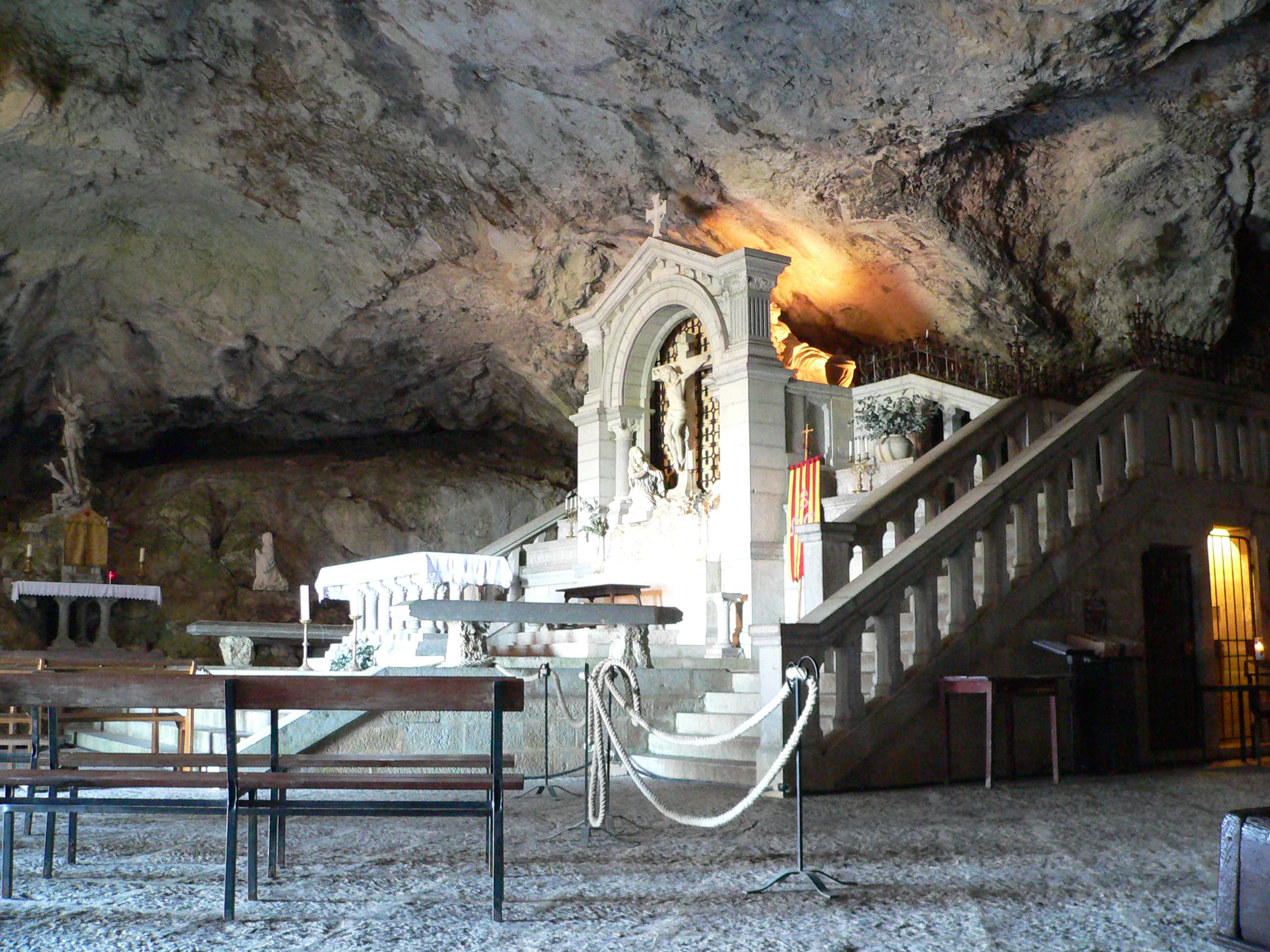
The cave holds a thousand people yet feels intimate. A centuries-old chapel remains within it, with Mass daily at 11 AM, but rough walls, dripping water, and cool ancient air remain cave. Whether Mary's literal hermitage or a place sanctified by fifteen centuries of prayer, the grotto invites her withdrawal: a temporary departure from the world to meet what lies beneath its surface.
Why this place is sacred
Something happens in caves. They have served as sacred spaces across cultures and millennia, offering passage from the world of light and activity into darkness and stillness. The Sainte-Baume grotto shares this universal cave quality—the temperature change as you enter, the dampness, the way sound behaves differently, the sense of entering the body of the earth itself.
Layered onto this natural potency is fifteen centuries of human intention. Since John Cassian established a priory here in the fifth century, this cave has been a destination for seekers. The walls have absorbed the prayers of peasants and kings, the tears of the grieving and the gratitude of the healed. This accumulated devotion creates an atmosphere that many visitors sense immediately—a weight of presence, a density of intention.
But the particular power of Sainte-Baume may lie in the identity of its patron. Mary Magdalene represents transformation itself. According to tradition, she was possessed by seven demons before encountering Jesus—her healing was complete, radical, life-altering. She remained faithful when disciples fled. She witnessed the worst moment (crucifixion) and the best moment (resurrection) of the Christian story. Her retreat to this cave represents the ultimate withdrawal for integration—thirty years to absorb what she had witnessed, to let the resurrection work itself through her being.
Pilgrims climbing to this cave undertake their own small version of that withdrawal. The physical effort removes them from ordinary life. The forest path provides transition. The cave receives them into an older rhythm. Whether they come seeking healing, clarity, or simply the pause that modern life rarely permits, the grotto offers what caves have always offered: a place where the surface world recedes and something deeper becomes available.
According to tradition, Mary Magdalene sought the cave as a place of withdrawal and contemplation after her years of active evangelization. The site may have had sacred significance before Christian tradition claimed it, as caves often served as worship sites in ancient Provence.
From private hermitage to organized pilgrimage site, the grotto has continuously served seekers. The Dominicans have maintained guardianship since 1295, providing hospitality at the Hostellerie and celebrating daily mass. Despite interruption during the French Revolution, the pilgrimage tradition has continued without permanent break. Today the site welcomes over 200,000 visitors annually—pilgrims, tourists, hikers, seekers of all kinds.
Experience and orientation
The experience begins at the Hostellerie de la Sainte-Baume, the Dominican-run guesthouse at the forest's edge. Here, vehicles are left behind. The path forward is walked, and walking changes the mode of consciousness. Choose the Chemin des Roys for the most gradual ascent, or the steeper routes for a more demanding journey.
The forest closes around you almost immediately. These are ancient trees—beech and oak, lime and maple—protected since 1853, part of one of the oldest forests in France. Light filters green through the canopy. The path rises steadily. Breath deepens. Thoughts that seemed urgent at the trailhead begin to release.
Forty-five minutes to an hour of walking brings the cliff face into view, and with it, the final approach: 150 stone steps carved into the mountain. This last ascent requires something. By the time you reach the cave entrance, the body knows it has worked, and that work creates receptivity.
The temperature drops as you pass the threshold. Eyes adjust from forest light to cave shadow. The space opens—larger than expected, a natural cathedral hollowed by time. The chapel of Saint Cassian occupies one side; a life-size statue shows Mary Magdalene being lifted by angels. But much of the space is simply cave: walls slick with moisture, the constant sound of dripping water, the particular stillness that belongs to enclosed spaces.
Pews allow sitting; stone allows kneeling. The atmosphere discourages casual conversation. Whether or not you attend the 11 AM mass, the grotto invites what mass cultivates: attention, presence, availability to something beyond ordinary thought. Many visitors report unexpected emotional release, insight, or simply a profound peace that continues as they descend through the forest, the cave's gift carried into the world.
Approach the pilgrimage with physical preparation and inner intention. The climb requires moderate fitness—come with appropriate footwear and water. But also come with something you seek, even if you cannot name it precisely. Let the walk be contemplative rather than conversational. Allow the cave to receive you rather than demanding particular experience. Bring a jacket for the cool grotto. Consider attending mass if that resonates with your practice—the liturgy provides structure for the encounter. Plan time for the descent as well; integration happens on the way down.
Context and lineage
The Provencal tradition begins with a boat—rudderless, sailless, divinely guided—carrying Mary Magdalene, her siblings Martha and Lazarus, and other disciples from persecution in the Holy Land to the shores of what is now Saintes-Maries-de-la-Mer around 47 AD. While her companions evangelized the coastal cities, Mary eventually sought solitude. She withdrew to this mountain cave, drawn to its embrace as a place of prayer and contemplation. For thirty years she lived as a hermit, sustained not by earthly food but by angelic visitation seven times daily. At life's end, angels bore her to Saint Maximin for final communion and burial. The tradition explains both the grotto's significance and the relics at Saint-Maximin, linking the two sites in a single sacred geography.
The lineage of guardianship traces from John Cassian's fifth-century priory through Benedictine care to Dominican custody since 1295. The French Revolution disrupted this continuity—the friars were expelled, the site pillaged—but Dominican presence was restored in 1859 and continues to the present. Today's friars maintain the same charge Pope Boniface VIII gave their predecessors: to welcome and evangelize the pilgrims who come to Mary Magdalene's cave.
Mary Magdalene
The Gospel figure whose thirty-year hermitage in this cave is commemorated by the pilgrimage tradition
John Cassian
Fifth-century monk who established a priory at Sainte-Baume, beginning organized religious presence at the site
Louis IX (Saint Louis)
King of France who made pilgrimage to the grotto in 1254, giving the Kings Path its name
Pope Boniface VIII
Pope who installed the Dominicans as guardians in 1295
Henri Lacordaire
Dominican friar who led the restoration of the sanctuary after the French Revolution in 1859
Traditions and practice
The primary traditional practice is pilgrimage itself: the physical journey from the Hostellerie up through the forest to the cave. The Chemin des Roys (Kings Path) has served pilgrims for centuries. Many walk the Stations of the Cross along the trail, pausing at each station for prayer and reflection. At the grotto, traditional devotion includes veneration at the statue of Mary Magdalene, lighting candles, and attending mass when scheduled. The feast day on July 22 brings heightened pilgrimage activity.
Daily mass at 11 AM in the Chapelle Grand Saint-Cassien provides liturgical anchor for those who seek it. The Dominican Hostellerie offers overnight accommodation for pilgrims wishing deeper immersion—meals and hospitality within a monastic rhythm. Many contemporary visitors combine the pilgrimage with hiking in the Sainte-Baume massif, treating the journey as both spiritual practice and nature immersion. The grotto also draws those outside traditional Catholicism—seekers of the sacred feminine, those exploring contemplative practice, or simply those drawn to the cave's remarkable atmosphere.
Walk the trail in contemplative silence if possible, treating the ascent as moving meditation. Pause at the forest viewpoints to appreciate the ancient trees. Upon entering the grotto, take time to adjust to the atmosphere before moving or seeking a seat. Allow at least twenty minutes of stillness. If Mary Magdalene's story resonates, consider what she withdrew from and what she sought—and what your own answers to those questions might be. On the descent, resist the urge to immediately process or discuss. Let the silence of the cave travel with you into the forest.
Roman Catholic
ActiveThe grotto is one of France's most important pilgrimage sites, considered by Provence to be the third holiest destination after Jerusalem and Rome. Mary Magdalene's thirty-year contemplative retreat provides a model of complete devotion to God.
Daily mass at 11 AM, pilgrimage hike, Stations of the Cross, veneration at Mary Magdalene's statue, feast day celebrations, overnight retreat at the Hostellerie
Dominican Order
ActiveThe Dominicans have served as guardians of the sanctuary since 1295, maintaining continuous presence except during the French Revolution. Mary Magdalene is a secondary patroness of the order.
Daily liturgy, pilgrim hospitality at the Hostellerie, spiritual direction, maintenance of the sanctuary, teaching and preaching about Mary Magdalene's significance
Perspectives and open questions
The Sainte-Baume grotto exists at the intersection of natural wonder, medieval tradition, and living pilgrimage. Different lenses reveal different facets, none capturing the whole, all contributing to understanding.
Scholarly perspective
Historical scholarship finds no evidence independent of tradition that Mary Magdalene ever traveled to Provence. The legend appears in medieval sources and likely developed in connection with relic veneration at Saint-Maximin. However, the cave's sacred use dates to at least the fifth century, when John Cassian established his priory. The surrounding forest is documented as one of the oldest in France, protected since 1853. The pilgrimage tradition, whatever its origins, has been continuous for over seven centuries.
Living and traditional perspectives
Catholic tradition holds the Provencal account as a credible pious tradition, though not as defined doctrine. The site is officially recognized as a sanctuary, and the pilgrimage enjoys church approval. The Dominicans maintain their papal charge to welcome pilgrims. For believers, the question of historical verification matters less than the grotto's effectiveness as a place of encounter with God and the example of Mary Magdalene's contemplative life.
Alternative interpretations
Some alternative perspectives emphasize the grotto's pre-Christian sacred significance, seeing Mary Magdalene as a Christianized form of goddess worship native to the site. Others connect her to Gnostic Christianity and view the cave retreat as representing inner spiritual journey. Feminist readings reclaim Mary Magdalene as a powerful female figure marginalized by patriarchal tradition, finding in her cave the ultimate assertion of female spiritual autonomy. The site welcomes these diverse approaches, each finding in the cave what they bring to it.
Open questions
What sacred function the cave may have served before Christian tradition remains unknown. The origins and precise development of the Provencal Mary Magdalene tradition are not fully documented. Whether the cave was used for worship in prehistoric times—as many caves were—cannot be verified. The grotto keeps its deeper history as secret as the mystery of Mary Magdalene's final years.
Plan your visit
Access and arrival
The grotto is located in the commune of Plan-d'Aups-Sainte-Baume in the Var department. By car, take the D80 from Saint-Maximin-la-Sainte-Baume. Parking is available at the Hostellerie de la Sainte-Baume. The grotto is accessible only on foot via hiking trails—no vehicular access exists. The main route (Chemin des Roys) takes approximately 45 minutes at a moderate pace.
The Hostellerie de la Sainte-Baume, operated by the Dominican friars, offers pilgrim accommodation at the trailhead. Rooms are simple and clean; meals are provided. The rhythm of the house follows a monastic pattern. Those preferring conventional hotels will find options in Plan-d'Aups-Sainte-Baume and Saint-Maximin.
Respectful visit
Modest dress covering shoulders and knees. Practical hiking attire and sturdy footwear recommended. Bring a jacket for the cool, humid cave. Layers allow adaptation to temperature change from trail to grotto.
Photography permitted without flash. Maintain silence while photographing. Do not photograph worshippers or those in prayer without permission. Refrain from photography during mass.
Candles may be lit in the grotto chapel. Donations support the sanctuary's maintenance and the Dominican community's work.
{"Dogs not permitted in the grotto","Silence expected in the cave","No food or drink inside the grotto","Stay on marked trails in the protected forest","Do not touch cave formations or artworks"}
The climb, while moderate, requires basic fitness. Those with mobility limitations should inquire about accessibility. The cave is cool and damp year-round—bring a jacket. No bathrooms exist at the grotto itself. The emotional intensity some experience can surprise visitors; plan time for integration.
Current practical details
Address
La Sainte-Baume (Grotte Chapelle), 83700 Saint-Raphaël, France
Hours, fees, and access can change — verify on the official source before you travel. Practical details last checked Jun 2026.
Location
Pilgrim reflections
A portrait of encounter, not a score
Pilgrims describe what they felt, how present they could become, and whether the place would shape a journey. There are no stars and no ranking of traditions.
No reviewed reflections yet
The first pilgrims can help describe the character of being here.
Share a reflection
Available after an account-backed “Been there.” Every reflection is reviewed before publication.
Nearby sacred places
Sacred places within a half-day’s reach. Pilgrims often visit them together: walk one, stay for the other.
The Sanctuary of Our Lady of Laghet
La Trinité, Alpes-Maritimes, France
50.8 km away
Basilique Sainte-Marie-Madeleine de Saint-Maximin
Saint-Maximin-la-Sainte-Baume, Saint-Maximin-la-Sainte-Baume, Provence-Alpes-Côte d'Azur (Var), France
83.8 km away
Saint-Maximin-la-Sainte-Baume, Basilica of Mary Magdalene
Saint-Maximin-la-Sainte-Baume, Var, France
83.8 km away

Relics of Mary Magdalene at Saint-Maximin-la-Sainte-Baume
Saint-Maximin-la-Sainte-Baume, Var, France
83.8 km away
References
Sources consulted when researching this page. Independent verification by readers is welcome.
- 01Sainte-Baume cave (Mary Magdalene) — Provence-Alpes-Côte d'Azur Tourismhigh-reliability
- 02Inside the cave in France where many believe St. Mary Magdalene spent her final years — Catholic News Agencyhigh-reliability
- 03Saint-Maximin et La Sainte-Baume — Villes Sanctuaires en Francehigh-reliability
- 04Sainte-Baume — Wikipedia
- 05Mary Magdalene's Cave the Sainte Baume Grotto — Perfectly Provence
- 06Sainte Baume Grotto — Atlas Obscura
- 07Pilgrimages in France: Walking a Mountain to Mary Magdalene — France Today
- 08Sacred Sainte Baume Grotto a Pilgrims' Walk in Provence — Perfectly Provence
Share a photo
Help visitors recognize La Sainte-Baume, Grotto of Mary Magdalene. Every submission is reviewed before publication.