La Madeleine (Church of Saint Mary Magdalene)
A Greek temple in Paris dedicated to the woman who first announced resurrection
Paris, Paris, France
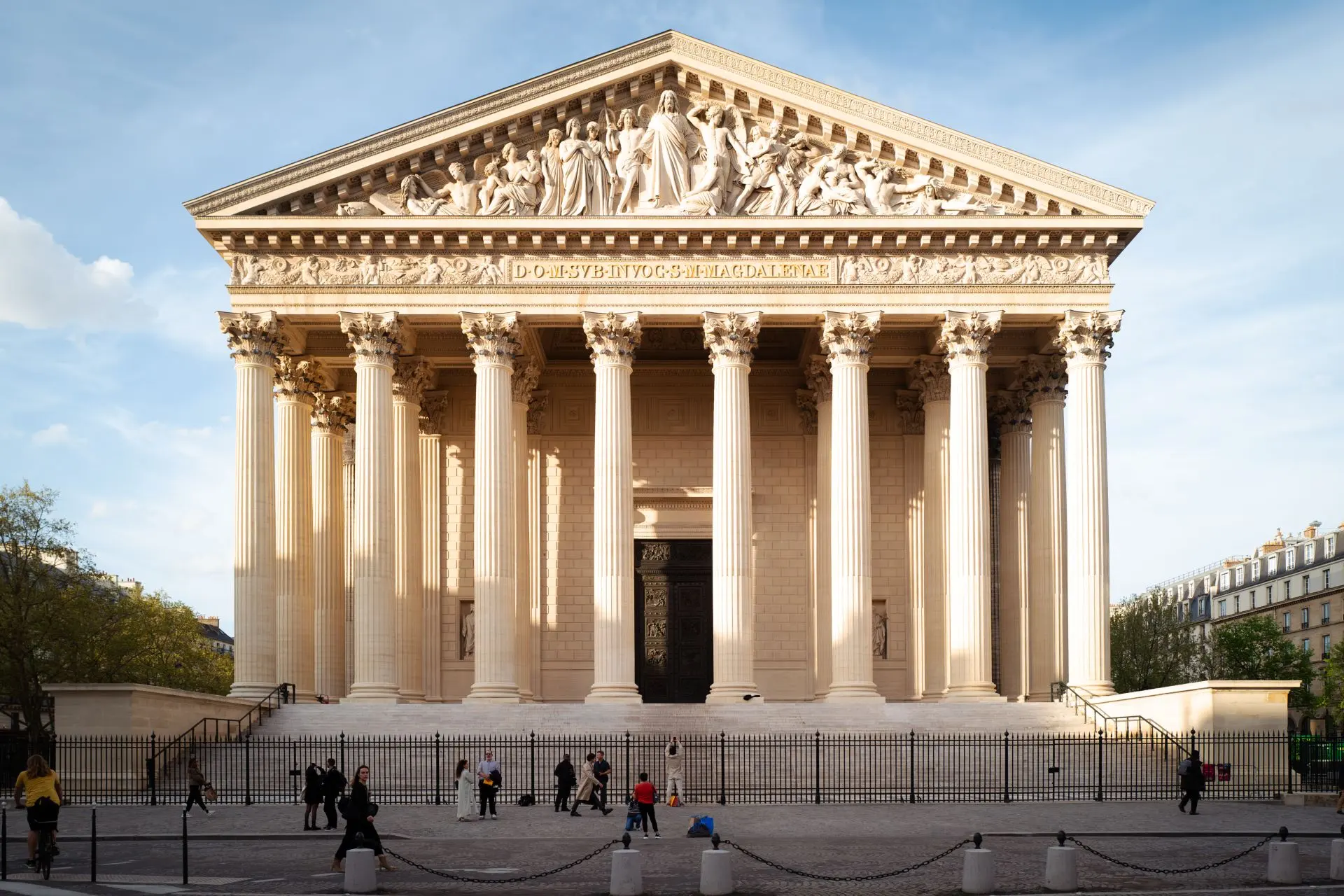
Image of La Madeleine (Church of Saint Mary Magdalene). Image source · CC-BY-3.0
Visit essentials
Before you go
- Access
- Place de la Madeleine, 8th arrondissement.
- Address
- Pl.
- Duration
- 30-60 minutes; longer with concert
- Etiquette
- Active parish church in tourist context.
Overview
After eighty-five years of construction, Pierre-Alexandre Vignon's neoclassical design—inspired by the Roman temples Napoleon admired—emerged as a Greek temple with 52 Corinthian columns, each 20 meters high, encircling the entire building. No cross marks the exterior. No bell tower rises. The bronze doors bear the Ten Commandments; the pediment shows the Last Judgment. Only inside does the building reveal its Christian identity.
That interior surprises. The single nave is covered in colored marble, gilded decoration, and three domes that filter light. Above the altar, Charles Marochetti's sculpture shows Mary Magdalene carried to heaven by angels—the penitent saint's final apotheosis. To the right, against the south pilaster, a reliquary holds what is claimed to be a bone of the woman the church honors.
Sites inside
Why this place is sacred
What makes this place thin is its contradictions. The exterior proclaims classical order—columns, pediment, symmetry—the language of reason and empire. The interior overflows with Christian symbolism—Magdalene ascending, Commandments carved, heaven depicted in paint and stone. The building embodies France's struggle to reconcile Enlightenment and faith.
Mary Magdalene herself carries contradictions. Tradition conflated her with the sinful woman who washed Jesus's feet, making her the great penitent. Scholarship now distinguishes these figures, but the conflation shaped centuries of devotion. In this church, Magdalene is both: witness to resurrection and symbol of redemption, first to proclaim Easter and archetype of forgiveness received.
The musical tradition adds another dimension. Saint-Saëns served as organist here; Fauré followed. Chopin's funeral was held in this space; so were the funerals of Saint-Saëns and Fauré themselves. The Cavaillé-Coll organ—one of Paris's finest—sounds in a room designed for other purposes, creating acoustic that was never intended but became celebrated.
Louis XV's church (1764), Napoleon's temple to military glory (1806), finally dedicated to Mary Magdalene (1842)
Site dedicated to Magdalene 1182. Construction began 1764 (d'Ivry design). Revolution interrupted. Napoleon's temple design 1806 (Vignon). Louis XVIII returned to religious use. Consecrated 1842. Musical tradition with Saint-Saëns, Fauré as organists. Chopin's funeral held here 1849.
Experience and orientation
Approach from Place de la Concorde via Rue Royale, the vista Louis XV intended. The Madeleine anchors the view: 52 columns of Corinthian order, monumental steps, a building that reads as Roman temple rather than Christian church.
Climb the steps. Pass through the bronze doors with their Ten Commandments relief. Enter—and the temple transforms. Colored marble covers the walls in geometric patterns. Three domes punctuate the single nave, each filtering light through oculi. Gilding gleams everywhere. The space is simultaneously overwhelming and intimate, vast in scale but enclosed in ornament.
Seek the altar. Marochetti's sculpture shows Mary Magdalene borne to heaven by two angels—the moment of apotheosis for the penitent saint. The half-dome above depicts Christianity's history with special attention to France. The Magdalene relic waits in its reliquary to the right of the altar.
If timing permits, experience the organ. Cavaillé-Coll built it; Saint-Saëns and Fauré played it. The acoustic in this marble room—never designed for music—has become one of Paris's great sounds. Concert schedules are posted at the entrance.
Come as the Magdalene came—transformed. This building meant for glory became a church; she who was called sinner became apostle to apostles.
Context and lineage
The Place de la Madeleine was consecrated to Mary Magdalene in 1182. Louis XV commissioned a church in 1757 as focal point for Rue Royale. Construction began 1764 but was interrupted by Revolution. Napoleon in 1806 declared it would become a Temple to the Glory of the Grand Army, choosing Vignon's neoclassical design. After Napoleon's fall, Louis XVIII continued construction as a church, finally consecrating it to Mary Magdalene in 1842.
Paris Magdalene devotion since 1182. Part of Parisian sacred geography with Notre-Dame, Sacré-Cœur, Sainte-Chapelle.
Pierre-Alexandre Vignon
Architect of Napoleon's temple design (1806)
Jean-Jacques-Marie Huvé
Completed the interior
Charles Marochetti
Sculptor of altar Magdalene
Aristide Cavaillé-Coll
Organ builder
Camille Saint-Saëns
Organist
Gabriel Fauré
Organist
Traditions and practice
Mass, Magdalene veneration, relic devotion
Daily mass, frequent concerts (organ and other), Magdalene feast (July 22), funerals of notable figures
Take time to let eyes adjust to the interior's richness. Seek the Magdalene relic to the right of altar. Attend a concert if possible to experience the Cavaillé-Coll organ.
Roman Catholicism / Mary Magdalene Veneration
ActiveParis's church dedicated to Mary Magdalene since 1182. Neoclassical temple form unique among churches. Houses Magdalene relic. Cavaillé-Coll organ; Saint-Saëns and Fauré served as organists. Chopin's funeral held here.
Mass, Magdalene veneration, relic devotion, concerts
Perspectives and open questions
La Madeleine can be approached as neoclassical architecture, Magdalene shrine, or musical venue with celebrated organ and history.
Scholarly perspective
Recognized as significant French Neoclassical architecture. Organ by Cavaillé-Coll among Paris's finest. Building history well-documented as example of France's religious-political struggles.
Living and traditional perspectives
Catholic tradition honors the church as Paris's shrine to Mary Magdalene—apostle to apostles, first to proclaim resurrection.
Alternative interpretations
Some see Magdalene as representing feminine sacred suppressed in Christianity. The temple architecture (rather than cross-plan) invites alternative interpretations.
Open questions
Why Napoleon chose temple form. Exact provenance of Magdalene relic. What original d'Ivry dome design would have looked like.
Plan your visit
Access and arrival
Place de la Madeleine, 8th arrondissement. Metro: Madeleine (lines 8, 12, 14). Open daily. Free admission. Concert schedules vary.
Central Paris offers full range
Respectful visit
Modest church attire
Generally permitted outside services
Donations welcome
Quiet during services and concerts
Popular tourist site; can be crowded.
Current practical details
Address
Pl. de la Madeleine, 75008 Paris, France
Phone
Hours
Hours, fees, and access can change — verify on the official source before you travel. Practical details last checked Jun 2026.
Location
Map loads as you approach this section.
Pilgrim reflections
A portrait of encounter, not a score
Pilgrims describe what they felt, how present they could become, and whether the place would shape a journey. There are no stars and no ranking of traditions.
No reviewed reflections yet
The first pilgrims can help describe the character of being here.
Share a reflection
Available after an account-backed “Been there.” Every reflection is reviewed before publication.
Nearby sacred places
Explore other sacred places in the region. Proximity does not establish access or travel time; check each place’s guidance.
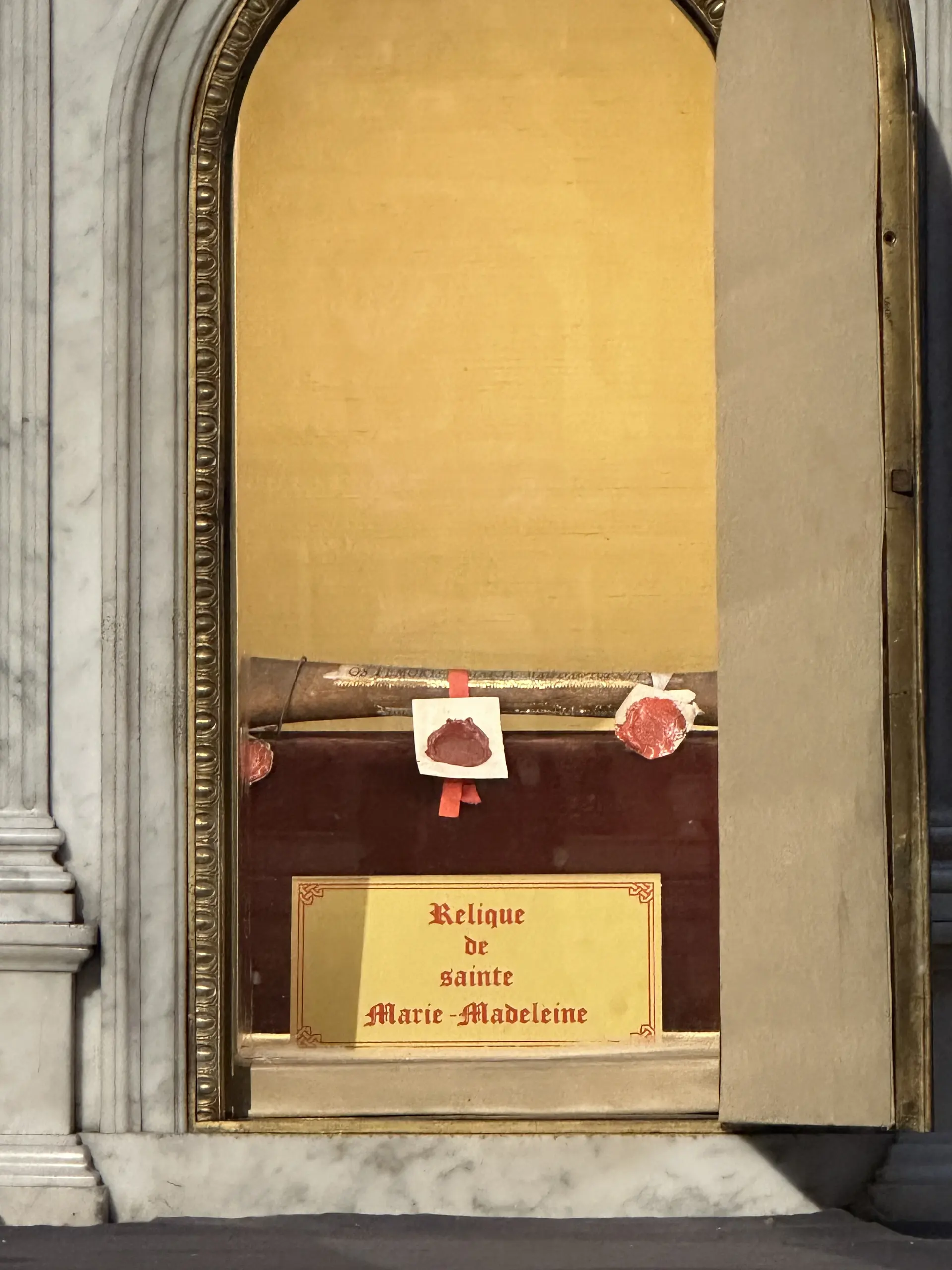
Relic of Mary Magdalene at La Madeleine
Paris, Paris, France
0.0 km away

Chapel of Our Lady of the Miraculous Medal
Paris, Paris, France
1.9 km away

Sainte-Chapelle
Paris, Paris, Paris / Île-de-France, France
2.3 km away

Basilica of the Sacré-Cœur, Montmartre
Paris, Paris, Paris / Île-de-France, France
2.6 km away
References
Sources consulted for this page. Source categories describe the publication, not a guarantee that every claim is verified. Traditional accounts and outside interpretations may differ.
- 01La Madeleine, Paris — WikipediaSource contextComprehensive history
- 02Madeleine — BritannicaSource contextAcademic overview
- 03Pierre-Alexandre Vignon, Church of La Madeleine — SmarthistoryacademicArt historical analysis
- 04The Madeleine church — Paris Je T'aimeSource contextOfficial Paris tourism
- 05La Madeleine - Paris, France — Sacred DestinationsspiritualPilgrimage context
Share a photo
Help visitors recognize La Madeleine (Church of Saint Mary Magdalene). Every submission is reviewed before publication.