Chapel of Our Lady of the Miraculous Medal
The Paris chapel where Mary appeared to a 24-year-old novice in 1830 and asked for the miraculous medal
Understand sacred places, explore living traditions, and learn how to engage respectfully with Pilgrim Map.
Access has not been verified. Check current local guidance before planning a visit.
Paris, Paris, France

Visit essentials
A quick read before you go
- Duration
- One to two hours for prayer, veneration of the relics, and reception of a medal; half a day if…
- Access
- 140 rue du Bac, 75007 Paris.
Overview
The Chapel of Our Lady of the Miraculous Medal, among France's most-visited Catholic shrines and modern Marianism's most consequential sites, stands at 140 rue du Bac in Paris's seventh arrondissement, inside the Daughters of Charity of Saint Vincent de Paul's motherhouse.
In 1830, the Virgin Mary is reported to have appeared three times here to Sister Catherine Labouré, a 24-year-old novice from a Burgundian peasant family, and requested the medal whose attributed graces and conversions gave it the popular name “Miraculous Medal.” More than a million were minted within four years of the first striking in June 1832. The 1836 canonical investigation concluded the apparitions could not be imposture.
Catherine remained hidden for forty-six years, was canonised by Pius XII in 1947, and lies beneath the Virgin of the Globe altar; her body, exhumed in 1933, was found incorrupt.
Why this place is sacred
What gives the rue du Bac chapel its concentrated thinness is the convergence of relics in an intimate domestic-scaled space. The chapel itself is small — built between 1813 and 1815 by Hippolyte Le Bas, enlarged in 1849 and 1930 — and entered through a long passage from the porter's door at 140 rue du Bac. The contrast with the noise of the boulevard outside is one of the most consistent first impressions pilgrims report.
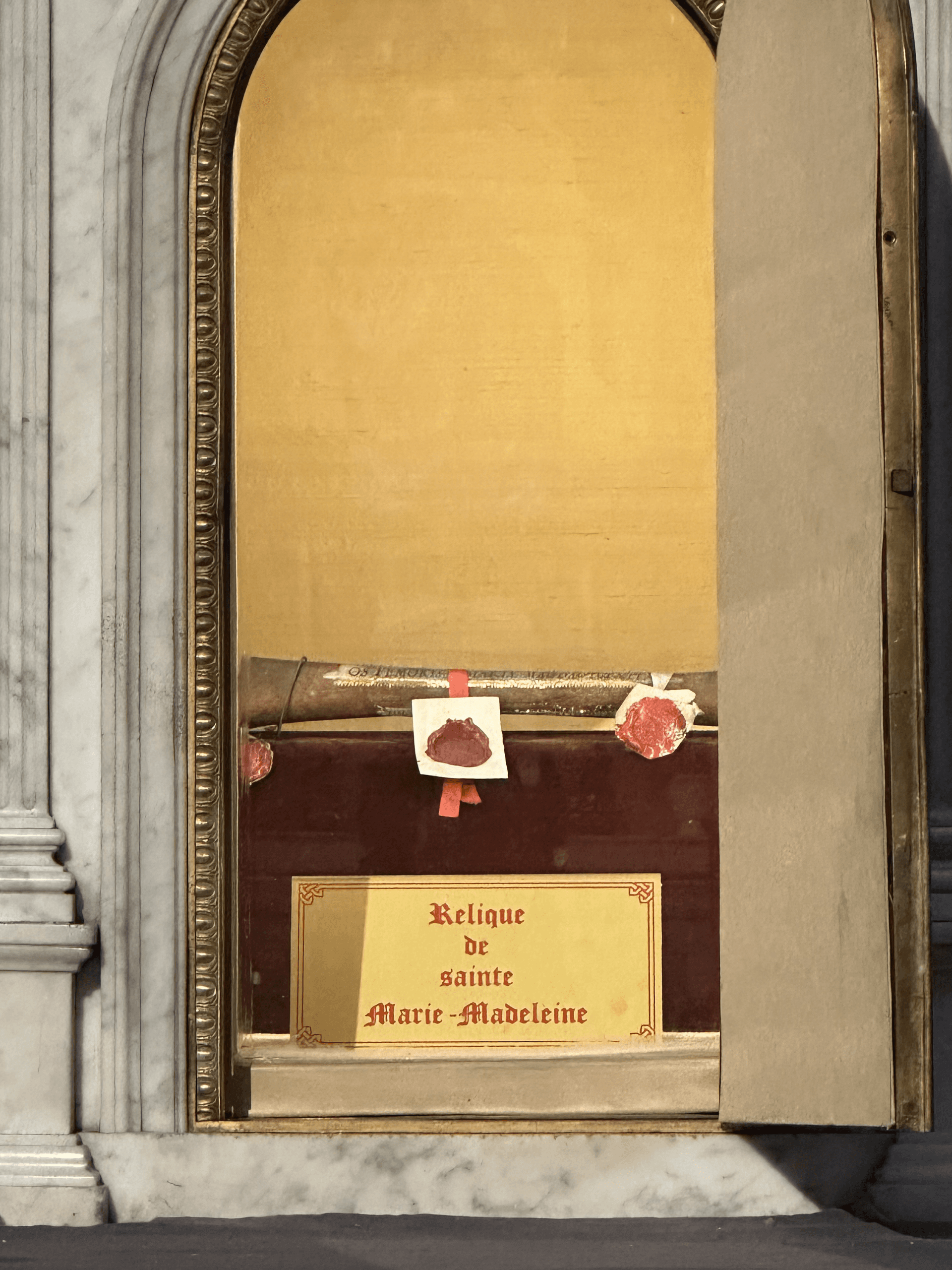
Inside, three relics converge: the chair where the Virgin is said to have sat in conversation with Catherine on the night of 18–19 July 1830, preserved at the right of the sanctuary; the incorrupt body of Saint Catherine Labouré, displayed in a glass reliquary beneath the altar of the Virgin of the Globe and visible to the kneeling pilgrim; and the heart of Saint Vincent de Paul, preserved in a separate reliquary.
Around these three relics the chapel holds nearly two centuries of continuous Marian devotion — daily Mass, exposition of the Blessed Sacrament, rosary, confession in several languages most hours of the day, and the steady distribution of blessed medals at the small door-shop.
The chapel's identity is also shaped by Catherine's forty-six years of silence: the 'hidden-life' sanctity of a novice who kept the apparitions to herself for nearly half a century, working as a doorkeeper and chicken-keeper, is invoked at the site as a model of obscure faithfulness. Many pilgrims describe a sense of being personally known after extended prayer.
Experience and orientation
The entrance is unobtrusive: a porter's door at 140 rue du Bac opens onto a long passage that leads to the chapel courtyard, where the modest facade of the Chapelle Notre-Dame de la Médaille Miraculeuse stands at the end. The chapel interior is intimate, almost domestic in scale after the boulevard outside.
To the right of the sanctuary stands the chair preserved as the place where the Virgin sat with Catherine on the night of 18–19 July 1830; pilgrims touch the chair and leave written intentions.
The altar of the Virgin of the Globe — the imagery of the November 1830 apparition, Mary standing on a globe with rays streaming from her hands — is the focal point of the chapel; beneath it, in a glass reliquary, lies the body of Saint Catherine Labouré, exhumed in 1933 and found incorrupt. The heart of Saint Vincent de Paul is preserved in a separate reliquary.
Pilgrims kneel in the front pews, often for long periods; queues form by mid-morning and remain through the afternoon. The chapel closes for the community's lunch hour around one o'clock and reopens in the early afternoon. Daughters of Charity, in the distinctive blue habit of the Order, distribute blessed Miraculous Medals at the small door-shop on the way out; many visitors leave with a medal even if they did not come expecting one.
One to two hours for prayer, veneration of the relics, and reception of a medal; half a day if combined with confession and Mass. The chapel opens at 07:45; early morning is the most contemplative time. Queues build through mid-morning and remain long through the afternoon. The chapel closes during the community's meal hours around 13:00 and overnight.
27 November (Feast of the Manifestation of the Immaculate Virgin of the Miraculous Medal) and 28 November (Feast of Saint Catherine Labouré) bring the largest devotional crowds of the year.
Context and lineage
Catherine Labouré, then a 24-year-old novice of the Daughters of Charity, was awakened on the night of 18–19 July 1830 — the vigil of the feast of Saint Vincent de Paul — by a child of light who led her to the chapel.
The Virgin Mary entered, sat in the director's chair to the right of the altar, and conversed with Catherine for over two hours about coming trials for France and the Church and the mission of the Daughters of Charity. On 27 November of the same year, during evening meditation in the chapel, Catherine saw the Virgin standing on a globe, crushing a serpent under her foot, with rays of light streaming from rings on her hands.
An oval frame appeared around the figure with the inscription 'O Marie, conçue sans péché, priez pour nous qui avons recours à vous.' The image then turned to reveal the reverse — an M surmounted by a cross, the Sacred Heart of Jesus and the Immaculate Heart of Mary, framed by twelve stars. Mary asked: 'Have a medal struck on this model. All who wear it will receive great graces.' A confirming third apparition followed in December.
Catherine confided everything only to her confessor, Father Jean-Marie Aladel, C.M., who carried the request to Archbishop Hyacinthe-Louis de Quélen of Paris. The first medals were struck in June 1832 by the silversmith Adrien Vachette; over a million were minted within four years, and the unexplained graces, conversions, and healings attributed to it earned it the popular title 'Miraculous Medal.' The 1836 canonical investigation by Archbishop de Quélen concluded the apparitions could not be attributed to imposture.
Catherine kept her identity hidden for forty-six years, taking up the humble work of doorkeeper and chicken-keeper at the Daughters of Charity hospice at Enghien-Reuilly. She identified herself to her superior only days before her death in 1876. Beatified by Pius XI in 1933, canonised by Pius XII on 27 July 1947.
The chapel belongs to the Latin Church and is under the care of the Daughters of Charity of Saint Vincent de Paul; the wider Vincentian charism (Vincentian priests, Daughters of Charity, lay Vincentians) is the proper 'home tradition' of the site. The chapel is canonically a sanctuary of the Archdiocese of Paris; the Feast of Our Lady of the Miraculous Medal was extended to the universal Church by Pope Leo XIII in 1894 (27 November).
Saint Catherine Labouré
Daughter of Charity novice who received the three apparitions in 1830. She kept her identity hidden for forty-six years, working as a doorkeeper and chicken-keeper at the Daughters of Charity hospice at Enghien-Reuilly, and was identified to her superior only days before her death. Her body, exhumed in 1933, was found incorrupt and now lies beneath the altar of the Virgin of the Globe. Beatified 1933, canonised 1947.
Father Jean-Marie Aladel, C.M.
Vincentian priest, Catherine's confessor and the immediate ecclesiastical intermediary for the apparitions. He carried the Virgin's request for the medal to Archbishop de Quélen and supervised the early diffusion. The original recorded wording of Mary's speech to Catherine survives chiefly through Aladel's transcriptions of Catherine's accounts.
Archbishop Hyacinthe-Louis de Quélen of Paris
Archbishop of Paris who authorised the striking of the first medal in June 1832 and who, in 1836, conducted the canonical investigation that concluded the apparitions could not be the work of imposture, giving de facto ecclesial recognition to the cult.
Adrien Vachette
Parisian silversmith who engraved the first die and struck the original Miraculous Medal in June 1832 to the design Catherine had described through Father Aladel.
Daughters of Charity of Saint Vincent de Paul
The religious community of which Catherine was a novice in 1830 and which has been custodian of the chapel since. Founded in 1633 by Vincent de Paul and Louise de Marillac, the Daughters of Charity remain in the blue habit of their original constitution; they staff the chapel, distribute the medals, and serve the poor in keeping with their Vincentian charism.
Traditions and practice
The core devotional acts are prayer at the chair where the Virgin is said to have sat, prayer before the altar of the Virgin of the Globe with the incorrupt body of Saint Catherine visible below, and the recitation of the medal's invocation: 'O Mary, conceived without sin, pray for us who have recourse to thee.'
Pilgrims receive a blessed Miraculous Medal at the small door-shop on the way out; many ask one of the Daughters of Charity in the blue habit to bless the medal before they leave. The Novena to Our Lady of the Miraculous Medal — nine consecutive Saturdays or a nine-day lead-in to 27 November — is a widely-kept devotional practice. The heart-relic of Saint Vincent de Paul receives separate veneration, especially around 27 September (the feast of Saint Vincent).
Multiple daily Masses are celebrated in French with regular Masses in English, Spanish, Italian, Vietnamese, Polish, and other languages reflecting the international pilgrim community. Daily exposition of the Blessed Sacrament and the Marian rosary anchor the day. Confessions are heard in several languages for most hours of the day.
The Solemn liturgies of 27 November (Feast of the Manifestation of the Immaculate Virgin of the Miraculous Medal) and 28 November (Feast of Saint Catherine Labouré) bring the largest crowds and the great procession of the medal.
Arrive at the 07:45 opening for the calmest chapel and the easiest approach to the chair and the altar. Sit in the front pews for a long while; the chapel rewards staying. If you have come with a personal intention, write it down and leave it at the chair of the apparition. Receive a blessed medal at the door-shop on the way out — even visitors who came without expecting one usually leave with one.
If you can come during the Marian month of May or the rosary month of October, the devotional rhythm is strongest. Avoid the lunch closure around 13:00.
Roman Catholicism — Marian apparitions and the Vincentian tradition
ActiveSite of the 1830 apparitions of the Blessed Virgin Mary to Sister (later Saint) Catherine Labouré, then a 24-year-old novice of the Daughters of Charity at 140 rue du Bac, Paris. In three principal apparitions — the night of 18–19 July, 27 November, and December 1830 — Mary asked that a medal be struck after a vision Catherine saw: the Virgin standing on a globe, crushing a serpent under her foot, with rays of light streaming from rings on her hands and an oval inscription reading 'O Mary, conceived without sin, pray for us who have recourse to thee.' The reverse showed an M surmounted by a cross, with the Sacred and Immaculate Hearts of Jesus and Mary, framed by twelve stars. Struck in June 1832 under the authority of Archbishop de Quélen of Paris, the medal spread with extraordinary rapidity — over a million minted within four years — and the unexplained graces, conversions, and healings attributed to it earned it the popular title 'Miraculous Medal.'
Daily veneration at the chair where the Virgin is said to have sat (preserved at the right of the sanctuary); veneration of the incorrupt body of Saint Catherine Labouré, displayed in a glass reliquary beneath the altar of the Virgin of the Globe; veneration of the heart of Saint Vincent de Paul, preserved in a separate reliquary; distribution of blessed Miraculous Medals at the small door-shop; daily Mass, rosary, and exposition of the Blessed Sacrament; major liturgies on 27 November (Feast of the Manifestation of the Immaculate Virgin of the Miraculous Medal) and 28 November (Feast of Saint Catherine Labouré).
Perspectives and open questions
The rue du Bac chapel is read as a foundational event of modern Catholic Marian devotion, as the first in a major nineteenth-century sequence of approved apparitions, and as a Vincentian sanctuary held within the Daughters of Charity's charism of service to the poor.
Scholarly perspective
Historians of nineteenth-century Catholicism — Sandra Zimdars-Swartz, René Laurentin, and David Blackbourn — treat the rue du Bac apparitions as a foundational event of modern Marian devotion: the first in a sequence (La Salette 1846, Lourdes 1858, Pontmain 1871, Knock 1879, Fátima 1917) that decisively shaped Catholic spirituality and the theological road to the dogma of the Immaculate Conception (1854).
The 1836 archdiocesan investigation by Archbishop de Quélen — which concluded the apparitions could not be attributed to imposture — and Catherine's canonisation in 1947 constitute the Church's formal reception of the events. The rapid global diffusion of the medal without organised promotion is treated as historically remarkable but not exhaustively explained.
Living and traditional perspectives
In Catholic tradition the apparitions are authentic encounters of Catherine Labouré with the Virgin Mary, the medal a vehicle of grace given by Mary herself, and the inscription 'O Mary, conceived without sin, pray for us who have recourse to thee' a direct theological precursor to the 1854 dogma of the Immaculate Conception. The Vincentian and Daughters of Charity charism — service of the poor — is the proper home tradition of the site and shapes its lived devotional culture.
Alternative interpretations
The medal's imagery — globe, rays, twelve stars, serpent — has occasionally been read by esoteric writers in symbolic-cosmic terms. Catholic tradition reads the iconography strictly biblically (Genesis 3:15; Revelation 12) and as a visual catechesis of the Immaculate Conception and the mediation of grace.
The most famous conversion attributed to the medal — the Jewish banker Alphonse Ratisbonne's sudden conversion in Rome in 1842 — contributed to the early reputation and is well documented, though contested by some historians of nineteenth-century French Catholicism.
Open questions
Catherine's silence about the apparitions for forty-six years, the rapid global diffusion of the medal without any organised promotion, and the patterns of attributed conversion and healing remain phenomena that historians describe but do not exhaustively explain. The exact wording of Mary's private speech to Catherine survives only through Catherine's later recollections, recorded chiefly by Father Aladel. The Church treats the events as a private revelation worthy of belief and leaves their inner mystery to the encounter of each pilgrim.
Plan your visit
Access and arrival
140 rue du Bac, 75007 Paris. Métro Sèvres-Babylone (lines 10 and 12), four minutes' walk; or Rue du Bac (line 12). Entry is through the porter's door at no. 140 and a long passage opening on the chapel courtyard. Wheelchair access via the main door (a single low step; staff assist). Mobile signal in central Paris is reliable. The chapel office can answer specific questions about Mass times, confession schedules, and group pilgrimages.
Hotels and small inns in the seventh arrondissement around Saint-Sulpice, Sèvres-Babylone, and Saint-Germain-des-Prés give the easiest walking access to the chapel. Pilgrim hostels run by religious communities in the surrounding arrondissements offer simpler accommodation. Many pilgrims visit the chapel as a stop on a wider Paris itinerary and stay anywhere convenient on the Métro.
Respectful visit
Modest dress; shoulders and knees covered inside the chapel. Many pilgrims wear a Miraculous Medal visibly. Smart but quiet clothing on the feast days of 27 and 28 November.
Permitted without flash outside Mass times. Many pilgrims prefer to keep phones away; the Daughters of Charity quietly discourage extended photography near the chair and the reliquary. No photography during Mass or the great procession of the medal on 27 November.
Donations toward candles, the medals, and the Daughters of Charity's charitable works. Written intentions left at the chair of the Virgin. Mass intentions may be commissioned at the chapel office.
No talking above a whisper. No phone calls. No eating, drinking, or noise. The inner convent and novitiate are strictly cloistered and inaccessible. Do not interrupt other pilgrims' prayer at the chair or the reliquary.
Reverent silence is taken seriously; conversation above a whisper is unwelcome. Phone calls are not permitted in the chapel. The chapel closes during the community's meal hours and overnight; check current opening times before travelling. The inner convent and novitiate are strictly cloistered and inaccessible. Many pilgrims prefer to keep phones away inside the chapel even where photography is allowed.
Current practical details
Address
140 Rue du Bac, 75007 Paris, France
Phone
Hours
Hours, fees, and access can change — verify on the official source before you travel. Practical details last checked Jun 2026.
Location
Map loads as you approach this section.
Pilgrim reflections
A portrait of encounter, not a score
Pilgrims describe what they felt, how present they could become, and whether the place would shape a journey. There are no stars and no ranking of traditions.
No reviewed reflections yet
The first pilgrims can help describe the character of being here.
Share a reflection
Available after an account-backed “Been there.” Every reflection is reviewed before publication.
Nearby sacred places
Explore other sacred places in the region. Proximity does not establish access or travel time; check each place’s guidance.


Share a photo
Help visitors recognize Chapel of Our Lady of the Miraculous Medal. Every submission is reviewed before publication.