Kutuklu Baba Tekke, Selina, Greece
An octagonal tomb where a Sufi saint's green-draped grave rests beside an Orthodox icon of St. George
Understand sacred places, explore living traditions, and learn how to engage respectfully with Pilgrim Map.
Access has not been verified. Check current local guidance before planning a visit.
Συδινή, Eastern Macedonia and Thrace, Greece
Read the sources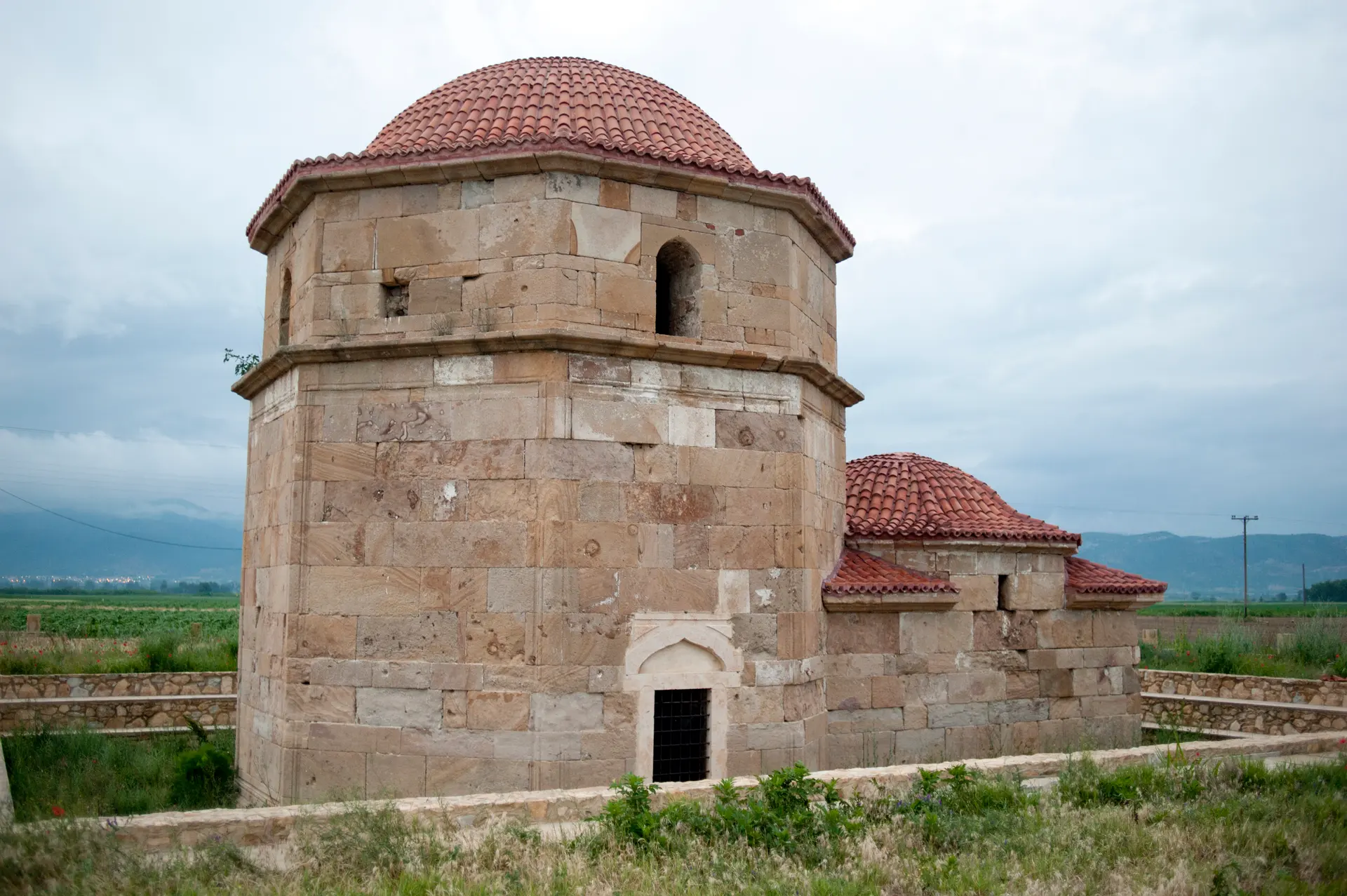
Image of Kutuklu Baba Tekke, Selina, Greece. Image source · CC-BY-SA-3.0
Visit essentials
A quick read before you go
- Duration
- Thirty minutes to one hour.
- Access
- Located near Selino village on the western shore of Lake Vistonida, Xanthi prefecture, Western…
Overview
At Kutuklu Baba Tekke, borders dissolve through the sacred rather than politics. Near Selino in Western Thrace, not far from Lake Vistonida's reeds and still water, a modest octagonal mausoleum has sustained a centuries-long conversation between Islam and Christianity.
The domed tomb, built from local stone, bears Bektashi symbols—the axe and kioulachi—that identify a lodge of Sufi mystics. Kutuklu Baba's tomb lies beneath green cloth. In the antechamber, an icon of St. George and candles lit by Christian hands reveal two sacred spaces layered into the same stones.
The Bektashi order's mystical openness and willingness to honor saints across traditions made this coexistence natural. The tekke remains lived proof that boundaries between faiths can be thinner than the walls holding them.
Why this place is sacred
The quality that distinguishes this tekke is not grandeur but permeability. The walls between traditions have worn thin here through sustained, overlapping devotion. The Bektashi Sufis who built the tekke practiced a form of Islam steeped in mystical inwardness, with an openness to Christian saints that made the coexistence something more than tolerance.
Lake Vistonida spreads east, a wetland of shifting light where water and land trade places with the seasons. Water has always served as a threshold in sacred geography, and the lake gives the tekke the feeling of a place where passage is possible.
The site may have begun as a Christian church dedicated to Saint Nicholas. The Bektashi Sufis built here, perhaps on those older foundations. When Greek refugees arrived in 1920, the dervishes told them of the building's Christian origins, and the eastern chambers became a chapel of St. George. Each layer did not erase the one beneath it but accumulated, a vertical history visitors enter by stepping through the door.
Established as a Bektashi dervish lodge and mausoleum for the Sufi saint Kutuklu Baba in the late 14th or early 15th century. A place of Sufi worship, meditation, and community gathering, possibly built on the site of a Christian church dedicated to Saint Nicholas.
The transformation to shared sacred space happened gradually. The Bektashi order's suppression in 1826 reduced the dervish presence, though tomb veneration continued. Greek Orthodox refugees arrived in 1920, learned from the remaining dervishes of the site's Christian origins, and established a chapel of St. George in the antechamber. Both communities have maintained their devotions within the same walls since.
Experience and orientation
You arrive along the western shore of Lake Vistonida, near Selino village. The building is small and could be mistaken for a rural chapel if not for the octagonal dome and carved stonework. There is no signage to match its significance. This is a place that asks to be found rather than visited.
Bektashi symbols — the axe and the kioulachi — are carved into the stone with a directness that suggests craft rather than ornament. The dome sits low and solid, proportioned for one person's tomb and the small gatherings of those who came to honor it.
Inside, the central chamber holds the tomb beneath green cloth. The room is cool, dim, and still — not the silence of emptiness but the silence of presence. In the antechamber, an Orthodox icon of St. George stands with candles and the modest furnishings of a working chapel. Moving between these two spaces is the experience that defines this place.
Outside, Vistonida's still surface creates a quality of light and quiet that seeps into the tekke. The brightness off the water after the dim interior is almost a second threshold.
Approach with the understanding that this is both an active Muslim shrine and an active Christian chapel. The site is informal, with no fixed visiting hours or admission. Come during daylight hours. Allow the small scale of the building to set the pace — there is no need to rush through a space this intimate.
Context and lineage
Kutuklu Baba was a Bektashi sheikh of the late 14th or early 15th century, a contemporary of Gazi Evrenos Bey, the Ottoman commander who led the conquest of Thrace. He established his lodge on the western shore of Lake Vistonida, either on open ground or — as tradition holds — on the foundations of a Christian church dedicated to Saint Nicholas.
The Bektashi order followed the Ottoman armies into the Balkans, establishing frontier shrines that blended mysticism and reverence for the holy dead.
The dual identity emerged in 1920 when Greek refugees from East Thrace found dervishes still living in the tekke. The dervishes told them of its Christian origins. The refugees established a chapel of St. George in the eastern chambers, and the shared arrangement that persists today took form.
The tekke belongs to the Bektashi order, one of the most important Sufi brotherhoods in the Ottoman Balkans. The Bektashis incorporated elements of Christianity, pre-Islamic Turkic tradition, and Shia Islam — an openness that made their presence in multi-religious Thrace particularly significant. The Christian chapel of St. George connects the site to the broader Balkan tradition of saint veneration shared across faiths.
Kutuklu Baba
The Bektashi Sufi saint whose tomb is the tekke's central feature. A sheikh contemporary with Gazi Evrenos Bey (d. 1417), he established the dervish lodge during the Ottoman settlement of Thrace. His full biography is largely lost.
Gazi Evrenos Bey
Ottoman military commander whose campaigns brought Islam to Thrace. His association with Kutuklu Baba places the tekke within the wider story of Ottoman frontier spirituality.
The dervishes of 1920
The unnamed Bektashi dervishes who, when Greek refugees arrived from East Thrace, shared the building's Christian origins with the newcomers — an act of interfaith memory that enabled the shared sacred arrangement still visible today.
Traditions and practice
The Bektashi order practiced zikr — the rhythmic remembrance of God's names — along with communal meals and the veneration of saints' tombs. The tekke was a gathering place for dervishes and laypeople, a center of mystical practice and community life. The tomb of Kutuklu Baba served as a focus for prayer and intercession in the Sufi tradition of seeking the baraka (blessing) of holy figures.
Muslim visitors from the region's Turkish-speaking community pray at Kutuklu Baba's tomb, continuing the saint veneration that defines Bektashi piety. Christian visitors light candles at the icon of St. George and offer prayers in the antechamber. The two practices coexist without formal coordination — each community maintains its side through continued use rather than institutional agreement.
Visitors who wish to engage with the site's spiritual character might spend time in both chambers, sitting quietly with each tradition's expression of the sacred. The transition between the Sufi tomb and the Orthodox chapel is itself a contemplative act — a physical movement between two ways of approaching the divine that share more than their proximity. Outside, the lakeshore offers a place to sit with whatever the visit has stirred.
Bektashi Sufism
ActiveOne of the surviving Bektashi shrines in Greek Thrace. The tomb, with its carved Bektashi symbols and green-draped grave, remains a focus of veneration for the region's Muslim community. The Bektashi order's mystical openness makes this site an important marker of Islamic spiritual history in the Balkans.
Eastern Orthodox Christianity
ActiveThe antechamber of the tekke functions as a makeshift chapel of St. George, established by Orthodox refugees from East Thrace after 1920. The icon of St. George and the lit candles mark an active worship space within a building originally constructed for a different faith. The tradition maintains that the site was originally a Christian church dedicated to Saint Nicholas.
Perspectives and open questions
The tekke can be understood through Sufi architecture, Balkan interfaith history, or the phenomenology of shared sacred space. Each lens illuminates a different facet of this small but significant site.
Scholarly perspective
The tekke is recognized as a significant example of Bektashi Ottoman architecture in Greece. Shared sacred sites between Muslims and Christians, known as 'ambiguous sanctuaries,' are a characteristic Balkan phenomenon. This tekke is a clear instance, with architectural and devotional evidence of both traditions visible and active.
Living and traditional perspectives
For the Muslim community, the tekke connects to the Sufi heritage of the Ottoman period. The tomb carries the baraka of a holy man, and visiting it is an act rooted in Islamic devotion. For the Christian community, the chapel of St. George represents the persistence of Orthodox worship at a site understood as originally Christian. The coexistence is maintained through mutual respect rather than theological agreement.
Alternative interpretations
The Bektashi order's emphasis on mystical union and its incorporation of Christian elements gives the shared nature of this site a deeper resonance than mere coexistence. The Bektashis understood spiritual truth as transcending the boundaries of formal religion. The tekke is not a compromise between two faiths but an expression of the Sufi insight that the sacred does not belong to any single tradition.
Open questions
The true biography of Kutuklu Baba remains largely unrecovered. Whether the site was originally a Christian church has not been archaeologically confirmed. The dating varies across sources — from the late 14th to the early 16th century. These uncertainties are part of the site's character: a place where definitive answers yield to layered traditions and inherited memories.
Plan your visit
Access and arrival
Located near Selino village on the western shore of Lake Vistonida, Xanthi prefecture, Western Thrace. Approximately 20 km by car from Xanthi. Public transport is limited — a car is recommended. The site is not prominently signed; look for the octagonal domed structure near the lake. Flat ground approach at ground level, though interior spaces are not wheelchair-adapted. Mobile phone signal generally available.
Xanthi offers hotels and guesthouses, with the Old Town area providing the most atmospheric options. Limited accommodation near Selino itself.
Respectful visit
Modest clothing covering shoulders and knees, suitable for entering both a Muslim shrine and a Christian chapel. Women may wish to carry a headscarf, though it is not strictly required. Remove shoes before entering the tomb chamber.
Photograph the exterior freely. Inside, ask permission if anyone else is present. Do not photograph worshippers without their consent. Avoid flash photography near the tomb or the icons.
Candles may be lit at the Christian chapel side. No specific offerings are expected at the Muslim tomb. Small contributions to the upkeep of either worship space are welcomed if there is a place to leave them.
Do not touch or disturb the green cloth covering the tomb. Do not move or rearrange the icons, candles, or furnishings in the chapel. Respectful behavior is expected in both worship areas at all times.
This is a living sacred space for both communities, not an interfaith exhibition. Treat the Muslim tomb and the Christian chapel with equal reverence. Do not rearrange, move, or touch the tomb covering or the icons. If members of either community are present and worshipping, give them space and silence.
Current practical details
Address
33G5+68, Vistonida 670 64, Greece
Hours
Hours, fees, and access can change — verify on the official source before you travel. Practical details last checked Jun 2026.
Location
Map loads as you approach this section.
Pilgrim reflections
A portrait of encounter, not a score
Pilgrims describe what they felt, how present they could become, and whether the place would shape a journey. There are no stars and no ranking of traditions.
No reviewed reflections yet
The first pilgrims can help describe the character of being here.
Share a reflection
Available after an account-backed “Been there.” Every reflection is reviewed before publication.
Nearby sacred places
Explore other sacred places in the region. Proximity does not establish access or travel time; check each place’s guidance.


References
Sources consulted for this page. Source categories describe the publication, not a guarantee that every claim is verified. Traditional accounts and outside interpretations may differ.
- 01Kütüklü Baba Tekke — Wikipedia — Wikipedia contributorsencyclopediaBasic overview with architectural details
- 02The Tekes Kioutouklou Baba — GoToThrace — GoToThrace.comofficialRegional tourism with cultural context
- 03The Tekes Kioutouklou Baba — JTI Rhodope — JTI Tour Guide SystemofficialHeritage tourism with detailed architectural description
- 04Kütüklü Baba Tekke and Tomb — Cultural Inventory — Kultur EnvanteriofficialTurkish cultural heritage database with photos
- 05Kioutouklou Baba Teke — Lonely Planet — Lonely PlanetguideReputable travel guide
Share a photo
Help visitors recognize Kutuklu Baba Tekke, Selina, Greece. Every submission is reviewed before publication.