Belintash
A Thracian rock plateau carved with three hundred holes where the priest-tribe once read the sky
Understand sacred places, explore living traditions, and learn how to engage respectfully with Pilgrim Map.
Access has not been verified. Check current local guidance before planning a visit.
Near Mostovo (central Rhodope Mountains), Plovdiv, Bulgaria
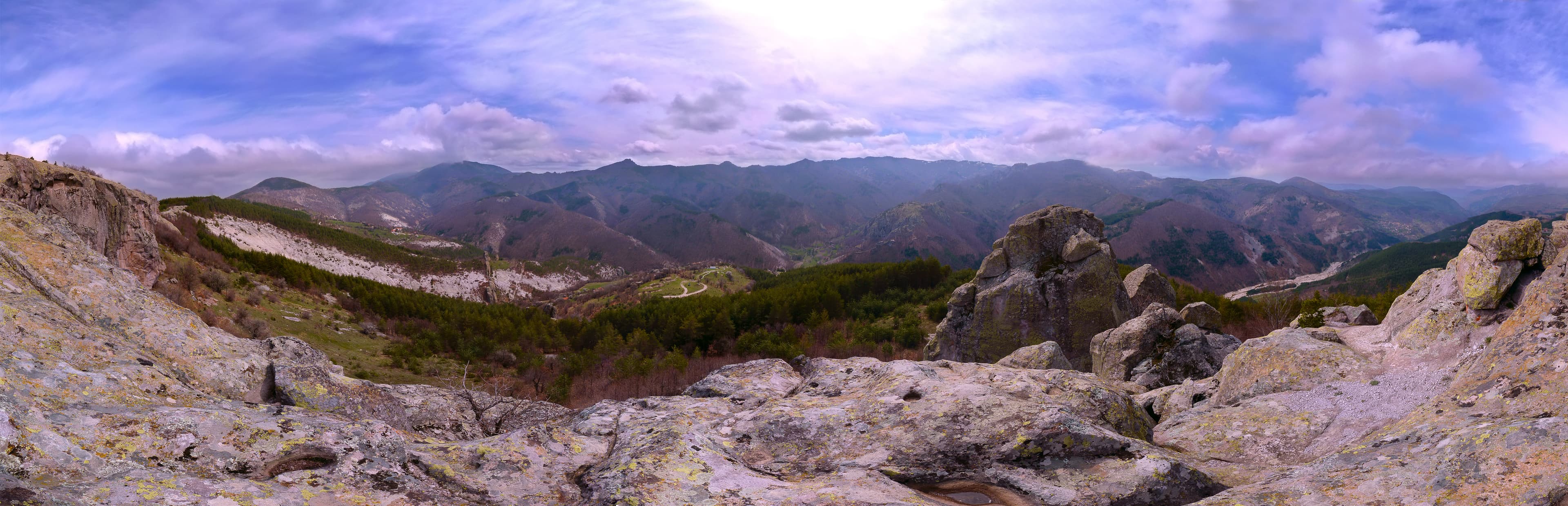
Image of Belintash. Image source · CC-BY-3.0
Visit essentials
A quick read before you go
- Duration
- Two to three hours including the hike to the summit and time to explore the plateau.
- Access
- Located in the central Rhodope Mountains, Plovdiv Province, southeastern Bulgaria.
Overview
Belintash rises like a bare stone ship above the central Rhodope forests. At 1,225 meters, the weather-scoured plateau commands views in every direction and bears approximately three hundred carved holes. Proposed meanings range from a star map of Orion, Ursa Major, Ursa Minor, and Leo to libation cups, post holes, or lost ritual markings.
The Thracian Bessi used this exposed platform as a sanctuary. Known in the ancient world as a priestly people, they were described by Herodotus as interpreters of Dionysos's Rhodope oracle, a role scholars associate with the Thracian god Sabazios. A silver votive plate found here confirms valuable offerings: the plateau was consecrated, not merely observed.
Popular literature makes Belintash one point of a sacred triad with Krastova Gora, a Christian pilgrimage site called the Bulgarian Golgotha, and Karadjov Kamak, another Thracian rock sanctuary. Any Thracian-period significance of that triangle is unverified, though the region's density of sacred sites is not disputed. Without instruction or documented tradition, visitors now press paper bearing their deepest hopes into ancient tree roots at the summit, perhaps echoing an impulse the Thracians recognized.
Why this place is sacred
The thinness at Belintash operates through exposure. The plateau is bare rock. There are no walls, no enclosures, no structures mediating the relationship between the person standing here and the sky above. Wind moves across the surface without obstruction. The Rhodope forests fall away on every side, and the horizon opens to a scale that makes human concerns feel proportionally adjusted.
The carved holes add another register. Whether they form a star map or served some other ritual function, they are evidence that people stood on this same rock and looked up. The question of what they saw when they studied the night sky from this platform transforms the visitor's experience: this is not merely a viewpoint but a place of sustained attention directed at the heavens.
If the Bessi were indeed the priestly oracles Herodotus described, then this exposed platform was their consultation room, the place where messages from the divine were received.
The spontaneous wish-making at the twisted tree roots suggests something the Bessi may have understood: that certain places call forth the need to speak to forces larger than oneself. No one instructs visitors to write wishes. No sign explains the practice. People arrive at the summit and find themselves compelled to articulate something. The tree roots receive these articulations without judgment or response, which may be the most honest form of oracle available.
Belintash served as a sacred sanctuary of the Thracian Bessi tribe, a people known in classical sources as priestly interpreters of an oracle in the Rhodope Mountains. The approximately three hundred carved holes in the rock surface, whatever their specific function, indicate sustained ritual attention to the plateau over a period likely spanning centuries. The silver votive plate found at the site confirms that offerings of significant value were made here.
The plateau's elevation and exposure suggest it was chosen precisely for its proximity to the sky, consistent with worship of Sabazios, a celestial deity associated with sovereignty and cosmic order.
After the decline of Thracian civilization and the absorption of the region into the Roman Empire, the sanctuary's religious function ceased. The plateau remained known locally but did not receive systematic archaeological attention until the modern era. In recent decades, Belintash has been recognized as a significant archaeological and natural landmark. The spontaneous wish-making practice at the tree roots appears to have developed organically through visitor culture, with no connection to Thracian religion.
New Age and esoteric groups have also begun visiting the site, drawn by claims of concentrated earth energy.
Experience and orientation
The trail to Belintash begins in the forest and remains there for most of the ascent. The Rhodopes here are densely wooded, the path climbing through trees that filter the light and muffle the wind. The transition to the plateau is abrupt. The trees end, the rock begins, and suddenly there is nothing above but sky and nothing below but the canopy you just climbed through.
The rock surface is uneven, scarred and pitted, with the approximately three hundred carved holes visible as small depressions in the stone. They are not dramatic individually. Their significance accumulates as you walk across the plateau and realize how many there are, how deliberately they were placed. If you know the star map interpretation, you may begin to see patterns.
If you do not, you see evidence of sustained human effort applied to stone, which is its own form of significance.
At the summit, twisted trees grow from crevices in the rock, their roots exposed and gnarled. Paper wishes are tucked into these roots, some fresh, some weathered into illegibility. The wind at this elevation is persistent. The panoramic views extend across the Rhodope peaks in every direction, and on clear days the sense of exposure is physical.
This is not a sheltered sanctuary but an open altar, a platform where the Bessi stood with nothing between them and whatever they were listening for.
Belintash is located in the central Rhodope Mountains, Plovdiv Province, southeastern Bulgaria. The trailhead is accessible from the village of Mostovo or from the road between Asenovgrad and Smolyan. The nearest town with services is Asenovgrad, approximately 40 kilometers away. There are no facilities at the summit.
Context and lineage
No textual origin story survives from the Thracian period. The Bessi, who used this sanctuary, were described by both Herodotus and the geographer Strabo as a priestly people inhabiting the Rhodope Mountains. Herodotus specifically identifies them as interpreters of the oracle of Dionysos, a deity whom modern scholars associate with the Thracian god Sabazios, a sky deity connected to fertility, sovereignty, and the horseman archetype.
The Bessi were not merely a tribe but a priestly caste whose role in Thracian society was religious interpretation and oracular prophecy. Their use of Belintash as a sanctuary suggests the plateau served some function in this oracular practice, though the specific nature of that function has not been recovered.
The approximately three hundred carved holes in the rock surface have generated the most sustained interpretive effort. Some researchers see in their arrangement the constellations Orion, Ursa Major, Ursa Minor, and Leo, arguing that the Thracians used the plateau as a celestial observatory. If this interpretation is correct, it would connect the sanctuary to a tradition of astronomical observation found at sacred sites across the ancient world. Mainstream archaeology, however, treats this interpretation as unproven.
Belintash belongs to the Thracian tradition of rock sanctuaries in the Rhodope Mountains, a tradition that produced numerous sacred sites including Kovan Kaya, Tatul, and Perperikon. These sanctuaries share common features: elevated positions, rock-cut features, and evidence of fire-related ritual. The Bessi's oracular tradition connects to broader patterns of prophetic practice in the ancient Mediterranean, from Delphi to Dodona.
The plateau's popular identification as part of a sacred triad with Krastova Gora and Karadjov Kamak, while not archaeologically verified, reflects the region's density of sacred sites.
The Bessi
priestly tribe and sanctuary custodians
A Thracian tribe or priestly caste inhabiting the central Rhodope Mountains, described by Herodotus as interpreters of the oracle of Dionysos. Known throughout the ancient world for their religious role, the Bessi maintained sanctuaries in the Rhodopes where they practiced divination and ritual worship. Their association with Belintash connects the plateau to the broader tradition of Thracian oracular practice.
Herodotus
ancient chronicler
The fifth-century Greek historian who described the Bessi as priestly interpreters of an oracle in the Rhodope Mountains. His account is the most significant ancient literary reference connecting the Bessi to the religious landscape of the Rhodopes.
Traditions and practice
The Bessi conducted ritual worship at the Belintash sanctuary involving offerings of significant value. The silver votive plate found at the site confirms that precious objects were deposited here as gifts to the divine. The nature of oracular practices the Bessi performed remains unknown in detail, though their reputation across the ancient world as prophetic interpreters suggests that divination or vision-seeking was central to the sanctuary's function.
Fire ceremonies and libations, common to Thracian worship throughout the Rhodopes, were likely practiced here as well.
A spontaneous folk practice has emerged at the summit of Belintash. Visitors write wishes on pieces of paper and tuck them into the twisted roots of trees growing from rock crevices at the plateau's edge. This practice has no documented historical precedent at the site and appears to have developed organically through visitor culture. No one instructs newcomers; the practice is transmitted by the visible evidence of previous wishes.
New Age and esoteric groups also visit the plateau for meditation and energy-focused gatherings, though these are informal and unorganized.
Climb steadily and allow the transition from forest to bare rock to register fully. When you emerge onto the plateau, resist the impulse to immediately scan the panorama. Instead, look at the rock beneath your feet. The carved holes are modest individually but their accumulation across the surface is remarkable. Walk the plateau slowly, letting the wind and exposure work on your attention.
If the star map interpretation interests you, bring a chart of the proposed constellation alignments and compare what you see in the rock with what you know of the night sky.
At the summit, sit with the twisted trees and the paper wishes. Read a few if they are legible. Notice what people ask for when they stand at the edge of a cliff on a platform that was sacred three thousand years ago. If you wish to write your own, use biodegradable paper and tuck it gently into the roots.
Thracian Religion (Worship of Sabazios)
HistoricalBelintash was a sacred sanctuary of the Thracian Bessi tribe, known throughout the ancient world as priestly custodians of an oracle in the Rhodope Mountains. The plateau is believed to have been dedicated to Sabazios, the supreme Thracian deity associated with the sky and cosmic sovereignty. The approximately three hundred carved holes and the silver votive plate found at the site testify to sustained ritual activity. The Bessi's reputation as oracles suggests the sanctuary served a prophetic as well as devotional function.
Ritual offerings including silver votive objects. Possible astronomical observation through carved rock holes. Oracular interpretation and divination. Fire ceremonies and libations consistent with Thracian sanctuary worship throughout the Rhodopes.
Modern Folk Spiritual Practice
ActiveContemporary visitors have established an informal tradition of writing wishes on paper and placing them in the twisted roots of trees at the summit. This practice has no documented historical precedent but reflects a widespread human impulse to engage with places perceived as spiritually potent. The practice suggests that the plateau continues to evoke a sense of contact with forces beyond the ordinary.
Writing wishes on paper and placing them in tree roots. Meditation and contemplation at the summit. Informal New Age and esoteric gatherings.
Perspectives and open questions
Belintash invites interpretation through multiple lenses: as a Thracian sanctuary, as a possible astronomical site, as a natural geological formation, and as a place where the impulse to make wishes persists across millennia.
Scholarly perspective
Archaeologists recognize Belintash as a significant Thracian rock sanctuary associated with the Bessi tribe. The silver votive plate confirms ritual activity. The carved holes are acknowledged as human-made, but their interpretation as a star map depicting Orion, Ursa Major, Ursa Minor, and Leo is not universally accepted. Some scholars consider them libation cups, post holes, or ritual markings rather than astronomical representations.
The proposed sacred triad connecting Belintash to Krastova Gora and Karadjov Kamak is primarily a feature of popular and tourist literature rather than peer-reviewed archaeology.
Alternative interpretations
Belintash has become a focus for visitors who believe the plateau possesses concentrated earth energy. The star map interpretation is particularly popular in alternative archaeology circles, with claims that the Thracians possessed advanced astronomical knowledge. Some visitors report experiencing unusual sensations at the summit, including tingling, disorientation, and heightened awareness, which they attribute to the site's energy rather than its elevation and exposure to wind.
Open questions
Whether the approximately three hundred carved holes genuinely represent a star map or served other ritual functions remains the site's central unresolved question. The precise nature of the Bessi oracular practices and whether they were conducted at this specific site cannot be determined from available evidence. The dating of the earliest human activity at Belintash has not been verified by published excavation reports.
The ritual relationship, if any, between Belintash, Krastova Gora, and Karadjov Kamak during the Thracian period is unknown.
Plan your visit
Access and arrival
Located in the central Rhodope Mountains, Plovdiv Province, southeastern Bulgaria. The trailhead is accessible by car from the village of Mostovo or from the road between Asenovgrad and Smolyan. The hike to the summit takes approximately 45 to 60 minutes on a moderately steep trail. No entrance fee. No facilities at the summit; bring water and food. Mobile phone signal may be unreliable at the summit. The nearest town with services is Asenovgrad, approximately 40 kilometers away.
No accommodation at the site. The nearest options are guesthouses in the village of Mostovo or in Asenovgrad. Bachkovo Monastery area also offers accommodation.
Respectful visit
Sturdy hiking shoes are essential for the rocky trail and exposed summit. Layers are recommended as temperatures drop significantly at elevation. Wind protection is advisable.
Photography is permitted without restriction. The panoramic views and carved rock surfaces are the primary photographic subjects.
If participating in the wish-making tradition, use biodegradable paper. Do not leave plastic, metal, or other non-natural materials. Do not place objects on the carved rock surface.
Do not damage or scratch the carved rock surfaces. Do not attempt to enlarge or modify the carved holes. Stay well back from cliff edges. Exercise extreme caution in wet or windy conditions.
The plateau has steep drop-offs without guardrails. Exercise caution near cliff edges, especially in wind. The rock surface can be slippery when wet. The exposed summit is dangerous in thunderstorms. In winter, the trail can be icy. Bring water and food as there are no facilities at the summit.
Current practical details
Address
4236 Asenovgrad, Bulgaria
Hours, fees, and access can change — verify on the official source before you travel. Practical details last checked Jun 2026.
Location
Map loads as you approach this section.
Pilgrim reflections
A portrait of encounter, not a score
Pilgrims describe what they felt, how present they could become, and whether the place would shape a journey. There are no stars and no ranking of traditions.
No reviewed reflections yet
The first pilgrims can help describe the character of being here.
Share a reflection
Available after an account-backed “Been there.” Every reflection is reviewed before publication.
Nearby sacred places
Explore other sacred places in the region. Proximity does not establish access or travel time; check each place’s guidance.

Share a photo
Help visitors recognize Belintash. Every submission is reviewed before publication.