Panagia Krimniotissa
Where an icon chose the precipice — a cliff chapel above the Aegean
Understand sacred places, explore living traditions, and learn how to engage respectfully with Pilgrim Map.
Access has not been verified. Check current local guidance before planning a visit.
Municipality of Samothraki, Eastern Macedonia and Thrace, Greece
Read the sources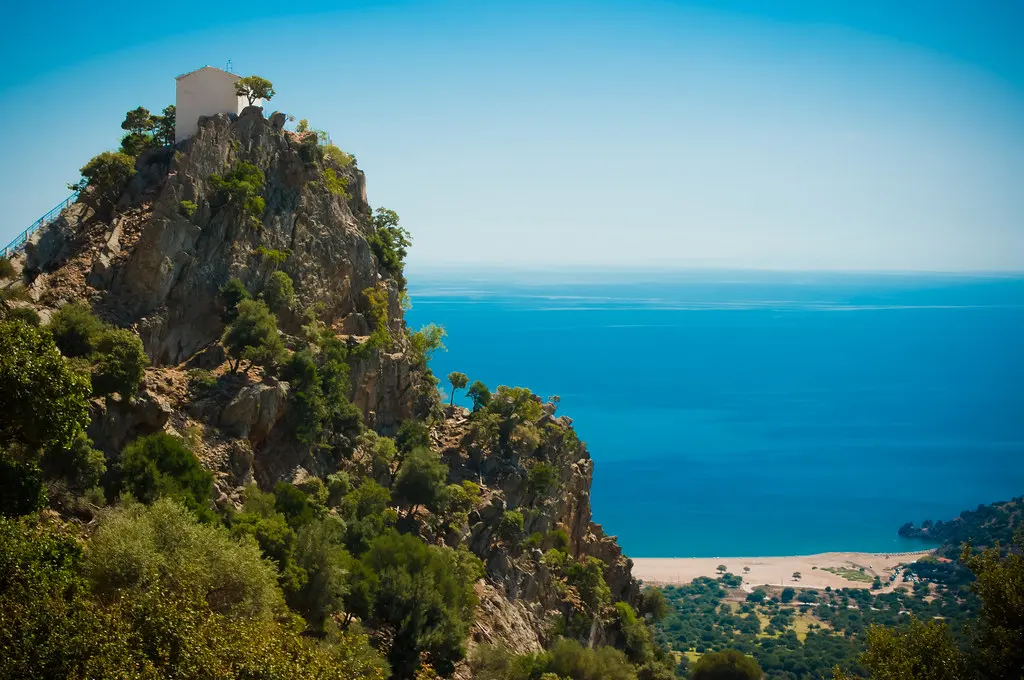
Image of Panagia Krimniotissa. Image source
Visit essentials
A quick read before you go
- Duration
- Allow 1.5 to 2 hours including travel on the rough road and time at the chapel.
- Access
- From Samothrace's main road, turn toward Pahia Ammos beach and follow the concrete road uphill…
Overview
Above Pahia Ammos on Samothrace's southern cliffs, the white Panagia Krimniotissa—the Virgin of the Cliff—stands on a ledge 311 meters above the sea. Built in 1887, it occupies a site that held something older, which the sources do not fully remember.
During the Byzantine Iconoclasm, when imperial authorities ordered icons destroyed, tradition says faithful Christians cast a sacred image of the Virgin Mary into the sea rather than see it burned. It reached Samothrace, where a shepherd's son found it on the cliff rock. The people repeatedly carried it to the church in Chora, but it returned to the precipice, understood as the Virgin choosing this place.
The miraculous icon now resides in the Church of Chora, while the cliff chapel remains a pilgrimage site. The ascent is part of the devotion—a physical offering that thins the distance between the ordinary world and whatever waits at the edge.
Why this place is sacred
Samothrace has been a place of encounter with the numinous for at least three thousand years. The Sanctuary of the Great Gods sits on the northern coast; Panagia Krimniotissa rises on the southern cliffs. Between these two poles — the ancient mystery rite and the Christian chapel — the island holds a density of sacred presence that its small size belies.
The cliff chapel gathers its thinness from convergent forces. At 311 meters, with the cliff falling away beneath and the Aegean spreading to the horizon, the physical setting strips away everything inessential. The wind is constant. The light off the water is severe and clarifying. The icon's legend adds another dimension — the insistence of the sacred upon this particular location, the refusal to be domesticated or made convenient.
This island was sacred before it was Christian, and the chapel sits atop traditions that extend far below its foundations.
The chapel was built to honor the place where a miraculous icon chose to reside. During the Byzantine Iconoclasm, the icon was cast into the sea to save it from destruction. It arrived at Samothrace and was found on this cliff. Repeated attempts to move it to Chora failed — the icon returned each time. The chapel marks where divine will and human devotion found their meeting point.
The current structure dates to 1887, built on older foundations whose history is poorly documented. A 1999 fire required renovation. The icon was historically moved seasonally between the cliff chapel and Chora — carried up at Easter, brought down at the Feast of Saint Demetrios — with each Chora family hosting it for one night of prayer. This practice has ceased; the icon now remains permanently in Chora.
The cliff chapel continues to draw pilgrims who make the ascent on foot.
Experience and orientation
The road begins on the route toward Pahia Ammos beach, then turns upward on a rough concrete track climbing three kilometers to the chapel. Many visitors walk the final stretch, and the walking is the better choice. The body's labor becomes part of the offering.
As the elevation increases, the landscape opens. Samothrace's interior mountains rise to the north — Mount Fengari, the highest peak in the Aegean islands, where Poseidon is said to have watched the Trojan War. To the south, the sea widens with every switchback. The Turkish island of Gokceada becomes visible across the strait.
The chapel itself is small and white, ordinary in its architecture but extraordinary in its placement. It perches on the cliff like something that arrived rather than something that was built. When the church is open, the interior is cool and dim, scented with old stone and candle wax. When it is locked, the experience happens entirely outside — and outside is where the full power of the place resides. The cliff drops away. The wind moves without obstacle.
Stand here long enough and the distinction between looking at the world and being held by it begins to dissolve.
Approach from the Pahia Ammos road. Bring water, sun protection, and sturdy footwear. Morning visits offer the best light and cooler temperatures. Allow at least ninety minutes for the round trip. There are no facilities at the site. The chapel may be locked outside feast days, but the cliff-top setting is the primary experience.
Context and lineage
The story exists in several versions, each converging on the same conclusion: the icon chose this cliff. In the most common telling, Christians of Asia Minor threw the icon into the sea during the Iconoclasm rather than see it destroyed. A sea captain later found it floating in a storm. The Virgin appeared in his dream and told him to carry the icon to Samothrace. A shepherd's son found it on the cliff rock above Pahia Ammos.
The people carried it to Chora. The icon returned to the cliff. They carried it down again. It went back. A third time, the icon became so heavy it could not be lifted. The Virgin had spoken through weight and resistance: this precipice was her chosen dwelling.
The chapel belongs to the Eastern Orthodox tradition under the Metropolitan of Alexandroupolis. Its significance is local rather than institutional — a small cliff chapel whose power derives from its legend and location. The miraculous icon connects it to the broader Aegean tradition of Marian devotion, in which icons arriving by sea are understood as choosing their own dwelling places.
The unnamed faithful of the Iconoclasm
Christians who cast the icon into the sea rather than allow its destruction, setting in motion the chain of events that brought the image to Samothrace.
The shepherd's son
The figure in local tradition who first discovered the icon on the cliff rock, initiating the attempts to move it and the icon's repeated return.
Traditions and practice
The most distinctive tradition was the seasonal transfer of the icon between the cliff chapel and Chora. From Easter until the Feast of Saint Demetrios in late October, the icon resided on the cliff. For winter, it was carried down to Chora, where each family hosted it for one night of prayer and vigil.
This rotation wove the sacred image into daily life — the icon was not a distant object of veneration but a guest who slept under every roof.
The seasonal transfer has ceased; the icon now remains permanently in the Church of Chora. The cliff chapel functions as a place of worship on feast days, particularly the Dormition of the Virgin Mary on August 15, with religious ceremonies, traditional music, and communal celebration. Throughout summer, visitors make the ascent as informal pilgrimage.
Approach the hike as contemplative practice rather than tourist excursion. Walk slowly. Let the physical effort quiet the mind. At the top, resist the impulse to photograph immediately. Stand at the cliff edge and let the wind and vastness register in the body. If the chapel is open, enter quietly. Light a candle if candles are available.
Eastern Orthodox Christianity
ActiveThe chapel houses the site where a miraculous icon of the Virgin Mary chose to reside, repeatedly returning to this cliff when moved to the more accessible Church of Chora. The name Krimniotissa — from krimnos, meaning cliff or precipice — anchors the icon's identity to this specific landscape. The chapel is part of a network of Marian icons that protect Samothrace.
Veneration of the miraculous icon (now kept in the Church of Chora). Historical seasonal transfer of the icon between cliff chapel and Chora, with household hosting rotation. Feast of the Dormition (August 15) with religious ceremonies and traditional celebration. Pilgrimage hiking to the cliff chapel.
Perspectives and open questions
Panagia Krimniotissa can be understood as a modest Greek Orthodox chapel, as a node in the Aegean network of miraculous Marian icons, or as the latest expression of an island's ancient vocation for the sacred.
Scholarly perspective
Academic study of this specific chapel is limited. The icon legend follows patterns documented in broader Marian scholarship: miraculous arrival by sea, resistance to relocation, divine selection of site. These narratives anchor sacred presence in landscape, transforming geography into a site of ongoing encounter between the human and the divine. Samothrace's broader sacred history offers a rich field for study of continuity across religious transitions.
Living and traditional perspectives
For the people of Samothrace, the Panagia Krimniotissa is one of several protective icons watching over the island. The tradition of each family hosting the icon for one night reveals a faith that is communal rather than institutional, woven into daily rhythms rather than confined to church services. The icon's insistence on the cliff speaks to a relationship between the divine and the landscape that the community understands as fact, not metaphor.
Alternative interpretations
Samothrace's pre-Christian history invites layered readings. The Sanctuary of the Great Gods hosted mystery initiations for over a millennium before Christianity arrived. Some visitors perceive the cliff chapel as a continuation of the island's ancient vocation as a place of encounter with the numinous. The vertical geography — the climb from sea level to 311 meters — echoes ascent metaphors common to both ancient mysteries and Christian mysticism.
Open questions
Whether the chapel site held pre-Christian sacred significance is an open question. The exact age and origin of the icon are uncertain, with multiple conflicting legends. The relationship between the cliff chapel and the ancient mystery traditions of the Sanctuary of the Great Gods remains unexplored. These gaps remind us that some places hold more than can be documented.
Plan your visit
Access and arrival
From Samothrace's main road, turn toward Pahia Ammos beach and follow the concrete road uphill approximately 3 km to the chapel at 311 meters. The road is rough; 4WD recommended. Samothrace is reached by ferry from Alexandroupolis (approximately 2 hours) or seasonally from Kavala. No airport on the island. Mobile signal may be unreliable at the chapel.
Accommodation available in Kamariotissa (port town), Chora (hilltop capital), and Therma (village with hot springs). Any base provides reasonable access. Book ahead for August when the island fills for the Dormition feast.
Respectful visit
Shoulders and knees covered. Modest clothing appropriate for a church visit. The hike requires sturdy shoes and sun protection — bring a light covering to put on before entering the chapel if you are dressed for hiking.
Photography is generally permitted outside the chapel, and the cliff-top views are the primary attraction for many visitors. If the chapel is open, ask before photographing the interior. Do not photograph worshippers or clergy without permission.
Candles may be available inside the chapel. No formal offering is expected. The act of making the ascent is itself understood as a form of devotion.
No formal restrictions beyond standard church etiquette and common sense regarding the cliff edge. The rough road and exposed location are their own natural gatekeepers.
The cliff edge lacks protective barriers in places. Exercise care, especially in wind. The path is exposed to sun and heat in summer. Do not attempt the visit in winter when roads may be impassable and winds dangerous. If services are in progress, wait quietly outside.
Current practical details
Address
Samothrace 680 02, Greece
Hours, fees, and access can change — verify on the official source before you travel. Practical details last checked Jun 2026.
Location
Map loads as you approach this section.
Pilgrim reflections
A portrait of encounter, not a score
Pilgrims describe what they felt, how present they could become, and whether the place would shape a journey. There are no stars and no ranking of traditions.
No reviewed reflections yet
The first pilgrims can help describe the character of being here.
Share a reflection
Available after an account-backed “Been there.” Every reflection is reviewed before publication.
Nearby sacred places
Explore other sacred places in the region. Proximity does not establish access or travel time; check each place’s guidance.


References
Sources consulted for this page. Source categories describe the publication, not a guarantee that every claim is verified. Traditional accounts and outside interpretations may differ.
- 01Panagia Krimniotissa, the Church on the Rock — InSamothraki — InSamothraki.comguideLocal tourism site with detailed legend and access information
- 02Sacred Temple of Panagia Krimniotissa — Samothrace Tsakbam — Samothrace.tsakbam.euguideLocal guide with basic historical information
- 03Church of Panagia Krimniotissa — Evros TravelFind — TravelFind.grguideRegional tourism guide
- 04Panagia Krimniotissa — WonderGreece — WonderGreece.grguideGeneral tourism with cultural context
- 05Holy Mary (Panagia) Krimniotissa in Samothrace — Maritza-Evros — Maritza-Evros regional authorityofficialRegional cultural authority
- 06Panagia Krimniotissa — Terrabook Greece — TerrabookguideCultural tourism guide
Share a photo
Help visitors recognize Panagia Krimniotissa. Every submission is reviewed before publication.