Kasamori-ji
Japan's only shihō-kakezukuri Kannon-dō, suspended on 61 stilts above an old-growth forest
Understand sacred places, explore living traditions, and learn how to engage respectfully with Pilgrim Map.
Access has not been verified. Check current local guidance before planning a visit.
Chōnan, Chiba Prefecture, Japan
Read the sources
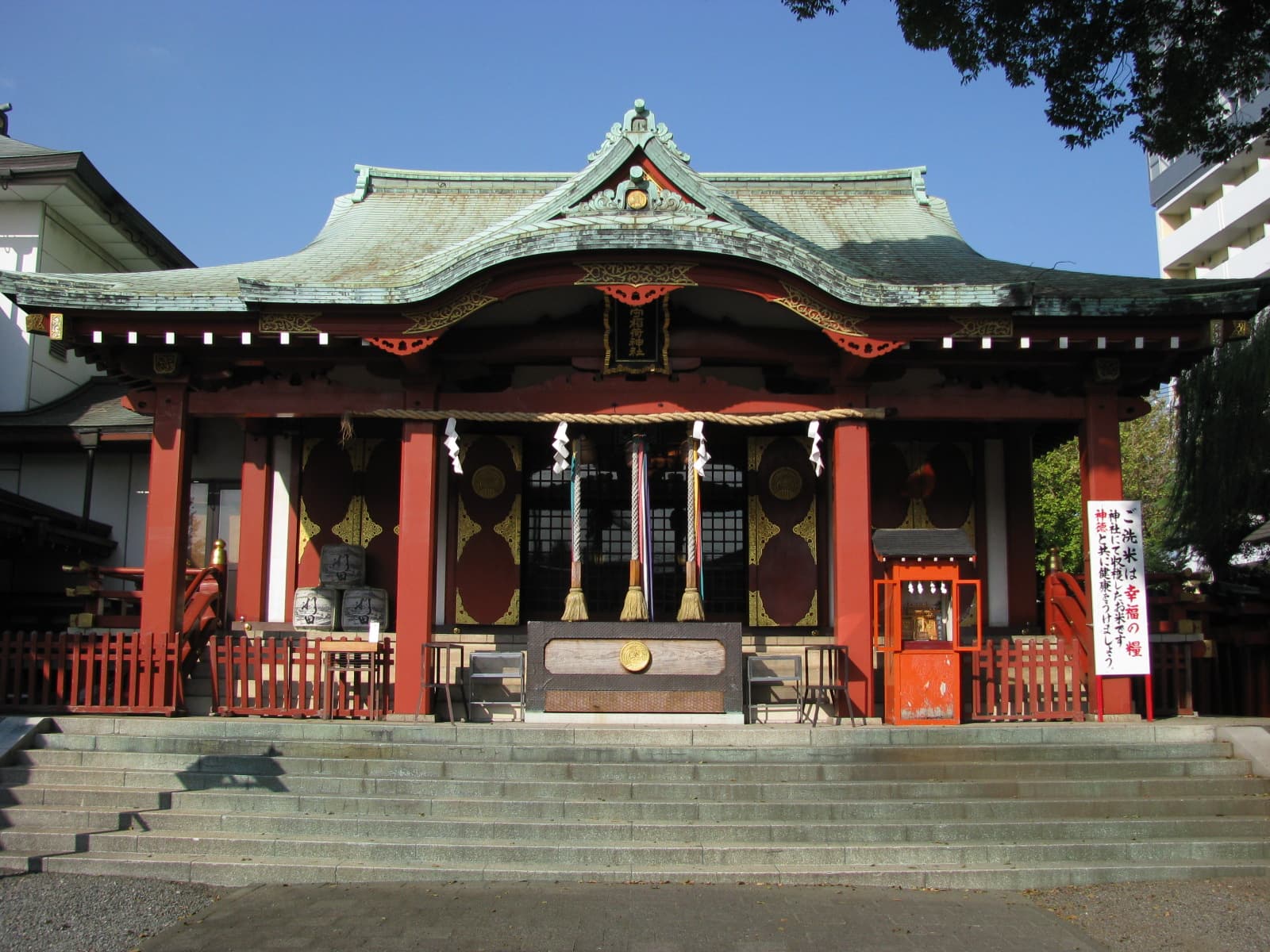
Image of Kasamori-ji (笠森寺). Image source · CC-BY-4.0
Station 31 of 33
Bandō Sanjūsankasho PilgrimageVisit essentials
A quick read before you go
- Duration
- 60–90 minutes for the climb, the Kannon-dō, the Kosazuke-no-kusu, and a slow walk in the…
- Access
- By car: roughly 25–35 minutes inland from the JR Sotobō coast (Mobara / Chōnan area).
Overview
Kasamori-ji stands on a low forested mountain in inland Chiba, on the central Bōsō Peninsula. The temple's mountain name is Daihizan — 'Mountain of Great Compassion' — and its Main Hall is, by general scholarly recognition, the only surviving shihō-kakezukuri structure in Japan. Shihō-kakezukuri (四方懸造り) is a 'four-direction suspended' construction technique in which the entire hall sits atop a large rock outcrop on 61 wooden stilts arranged on all four sides of the rock.
The form is a kin to the famous kakezukuri stage of Kyoto's Kiyomizu-dera, but pushed further: where Kiyomizu suspends its platform from one side, Kasamori suspends its hall from all four. Approaching the structure is a literal ascent above the forest canopy.
By temple tradition, Kasamori-ji was founded in 784 CE (Enryaku 3) by Saichō (Dengyō Daishi, 767–822), founder of Japanese Tendai Buddhism. Saichō is said to have carved a Jūichimen Kannon (Eleven-faced Kannon) from a sacred camphor tree at the site and dedicated a small hall on the rock outcrop. The first Kannon-dō was reportedly built in 1028 (Chōgen 1) by imperial commission of Emperor Go-Ichijō.
Ink inscriptions found during the 1958–60 restoration date the present structure to about 1579–1597 (Azuchi–Momoyama period). The hall was designated a National Treasure under the pre-war system in 1908 and redesignated a National Important Cultural Property under the 1950 Cultural Properties Protection Law (popular sources sometimes still describe it as a National Treasure; the current strict designation is ICP).
The surrounding forest — Castanopsis-dominated temperate rainforest, with weasels, badgers, scops owls, and Eurasian sparrowhawks among its wildlife — is a Nationally Designated Natural Monument. The Kosazuke-no-kusu, a great ancient camphor tree near the temple with a natural cavity at its base, is the focus of a long-standing fertility tradition: visitors crawl through its opening for blessings of conception, health, and youthful vigor.
The temple has stood on its rock outcrop through more than twelve centuries of major regional seismic events, and the climb up its steep stairs followed by the entry into the suspended hall is what most pilgrims describe as the visit's structural and spiritual heart.
Why this place is sacred
Kasamori-ji's quality of thinness rests on three intertwined registers, none of which exists at this concentration anywhere else in Japan. The first is architectural. The shihō-kakezukuri Main Hall — perched on 61 wooden stilts atop a rock outcrop — is the sole surviving example of its construction type in the country. The visitor climbs 75 steep stone stairs to the foot of the rock, removes their shoes, and ascends into a wooden volume suspended above the forest floor.
Once inside, the floor underfoot is a wooden platform supported by stilts running down to the rock and the earth below; the windows look out over the canopy. The structure has stood through more than twelve centuries of regional seismic events, and the experience of standing in it cannot be photographed — the proportions register only when the body is held inside the suspended volume.
The second register is the founding lineage. Saichō, founder of Japanese Tendai, is said to have carved the Jūichimen Kannon from a sacred camphor tree at this site in 784 CE — a foundation narrative that locates Kasamori-ji at the start of Tendai's eastward diffusion from Mount Hiei. The Tendai cosmology of climbing toward Kannon's compassion, of hearing her voice from above, is literalized here: the worshipper genuinely climbs upward, leaving the forest floor behind to enter the elevated sanctuary.
The third register is the forest itself. The Castanopsis-dominated temperate rainforest around the precinct is a Nationally Designated Natural Monument and a remnant of vegetation rare in modern Japan. Old growth, deep silence, scops owls audible at dawn, woodpeckers throughout the day. The Kosazuke-no-kusu — a great ancient camphor with a natural opening at its base — is the focus of a long fertility tradition: crawling through its hollow for blessings of conception, health, and vigor.
The forest functions as the temple's outer mandala; the rock and the suspended hall as its center.
Per temple tradition, founded in 784 CE by Saichō, who carved the Jūichimen Kannon honzon from a sacred camphor tree atop the rock outcrop and dedicated a small hall on the site. Devotion has been to the Eleven-faced Kannon ever since, with successive halls built and rebuilt over the same outcrop.
The first Kannon-dō was reportedly built in 1028 by imperial commission of Emperor Go-Ichijō; the present structure dates by ink inscription to about 1579–1597 (Azuchi–Momoyama period). The hall was designated a National Treasure under the pre-war system in 1908 (Meiji 41), and redesignated a National Important Cultural Property under the 1950 Cultural Properties Protection Law. A comprehensive restoration in 1958–60 reinforced the rock foundation with concrete, installed fire-prevention systems, and restored the structure to its original appearance.
The surrounding forest's status as a Nationally Designated Natural Monument formalized centuries of community protection of the sacred grove.
Experience and orientation
Kasamori-ji is reached most easily by car from the JR Sotobō coast (Mobara / Chōnan area), about 25 to 35 minutes inland. Local bus from JR Mobara Station is available but limited; many pilgrims combine bus with hired taxi or rent a car. The approach passes through quiet inland country and ends at the temple's parking area, where the precinct's character makes itself immediately felt: the Castanopsis canopy, ferns underfoot, a hush characteristic of old-growth forest.
From the parking area, the path leads to the foot of the rock outcrop and the 75 steep stone stairs that climb toward the suspended hall. At the foot of the stairs, shoes are removed; the climb itself becomes the prayer for many pilgrims. Forest sound — woodpecker, finch, occasional scops owl at dusk — is what most visitors first register. The stairs are uneven and steep; sturdy footwear (carried, not worn) and steady pace are essential.
At the top, the suspended hall opens. The Kannon-dō is shihō-kakezukuri — the four-direction suspended construction unique in Japan — perched on 61 wooden stilts above the rock. Entering means stepping into a wooden volume whose floor is suspended above the forest floor. The Jūichimen Kannon honzon stands at the altar; visitors light incense, offer at the saisen box, and chant or quietly listen. Capacity inside the hall is limited; be aware of others on the climb up.
The platform views over the unbroken Castanopsis canopy are, for many pilgrims, the visual heart of the visit. Back at the foot of the climb, the Kosazuke-no-kusu — the 'Camphor of Conception' — stands with its natural cavity at the base; visitors who wish to participate in the fertility tradition crawl through the opening.
By car, drive 25–35 minutes inland from JR Mobara Station. By public transport, take the JR Sotobō Line to Mobara and connect to a local bus or taxi to the temple — confirm timetables before traveling. From greater Tokyo, the Aqua-Line + drive route or the JR Sotobō Line both work. At the temple, follow the path to the foot of the rock, remove shoes at the bottom of the 75 stone stairs, climb steadily, and enter the suspended Kannon-dō.
After veneration, descend, replace shoes, and walk to the Kosazuke-no-kusu camphor for the fertility crawl. Bandō pilgrims should bring their nōkyō-chō to the office at the foot of the climb for the Bandō #31 stamp.
Context and lineage
By temple tradition, in 784 CE (Enryaku 3), Saichō (Dengyō Daishi, 767–822) — soon to become founder of Japanese Tendai Buddhism — was traveling through the Bōsō region. He was drawn to a luminous sacred camphor tree (kusu) atop a great rock outcrop. From its wood he carved the Jūichimen Kannon (Eleven-faced Kannon) and dedicated a small hall on the rock to enshrine the image. The site became a Tendai foundation node in eastern Japan.
In 1028 (Chōgen 1), Emperor Go-Ichijō commissioned construction of the Kannon-dō atop the rock. The shihō-kakezukuri form — a hall suspended on 61 wooden stilts above the rock outcrop — appears to date from this imperial commission, though the present structure is a later rebuilding. Ink inscriptions found during the 1958–60 restoration date the surviving Main Hall to approximately 1579–1597 (Azuchi–Momoyama period), making it the work of late-16th-century carpenters.
The hall was designated a National Treasure under the pre-war system in 1908 (Meiji 41), and redesignated a National Important Cultural Property under the 1950 Cultural Properties Protection Law. The 1958–60 comprehensive restoration reinforced the rock foundation with concrete, installed fire-prevention systems, and returned the structure to its original appearance. The surrounding forest, long protected as the temple's sacred grove, was designated a Nationally Designated Natural Monument in modern times.
Local tradition holds that the haiku poets Bashō and Issa each visited the temple and composed verses there; specific attributions vary between sources.
Kasamori-ji is a parish temple of the Tendai school, anchored in the foundational lineage of Saichō and the headquarters at Mount Hiei. The Eleven-faced Kannon devotion at the heart of the temple is older than the surviving structure; it traces, in the temple's own narrative, to Saichō's 784 CE carving from the sacred camphor on the rock.
Saichō / Dengyō Daishi (767–822)
Traditional founder
Founder of Japanese Tendai Buddhism, who established the headquarters at Mount Hiei after travel and study in Tang China. Temple tradition places him at the foundation of Kasamori-ji in 784 CE, carving the Jūichimen Kannon honzon from a sacred camphor tree atop the rock outcrop.
Emperor Go-Ichijō (1008–1036)
Imperial commissioner of the original Kannon-dō
Eleventh-century emperor whose imperial commission, in 1028, is traditionally credited with the construction of the original shihō-kakezukuri Kannon-dō atop the rock.
Late-16th-century Azuchi–Momoyama carpenters
Builders of the surviving Main Hall
The carpenters whose work, dated by ink inscriptions to ca. 1579–1597, produced the surviving shihō-kakezukuri Main Hall — the only structure of its construction type still standing in Japan.
Shōwa-era cultural-properties teams (1958–60)
Modern conservators
The restoration teams responsible for the comprehensive 1958–60 restoration: concrete reinforcement of the rock foundation, fire-prevention systems, and restoration to original appearance. Their work is the reason the suspended hall remains structurally sound after twelve centuries of regional seismic activity.
Resident Tendai clergy
Contemporary stewards
The continuing community responsible for daily Tendai liturgy, conservation stewardship of the Nationally Designated Natural Monument forest, periodic structural maintenance of the kakezukuri pillars, and Bandō pilgrim reception.
Traditions and practice
The temple's liturgy follows Tendai practice — recitation of the Hannya Shingyō, the Kannon-kyō, and the Eleven-faced Kannon mantra at the Jūichimen Kannon honzon. Tendai liturgical observances are held on annual festival days. The Kosazuke-no-kusu fertility tradition — crawling through the natural cavity at the base of the great ancient camphor — is a long-standing lay devotional practice, attended for blessings of conception, health, and youthful vigor.
Bandō pilgrims arrive year-round for the #31 nōkyō, often combining the visit with Kōzō-ji (#30) earlier the same day and Kiyomizu-dera (#32) the next. The temple maintains conservation stewardship of the Nationally Designated Natural Monument forest, including periodic structural maintenance of the kakezukuri pillars. Bandō pilgrimage office hours are commonly 8:00–17:00; confirm with the temple before traveling. Spring (April–early May) and autumn (mid-November–early December) bring the steadiest visitor flow.
Allow 60 to 90 minutes for an unhurried visit, longer if you intend to walk in the surrounding sacred forest. Wear sturdy footwear suited to the steep stone stairs (and remove them at the foot of the climb). Climb at a steady pace; the 75 steps are the embodied beginning of the prayer, and the proportions of the suspended hall register most clearly when arrived at slowly.
Inside the Kannon-dō, light incense, offer at the saisen box, and chant or quietly listen. Be aware of others on the climb up — interior capacity is limited. After descending, walk to the Kosazuke-no-kusu and, if you wish to participate in the tradition, crawl through the natural opening at its base. Bandō pilgrims should bring their nōkyō-chō to the office for the #31 stamp.
Buddhism
ActiveKasamori-ji is a Tendai temple founded by tradition in 784 CE by Saichō (Dengyō Daishi), founder of Japanese Tendai Buddhism, who is said to have carved the Jūichimen Kannon (Eleven-faced Kannon) from a sacred camphor tree atop the rock outcrop at the site. The Main Hall (Kannon-dō) is the only surviving example in Japan of the shihō-kakezukuri (four-direction suspended) construction style — the entire hall sits atop a large rock outcrop on 61 wooden stilts, raising the worshipper roughly 30 metres above the surrounding forest floor. As Bandō #31, the temple is one of Kannon's 33 manifestations on the eastern Japanese pilgrimage circuit, and the architectural climax of the southern Chiba leg. The surrounding Castanopsis-dominated forest is a Nationally Designated Natural Monument; the Kosazuke-no-kusu (Camphor of Conception), a great ancient camphor with a natural cavity at its base, is the focus of a long-standing fertility tradition.
Bandō Sanjūsankasho Pilgrimage
Active31st station of the 1,300+ km Bandō Kannon pilgrimage; the architectural climax of the southern Chiba leg, and one of the route's most distinctive halls.
Perspectives and open questions
Kasamori-ji is a temple where architectural uniqueness, founder lineage, and old-growth forest meet on a single sacred outcrop. The visit rewards holding all three open at once.
Scholarly perspective
The current Kannon-dō is dated by ink inscriptions found during the 1958–60 restoration to ca. 1579–1597 (Azuchi–Momoyama period), with comprehensive restoration in 1958–60 (concrete reinforcement of the rock foundation, fire-prevention systems, restoration to original appearance). The shihō-kakezukuri structure is recognized as the sole surviving example of its type in Japan.
The hall was a National Treasure under the pre-war system (designated 1908) before being redesignated a National Important Cultural Property in 1950 — popular sources sometimes still describe it as a National Treasure, but the current strict designation is ICP. The surrounding forest is a Nationally Designated Natural Monument representing a remnant of Japanese temperate rainforest.
Living and traditional perspectives
Temple tradition holds that Saichō himself founded the temple in 784 CE by carving the Jūichimen Kannon from a luminous camphor on the sacred rock — a foundation narrative that locates Kasamori-ji within the origin story of Japanese Tendai. Local lay tradition centers on the Kosazuke-no-kusu, the great camphor whose hollow is crawled through for fertility blessing.
Within Tendai practice, the suspended hall reads as a literalization of Kannon's reaching down from elevated compassion: the worshipper climbs toward the bodhisattva rather than meeting her on flat ground. The forest functions as outer mandala.
Alternative interpretations
Some readings emphasize the temple's earthquake survival as itself the spiritual lesson: the structure has stood on its rock outcrop through more than twelve centuries of major regional seismic events, and visitors who climb into the suspended hall are entering a structure whose persistence is part of its meaning. Others emphasize the Kosazuke-no-kusu and the forest as the deeper sacred site, with the architectural hall as a particular concentration of the older grove sanctity.
Open questions
{"The exact nature of the original 8th-century structure is unknown","The relationship between the 1028 imperial-commission Kannon-dō and the surviving late-16th-century building is reconstructed largely from inscriptions found during the Shōwa restoration","Pre-historic religious significance of the great rock outcrop on which the temple sits is not securely documented","Specific haiku attributions (Bashō / Issa) at the temple vary between sources","Full annual festival schedule beyond regular Bandō pilgrimage practice not exhaustively retrieved"}
Plan your visit
Access and arrival
By car: roughly 25–35 minutes inland from the JR Sotobō coast (Mobara / Chōnan area). Public transport: bus from JR Mobara Station (limited frequency); pilgrims often combine with a hired taxi or rental car. Reachable as a day trip from Tokyo via Aqua-Line + drive or via JR Sotobō Line. Bandō pilgrimage office hours commonly 8:00–17:00; confirm with the temple before traveling.
Mobile phone signal is generally available on major Japanese carriers in the temple area, though some forest pockets may have weaker reception.
Mobara, Chōnan, and the surrounding Bōsō inland offer modest local lodging; many Bandō pilgrims base themselves in Mobara or in central Chiba and visit Kasamori-ji as a focused half-day or full-day excursion.
Respectful visit
Modest, comfortable clothing; sturdy footwear is strongly recommended for the steep stone stairs (carried for the climb, removed before entry). Pilgrim attire welcome.
Permitted in the precincts and from the suspended platform; interior altar photography is generally restricted. No flash. Be considerate of the limited interior capacity when others are praying.
Saisen (offering box), incense, and candle offerings are standard. Stamp fees at the office at the foot of the climb.
Remove shoes at the foot of the stone stairs before climbing into the Main Hall | Do not lean on or climb the historic kakezukuri pillars (National Important Cultural Property) | Limited interior capacity in the Main Hall — be aware of others on the climb up | Stay on marked paths in the protected forest (Nationally Designated Natural Monument) | Do not collect plants or disturb wildlife
The kakezukuri pillars are historic structural elements of a National Important Cultural Property; do not lean on, climb, or otherwise disturb them. The stone stairs are steep and uneven — take them slowly, and avoid the climb during heavy summer typhoon weather (August–September) when the steep approach is slick and the platform exposed. The surrounding forest is a Nationally Designated Natural Monument; stay on marked paths, do not collect plants or disturb wildlife.
Forest wildlife (Japanese weasels, badgers, squirrels; Oriental scops owls, great spotted woodpeckers, Eurasian sparrowhawks) is most active at dawn and dusk.
Current practical details
Address
302 Kasamori, Chonan, Chōsei District, Chiba 297-0125, Japan
Phone
Hours
Hours, fees, and access can change — verify on the official source before you travel. Practical details last checked Jun 2026.
Location
Map loads as you approach this section.
Pilgrim reflections
A portrait of encounter, not a score
Pilgrims describe what they felt, how present they could become, and whether the place would shape a journey. There are no stars and no ranking of traditions.
No reviewed reflections yet
The first pilgrims can help describe the character of being here.
Share a reflection
Available after an account-backed “Been there.” Every reflection is reviewed before publication.
Nearby sacred places
Explore other sacred places in the region. Proximity does not establish access or travel time; check each place’s guidance.


References
Sources consulted for this page. Source categories describe the publication, not a guarantee that every claim is verified. Traditional accounts and outside interpretations may differ.
- 01笠森観音 — 日本唯一の四方懸造り 坂東三十三観音札所 第三十一番札所 — Kasamori-ji templeofficialOfficial temple website (Japanese / English versions).
- 02Kasamori-Kannon Temple (English) — Kasamori-ji templeofficialOfficial English-language temple page.
- 03笠森寺観音堂/千葉県 — Chiba Prefecture Board of EducationofficialPrefectural cultural-property record for the Kannon-dō.
- 04笠森寺観音堂 — 文化遺産オンライン — Agency for Cultural Affairs (Bunka.nii.ac.jp)officialNational cultural-properties online register entry.
- 05Kasamori-ji — Wikipedia — Wikipedia contributorsofficialConfirms shihō-kakezukuri designation, 61 pillars, and forest natural-monument status.
- 06笠森寺 — Wikipedia (Japanese) — Wikipedia contributorsofficialMost detailed treatment; gives 1908 National Treasure designation, 1950 ICP redesignation, 1958–60 restoration, and the 1579–1597 ink-inscription dating.
- 07Kasamori-Kannon Temple — Visit Chiba — Chiba Prefecture Tourism AuthorityofficialPrefectural tourism page with practical details.
- 08Kasamori, A Temple That Has Withstood Earthquakes For Over 1200 Years — MATCHA — MATCHA Japan Travel GuideguideVisitor-oriented English guide with descriptions of the climb, sacred trees, and Kosazuke-no-kusu.
- 09Kasamori-ji, or Kasamori Kannon — Japan Travel — Japan TravelguideDetailed visitor description of approach, surrounding forest, and stair climb.
- 10Kakezukuri — Japan Airlines Travel Guide — Japan Airlines / Japan TravelguideArchitectural-context article on the kakezukuri (suspended-construction) family of temple structures.
Pilgrim glossary
- Honzon
- The principal Buddhist deity enshrined as a temple's central object of worship.
- Kannon
- The bodhisattva of compassion, central to many East Asian pilgrimage routes.
- Bodhisattva
- An enlightened being who postpones full nirvana to help others toward awakening.
- Mandala
- A symbolic diagram of the cosmos used in meditation and ritual.
- Sutra
- A canonical Buddhist scripture, often chanted as part of practice.
- Mantra
- A sound, word, or phrase repeated as part of meditation or ritual.
- Tendai
- A Japanese Buddhist school based on the Lotus Sutra, foundational to many later traditions.
Share a photo
Help visitors recognize Kasamori-ji. Every submission is reviewed before publication.