Kiri Vehera
A quiet stupa a short walk from Kataragama's shrine
Understand sacred places, explore living traditions, and learn how to engage respectfully with Pilgrim Map.
Access has not been verified. Check current local guidance before planning a visit.
Kataragama, Monaragala, Sri Lanka
Read the sources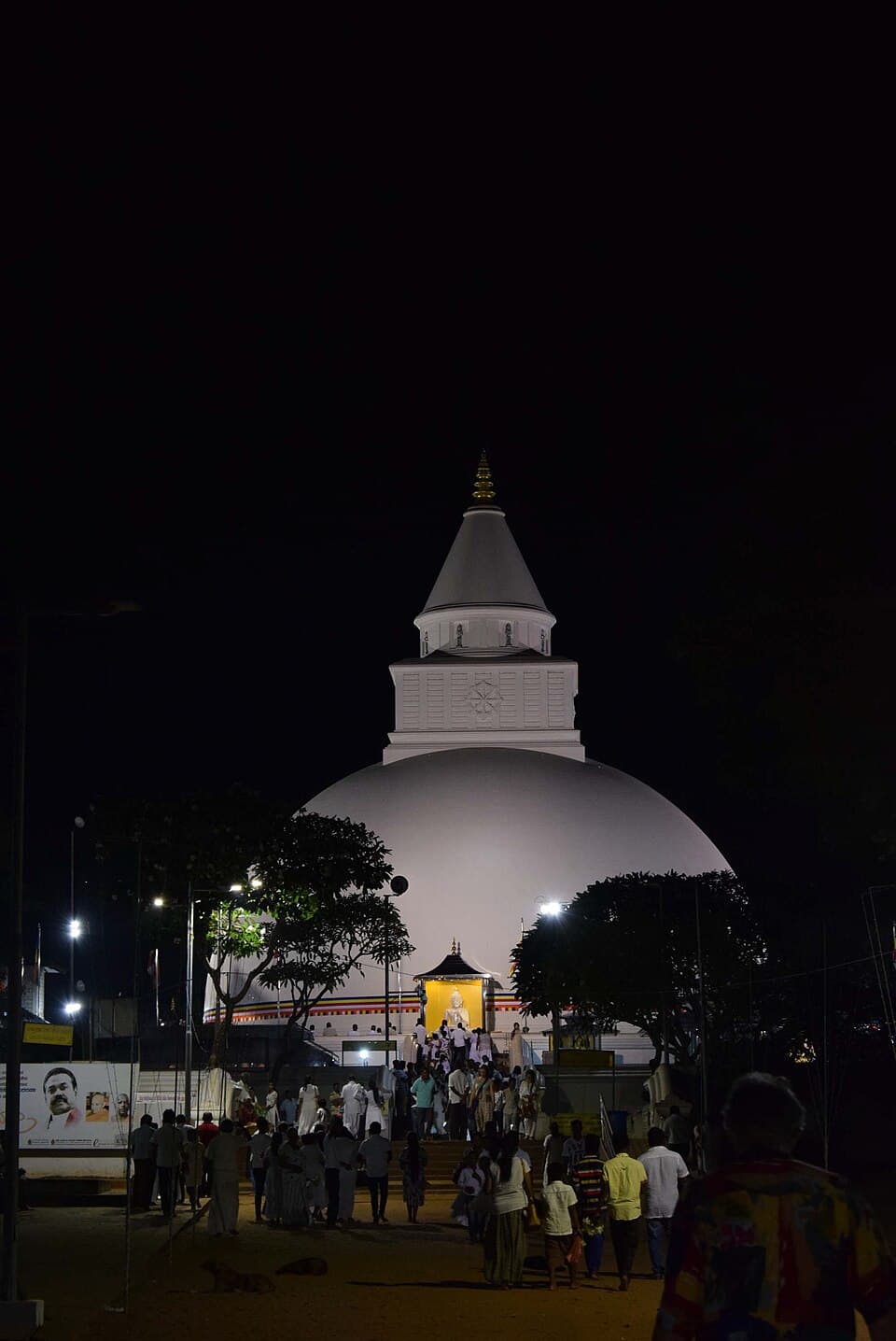
Image of Kiri Vehera. Image source
Visit essentials
A quick read before you go
- Duration
- 30–60 minutes; longer for pilgrims combining worship with the wider Kataragama circuit.
- Access
- About 800 meters north of the Ruhunu Maha Kataragama Devalaya in Kataragama town, Uva Province;…
Overview
Sources name two builders for Kiri Vehera in two different centuries. Rather than a flaw, the unsettled founding story shows how devotional memory works across two thousand years: details drift, names blur, and local traditions sharing one ground fold together.
Kiri Vehera must remain distinct from Kataragama Devalaya, the multi-faith shrine roughly 800 meters south that is sacred to Buddhist, Hindu, Muslim, and Vedda communities and ranks among Sri Lanka's most visited pilgrimage sites. Kiri Vehera has its own monastic chapter and quieter worship: circumambulation, flowers, oil lamps, and a white dome drawing less ecstatic devotion than its famous neighbor. Pilgrims often visit both in one day, but they are not the same place.
Why this place is sacred
Tradition ties the stupa to the Buddha's own presence: a hair relic, a golden seat, a sword, all said to have been enshrined here after a sermon delivered on this spot. Exactly which local ruler received that sermon, and in which century the stupa was actually raised, is not settled among the available sources; the disagreement is real enough that this entry presents both attributions rather than choosing between them.
What stays consistent across every source is that this stupa, not the neighboring devale, is where that particular Buddhist relic tradition is anchored.
To enshrine relics — a hair relic, a golden seat, and a sword — associated with the Buddha's meeting with a local ruler during his third and final visit to the island.
The stupa fell into disrepair over the centuries. An early-20th-century survey (H.C.P. Bell, Hocart, and Senarath Paranavitane, 1911–12) documented its condition, and a substantial restoration followed under Cyril de Zoysa in 1970. No detailed academic conservation record beyond these popular summaries was located.
Experience and orientation
The dome sits apart from the devale's intensity — a quieter register of devotion, without the more ecstatic, petitionary quality associated with Kataragama's Hindu-influenced rites next door. Early morning and late afternoon light suit the stupa well, and pilgrims combining a Solosmasthana visit with the wider Kataragama circuit tend to treat Kiri Vehera as the calmer half of the day.
Visit Kiri Vehera and the Kataragama Devalaya as two separate stops rather than one continuous site — they sit about 800 meters apart and belong to different priesthoods and different registers of worship. Go barefoot with care on the stupa's stone walkways, which grow hot by midday.
Context and lineage
Buddhist tradition holds that the stupa marks the spot where the Buddha, during his third and final visit to Sri Lanka, met and preached to a local ruler of the Kataragama area, afterward giving him a hair relic and the sword used in his own renunciation; the ruler then built the stupa to enshrine these relics along with the golden seat used during the sermon.
Sources do not agree on who that ruler was. Some name King Mahanaga, brother of King Devanampiyatissa, which would place construction in the 3rd century BCE. Others name a more locally rooted figure called King Mahasena or Mahagosha, in a telling that ties the stupa's founding directly to the Buddha's own lifetime — implying a considerably earlier date, sometimes given as the 6th century BCE.
Available sources do not reconcile these two figures or two dates; they may describe the same person remembered differently across centuries of retelling, or two genuinely distinct local traditions folded into one. Archaeological evidence — Brahmi-script masons' marks and 2nd-century-CE donative inscriptions referring to the site by an earlier name, 'Mangalamahaseya of the Kajaragama raja maha vehera' — supports a 3rd-century-BCE date for the extant structure, without settling the separate question of who specifically built it.
Custodianship rests with the resident Kirivehera Rajamaha Viharaya monastic chapter, administratively distinct from the priesthood of the nearby Kataragama Devalaya.
Gautama Buddha
deity
Said to have met and preached to a local ruler at this site during his third visit to Sri Lanka, leaving behind a hair relic and his renunciation sword.
King Mahanaga
historical
Named in some sources as the stupa's builder, brother of King Devanampiyatissa; implies a 3rd-century-BCE dating.
King Mahasena
historical
Named in other sources as the stupa's builder and the ruler who met the Buddha directly; this attribution implies an earlier, legendary dating.
Traditions and practice
Circumambulation of the stupa, offerings of flowers and oil lamps, and pirith chanting are the customary devotional acts.
The stupa serves as the terminus of the annual Kataragama Esala Perahera's Maha Perahera procession, which arrives here with offerings to Buddhist monks — a distinct Buddhist ritual component kept separate from the devale's own Hindu-influenced rites.
Visitors may purchase flowers and oil lamps near the site to make simple offerings; circumambulating quietly is the most straightforward way to participate.
Theravada Buddhism
ActiveKiri Vehera is venerated as the site where the Buddha, during his third and final visit to Sri Lanka, is traditionally said to have met a local ruler and delivered a sermon, after which a stupa was raised to enshrine a hair relic, a golden seat, and a sword. It is counted as one of the Solosmasthana.
Perspectives and open questions
Sourcing for Kiri Vehera is noticeably thinner than for the major Anuradhapura Solosmasthana sites, and the gaps are worth naming rather than smoothing over.
Scholarly perspective
Archaeologists and epigraphists date the extant stupa to approximately the 3rd century BCE, based on Brahmi-script masons' marks and 2nd-century-CE donative inscriptions found at the site, attributing construction to a regional ruler of the Kataragama area without full agreement on that ruler's name.
Living and traditional perspectives
Buddhist tradition holds that the stupa marks the exact spot where the Buddha met and preached to a local ruler during his third and final visit to Sri Lanka, enshrining a hair relic, a golden seat, and his renunciation sword.
Alternative interpretations
No significant alternative or esoteric interpretive tradition specific to Kiri Vehera itself was identified, as distinct from the substantial esoteric and folk-Hindu material associated with the neighboring Kataragama devale and its association with the god Skanda/Murugan — material that belongs to that separate site, not this one.
Open questions
The exact identity of the founding ruler — Mahanaga, Mahasena, or Mahagosha — and the reconciliation between a legendary 6th-century-BCE dating and the archaeological 3rd-century-BCE dating remain unresolved.
Plan your visit
Access and arrival
About 800 meters north of the Ruhunu Maha Kataragama Devalaya in Kataragama town, Uva Province; reachable on foot or by local transport within Kataragama.
Kataragama town offers a range of pilgrim guesthouses and small hotels serving visitors to both Kiri Vehera and the neighboring devale.
Respectful visit
Modest dress covering shoulders and knees; white clothing is traditionally favored by devotees though not mandatory for visitors.
Generally permitted for the stupa exterior; avoid flash or disruptive photography during active worship.
Flowers, oil lamps, and incense are customary and can be purchased near the site.
Footwear and hats must be removed before entering the sacred stupa precinct.
Location
Map loads as you approach this section.
Pilgrim reflections
A portrait of encounter, not a score
Pilgrims describe what they felt, how present they could become, and whether the place would shape a journey. There are no stars and no ranking of traditions.
No reviewed reflections yet
The first pilgrims can help describe the character of being here.
Share a reflection
Available after an account-backed “Been there.” Every reflection is reviewed before publication.
Nearby sacred places
Explore other sacred places in the region. Proximity does not establish access or travel time; check each place’s guidance.
Kataragama Temple, Sri Lanka
Kataragama, Monaragala, Sri Lanka
0.8 km away

Tissamaharama Raja Maha Vihara
Tissamaharama, Tissamaharama, Hambantota District, Southern Province, Sri Lanka
16.6 km away

Muthiyangana Raja Maha Vihara
Badulla, Badulla, Badulla District, Uva Province, Sri Lanka
69.2 km away
Adam's Peak (Sri Pada)
Dalhousie, Ratnapura, Sri Lanka
102.0 km away
References
Sources consulted for this page. Source categories describe the publication, not a guarantee that every claim is verified. Traditional accounts and outside interpretations may differ.
- 01Kiri Vehera — Wikipedia — Wikipedia contributorsacademicGeneral overview; dating to 3rd century BCE, builder King Mahanaga (brother of Devanampiyatissa), dimensions (95 ft height, 280 ft circumference), Solosmasthana status.
- 02Kiri Vehera — Ruhunu Maha Kataragama Dewalaya (official devalaya site) — Ruhunu Maha Kataragama DewalayaSource contextDevalaya-affiliated official page; details 2nd-century CE inscriptions naming the stupa 'Mangalamahaseya of the Kajaragama raji maha vehera', 1911-12 archaeological survey (H.C.P. Bell, Hocart, Paranavitane et al.), and the 1970 Cyril de Zoysa restoration.
- 03Kiri Vehera — Kataragama Devalaya: A Temple for All Faiths — Ruhunu Maha Kataragama DewalayaSource contextPresents Kiri Vehera as a distinct site from the main devale within the same devalaya administration; legend of King Mahasena's meeting with the Buddha and enshrinement of hair relic, golden seat, and sword.
- 04Kiri Vehera Kataragama — History, Contact Number & Buddhist Stupa Guide — VisitKataragama.comSource contextVisitor-facing guide; name etymology (Kihiri Vehera -> Kiri Vehera), opening hours, structure description.
- 05Sixteen Sacred Places (සොළොස්මස්ථාන) — Colombo Dhamma Friends — Colombo Dhamma Friends (CDF)spiritualLists the Solosmasthana; identifies Kataragama Kiri Vehera as the sixteenth of the sixteen sacred places associated with the Buddha's visits.
- 06Kataragama Festival — Sri Lanka's Sacred Pilgrimage — IslandsEventsSource contextDescribes the Kataragama Esala Perahera and confirms the final Maha Perahera procession travels specifically to Kiri Vehera with offerings to Buddhist monks, distinguishing this Buddhist ritual component from the devale's own Hindu-influenced rites.
- 07Kiri Vehera, Katargama — History, Legends, Pilgrimage — HolidifySource contextPopular travel-guide summary of legend and visitor logistics; used only to corroborate widely-repeated legendary details, not as primary evidence.
Pilgrim glossary
- Stupa
- A dome-shaped Buddhist monument that holds relics or marks a sacred place.
Share a photo
Help visitors recognize Kiri Vehera. Every submission is reviewed before publication.