Sri Dalada Maligawa, Temple of the Tooth
The shrine of a tooth that has never been shown
Understand sacred places, explore living traditions, and learn how to engage respectfully with Pilgrim Map.
Access has not been verified. Check current local guidance before planning a visit.
Kandy, Kandy, Sri Lanka
Read the sources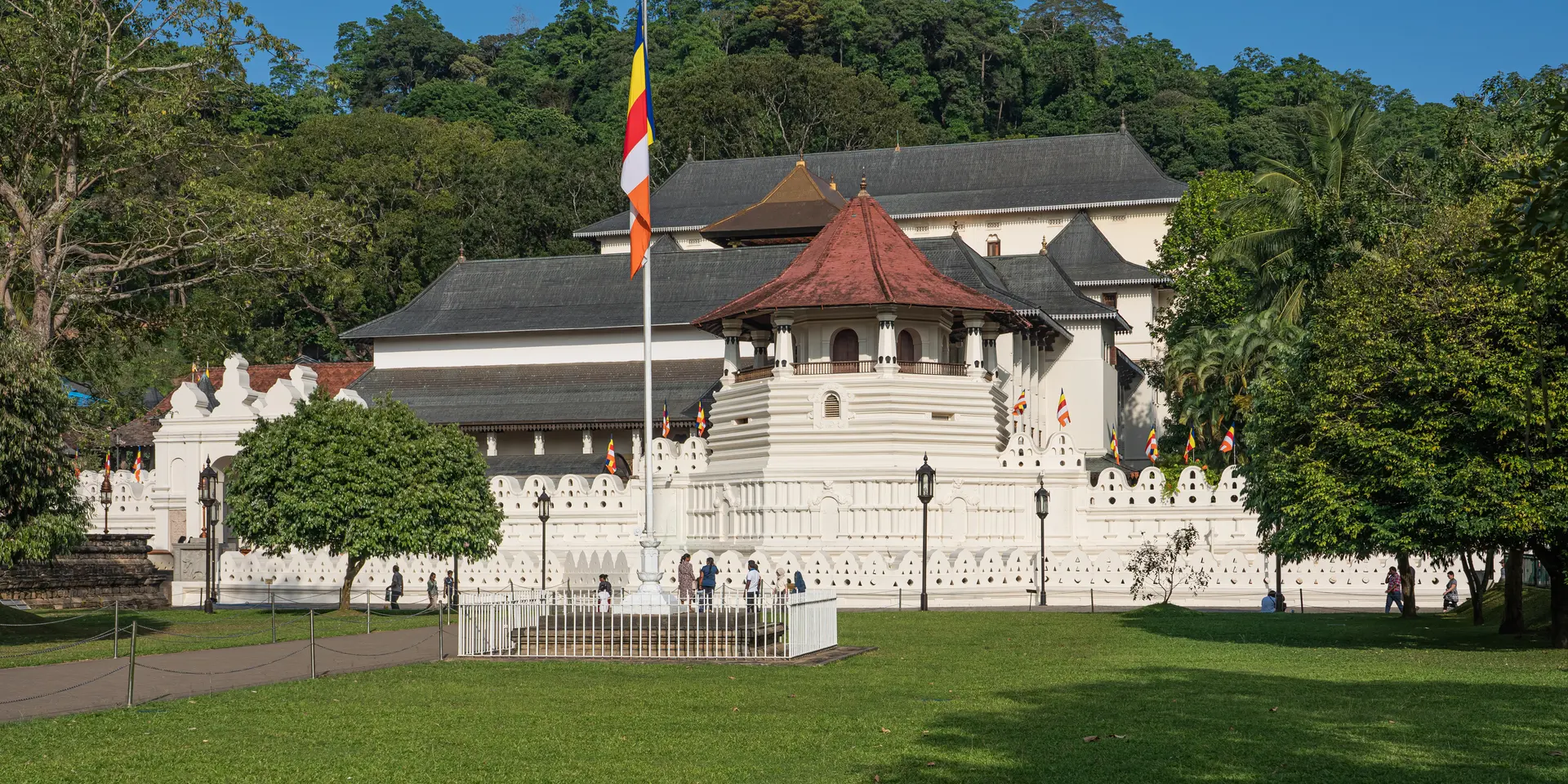
Image of Sri Dalada Maligawa, Temple of the Tooth. Image source · FAL
Visit essentials
A quick read before you go
- Duration
- Allow 1.5 to 2 hours for the temple and adjoining museums.
- Access
- Central Kandy, beside Kandy Lake.
Overview
Sri Dalada Maligawa—the Temple of the Sacred Tooth Relic—is Sri Lanka's holiest Buddhist site and has been the spiritual heart of national identity for more than four centuries. In Sinhala Buddhist tradition, its relic is Gautama Buddha's left canine tooth, recovered from his cremation pyre at Kushinagar and brought to the island in the fourth century CE, hidden in the hair of the Kalinga princess Hemamala.
The relic moved with Sinhala power through Anurādhapura, Polonnaruwa, Dambadeniya, Yapahuwa, Kurunegala, Gampola, and Kotte before settling at Kandy. Kandyan kings built the present complex between 1707 and 1782; the octagonal Pattirippuwa pavilion overlooking Kandy Lake followed in the early nineteenth century.
Seven nested caskets—the karaduwa—hold the relic and are never opened, even for visiting heads of state. Three daily thevava puja services open the inner door for darshan. Each year in Esala (July or August), an elephant carries the outer casket through Kandy in a ten-night procession, among the world's oldest continuous religious processions. UNESCO inscribed the Sacred City of Kandy in 1988 (WHL #450).
Why this place is sacred
Many sacred sites stage a moment of revelation — the lifting of a veil, the opening of a chamber. Kandy works differently. The inner door of the relic chamber opens three times a day, and pilgrims pass before the outer casket in a steady, often weeping queue. The karaduwa within remains closed.
The deeper one moves into the temple, the more layers there are between the visitor and the relic — outer hall, inner hall, threshold of the rawza, the chamber itself, the seven nested caskets. This is the architecture of a tradition that holds the Buddha's presence as something the devotee approaches but does not possess.
The Esala Perahera amplifies the same logic at city scale: drummers, dancers, fire-jugglers, and finally the great Maligawa Tusker carrying a replica casket beneath illuminated parasols — the relic itself remains in the temple. What pilgrims describe is not access but participation in continuity: unbroken devotion since the fourth century CE, layered with royal, monastic, and household ritual, concentrated in the mountain-bowl of Kandy beside its lake.
Palace-temple of the Kandyan kings, housing the Sacred Tooth Relic as the palladium of Sinhala sovereignty. In Sinhala political theology, whoever held the relic held the right to rule.
Earlier shrines housing the relic followed the Sinhala capital through Anurādhapura, Polonnaruwa, Dambadeniya, Yapahuwa, Kurunegala, Gampola, and Kotte. The Kandyan complex was begun under King Vimaladharmasuriya II (r. 1687–1707) and completed under his successors; the moat and Pattirippuwa pavilion were added in the early nineteenth century. The temple was severely damaged in the 1998 LTTE truck bombing and rebuilt. Today the relic remains under the joint custody of the Asgiriya and Malwatte monastic chapters, rotated each puja.
Experience and orientation
The approach is across the white moat bridge into the temple compound, with shoes already removed at the entrance stand. The path moves through outer galleries — wooden ceilings painted with stories from the Buddha's life, long flower-altars where pilgrims set down jasmine and frangipani — before climbing to the upper level of the relic chamber. As the puja hour approaches, the hewisi musicians begin: deep double-headed drums, the long horanewa flute, the spiralling conch.
The drumming continues without pause as the inner door slides open and the queue advances slowly to pass before the outer casket. Pilgrims, most dressed in white, hold their flower offerings at the brow. There is no rushing the queue and no instruction beyond presence. After darshan, many circumambulate the relic chamber, sit in the side galleries, or walk through the alut maligawa (the newer shrine hall, rebuilt after 1998) and the small museums attached to the complex.
The Sri Dalada Museum traces the relic's history; the National Museum, in the old Royal Palace, holds Kandyan regalia.
Enter from the southern gate by Kandy Lake; the security check is at the main entrance and bags are screened. Shoes are removed at the shoe stand at the inner gate. Move clockwise through the lower galleries and up the stairs to the relic chamber level. Puja times: dawn (approximately 05:30), mid-morning (approximately 09:30), and evening (approximately 18:30) — the evening puja is the most attended and atmospheric.
Context and lineage
According to the thirteenth-century Pali chronicle Dāṭhāvaṃsa and earlier sources, the Buddha's left canine tooth was retrieved from his cremation pyre at Kushinagar by the arahant Khema and presented to the king of Kalinga in eastern India, where it was venerated at the city of Dantapuri. In the reign of King Guhasiva, threatened by hostile rulers, the king sent his daughter Hemamala and her husband Prince Dantakumara to carry the relic to Sri Lanka.
Hemamala hid the tooth in her hair. They landed on the southern coast and brought it overland to Anurādhapura, where King Kirti Sri Meghavanna received it with honour and enshrined it in the Meghagiri Vihara. From that moment, the Sinhala kings understood themselves as the relic's custodians, and the relic as the guarantor of their right to rule.
As the centre of power moved south and east under successive pressures, the relic moved with it: to Polonnaruwa under Parākramabāhu the Great, then through Dambadeniya, Yapahuwa, Kurunegala, Gampola, Kotte, and finally to Kandy in 1592. The present temple was begun under King Vimaladharmasuriya II in the early eighteenth century, completed under King Sri Vikrama Rajasinha, and gravely damaged by the 1998 truck bombing — restored within years.
Theravāda Buddhism, in the Sinhala tradition. The relic chamber is jointly served by the Asgiriya and Malwatte Maha Viharas, the two great Kandyan monastic chapters whose monks rotate custody. The lay administration of the temple is led by the Diyawadana Nilame, an office that retains royal-period dignity.
Traditions and practice
Thevava puja is held at dawn, mid-morning, and evening, with drumming on the great hewisi drums, the horanewa flute, and the conch. The inner door of the relic chamber is opened for the duration of the puja for darshan of the outer casket; the karaduwa within is not opened. Offerings of lotus, jasmine, frangipani, and oil for lamps are laid at the flower altars. Circumambulation of the relic chamber is done clockwise.
The Esala Perahera is held in the lunar month of Esala — late July or August — across ten nights, ending on the Nikini full-moon poya. It begins with the kap planting and proceeds through five nights of Kumbal Perahera and five nights of Randoli Perahera; the Maligawa Tusker carries the replica casket beneath illuminated parasols, accompanied by hundreds of dancers, drummers, fire-twirlers, and the standard-bearers of the four guardian devales.
The festival concludes with the Diya Kepeema (water-cutting) ceremony at the Mahaweli river. Full-moon poya days each month also bring large numbers of white-clad devotees.
Arrive thirty minutes before a puja service. Buy a small flower offering at one of the stalls outside the gate. Move through the temple at the pace of the white-clad pilgrims around you — not faster. Stay for the full puja, including the drumming that continues after the inner door closes. If you can plan around the Esala Perahera, the Randoli Perahera nights (the last five) are the most concentrated.
Theravāda Buddhism
ActiveThe Sacred Tooth Relic (sri dalada) is the most venerated Buddhist relic in Sri Lanka and, historically, the palladium of Sinhala kingship — whoever held the relic was understood to hold the right to rule. The Dalada Maligawa has been its permanent shrine since the Kandyan kingdom.
Three daily thevava (puja) services with drumming on the great hewisi drums; offering of lotus and frangipani flowers; circumambulation of the relic chamber; the annual Esala Perahera ten-night procession honouring the Tooth and the four guardian devales.
Perspectives and open questions
The relic at Kandy holds together questions that scholarship and faith ordinarily separate. The composition of what lies inside the seven nested caskets is not subject to scientific examination. The political and religious history that has accumulated around the karaduwa is exceptionally well documented.
Scholarly perspective
The Dalada Maligawa is the political-religious centre of late Sinhala kingship and the most important Buddhist site in Sri Lanka. Its present buildings date from the Kandyan period (eighteenth century) with major restoration after the 1998 bombing. The Sacred Tooth Relic's role as the palladium of Sinhala sovereignty is the consensus reading across modern historians of Sri Lanka.
The relic itself is not subject to scientific examination, and the question is treated as one of religious meaning rather than empirical inquiry.
Living and traditional perspectives
Sinhala Buddhist tradition holds the relic to be the Buddha's left canine tooth, brought from Kalinga by Princess Hemamala in the fourth century CE and rightfully Sri Lanka's. The relic legitimises the polity and protects the island; as long as the relic resides in Sri Lanka, the Dhamma will flourish there.
Alternative interpretations
Some commentators read the Esala Perahera in light of pre-Buddhist agricultural and rain-making rhythms; the Diya Kepeema (water-cutting) ceremony has been interpreted as continuous with older Sinhala river ritual. These are scholarly hypotheses about ritual layering, not challenges to the relic's standing.
Open questions
The relic has not been examined. What lies inside the seven nested caskets remains a matter of faith. Devotees would say the question itself misses the point — the relic's power is its continuous worship, and the karaduwa has never been opened because it does not need to be.
Plan your visit
Access and arrival
Central Kandy, beside Kandy Lake. The train from Colombo Fort to Kandy (~3.5 hours, through the hill country) is itself part of the journey. Road travel via the Colombo–Kandy expressway is roughly three hours. The temple compound is in central Kandy, a 15-minute walk from the rail station or a short tuk-tuk ride.
Kandy has accommodation across all budgets, from guesthouses around the lake to colonial-era hotels on the surrounding ridges. During Esala Perahera, rooms with a view of the procession route on Dalada Veediya book up months in advance and command premium prices.
Respectful visit
White preferred; modest dark colours acceptable. Shoulders and knees covered. Shoes and hats removed at the entrance.
Permitted in outer courtyards. Not permitted of the relic chamber interior during puja. No flash anywhere inside the temple. Do not turn your back to the relic for a photograph.
Flowers (lotus, jasmine, frangipani), oil for lamps, and incense are sold at stalls outside the gate. Donations to the temple are welcomed; no specific amount is expected.
No visible Buddha tattoos (national law). No pointing feet at Buddha images. Silence inside the relic chamber. Bags screened; large bags not permitted. Avoid black on Esala Perahera nights.
The temple is a high-security national heritage site after the 1998 bombing. Expect bag screening at the gate; large bags are not permitted. Photography of the relic chamber interior during puja is not permitted; never turn your back to the relic for a selfie. Avoid wearing black on Esala Perahera nights as a basic courtesy. No tattoos depicting the Buddha may be visibly displayed — this is national law and has resulted in deportations.
Current practical details
Address
Kandy, Sri Lanka
Phone
Hours
Hours, fees, and access can change — verify on the official source before you travel. Practical details last checked Jun 2026.
Location
Map loads as you approach this section.
Pilgrim reflections
A portrait of encounter, not a score
Pilgrims describe what they felt, how present they could become, and whether the place would shape a journey. There are no stars and no ranking of traditions.
No reviewed reflections yet
The first pilgrims can help describe the character of being here.
Share a reflection
Available after an account-backed “Been there.” Every reflection is reviewed before publication.
Nearby sacred places
Explore other sacred places in the region. Proximity does not establish access or travel time; check each place’s guidance.

Gadaladeniya Vihara
Pilimathalawa, Pilimathalawa, Kandy District, Central Province, Sri Lanka
10.2 km away

Matale Aluvihara Raja Maha Viharaya
Thotagamuwa, Matale, Sri Lanka
22.8 km away

Ridi Vihara
Ridigama, Ridigama, Kurunegala District, North Western Province, Sri Lanka
33.2 km away

Mahiyangana Raja Maha Vihara
Mahiyangana, Badulla, Sri Lanka
38.7 km away
References
Sources consulted for this page. Source categories describe the publication, not a guarantee that every claim is verified. Traditional accounts and outside interpretations may differ.
- 01Sacred City of Kandy — UNESCO World Heritage Centre — UNESCO World Heritage CentreofficialWHL #450, inscribed 1988 (criterion vi). Documents the Dalada Maligawa as the focal sanctuary of the sacred city and the Esala Perahera festival.
- 02Sri Dalada Maligawa — Official Website — Sri Dalada Maligawa TrusteesofficialPuja times (thevava), history, Diyawadana Nilame office, Esala Perahera information.
- 03Temple of the Tooth — Wikipedia — Wikipedia contributorsencyclopediaArchitecture, history of the Kandyan kings 1707–1782, 1998 LTTE truck bombing and restoration.
- 04Esala Perahera — Wikipedia — Wikipedia contributorsencyclopediaTen-night procession structure: Kumbal Perahera (5 nights) and Randoli Perahera (5 nights); Maligawa Tusker carrying the karaduwa (relic casket).
- 05Kandy | Sri Lanka — Britannica — Encyclopædia BritannicaencyclopediaKandy as last seat of Sinhala kingship until 1815; the Tooth Relic as the palladium of sovereignty.
- 06The Sacred Tooth Relic of the Buddha — Asia Society — Asia Society / John Clifford Holt scholarshipacademicScholarly framing of the Tooth Relic's political and religious role across South and Southeast Asia.
- 07Dāṭhāvaṃsa: The Chronicle of the Tooth Relic — overview — Dhammakitti (13th c.); cited in modern Pali scholarshipacademicSource for the Hemamala-Dantakumara narrative of the relic's translation from Kalinga in the 4th century CE.
- 08Esala Perahera — schedule and rituals (Ceylon Today coverage) — Ceylon Today editorialnewsAnnual reporting on the precise dates and rituals of the Esala Perahera (July/August).
Share a photo
Help visitors recognize Sri Dalada Maligawa, Temple of the Tooth. Every submission is reviewed before publication.