Bachkovo Monastery, Plovdiv, Bulgaria
Where Georgian devotion, Byzantine artistry, and Bulgarian resilience converge beneath the Rhodope peaks
Understand sacred places, explore living traditions, and learn how to engage respectfully with Pilgrim Map.
Access has not been verified. Check current local guidance before planning a visit.
Bachkovo, Plovdiv, Bulgaria
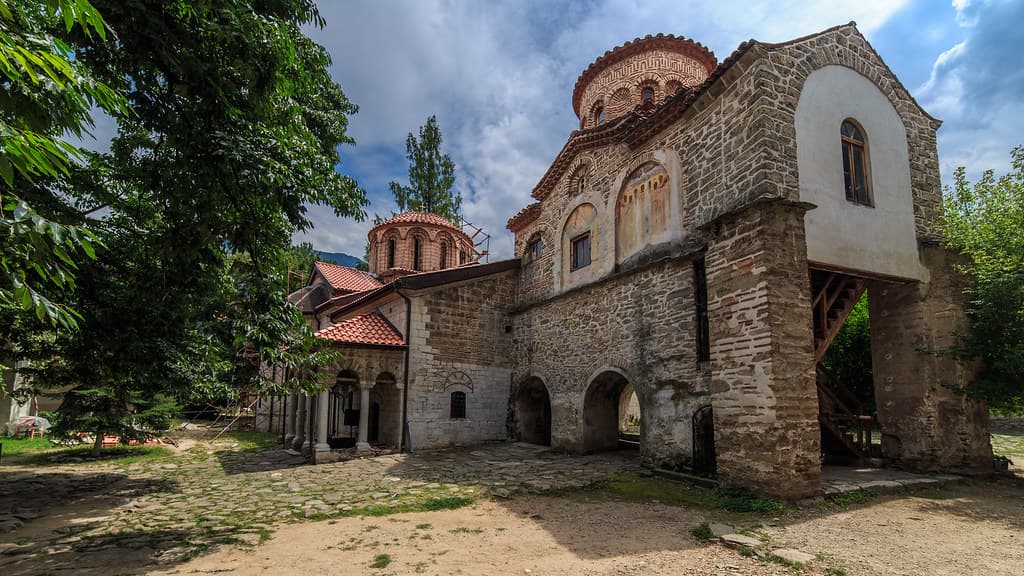
Image of Bachkovo Monastery, Plovdiv, Bulgaria. Image source
Visit essentials
A quick read before you go
- Duration
- Two to three hours to explore the monastery complex including the Cathedral Church, ossuary,…
- Etiquette
- Modest dress required for an active Orthodox monastery.
Overview
In 1083, Gregory Pakourianos, a Georgian military commander of the Byzantine Empire, founded a monastery in the Rhodope Mountains along the Chepelare River. He was not building merely for his own people. The Typikon he established, written in Georgian and Greek, envisioned a community where devotion transcended ethnic identity. That vision has outlasted empires.
The monastery's soul resides in a small painted panel. The Virgin Mary Eleusa icon, brought from Georgia in 1310, is believed by generations of pilgrims to possess healing power. Visitors find it surrounded by candlelight in the Cathedral Church, where Zahari Zograf's frescoes blaze with the colors of the Bulgarian National Revival. But the oldest surviving structure tells a different story.
The ossuary, dating to the 11th or 12th century, holds 14 burial niches and murals of saints watching over the dead. Below, bones. Above, prayer. The Orthodox understanding of resurrection compressed into architecture.
Bachkovo is Bulgaria's second-largest monastery, but numbers fail the place. What matters is the accumulation of devotion across cultures and centuries. Georgian monks gave way to Bulgarian Orthodox stewardship. Ottoman domination could not extinguish the liturgical flame. The monastery became a keeper of Bulgarian language and faith during the long centuries of subjugation. Each Easter Monday, the Eleusa icon is carried in procession from the monastery to the Kluviyata meadow, and thousands walk together through the mountain spring.
The living tradition continues because someone has always chosen to continue it.
Why this place is sacred
Stand in the courtyard and look at the jujube tree. It was brought from Georgia over two centuries ago, a living transplant from the monastery's founding culture. It still bears fruit. This small botanical fact carries the weight of the monastery's entire history: things planted here survive.
The ossuary demands a different kind of attention. Enter its low doorway and you step into the monastery's oldest surviving space, built in the Syrian-Palestinian architectural style with a semicircular apse and 14 burial niches. The murals are faded but not gone. Saints regard you from the walls. A portrait of Tsar Ivan Alexander, added in the 14th century, places political authority in the company of the dead.
This is where the monks were laid to rest, and standing among their burial places strips away the comfortable distance between the living and those who came before.
Ascend to the Cathedral Church and the atmosphere shifts entirely. Zahari Zograf's frescoes, painted in the mid-19th century, fill the walls with vivid color and theological drama. But the eye is drawn to the Eleusa icon, surrounded by candles and the quiet concentration of those who have come to pray. The icon's presence is not archival. Pilgrims approach it seeking healing, intercession, resolution. They have been doing so since 1310.
The thinness at Bachkovo arises from this vertical layering: bones below, prayer above, a foreign tree fruiting in the courtyard, and the sound of the Chepelare River threading through it all. Nine centuries of continuous worship have given the stone a quality that photographs cannot transmit.
Gregory Pakourianos founded the monastery in 1083 as a center of Georgian Orthodox spiritual life within the Byzantine Empire. His Typikon established a monastic community with Georgian and Greek as its liturgical languages, combining military piety with contemplative aspiration. The monastery was endowed with extensive properties to ensure its perpetual function.
The original Georgian character gradually gave way to Bulgarian Orthodox administration over the medieval period. Ottoman devastation in the late 14th century damaged but did not destroy the community. The Cathedral Church was rebuilt in 1604. During the Bulgarian National Revival, the monastery became a center of cultural and spiritual resistance, with Zahari Zograf's frescoes (1841 and 1850) expressing a newly confident Bulgarian artistic identity. The ossuary remains the only surviving structure from the original 11th-century foundation.
Experience and orientation
The road from Asenovgrad follows the Chepelare River into the Rhodope Mountains, the valley narrowing as the landscape rises. Ten kilometers beyond Asenovgrad, the monastery appears, its fortified walls set against the mountain slope like a settlement that chose to stay when everything else moved on.
Enter through the main gate into the courtyard. The space opens around you, residential wings rising four stories on the perimeter, the Cathedral Church occupying the center. To your left, the Georgian jujube tree, still living after more than two hundred years. Its presence is quiet but significant. Touch the bark if you feel inclined. This is the oldest living connection to the monastery's Georgian founding.
The Cathedral Church of the Dormition draws the eye. Inside, Zahari Zograf's frescoes cover every surface with scenes from the life of Christ, the Virgin, and the saints. The colors are vivid, the composition confident, the theological vision comprehensive. But the axis of the space points toward the Eleusa icon. Approach it. Pilgrims stand before this small painted panel and pray with a concentration that suggests they believe it hears them.
Whether you share that belief or not, the quality of attention in this space is palpable.
Descend to the ossuary. The shift in atmosphere is immediate. This is the monastery's oldest surviving structure, and its low ceiling, burial niches, and faded murals create a space where mortality is not abstract. The Syrian-Palestinian architectural design, unique in the Balkans, gives the room an unfamiliar geometry. Saints gaze from the walls. Tsar Ivan Alexander's portrait, added in the 14th century, places worldly power in the company of the dead.
The museum offers Friedrich Barbarossa's sword and other artifacts, but the deeper experience is in the rhythm of the place itself. If you can, attend a service. The liturgical chanting in this mountain valley, echoing off stones that have absorbed nine centuries of prayer, is the monastery's true medium.
Enter through the main gate into the central courtyard. The Cathedral Church of the Dormition is the central building. The ossuary is accessible from the courtyard. The Church of the Archangels Michael and Gabriel is the secondary church. The museum is in a separate building. The refectory contains Zahari Zograf's panoramic mural. Allow your visit to move between the cathedral above and the ossuary below to experience the vertical dimension of the space.
Context and lineage
Gregory Pakourianos held the title Grand Domestic of the Byzantine western armies. He was Georgian by birth, a soldier by profession, and a man of deep Orthodox faith. In 1083, he chose a site in the Rhodope Mountains along the Chepelare River and established a monastery with a Typikon written in both Georgian and Greek. The document reveals a mind that was both practical and devout: it governed everything from property management to the rhythm of daily prayer.
Pakourianos endowed the monastery with vast estates to ensure its survival. He could not have known that survival would be tested across nearly a millennium of political upheaval, foreign domination, and fire. Yet the community he planted took root. When the Eleusa icon arrived from Georgia in 1310, the monastery acquired its spiritual center, an object of devotion that would draw pilgrims for the next seven centuries and counting.
Bachkovo represents a convergence of Georgian, Byzantine, and Bulgarian Orthodox monastic traditions. Founded within the Georgian Orthodox tradition, the monastery gradually transitioned to Bulgarian administration while preserving architectural and spiritual elements from its Georgian origins. The monastery's survival through Ottoman domination placed it in the lineage of Bulgarian institutions that preserved national language, faith, and culture during centuries of foreign rule.
Its artistic heritage, particularly through Zahari Zograf's work, connects it to the Bulgarian National Revival movement of the 19th century.
Gregory Pakourianos
Founder
Zahari Zograf
Master painter
Tsar Ivan Alexander
Medieval patron
St. John of Rila
Spiritual predecessor
Traditions and practice
The monastic community has maintained the cycle of Orthodox worship since its founding: Divine Liturgy, the canonical Hours, Vespers, and Compline. The Eleusa icon has been the center of Marian devotion since its arrival in 1310. The Easter Monday procession, in which the icon is carried from the monastery to the Kluviyata meadow accompanied by thousands of pilgrims, is attested across centuries and remains the monastery's most important annual ritual. The ossuary served traditional memorial functions for departed monks.
Daily Divine Liturgy continues in the Cathedral Church. The Dormition of the Theotokos (August 15) is the monastery's patronal feast, celebrated with special liturgical solemnity. Easter Monday brings the great procession of the Eleusa icon through the mountain landscape. The monastic community maintains the monastery's buildings, gardens, and traditions of hospitality. The museum and ossuary are open to visitors throughout the year.
Attend a service to experience the monastery as a place of active worship rather than a museum of frescoes. Stand before the Eleusa icon and observe the quality of attention among the pilgrims who approach it. Descend to the ossuary and sit with the silence there. Visit the refectory to see Zahari Zograf's panoramic mural. If visiting at Easter, join the procession to Kluviyata. If visiting in August, the Dormition feast offers the monastery at its liturgical fullest.
Eastern Orthodox Christianity (Bulgarian)
ActiveBachkovo is one of Bulgaria's most important Orthodox monasteries, the second largest after Rila. Founded by a Georgian nobleman in 1083, it transitioned to Bulgarian Orthodox stewardship and became a center of Bulgarian spiritual and cultural life. The Eleusa icon, one of the most venerated Marian images in Bulgaria, has drawn pilgrims since 1310. The monastery preserved Bulgarian culture and faith through centuries of Ottoman domination.
Daily Divine Liturgy and the full monastic prayer cycle. Major celebrations include the Dormition of the Theotokos (August 15), Easter Monday procession of the Eleusa icon to the Kluviyata meadow, and feast days throughout the liturgical calendar. Pilgrims venerate the icon and light candles before it.
Georgian Orthodoxy (historical)
HistoricalThe monastery was founded as a Georgian Orthodox center by Gregory Pakourianos. The original Typikon was written in Georgian and Greek. Georgian liturgical traditions governed the early centuries of monastic life. The jujube tree in the courtyard, brought from Georgia over two hundred years ago, remains a living link to this founding heritage.
Georgian liturgical traditions were practiced in the monastery's early centuries. The Typikon stipulated Georgian and Greek as the languages of worship.
Perspectives and open questions
Bachkovo Monastery invites multiple readings: as a masterpiece of Bulgarian National Revival art, as a living monastic community, as a pilgrimage destination centered on the Eleusa icon, and as a site where Georgian, Byzantine, and Bulgarian traditions converge across centuries.
Scholarly perspective
Scholars recognize Bachkovo as one of the most significant medieval monastic foundations in Southeast Europe. The ossuary's Syrian-Palestinian architectural design, unique in the Balkans, and its murals are studied as important examples of medieval Balkan painting. Art historians regard Zahari Zograf's frescoes as masterpieces of the Bulgarian National Revival, blending traditional Byzantine iconography with modern sensibilities. The monastery's Typikon is an important primary source for understanding 11th-century monastic organization in the Byzantine world.
Living and traditional perspectives
For Bulgarian Orthodox believers, Bachkovo is sacred primarily because of the Eleusa icon, believed to be wonder-working and a channel of the Virgin Mary's intercession. The monastery represents spiritual resilience, having survived Ottoman occupation and served as a guardian of Bulgarian language, culture, and faith during centuries of foreign rule. The Easter Monday procession is experienced not as historical reenactment but as a living encounter with divine grace.
Alternative interpretations
Some visitors are drawn to the monastery's location in the Rhodope Mountains, a region rich in mythology associated with Orpheus and ancient Thracian spiritual traditions. The convergence of Georgian, Byzantine, and Bulgarian sacred traditions at a single site is seen by some as evidence of the location's inherent spiritual significance. The ossuary's confrontation with death resonates with seekers exploring mortality and the transcendent.
Open questions
The full history of the Eleusa icon before its arrival at Bachkovo in 1310 remains obscure. The identity and training of the artists who painted the ossuary murals are unknown. The exact circumstances of the monastery's transition from Georgian to Bulgarian administration are not fully documented. How Friedrich Barbarossa's sword came to reside in the monastery museum is a persistent curiosity.
Plan your visit
Access and arrival
The monastery offers guesthouse accommodation for pilgrims and visitors. Asenovgrad (10 km) and Plovdiv (30 km) provide a full range of lodging options. Staying overnight at the monastery allows attendance at morning services.
Respectful visit
Shoulders and knees covered. Women may need a headscarf inside churches. No shorts, tank tops, or revealing clothing.
Photography permitted in the courtyards and exterior areas. Photography inside the churches is restricted. No flash photography. The ossuary may have separate rules. Check posted signs.
Candles may be purchased and lit before icons. Monetary donations are welcome. Small offerings of food or supplies for the monastic community are appreciated.
Maintain silence and reverence inside the churches. Do not touch frescoes or icons. Respect areas marked as restricted or monastic-only. Do not use mobile phones inside churches.
The monastery is an active monastic community. Services are not performances for tourists. If you attend, participate or observe in silence. The Easter Monday procession draws large crowds. The ossuary may be dimly lit and the space confined. Check current visiting hours, as they may differ from seasonal tourist schedules.
Current practical details
Address
4251 Bachkovski manastir, Bulgaria
Phone
Hours
Hours, fees, and access can change — verify on the official source before you travel. Practical details last checked Jun 2026.
Location
Map loads as you approach this section.
Pilgrim reflections
A portrait of encounter, not a score
Pilgrims describe what they felt, how present they could become, and whether the place would shape a journey. There are no stars and no ranking of traditions.
No reviewed reflections yet
The first pilgrims can help describe the character of being here.
Share a reflection
Available after an account-backed “Been there.” Every reflection is reviewed before publication.
Nearby sacred places
Explore other sacred places in the region. Proximity does not establish access or travel time; check each place’s guidance.
Share a photo
Help visitors recognize Bachkovo Monastery, Plovdiv, Bulgaria. Every submission is reviewed before publication.