Gerdekkaya Tomb
A Hellenistic temple-tomb carved from a solitary rock in the Doğanlı Valley, where the dead were given the architecture of gods
Understand sacred places, explore living traditions, and learn how to engage respectfully with Pilgrim Map.
Access has not been verified. Check current local guidance before planning a visit.
Eskişehir, Turkey
Read the sources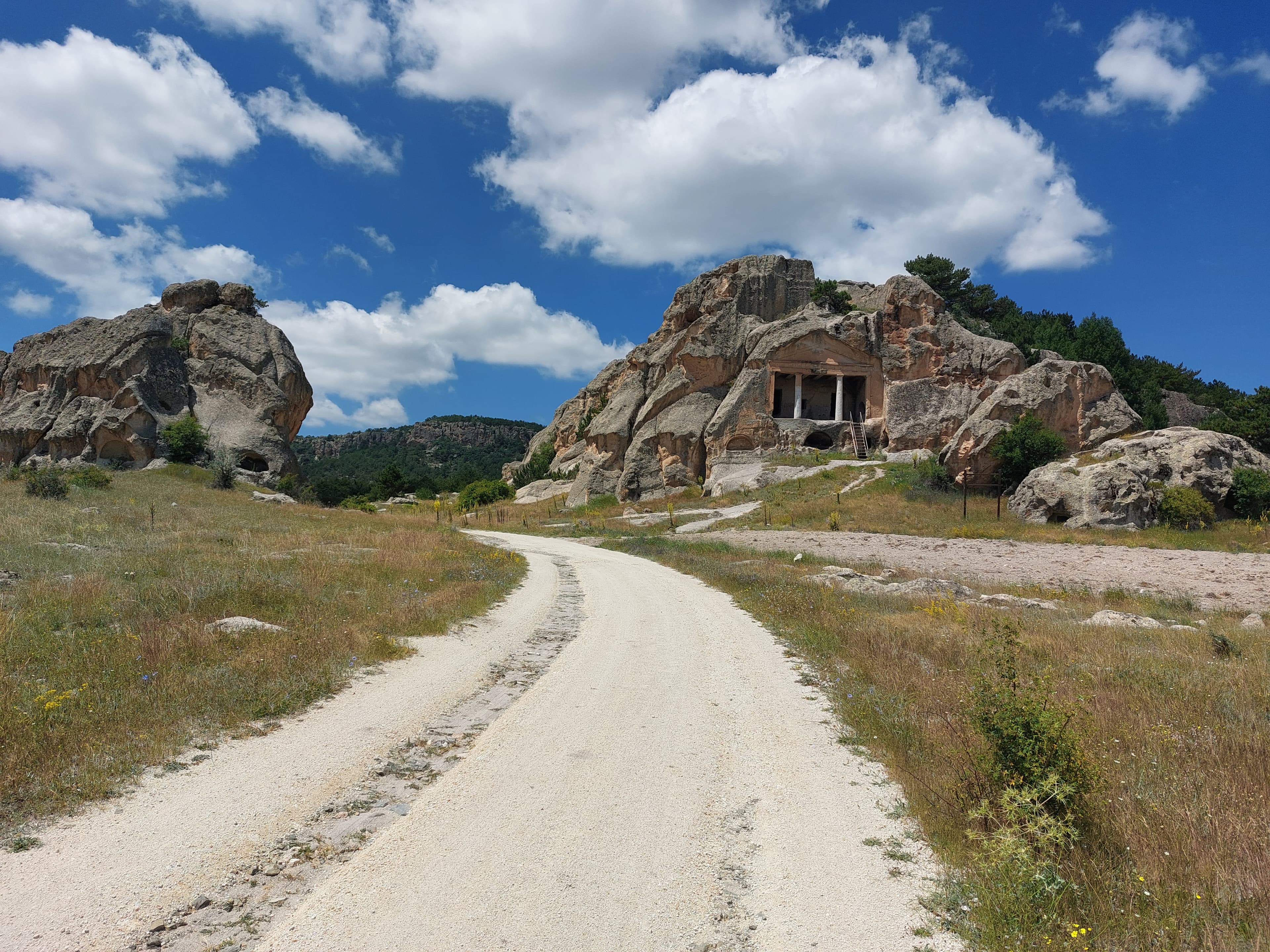
Image of Gerdekkaya Tomb. Image source
Visit essentials
A quick read before you go
- Duration
- 30–60 minutes at the tomb itself; allow additional time for the rural access drive and any…
- Access
- Located in Doğanlı Valley, 500 m southwest of Çukurca village, on the Eskişehir/Afyonkarahisar…
Overview
In the ordinary farmland of Doğanlı Valley, a solitary rock is carved as a Doric temple: triangular pediment, entablature, and two entrance pilasters. Hellenistic craftsmen of the 3rd or 2nd century BCE had absorbed Greek architecture deeply enough to cut it in miniature for the dead.
Gerdekkaya—roughly “wedding rock” in Turkish, though its ancient name is unknown—stands 500 meters southwest of Çukurca on the Phrygian Valley's northern margin, among rock-cut tombs, Kybele façades, fortresses, and niches made by Phrygian and later Hellenistic hands. Behind the façade, burial chambers contain arched loculi in the side and back walls; a carved stair gives access today and presumably served the rites.
Open, unguarded, weathered, and graffitied, its essential form survives: rock made temple where Phrygians had long held stone sacred. Documented astrophotography beneath the Milky Way sets two millennia of human marking against cosmic scale.
Why this place is sacred
The Phrygian Valley's religious logic was centered on the belief that Kybele, the mother goddess, inhabited living rock. Temples here were not built toward the sky but cut into the earth — or more precisely, into the volcanic and limestone outcrops that stood like natural altars across the landscape. This theology made every shaped rock a sacred object and gave the dead a peculiarly dignified address.
Gerdekkaya participates in this logic even as it adopts Hellenistic Greek architectural forms. The decision to carve a Doric temple façade on a natural rock mass is not simply decorative — it declares that this stone, in this valley, is the kind of stone that warrants the architecture of the divine. The burial chambers behind the pediment place the dead inside the rock-body of the goddess, however that theological premise had evolved by the Hellenistic period.
The valley's isolation — the fact that Gerdekkaya rises from an agricultural plain with no other large structures nearby — amplifies this sacred singularity. The rock announces itself. Whatever funerary cult was centered here, it required a monument that would be visible, distinctive, and architecturally legible from a distance: a landmark for the living navigating the landscape of the dead.
Funerary monument housing two burial chambers with loculi (arched burial niches). Built in the Hellenistic period, 3rd–2nd century BCE, likely for elite members of a local Phrygian or Hellenistic community.
From active funerary monument to abandoned heritage site. The tomb continued in occasional use through Roman and possibly Byzantine periods. Today it is a documented archaeological monument on Turkey's UNESCO Tentative List area of 'Mountainous Phrygia.'
Experience and orientation
Drive or walk across the Doğanlı Valley toward Çukurca village and the rock will appear before you reach it. It is not large by the standards of built monuments, but in this flat agricultural landscape a carved rock rising from the plain carries a disproportionate visual weight.
The Doric temple façade — pediment, entablature, pilasters — is legible from a distance, which was presumably the point: this was meant to be seen, to declare that the dead here had been given an architectural address worth approaching.
Climb the carved staircase to enter. The transition is abrupt — from open valley to carved interior, from wide sky to corbelled ceiling. The burial niches cut into the side and back walls of each chamber are the right size for a body. Sit in the entrance for a moment. The valley is visible through the doorway. The two chambers extend to either side. There is a quality of compression here that the photographs do not capture.
For those willing to return at night, Gerdekkaya offers a rare combination: the carved monument and, above it, one of the darkest skies in this part of Anatolia. Several astrophotographers have documented the site under the Milky Way. The juxtaposition — 3rd century BCE funerary architecture against the full night sky — is, at minimum, clarifying.
The tomb is 500 m southwest of Çukurca village, in the Eskişehir/Afyonkarahisar border area. A vehicle is strongly recommended; rural roads in this area are not well-served by public transport. Allow time for the access drive from either Eskişehir (60–80 km north) or Afyonkarahisar.
Context and lineage
The tomb was carved during the Hellenistic period, most likely between the 3rd and 2nd centuries BCE, when Phrygian cultural identity was being reshaped by Greek architectural and funerary conventions. The craftsmen who cut the Doric façade had absorbed Hellenistic Greek forms, but they deployed them in a landscape defined by the Phrygian tradition of carving the sacred into stone. The identity of the tomb's occupants is unknown.
The broader Phrygian belief that Kybele inhabited the living rock gave the entire valley a sacred character within which this funerary monument participated.
Hellenistic period (3rd–2nd century BCE) primary construction; Roman and Byzantine period reuse documented; abandoned and subject to vandalism in modern period; now under nominal protection as part of 'Mountainous Phrygia' on Turkey's UNESCO Tentative List (2022)
Traditions and practice
Ancient Hellenistic and Phrygian funerary rites were performed here — interment of the dead in the loculi, and likely offerings and mourning ceremonies at the tomb façade. The broader Phrygian landscape included Kybele veneration at rock-cut niches; Gerdekkaya, set in this landscape, participated in the wider sacred geography even if its primary function was funerary.
Heritage tourism and hiking on the Phrygian Way. Night visits for astrophotography are documented in travel accounts — the valley's dark skies make Gerdekkaya a destination for those combining archaeological interest with stargazing.
Approach from Çukurca village on foot if possible, giving the rock time to resolve from a distant shape into its architectural detail. Before entering, walk around the base of the rock and read the façade from different angles — the Doric proportions are precise and reward close attention. Climb the carved staircase deliberately; it is steep and the footing is worn.
Inside, stand in the entrance hall and look into both burial chambers in turn. The arched loculi in the side walls are approximately at shoulder height. The stone is cold even in summer. Notice how sound changes from the valley outside to the interior — ambient noise drops away quickly.
If you are there at dusk, stay for the transition. The valley's agricultural flatness means the horizon is wide and sunset is slow. The monument at this hour, in this valley, is close to its original intention — a landmark for the dead, visible from a distance, permanent in stone.
Hellenistic/Phrygian Funerary
HistoricalA rock-cut monument combining Hellenistic Doric temple architecture with the Phrygian tradition of carving the sacred into natural rock. The two burial chambers with arched loculi reflect the Hellenistic absorption of Greek funerary customs by Anatolian elite families.
Burial of the dead in carved niches; funerary offerings and rites performed at the monumental entrance.
Archaeological/Scholarly
ActiveDocumented heritage monument within the Phrygian Valley, included in Turkey's UNESCO Tentative List submission for 'Mountainous Phrygia' (2022). Studied as evidence of Hellenistic-Phrygian cultural interaction in western Anatolia.
Archaeological survey, heritage documentation, visitor interpretation through the Phrygian Way trail network.
Perspectives and open questions
Gerdekkaya Tomb is interpreted across scholarly, regional heritage, and contemplative frameworks — as a document of Hellenistic-Phrygian cultural encounter, as a monument in the broader sacred landscape, and as a site for meditation on mortality and the human relationship to stone.
Scholarly perspective
Scholars place Gerdekkaya within the broader phenomenon of Hellenistic funerary architecture in Anatolia, where Greek architectural vocabulary (Doric temple forms, pediments, entablatures) was adopted by indigenous populations for funerary purposes from the 4th century BCE onward. The site's Phrygian Valley context connects it to the longer tradition of rock-cut sacred architecture centered on Kybele worship. Gerdekkaya is included within the 'Mountainous Phrygia' area on Turkey's UNESCO Tentative List (submitted 2022), indicating national and international recognition of its heritage significance.
Living and traditional perspectives
No living indigenous community maintains direct ritual connection to Gerdekkaya. The memory of the Phrygian presence in the valley is preserved primarily through regional archaeology, heritage institutions, and the Phrygian Way trail.
Alternative interpretations
The Phrygian Valley monuments, including Gerdekkaya, are occasionally cited in alternative traditions interested in Anatolian mystery cults and cosmological alignments. The tomb's orientation and its relationship to celestial observation from the valley floor have been subjects of informal interest among those who combine archaeological and archaeoastronomical perspectives.
Open questions
The identity of the tomb's occupants is unknown. The relationship between Gerdekkaya and the nearby Doğanlı Kale fortress — whether they were functionally linked as settlement and burial site — has not been studied in detail. Whether Hellenistic-period burial at this site represents continuity of earlier Phrygian funerary practices or a cultural overlay remains debated.
Plan your visit
Access and arrival
Located in Doğanlı Valley, 500 m southwest of Çukurca village, on the Eskişehir/Afyonkarahisar provincial border. From Eskişehir city, approximately 60–80 km south via rural roads. From Afyonkarahisar, approach via the northern Phrygian Valley roads. No public transport serves this area reliably. A vehicle is essential. Mobile signal is likely limited in the valley — check route and conditions before setting out. The site is on or near the Phrygian Way hiking trail.
Contact the Eskişehir Provincial Directorate of Culture and Tourism for current access conditions.
No facilities at or near the site. Eskişehir city (60–80 km north) offers the widest range of accommodations. Afyonkarahisar is an alternative base for southern Phrygian Valley visits. Camping near the Phrygian Way is possible in some areas; check trail guidance.
Respectful visit
No specific requirements; practical clothing for rural outdoor conditions.
Permitted. Night astrophotography is documented and welcomed by those who know the site.
Not applicable.
Do not add graffiti. The monument has already sustained serious vandal damage. Do not chip or take stone fragments. Treat the burial chambers as what they are.
The monument has suffered significant graffiti damage. Do not add inscriptions. Be careful on the carved stairs, which are steep and uneven. The tomb has no formal site infrastructure — there are no facilities, no signage beyond basic heritage markers. Carry water.
Location
Map loads as you approach this section.
Pilgrim reflections
A portrait of encounter, not a score
Pilgrims describe what they felt, how present they could become, and whether the place would shape a journey. There are no stars and no ranking of traditions.
No reviewed reflections yet
The first pilgrims can help describe the character of being here.
Share a reflection
Available after an account-backed “Been there.” Every reflection is reviewed before publication.
Nearby sacred places
Explore other sacred places in the region. Proximity does not establish access or travel time; check each place’s guidance.


References
Sources consulted for this page. Source categories describe the publication, not a guarantee that every claim is verified. Traditional accounts and outside interpretations may differ.
- 01Gerdekkaya Mezarı - Vici.org — Vici.org contributorsacademicArchaeological heritage database entry with location description
- 02Silent Witnesses of History Under the Silver Lights of the Milky Way: Gerdekkaya and Yazılıkaya — Anatolian ArchaeologyacademicAcademic overview connecting Gerdekkaya with Yazılıkaya in the Phrygian Valley
- 03Gerdekkaya Monumental Tomb - Cultural Inventory — Kültür Envanteri (Turkish Cultural Inventory)officialOfficial Turkish cultural heritage inventory entry
- 04Gerdekkaya Mezar Anıtı - Salt Research Archives — SALT ResearchacademicArchival research documentation
- 05Mountainous Phrygia - UNESCO World Heritage Tentative List — UNESCO World Heritage CentreofficialUNESCO tentative listing that includes Phrygian Valley monuments
- 06Temple tomb Gerdekkaya — tuerkei-antik.deacademicDetailed description of tomb structure and burial chambers
- 07Phrygian Valley (Western Anatolia, Turkey) — Nomadic NikoguideTraveler account with site descriptions
- 08Gerdekkaya Monument (2026) - TripAdvisor — TripAdvisor contributorsguideVisitor reviews and access information
Share a photo
Help visitors recognize Gerdekkaya Tomb. Every submission is reviewed before publication.