Fanjingshan mountain and temple, Tongren
Twin temples crown a cloud-piercing peak where pilgrims ascend 8,888 steps toward the future Buddha
Understand sacred places, explore living traditions, and learn how to engage respectfully with Pilgrim Map.
Access has not been verified. Check current local guidance before planning a visit.
Tongren, Guizhou, China
Read the sources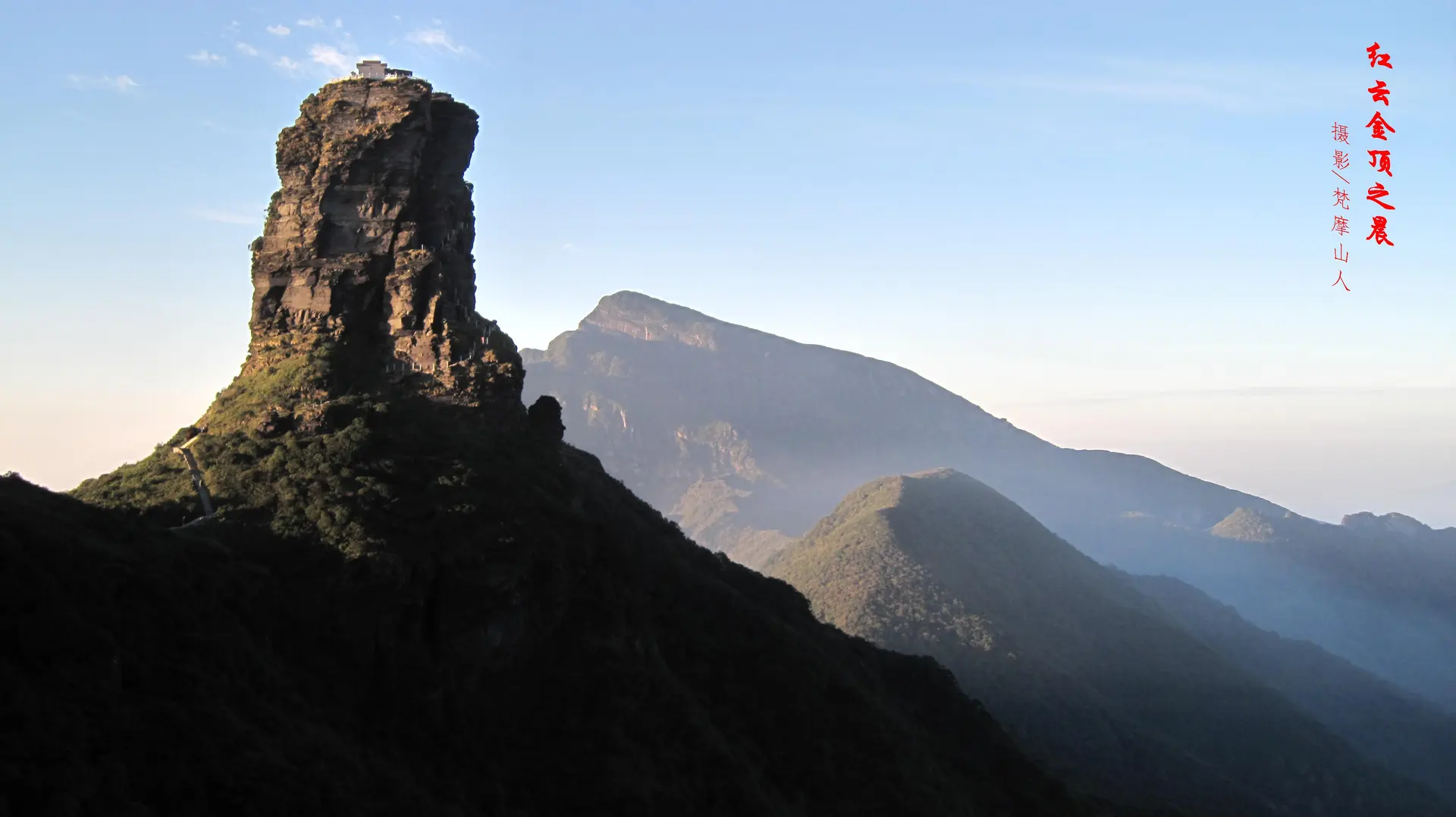
Image of Fanjingshan mountain and temple, Tongren. Image source · CC-BY-SA-3.0
Visit essentials
A quick read before you go
- Duration
- A full day is required for a complete summit visit, including 5-6 hours for the summit area…
- Access
- Two entrances serve the mountain: East Gate and West Gate.
Overview
The numbers tell something essential: 8,888 steps from base to summit. 2,570 meters of elevation rising above the Wuling Mountains. 1,400 years of continuous Buddhist presence. 84 temples still open to pilgrims. And at the pinnacle, two halls separated by a stone bridge across a gorge called Gold Sword Gorge.
Fanjingshan is the bodhimanda of Maitreya Buddha, the place designated across centuries of Chinese Buddhist understanding as where the future Buddha achieved or will achieve enlightenment. This is not metaphor. In the tradition that venerates this mountain, Maitreya is the Buddha of the age to come, the teacher who will descend when Shakyamuni's dharma has been forgotten, renewing the path for beings lost in confusion.
That this place should be his earthly seat gives every step of the pilgrimage eschatological weight.
The twin temples crystallize this understanding. On the southern peak stands the Temple of the Buddha, dedicated to Shakyamuni, the historical Buddha of our present age. On the northern peak, mere meters away yet separated by a vertiginous gap, stands the Maitreya Temple. Pilgrims cross between them on a narrow bridge.
This is not architectural whimsy but spiritual geography: to walk from one temple to the other is to enact the passage of Buddhist time, from the teachings that illuminate the present world to the promise of teachings yet to come.
The mountain's name confirms its purpose: Fanjingshan, an abbreviation of Fantian Jingtu, meaning 'Brahma's Pure Land.' This is a place where the sacred geography of Buddhist cosmology touches the physical world. Rising above the clouds, the summit temples appear to float in a celestial realm. Pilgrims who complete the arduous ascent arrive not at a mountaintop but at a threshold between worlds.
Why this place is sacred
What makes a place thin is the sense that boundaries dissolve there, that ordinary separation between worlds becomes permeable. At Fanjingshan, this thinning operates on several levels simultaneously.
First, the physical threshold. The ascent of 8,888 steps through primordial forest is not scenery but transformation. Each step accumulates. The body tires; the mind quiets. The ordinary concerns that dominated consciousness at the base of the mountain gradually lose their grip. By the time pilgrims reach the chain-assisted climbing sections near the summit, they have been walking for hours through one of Asia's most biodiverse forests, leaving the human world behind with each step.
Then comes the breakthrough. On favorable days, pilgrims ascend through the cloud layer and emerge into brilliant light. Below lies a sea of white, obscuring all trace of the ordinary world. Above, the sky opens. The twin temples appear as if suspended in heaven. This is not metaphor but sensory experience, the rare visceral sensation of having left one realm and entered another.
The temples themselves encode cosmic meaning. To stand in the Temple of the Buddha is to stand in the present age, receiving the teachings of Shakyamuni. To cross the bridge and enter the Maitreya Temple is to anticipate the future, to orient toward the age when the dharma will be renewed. The narrow bridge becomes a passage between epochs. Pilgrims who cross it are not merely visiting a monument but participating in Buddhism's understanding of sacred time.
Natural phenomena reinforce the mountain's numinous quality. The Buddha halo, a Brocken spectre effect creating a rainbow ring around the pilgrim's shadow, appears at the summit on certain atmospheric conditions. Spectacular sunrises paint the sea of clouds in transforming colors. The dramatic rock formations of the Red Cloud Golden Summit, rising nearly 100 meters above the surrounding peaks, suggest the architecture of realms beyond the human.
Fanjingshan has maintained its sacred function for over 1,400 years. Tang Dynasty practitioners opened the roads that made pilgrimage possible. Ming emperors patronized the reconstruction after war. Even the devastation of the Cultural Revolution could not sever the connection; since the 1980s, temples have been rebuilt and monastic life has resumed. The accumulated intention of countless pilgrims has saturated this ground. Whatever thin places are, sustained human devotion seems to strengthen them.
The mountain was identified as the bodhimanda of Maitreya Buddha, the place of the future Buddha's enlightenment. A 1618 stele commissioned by the Wanli Emperor designates Fanjingshan as 'Boundless Dharma Realm, Paradise Palace of Ultimate Bliss.' The purpose was and remains to provide a place where pilgrims can orient themselves toward the coming age when Maitreya will descend to renew the dharma.
The physical challenges of the pilgrimage are not incidental to this purpose but integral. The 8,888 steps purify through effort. The chain-climbing sections require courage and presence. By the time pilgrims reach the summit, they have proven something to themselves and demonstrated devotion through their bodies. This is Buddhism embodied, not merely believed.
Buddhism likely reached Fanjingshan during the Tang Dynasty (618-907 CE), with Hou Hongren's construction of the Zangke Road in 639 CE opening the mountain to religious development. The Song Dynasty saw the first major temple construction. But it was the Ming Dynasty (1368-1644 CE) that elevated Fanjingshan to extraordinary significance. Forty-eight temples were built. The cult of Tianguan Maitreya, a distinctively Chinese form of the future Buddha veneration, became dominant. Imperial patronage followed, establishing four Royal Temples.
The Bozhou Rebellion of the late 16th century devastated these structures, but Emperor Wanli ordered comprehensive reconstruction. The stele he commissioned in 1618 remains the definitive statement of the mountain's sacred identity.
The Qing Dynasty continued the tradition, but the 20th century brought catastrophe. The Cultural Revolution destroyed many temples. Yet what was rebuilt in the 1980s and afterward reflects not mere restoration but renewed commitment. The Fanjingshan Buddhist Cultural Park, opened in 2010, houses the world's largest gold Maitreya statue, 5 meters tall and cast with 250 kilograms of gold. The tradition has proven resilient. What pilgrims encounter today is living practice, not archaeological memory.
Experience and orientation
The experience begins with the challenge. Whether one takes the cable car or walks, Fanjingshan demands something. Those who climb the full 8,888 steps spend four to five hours ascending through primordial forest. The trees predate memory. Mist filters through canopy. The modern world fades with each switchback. By the time the chain-assisted sections begin, the climber has been transformed by hours of focused exertion.
Visitors consistently report that the forest itself produces effect. Not just the beauty, though Fanjingshan hosts extraordinary biodiversity including endemic species found nowhere else. Something about the quality of attention the climb requires. The steps demand presence. Distraction leads to stumbling. Hours of this presence-demanding movement alter consciousness before the destination is reached.
The breakthrough above the clouds, when it comes, is visceral. Below, the ordinary world vanishes into white. Above, blue sky and rock formations that seem to belong to a different planet. The Red Cloud Golden Summit rises from the surrounding peaks like a citadel in the sky. The twin temples, connected by their narrow bridge, appear impossible. How did builders carry stone and iron to this height? The answer is devotion powerful enough to move mountains.
Crossing the bridge between temples produces particular response. The drop into Gold Sword Gorge is severe. The crossing is narrow. Fear and exhilaration mingle. And then the recognition of what the bridge represents: the passage between Buddhist ages, from the present Buddha's teaching to the future Buddha's promise. The physical crossing enacts the spiritual meaning.
The natural phenomena add layers of intensity. Sunrise over the sea of clouds draws pilgrims to begin their ascent in darkness to arrive at the summit for dawn. The Buddha halo, when atmospheric conditions align, creates the uncanny experience of seeing one's shadow ringed with rainbow. Even without these phenomena, the summit's geology, its impossible forms rising against sky, suggests realms beyond ordinary creation.
Visitors often report that descending is different from ascending. Something has shifted. The physical challenge is different, knees rather than lungs, but more than that: the return to the ordinary world carries what was received above. The pilgrimage is not complete until the pilgrim brings the summit experience back to the life waiting below.
Approach Fanjingshan as pilgrimage rather than tourism. This is not a site to see but a journey to undertake. If physical condition permits, consider walking at least part of the ascent even if you take the cable car for part of the journey. The effort matters. What you bring to the summit depends on what you invested in reaching it.
Arrive early, ideally beginning your ascent before dawn if you seek the sunrise experience. The mountain opens early precisely to enable this. The first light over the sea of clouds, from the pinnacle of the Red Cloud Golden Summit, is among Asia's most spectacular sacred experiences.
The twin summit temples are small, intimate spaces. Do not expect grand halls. Their power lies in their location, their connection to the bridge between them, their representation of Buddhist time. Spend time in each. If you understand yourself to be in the present age of Shakyamuni's teaching, spend time in his temple. If you orient toward Maitreya's coming, spend time in his.
If visiting multiple temples across the mountain, Cheng'en Temple near the upper cable car station offers free porridge around 11:30 AM. This is not tourist hospitality but temple dana, the ancient practice of providing food to support pilgrims. Receiving it in the spirit in which it is offered completes a circle of generosity.
Leave time after the summit to sit with what you experienced. The descent can happen quickly, especially by cable car. But integration requires pause. Find a place to sit quietly before returning to ordinary motion. What rose through you on the mountain needs time to settle.
Context and lineage
Buddhism reached Fanjingshan no later than the Tang Dynasty. In 639 CE, Hou Hongren constructed the Zangke Road, opening the mountain region to broader access and enabling Buddhist expansion into this remote corner of Guizhou. By the Song Dynasty, temples dotted the mountain's slopes, with Xiyan Temple at the western foot marking Buddhism's formal establishment.
The Ming Dynasty transformed Fanjingshan from a regional sacred site into a mountain of national significance. Forty-eight temples were constructed during this period. The cult of Tianguan Maitreya, a distinctively Chinese veneration of the future Buddha featuring a crowned form, became dominant here. Imperial recognition followed.
When the Bozhou Rebellion devastated the temples in the late 16th century, Emperor Wanli, the 14th emperor of the Ming Dynasty, personally ordered reconstruction. He commissioned the monk Miaoxuan to rebuild the Golden Peak and Cheng'en Temple. The stele erected in 1618, 'Preface to the Reconstruction of Fanjing Mountain Jinding,' stands as the mountain's founding document in its current form, declaring it 'Boundless Dharma Realm, Paradise Palace of Ultimate Bliss.'
The Qing Dynasty continued this patronage, establishing four Royal Temples: Tianqing, Huguo, Cheng'en, and Chaotian. Buddhism flourished. But the 20th century brought rupture. The Cultural Revolution destroyed many temples and disrupted monastic life. Yet the mountain's sacredness survived. Since the 1980s, major reconstruction has restored temples including Cheng'en, Huguo Chan, Great Golden Buddha, and Longquan. The opening of Fanjingshan Buddhist Cultural Park in 2010, with its world's-largest gold Maitreya statue, signals the tradition's ongoing vitality.
Fanjingshan hosts temples from multiple Buddhist lineages, with Pure Land and Linji Chan (Zen) traditions historically most prominent. Most temples during the Ming and Qing dynasties belonged to these two schools. The Huguo Chan Temple near the West Gate maintains the Linji lineage, emphasizing meditation and direct insight. Other temples maintain Pure Land practice with its focus on devotion to Amitabha Buddha and rebirth in the Western Paradise.
The mountain's distinctive tradition is the veneration of Tianguan Maitreya, the Crowned Maitreya form that became dominant during the Ming Dynasty. This represents a specifically Chinese development of Maitreya devotion, one that understood the mountain as the future Buddha's actual bodhimanda rather than merely a symbol of his coming.
Maitreya Buddha
central deity
The Buddha of the future, who will appear on Earth when the teachings of Shakyamuni Buddha have been forgotten, to renew the dharma and guide beings to enlightenment. Fanjingshan is identified as his bodhimanda, the place of his enlightenment. The Tianguan (Crowned) Maitreya form venerated here is distinctively Chinese.
Shakyamuni Buddha
central deity
The historical Buddha of the present age. The Temple of the Buddha at the summit's southern peak is dedicated to him, representing the current era of Buddhist teaching that Maitreya will eventually renew.
Emperor Wanli
historical
The 14th Emperor of the Ming Dynasty who ordered the reconstruction of Fanjingshan's temples after the Bozhou Rebellion. His 1618 stele formally designates the mountain as 'Boundless Dharma Realm, Paradise Palace of Ultimate Bliss.'
Monk Miaoxuan
historical
The Buddhist monk commissioned by Emperor Wanli to lead the reconstruction of the Golden Peak and Cheng'en Temple following the destruction of the Bozhou Rebellion.
Hou Hongren
historical
Tang Dynasty official who constructed the Zangke Road in 639 CE, opening the mountain region to access and enabling Buddhism's expansion to Fanjingshan.
Traditions and practice
The pilgrimage ascent of 8,888 steps is itself the primary traditional practice. This is not mere transportation but walking meditation, each step an offering. The chain-assisted climbing sections near the summit require presence and courage. Arrival at the twin temples after hours of ascent transforms the encounter with the sacred spaces.
At the summit, traditional practices include worship at both temples, offerings of incense and prostrations, and the conscious crossing of the bridge between the Temple of the Buddha and Maitreya Temple. This crossing enacts the Buddhist understanding of temporal transition. Meditation at the Xiantai (Immortal Platform) offers opportunity for seated practice in extraordinary setting.
Circumambulation of sacred sites, making offerings at temple altars, and receiving blessings from resident monks constitute the devotional core of practice. Merit-making through donations supports the continued function of the temples.
The annual Buddhist event on the eighth day of the fourth lunar month draws thousands of believers to Fanjingshan. This celebration marks the historical Buddha's birthday in the Chinese Buddhist calendar and attracts pilgrims who make the full ascent as an act of devotion.
Cheng'en Temple near the upper cable car station maintains the tradition of offering free porridge to pilgrims around 11:30 AM. This dana practice connects contemporary visitors to centuries of monastic hospitality. The temple's scarlet walls and black tiles mark it as the spiritual heart of the mountain.
The Buddhist Cultural Park at the mountain's base, opened in 2010, offers contemporary devotional focus. The Golden Hall houses a 5-meter Maitreya statue cast with 250 kilograms of gold and adorned with thousands of gems, the largest gold Maitreya statue in the world. This modern construction expresses continuing investment in the mountain's religious function.
Begin your visit with intention. Whether ascending by foot or cable car, recognize that you are undertaking pilgrimage to a place identified as the throne of the future Buddha. Let this understanding inform your approach.
At temple altars, the traditional offering is incense. When lighting incense, wave your hand over the flame to extinguish it rather than blowing. Place incense in the designated holders with reverence. Prostrations, bowing three times with forehead touching ground, express complete devotion; gentler bows are also appropriate.
When crossing the bridge between the twin summit temples, pause to recognize what you are enacting. You are crossing from the age of Shakyamuni's teaching to the age of Maitreya's promise. Let this be conscious passage rather than casual walking.
If you encounter monks at any temple, a respectful bow with palms together at heart level is appropriate. Should you wish to receive a blessing, approach with humility and follow the monk's guidance.
The physical challenge of the ascent can itself be practice. Each step taken with awareness is meditation in motion. When you tire, rather than resenting the difficulty, recognize that the effort is purifying. What you bring to the summit depends on what you invest in the climbing.
Mahayana Buddhism (Maitreya Veneration)
ActiveFanjingshan holds unique status as the bodhimanda of Maitreya Buddha, the future Buddha who will appear when Shakyamuni's teachings have been forgotten. This makes the mountain not a commemoration of the past but an orientation toward the future. The Fifth Sacred Buddhist Mountain of China, Fanjingshan is the only one dedicated to a Buddha yet to come rather than a historical bodhisattva.
Pilgrimage ascent of 8,888 steps as spiritual practice. Worship at both Shakyamuni and Maitreya temples. Crossing the bridge between the twin summit temples as enactment of Buddhist temporal transition. Annual Buddhist celebration on the eighth day of the fourth lunar month. Offerings, prostrations, and receiving blessings from monks. Devotion to the Tianguan (Crowned) Maitreya form distinctive to Chinese Buddhism.
Pure Land Buddhism
ActiveThe mountain's name, Fanjingshan, abbreviates Fantian Jingtu, meaning 'Brahma's Pure Land.' This connects the site to Pure Land Buddhism's focus on sacred geography and the aspiration for rebirth in Amitabha Buddha's Western Paradise. The mountain is understood as a Pure Land manifest on earth, a place where the boundary between ordinary reality and Buddha realms becomes permeable.
Nianfo (Buddha-name recitation), devotional practices aimed at Pure Land rebirth, temple ceremonies and chanting. Most temples during the Ming and Qing dynasties belonged to the Pure Land school.
Chan (Zen) Buddhism - Linji School
ActiveThe Linji school of Chan Buddhism has maintained presence at Fanjingshan since the Ming Dynasty. Huguo Chan Temple near the West Gate represents this tradition, offering complement to the devotional Pure Land practices elsewhere on the mountain.
Seated meditation (zuochan), gong'an (koan) practice, mindful walking on pilgrimage paths, meditation retreats at Chan temples. The ascent of 8,888 steps can be undertaken as walking meditation in Chan style.
Perspectives and open questions
Fanjingshan occupies a unique position in Chinese Buddhist geography: a mountain designated as the throne of a Buddha who has not yet appeared. This temporal orientation, pointing toward the future rather than commemorating the past, distinguishes it from other sacred mountains. Understanding how different perspectives approach this site illuminates both the mountain and the traditions that venerate it.
Scholarly perspective
Academic scholarship recognizes Fanjingshan as an important site in the development of Chinese Maitreya devotion, particularly the Tianguan Maitreya form that became dominant during the Ming Dynasty. The mountain's elevation to the status of Fifth Sacred Buddhist Mountain represents a significant development in Chinese Buddhist sacred geography.
The 2018 UNESCO World Heritage inscription focused on natural values, specifically the extraordinary biodiversity of an isolated metamorphic rock island that hosts endemic species including the Guizhou golden monkey and Fanjingshan fir. The IUCN conservation outlook rates the site's status as 'good with some concerns,' noting effective management and recovering wildlife populations. Scholars note the interesting dual significance: a site sacred to Buddhist pilgrims for religious reasons that also holds global importance for ecological conservation.
Historians trace the pattern of destruction and reconstruction that marks Fanjingshan's history, from the Bozhou Rebellion through the Cultural Revolution. The resilience of the site, rebuilt repeatedly through imperial and popular devotion, suggests something about the depth of connection Chinese Buddhists maintain with this mountain.
Living and traditional perspectives
For Buddhist devotees, Fanjingshan is not a symbol but a reality: the actual bodhimanda of Maitreya Buddha. The 1618 imperial stele designating it 'Boundless Dharma Realm, Paradise Palace of Ultimate Bliss' expresses this understanding in its most authoritative form.
The pilgrimage ascent is understood as spiritual practice, not merely transportation. Each of the 8,888 steps purifies the pilgrim through effort and attention. The crossing between the twin summit temples enacts the fundamental Buddhist understanding of time: we live in the era of Shakyamuni's teaching, but Maitreya's era is coming. To walk from one temple to the other is to participate in this cosmic transition.
Pure Land practitioners understand the mountain's name, 'Brahma's Pure Land,' as indicating a place where the geography of Buddhist cosmology touches the physical world. The summit temples, rising above the sea of clouds, are not merely high but genuinely closer to the celestial realms. The natural phenomena, the Buddha halo and the sea of clouds, are signs of the mountain's sacred power rather than merely atmospheric effects.
Alternative interpretations
The natural phenomena of Fanjingshan draw interpretations beyond traditional Buddhist understanding. The Buddha halo, a Brocken spectre effect that creates a rainbow ring around the pilgrim's shadow, is viewed by some as evidence of supernatural presence rather than atmospheric optics. The sea of clouds and the dramatic geology inspire associations with hidden realms and earth energies.
Some visitors report the mountain possessing unusual energy or spiritual atmosphere that exceeds what traditional Buddhist vocabulary can capture. Whether this represents the accumulation of fourteen centuries of pilgrimage intention, something inherent in the mountain's geology and ecology, or projection of expectation onto dramatic landscape remains uncertain.
Open questions
Significant questions remain unanswered about Fanjingshan. What were the pre-Buddhist indigenous spiritual traditions at this mountain? The Miao and other local ethnic minorities of Guizhou have their own sacred traditions, but specific connections to Fanjingshan are poorly documented.
Why was this specific mountain identified as Maitreya's bodhimanda? The geological drama of the summit provides aesthetic justification, but the theological reasoning remains unclear. What rituals were performed at the summit temples during the Ming-Qing height of practice, and how did the distinctive Tianguan Maitreya cult develop specifically at this site?
The number 8,888 for the steps carries obvious numerological significance in Chinese culture, but is this count traditional or a modern marketing calculation? The relationship between the mountain's Buddhist identity and its natural heritage, and how these can be integrated rather than merely parallel, awaits fuller development.
Plan your visit
Access and arrival
Two entrances serve the mountain: East Gate and West Gate. Approximately 90% of visitors use the East Gate, which offers cable car access. The cable car ride takes 20 minutes and saves 4-5 hours of climbing. Sightseeing buses are required even for visitors with free entry tickets. The West Gate provides the hiking approach via Huguo Temple.
Peak season (March-November) combo tickets cost approximately 280 RMB. Cable car is additional. Advance reservation via QR code is required for Red Cloud Golden Summit access during peak times. Rest stops with snacks are available along hiking trails.
No accommodation exists at the summit; camping is prohibited. Lodging is available in towns at the mountain's base. The town of Jiangkou near the East Gate offers various options. For those seeking early morning access, staying nearby the previous night is essential. The physical separation between lodging and summit is part of the pilgrimage structure, the mountain offering no permanent dwelling.
Respectful visit
Dress modestly, covering shoulders and knees. This is both religious requirement and practical necessity. The summit can be 10 or more degrees Celsius cooler than the base, and weather changes rapidly at elevation. Comfortable hiking shoes are essential for the 8,888 steps. Layers allow adaptation to changing conditions. A windproof jacket or coat is advised even in warm seasons. Bring rain protection in summer months.
Personal photography is permitted in most exterior areas. Ask permission before photographing monks or devotees at prayer. Some temple halls prohibit photography, check for signs. Tripods may be restricted in crowded areas. Drones are not permitted. Commercial photography requires advance approval.
Incense, flowers, and candles may be offered at temple altars. These items are typically available for purchase near temple entrances. When lighting incense, wave your hand to extinguish the flame rather than blowing. Place incense in designated holders. Monetary offerings are accepted at temples; place donations in the appropriate boxes with a slight bow.
No camping or overnight accommodation at the summit. No accommodation is available on the mountain itself, lodging is at the base. No carrying fire sources or flammable materials. Advance reservation via QR code is required for Red Cloud Golden Summit access during peak seasons. The chain-assisted climbing sections are not recommended for children under 8 or elderly visitors with limited mobility. Physical fitness is required for summit access without cable car.
Do not approach the temples as mere tourist destinations. These are active places of worship where devotees come with sincere religious purpose. Your presence is welcomed as long as you maintain appropriate respect.
The chain-assisted climbing sections require genuine physical capability. Do not attempt these sections if you have mobility limitations, fear of heights, or insufficient physical fitness. The cable car provides alternative access to the summit area.
Photography is generally permitted in exterior areas but may be restricted inside temple halls. Check for signs and observe what others are doing. Never photograph monks or devotees at prayer without explicit permission.
Current practical details
Address
Fanjing Shan, Yinjiang Tujia and Miao Autonomous County, Tongren, China, 554409
Hours, fees, and access can change — verify on the official source before you travel. Practical details last checked Jun 2026.
Location
Map loads as you approach this section.
Pilgrim reflections
A portrait of encounter, not a score
Pilgrims describe what they felt, how present they could become, and whether the place would shape a journey. There are no stars and no ranking of traditions.
No reviewed reflections yet
The first pilgrims can help describe the character of being here.
Share a reflection
Available after an account-backed “Been there.” Every reflection is reviewed before publication.
Nearby sacred places
Explore other sacred places in the region. Proximity does not establish access or travel time; check each place’s guidance.




References
Sources consulted for this page. Source categories describe the publication, not a guarantee that every claim is verified. Traditional accounts and outside interpretations may differ.
- 01Fanjingshan — UNESCO World Heritage CentreofficialOfficial UNESCO documentation on natural heritage status
- 02Buddhism - Fanjingshan 5A Scenic Area — Fanjingshan Official TourismofficialOfficial scenic area website with Buddhist history
- 03Fanjingshan World Heritage Outlook — IUCNofficialConservation assessment
- 04Fanjingshan — Wikipedia contributorsencyclopediaComprehensive overview with historical timeline and UNESCO details
- 05The Two Fanjingshan Temples — Heritage DailySource contextDetailed article on the twin summit temples
- 06Fanjingshan Temple, Visit Fanjing Mountain Temple in China — China DiscoveryguideComprehensive travel guide with temple information
- 07Fanjingshan (Mount Fanjing) in Tongren — Atlas ObscuraguideCultural travel perspective
- 08Mount Fanjing: How to Enjoy a Hassle-Free and Fulfilling Visit — China HighlightsguidePractical visitor information
- 09Fanjing Shan — Tsem RinpochespiritualBuddhist teacher's perspective on the sacred mountain
- 10A pilgrimage to Fanjingshan temple — the ultimate buddhist enlightenment — Stefano MauriSource contextFirst-person pilgrimage account
Photo gallery
3 curated photos
Pilgrim glossary
- Dharma
- The teachings of the Buddha; also the universal law underlying them.
- Pure Land
- A Buddhist tradition focused on rebirth in Amida Buddha's western paradise through devotional practice.
- Zen
- A Japanese Buddhist school emphasizing seated meditation and direct insight.
Share a photo
Help visitors recognize Fanjingshan mountain and temple, Tongren. Every submission is reviewed before publication.