Mt. Fanjing, Guizhou, China
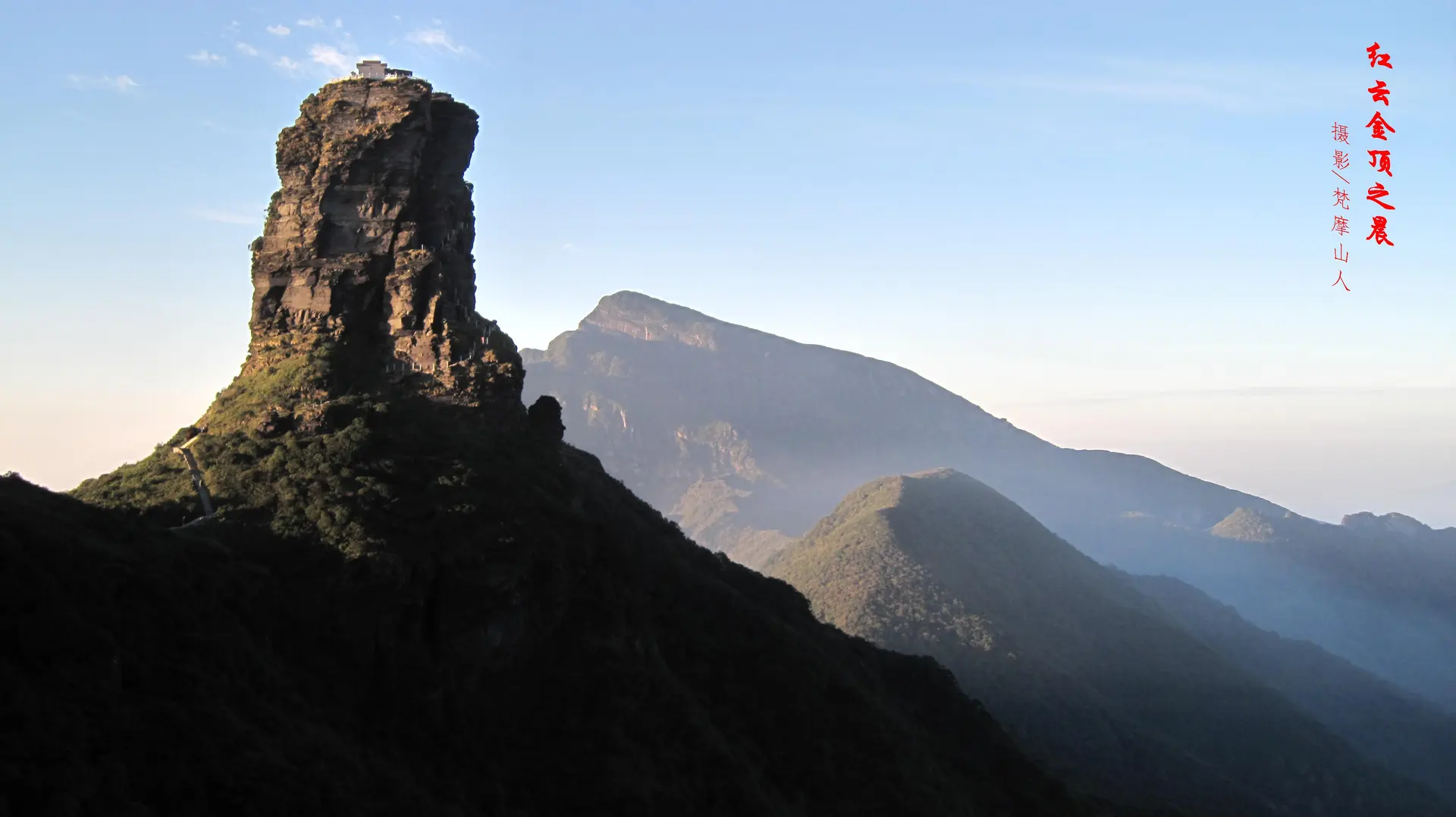
Where twin temples for the present and future Buddha sit atop a mushroom of stone above the clouds
Understand sacred places, explore living traditions, and learn how to engage respectfully with Pilgrim Map.
Access has not been verified. Check current local guidance before planning a visit.
Yinjiang Tujia and Miao Autonomous County, Guizhou, China

Visit essentials
A quick read before you go
- Duration
- Full day.
- Access
- Located near Tongren city in northeastern Guizhou Province.
Overview
The mountain's name tells you what it aspires to be. Fanjingshan derives from Brahma's Pure Land, the declaration that an earthly place can be a manifestation of a heavenly realm. Whether it succeeds depends on what you bring to the 8,888 stone steps between the entrance and the summit.
The geological centerpiece is the Red Clouds Golden Summit, a formation that looks designed rather than eroded. A mushroom-shaped rock pillar rises 100 meters from the mountain's ridge, split nearly in two by a narrow crevice. On one pinnacle sits the Maitreya Temple. On the other, directly across the gap, the Shakyamuni Temple. Between them arches the Bridge of Heaven, a small span over an abyss that connects the present Buddha to the future one.
This architectural arrangement carries the mountain's theological weight. Shakyamuni's teaching is the Dharma of this age. Maitreya is the Buddha of the next, prophesied to appear when the current teaching has been forgotten, to restore it and lead all beings to enlightenment. The two temples facing each other across a bridge above the clouds make the transition between Buddhist ages a physical space that pilgrims cross.
Below the summit, the mountain's primeval forest shelters one of the most biodiverse ecosystems in China, including the Guizhou golden monkey, an endemic primate found nowhere else on earth. The 2018 UNESCO inscription recognized this natural heritage. The Buddhist heritage, while acknowledged, was not the basis for inscription, though the two dimensions of the mountain, biological and devotional, are intertwined: centuries of reverence protected the forest that protects the monkeys.
Why this place is sacred
The thinness at Fanjingshan is cumulative. It builds step by step, literally, across the 8,888 stone stairs that constitute the pilgrimage path. Each step is a small act of effort that the mountain converts into a small act of transformation. By the thousands, these acts accumulate.
The forest through which the lower path passes is itself a threshold. Ancient trees drip with moisture. The air is dense with the scent of growth and decay. Light filters through the canopy in columns that shift with the wind. This is not a manicured park forest but something older and less tamed, a place where the Guizhou golden monkey lives because humans have not yet made it impossible.
The cloud line marks the second threshold. Fanjingshan frequently wears its Sea of Clouds, and pilgrims climbing through it experience a gradual loss of the world below. The landscape simplifies to what is immediately in front of you: the next step, the next handrail, the next breath. When you emerge above the clouds into clear sunlight, the effect is visceral. The world you came from has disappeared beneath a white floor.
The summit rises above you, a rock mushroom against blue sky.
The final climb is the most intense. The stone steps carved into the near-vertical face of the Red Clouds Golden Summit require hands as well as feet. The exposure is real. The small Bridge of Heaven, connecting the two summit pinnacles, spans open air with sheer drops on both sides.
Crossing it is a threshold experience in the most literal sense: you pass from the temple of the present Buddha to the temple of the Future Buddha, suspended between two ages of the Dharma over the void.
Buddhist activity on Fanjingshan dates to at least the Tang Dynasty, with the mountain's specific association with Maitreya firmly established during the Ming Dynasty. The name Fanjingshan, derived from Brahma's Pure Land, declares the mountain to be an earthly manifestation of a celestial realm. During the Ming Dynasty, imperial patronage supported the construction of over 48 temples.
The mountain's temple infrastructure reached its peak during the Ming Dynasty, when over 48 temples and monasteries received imperial patronage. Successive waves of destruction during Qing Dynasty conflicts and the Cultural Revolution damaged or destroyed most of these structures. Restoration began in the 1980s and continues. The 2018 UNESCO World Heritage inscription, based on the mountain's extraordinary biodiversity, brought international recognition and increased tourism.
The Buddhist pilgrimage tradition, while disrupted by the 20th century's upheavals, has been restored and continues alongside the growing environmental tourism.
Experience and orientation
The ascent begins at the base, where the Fanjingshan Buddhist Cultural Park provides an introductory encounter with the Maitreya tradition through a large gilded statue and temple complex. Then the forest swallows the path.
The 8,888 stone steps are not a gentle gradient. The climb takes four to six hours depending on fitness, and the steps are sustained and often steep. The forest compensation is constant: ancient trees, fern-covered understory, and an air quality that improves with each hundred meters of elevation. The golden monkey, if you are fortunate enough to see one, is a flash of orange against green.
The transition from forest to exposed rock signals the approach to the upper mountain. The Sea of Clouds, when present, transforms the experience from a hike into something more disorienting. The world below vanishes. The mountain's upper formations appear as islands in a white ocean. The Red Clouds Golden Summit, visible now, rises from the ridge like something imagined rather than geological.
The final approach to the summit involves a section of near-vertical stone steps carved into the rock face. Iron chains and handrails provide security, but the exposure is genuine. Vertigo is a common response. The steps are narrow, and other climbers share the space. This is not a place for rushing.
On the summit, the two temples face each other across the Bridge of Heaven. The bridge is small, the drop below it significant, and the crossing concentrates the mind in a way that makes the theological symbolism physical. You stand between the present and the future, the known and the prophesied, the Buddha who has come and the Buddha who will come. On a clear day, the view extends to ranks of cloud-topped peaks stretching to the horizon.
On a cloudy day, you stand above the world.
The mountain has two approaches: the stone steps (4 to 6 hours up) and the cable car (reducing ascent to 1 to 2 hours to the upper station, plus 1 to 2 hours for the summit area). The cable car skips the forest immersion but is the practical choice for those with limited time or mobility. Book tickets online in advance during peak seasons, as daily visitor caps are enforced. Carry water, rain gear, and layers.
The summit is significantly cooler and windier than the base.
Context and lineage
Fanjingshan is identified as the earthly bodhimanda of Maitreya, the Future Buddha who will appear when the teachings of Shakyamuni Buddha have been forgotten. The name Fanjingshan, derived from Brahma's Pure Land, declares the mountain to be an earthly manifestation of a heavenly pure land. The Red Clouds Golden Summit, where twin temples for the present and future Buddha face each other across a bridge in the sky, gives this theological concept a physical form of unusual power.
The mountain's association with Maitreya likely dates to the Tang or Song Dynasty, with the relationship firmly established during the Ming Dynasty when imperial patronage funded extensive temple construction. The exact origins of the Maitreya connection are not fully documented and may relate to lost sectarian traditions.
Fanjingshan's Buddhist lineage connects to the broader Chinese Mahayana tradition, specifically to the devotion to Maitreya that has been a significant strand of Chinese Buddhism since the early centuries of the faith's presence in China.
The mountain's unique position outside the canonical four Sacred Buddhist Mountains yet deeply embedded in the devotional landscape gives it a distinctive theological character: it is oriented toward the future rather than the past, toward the Buddha who is coming rather than the Buddhas who have already taught.
Maitreya
The Future Buddha, prophesied to appear on earth when the teachings of Shakyamuni have been forgotten, to achieve complete enlightenment and restore the Dharma. Fanjingshan is his bodhimanda, the place where his presence is most accessible in the present age.
Ming Dynasty imperial patrons
Successive Ming emperors, particularly during the Wanli era (1573 to 1620), funded the construction of over 48 temples and monasteries on the mountain, establishing Fanjingshan as one of China's great Buddhist sacred mountains.
The Guizhou golden monkey
An endangered primate found only on Fanjingshan and its immediate surroundings. The monkey's survival is directly linked to the mountain's sacred status, which protected its forest habitat through centuries when surrounding areas were deforested.
Traditions and practice
The pilgrimage ascent of the 8,888 stone steps serves as the primary devotional practice, understood as purification through physical effort. At the summit, worship at the Maitreya Temple includes incense burning, prostrations, and prayers to be reborn in Maitreya's pure land. The Shakyamuni Temple receives offerings to the present Buddha. Monastery retreats and sutra study at the mountain's monastic communities supplemented the pilgrimage practice. Maitreya's birthday celebrations draw particularly large numbers of devotees.
Daily worship services at both the summit and base temples are maintained by resident monks. Pilgrims and tourists ascend either by the stone steps or the cable car. The Buddhist Cultural Park at the base provides an accessible devotional space centered on a gilded Maitreya statue. Buddhist holidays draw larger numbers. Environmental education programs connected to the UNESCO nature reserve increasingly complement the religious dimension.
Climb the stone steps if you can. The cable car reaches the upper mountain, but the 8,888 steps were designed as a practice, not merely a route. Each step is meant to be a small act of letting go: of comfort, of hurry, of the assumption that the destination matters more than the approach.
At the Red Clouds Golden Summit, cross the Bridge of Heaven slowly. Stand on the bridge and look down, if you can. The void below is not an obstacle between the two temples but the space that gives their juxtaposition meaning. The present Buddha and the future Buddha are separated by an abyss of time and a bridge of hope. Crossing it is a physical act of faith in continuity.
At the Maitreya Temple, consider what it means to venerate a Buddha who has not yet arrived. The devotion at Fanjingshan is oriented toward what is coming, not what has passed. In a world preoccupied with nostalgia for lost certainties, this forward-looking faith offers something distinctive.
Chinese Mahayana Buddhism (Maitreya tradition)
ActiveFanjingshan is the bodhimanda of Maitreya, the Future Buddha. This gives the mountain a unique forward-looking character among Chinese sacred mountains. Over 48 temples were built during the Ming Dynasty. The twin summit temples for the present and future Buddha, connected by a bridge in the sky, physically embody the transition between Buddhist ages.
Pilgrimage ascent of 8,888 stone steps. Worship at the Maitreya and Shakyamuni temples at the Red Clouds Golden Summit. Incense burning and prayers for rebirth in Maitreya's pure land. Maitreya's birthday celebrations. Meditation retreats at mountain monasteries.
Perspectives and open questions
Fanjingshan can be read as a geological wonder, a biodiversity hotspot, a Buddhist sacred site, or a meditation on time and hope. The mountain holds all of these, but its deepest distinction is its orientation toward what has not yet happened.
Scholarly perspective
Scholars recognize Fanjingshan as one of China's most important Buddhist sacred mountains, distinguished by its unique association with Maitreya. The 2018 UNESCO inscription, while based on natural criteria, has drawn international attention to both the mountain's biodiversity and its religious significance. The relationship between centuries of religious reverence and forest preservation is a case study in faith-based conservation.
Living and traditional perspectives
In Chinese Buddhist understanding, Fanjingshan is the place where the boundary between the mundane world and Maitreya's pure land is thin. The pilgrimage ascent is a progressive purification culminating in the encounter with the Future Buddha's presence at the summit. The Tujia and Miao ethnic minorities indigenous to the region also hold the mountain sacred in their own animist traditions, predating the Buddhist overlay.
Alternative interpretations
In Chinese geomantic tradition, the Red Clouds Golden Summit is identified as a natural formation concentrating qi. The mountain's cloud phenomena and the Brocken spectre effect visible when conditions align are interpreted by some as manifestations of the mountain's spiritual power.
Open questions
The origins of Fanjingshan's specific association with Maitreya, rather than another bodhisattva, are not fully documented and may relate to lost sectarian traditions from the Tang Dynasty. The extent of pre-Buddhist sacred use of the mountain by indigenous peoples is poorly understood. The geological processes that created the Red Clouds Golden Summit's distinctive mushroom-shaped pillar are unusual and not fully explained.
Plan your visit
Access and arrival
Located near Tongren city in northeastern Guizhou Province. Tongren Fenghuang Airport receives flights from major cities. High-speed rail connects Tongren South Station to regional hubs. Shuttle buses from Tongren to the mountain entrance. Admission approximately 110 CNY, cable car approximately 160 CNY round trip. Daily visitor cap enforced; book tickets online in advance during peak seasons. The mountain base is at subtropical latitude but the summit at 2,570 meters is significantly cooler.
Mobile phone signal available at the base and cable car stations; intermittent at the summit.
Tongren city offers a range of hotels. Simpler accommodation is available in towns nearer the mountain entrance. No overnight accommodation on the mountain itself. A day trip from Tongren is the standard approach.
Respectful visit
Sturdy hiking shoes or boots essential for the climb. Layers recommended for temperature changes between base and summit. Rain gear advisable. Modest clothing appropriate for temple areas.
Generally permitted outdoors and at exterior temple areas. Some temple interiors may restrict photography. Do not photograph monks without permission. Drones are prohibited in the nature reserve.
Incense and candles can be purchased at the temples for offerings. Place incense in designated burners. Be mindful of fire safety in the forested environment.
Do not stray from marked trails. Do not litter; carry out all waste. Do not feed or approach wildlife. Do not pick plants or disturb the natural environment. Do not step on door thresholds when entering temple halls. Do not touch Buddha statues.
The stone steps are steep and sustained. Fitness is required for the full ascent. The final climb to the Red Clouds Golden Summit involves near-vertical sections with genuine exposure. Vertigo is common. Hold handrails. Do not rush, particularly on the descent, when knees and attention both flag. Weather changes rapidly at the summit. Lightning storms on the exposed rock are dangerous.
Current practical details
Address
Fanjing Shan, Yinjiang Tujia and Miao Autonomous County, Tongren, China, 554409
Hours, fees, and access can change — verify on the official source before you travel. Practical details last checked Jun 2026.
Location
Map loads as you approach this section.
Pilgrim reflections
A portrait of encounter, not a score
Pilgrims describe what they felt, how present they could become, and whether the place would shape a journey. There are no stars and no ranking of traditions.
No reviewed reflections yet
The first pilgrims can help describe the character of being here.
Share a reflection
Available after an account-backed “Been there.” Every reflection is reviewed before publication.
Nearby sacred places
Explore other sacred places in the region. Proximity does not establish access or travel time; check each place’s guidance.



Pilgrim glossary
- Sutra
- A canonical Buddhist scripture, often chanted as part of practice.
- Dharma
- The teachings of the Buddha; also the universal law underlying them.
- Pure Land
- A Buddhist tradition focused on rebirth in Amida Buddha's western paradise through devotional practice.
Share a photo
Help visitors recognize Mt. Fanjing, Guizhou, China. Every submission is reviewed before publication.