Đền Đức Mẹ La Vang
Vietnam's National Marian Center, where Mary is venerated in áo dài
Understand sacred places, explore living traditions, and learn how to engage respectfully with Pilgrim Map.
Access has not been verified. Check current local guidance before planning a visit.
Hải Lăng, Quảng Trị, Vietnam
Read the sources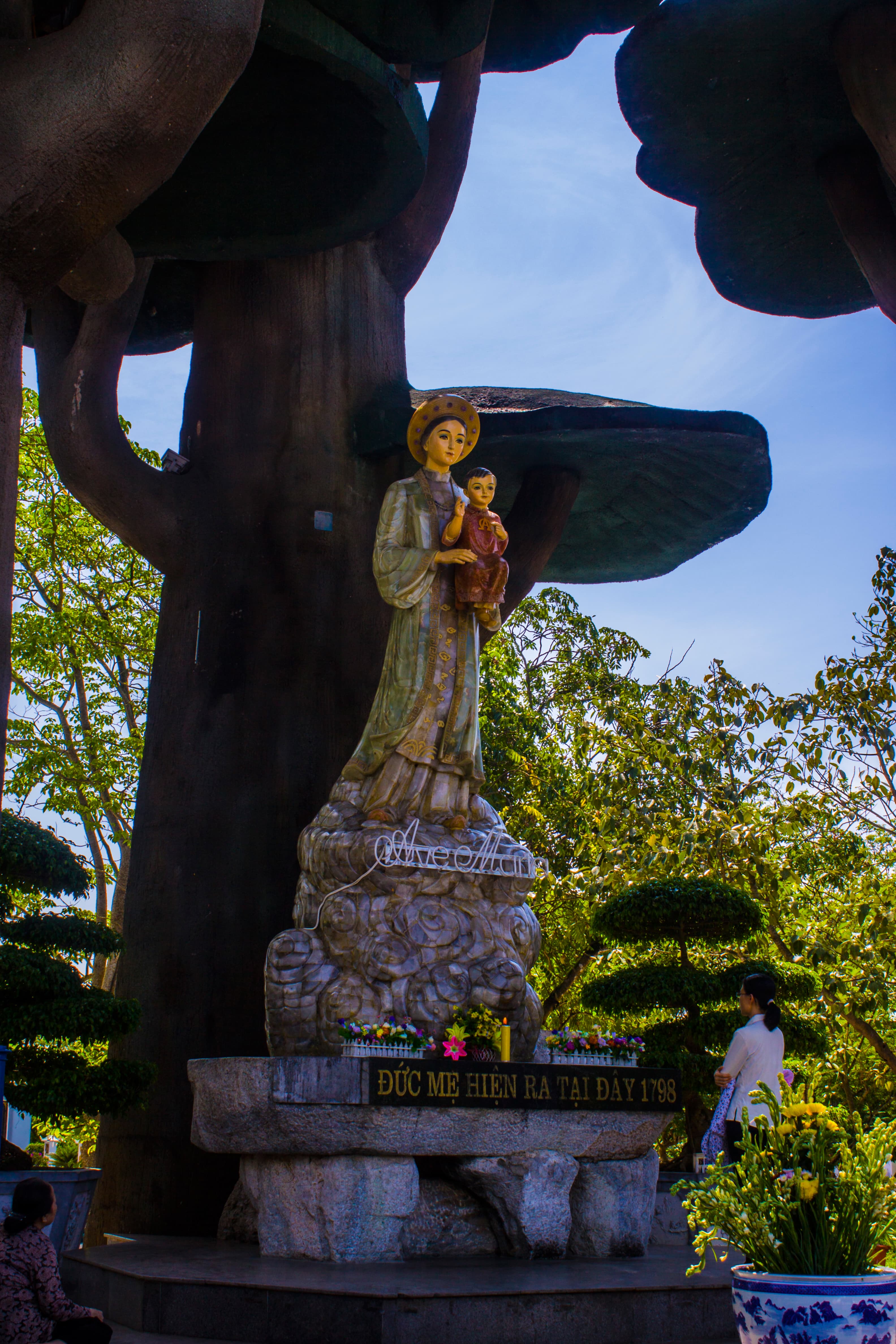
Image of Đền Đức Mẹ La Vang. Image source · CC-BY-SA-3.0
Visit essentials
A quick read before you go
- Duration
- Half a day for the sanctuary, monument, ruined tower, and basilica grounds.
- Access
- La Vang is in Hải Lăng District, Quảng Trị Province, central Vietnam — about 6 km south of Quảng…
Overview
In Hải Lăng District, Quảng Trị Province, La Vang is Vietnam's national Marian sanctuary and a vessel of more than two centuries of Catholic memory through persecution, war, and reconciliation. Tradition begins in August 1798, when Catholics fleeing Tây Sơn persecution reported Mary appearing in Vietnamese áo dài with the Christ Child and two angels. The full account of her comfort, medicinal instruction, and promise of heard prayer remains the sanctuary's origin tradition.
A chapel and later stone church followed. Pope John XXIII made it a minor basilica and Vietnam's National Marian Center in 1961. The 1972 Battle of Quảng Trị destroyed the basilica, leaving the bell-tower façade that still stands as witness; a new basilica is under construction. Around ninety thousand pilgrims gather annually for the Assumption, with larger National Marian Congress crowds expected for the 32nd congress in 2026.
Why this place is sacred
La Vang holds three temporal registers. First is the 1798 apparition tradition, carried orally through generations of persecution without surviving contemporary documentation; the Church recognised the devotion by elevating the site, not by juridical decree. Second is the basilica's destruction in the 1972 Battle of Quảng Trị, among the Vietnam War's bloodiest, and the surviving bell-tower façade as a memorial to twentieth-century suffering. Third is the present reconstruction under Vietnamese Episcopal Conference oversight, with partial dedications already held.
Across all three, Mary in áo dài remains one of Asia's most theologically significant inculturated Marian images.
Site of refuge for Catholics fleeing the August 1798 Tây Sơn edict against Christianity. A small chapel marked the apparition site through the nineteenth century; a stone church was built under Bishop Gaspar around 1900.
From a refuge in the jungle, La Vang has grown through successive churches — the small chapel of the early 1800s, Bishop Gaspar's stone church (c. 1900–1901), an enlargement in 1928, elevation to minor basilica in 1961, destruction in 1972, and the new basilica under construction since 2012.
The site has held continuity through Tây Sơn persecution, the nineteenth-century Văn Thân massacres of Catholics, French colonial rebuilding, the Vietnam War, and the long post-1975 negotiation between the Church and the Socialist Republic of Vietnam.
Experience and orientation
Most international visitors arrive at La Vang via Huế or Đà Nẵng, then by road. The sanctuary grounds are spacious and quiet outside major feasts, allowing pilgrims to move slowly between the three-banyan-tree pavilion at the apparition site, the ruined bell tower from 1972, and the rising new basilica.
During the Assumption pilgrimage (14–15 August), the site is transformed: tent cities cover the open ground, Masses are held in Vietnamese with occasional Latin and English elements, candlelight rosary processions extend through the evening, and pilgrims from across Vietnam and the worldwide diaspora gather for what is, for many, as much a homecoming as a devotion.
Outside major feasts, the rainy season from September through November brings typhoon risk; the cool, dry months from November through February offer the most comfortable contemplative visits.
The apparition site (three-banyan-tree pavilion), the ruined 1972 bell tower, the new basilica under construction, and the principal Marian monument are all within walking distance on the sanctuary grounds.
Context and lineage
In August 1798, Emperor Cảnh Thịnh of the Tây Sơn dynasty issued an edict ordering the destruction of Catholic churches and forbidding the practice of Christianity. Catholics in Quảng Trị Province fled into the La Vang jungle, suffering hunger and disease. Gathering each night at the base of a great banyan tree to pray the rosary, they reported being visited by a luminous woman in Vietnamese dress holding the Christ Child, flanked by two angels.
She comforted them, taught them to boil leaves from local trees for medicine, and promised that prayers at this place would be heard. After the persecution eased, Catholics returned and built a small chapel on the apparition site.
Bishop Jean-Marie Gaspar rebuilt it in stone around the turn of the twentieth century; the church was enlarged in 1928 and elevated to minor basilica on 22 August 1961 by Pope John XXIII (decree Magno Nos Solacio), with the title of National Marian Center of Vietnam confirmed earlier that year. In 1972 the Battle of Quảng Trị destroyed the basilica entirely; only the ruined façade of the bell tower survived.
A new basilica designed by Vietnamese architect Ngô Viết Nam Sơn has been under construction since 2012.
Roman Catholicism in Vietnam, administered locally by the Archdiocese of Huế. La Vang's devotion holds Mary as the inculturated mother of the Vietnamese Catholic people; the áo dài image is the visual canon of that lineage.
Bishop Jean-Marie Gaspar
Bishop of Huế who commissioned the first stone church on the apparition site around the turn of the twentieth century.
Pope John XXIII
Raised the church to the rank of minor basilica on 22 August 1961 (decree Magno Nos Solacio) and confirmed its status as the National Marian Center of Vietnam earlier that year.
Pope Francis
Approved the universal liturgical feast of Our Lady of La Vang during his pontificate.
Ngô Viết Nam Sơn
Vietnamese architect designing the new basilica, under construction since 2012.
Traditions and practice
The annual Assumption pilgrimage (15 August) is the principal feast, opening before dawn with a grand procession from the Marian monument to the basilica altar. The triennial National Marian Congress (13–15 August in congress years) is the largest gathering; the 32nd Congress is scheduled for 2026. Candlelight rosary processions extend through the evenings of the feast days. Mass is celebrated at the three-banyan-tree pavilion, and the ruined bell tower from 1972 is venerated as a site of remembrance.
The Archdiocese of Huế administers daily Mass in Vietnamese and oversees devotional novenas leading up to feast days. During the Assumption pilgrimage and the National Marian Congress, temporary tent cities accommodate tens of thousands of pilgrims. Major liturgies may include Latin and occasional English elements during international Marian congresses. The Vietnamese Catholic diaspora — particularly in the United States, Australia, France, and Germany — participates through pilgrimage and through parishes named for Our Lady of La Vang.
For a contemplative visit, the dry months from November through February are most comfortable. For the full pilgrimage experience, the Assumption (15 August) or a National Marian Congress year offers the broadest encounter with Vietnamese Marian devotion. The Mass at the three-banyan-tree pavilion is the most distinctive devotional moment outside the major liturgies.
Roman Catholicism (Vietnamese)
ActiveThe principal Marian shrine of Vietnam and the National Marian Center confirmed by Pope John XXIII in 1961. Tradition holds that in 1798, during the Cảnh Thịnh persecution under the Tây Sơn dynasty, Catholics hiding in the La Vang jungle saw Mary appear in áo dài holding the Christ Child. Pope Francis later approved the universal liturgical feast.
Annual Assumption pilgrimage on 15 August, triennial National Marian Congress (32nd in 2026), rosary, novenas, candlelight processions, veneration at the three-banyan-tree pavilion, and the áo dài image of Mary as central icon.
Perspectives and open questions
La Vang is held in multiple registers — as a Marian apparition tradition rooted in oral memory rather than juridical decree, as a memorial of Vietnamese Catholic persecution and wartime suffering, and as a uniquely inculturated icon of Mary in Vietnamese dress addressing a persecuted people in their own cultural language.
Scholarly perspective
Historians of Vietnamese Catholicism (Peter Phan, Charles Keith, among others) treat La Vang as a foundational site of Vietnamese Catholic identity, formed and reformed across colonial, revolutionary, and post-1975 periods. The 1798 apparition is documented in oral tradition; written attestation is later. Scholars distinguish between the historical persecution under the Tây Sơn (well-documented) and the apparition narrative itself (devotional tradition).
Living and traditional perspectives
Within Vietnamese Catholic devotion, La Vang holds Mary as the inculturated mother of the Vietnamese people, addressing them in their own cultural register. The áo dài image is one of the most theologically significant inculturated Marian icons in Asia and has become a unifying symbol for Vietnamese Catholics worldwide.
Alternative interpretations
Some Vietnamese Catholic devotional writers emphasize parallels with Guadalupe — a Marian apparition in Indigenous dress addressing a persecuted people in their own cultural language. This is a devotional and theological comparison rather than a formal Church teaching.
Open questions
The 1798 apparition has not been the subject of a formal canonical investigation in the manner of Lourdes or Fatima, in part because of the persecution context and the loss of contemporaneous records. The Church's recognition has proceeded by elevation of the site (Minor Basilica 1961; universal feast under Pope Francis) rather than by juridical decree on the apparition itself.
Plan your visit
Access and arrival
La Vang is in Hải Lăng District, Quảng Trị Province, central Vietnam — about 6 km south of Quảng Trị city and 60 km north of Huế. Most international pilgrims fly into Huế (Phú Bài Airport, HUI) or Đà Nẵng (DAD), then continue by bus or taxi. The Reunification Express train stops at Đông Hà (about 15 km north). Pilgrim accommodation is limited; major feasts require advance booking through diocesan or tour operators.
Limited accommodation on site; the diocese coordinates temporary tent cities during major feasts. Most pilgrims stay in Huế or Đông Hà and travel to the sanctuary daily.
Respectful visit
Modest dress (covered shoulders and knees). Many Vietnamese pilgrims wear áo dài. Comfortable shoes for outdoor walking and standing through long liturgies.
Permitted on the grounds and at the monument outside liturgies. Discreet during Mass; respectful of pilgrims at prayer. The ruined bell tower may be photographed with appropriate restraint.
Candles and flowers commonly offered at the Marian monument. Donations support basilica reconstruction.
Silence appropriate at the ruined bell tower. Patience required for large gatherings during the Assumption pilgrimage. Arrive early and bring water.
The rainy season runs September through November and brings typhoon risk to central Vietnam. The Assumption pilgrimage draws very large crowds; pilgrim accommodation is limited and requires advance booking through diocesan or tour operators. The site is administered in coordination with local authorities; large international groups should coordinate in advance.
Current practical details
Address
Hai Lang, Quang Tri 520000, Vietnam
Phone
Hours
Hours, fees, and access can change — verify on the official source before you travel. Practical details last checked Jun 2026.
Location
Map loads as you approach this section.
Pilgrim reflections
A portrait of encounter, not a score
Pilgrims describe what they felt, how present they could become, and whether the place would shape a journey. There are no stars and no ranking of traditions.
No reviewed reflections yet
The first pilgrims can help describe the character of being here.
Share a reflection
Available after an account-backed “Been there.” Every reflection is reviewed before publication.
Nearby sacred places
Explore other sacred places in the region. Proximity does not establish access or travel time; check each place’s guidance.
References
Sources consulted for this page. Source categories describe the publication, not a guarantee that every claim is verified. Traditional accounts and outside interpretations may differ.
- 01Our Lady of La Vang — Wikipedia — Wikipedia contributorsencyclopediaCore history: 1798 apparition tradition, Tây Sơn edict of 17 August 1798, basilica destruction in 1972 Battle of Quảng Trị, National Marian Center status 13 April 1961, Minor Basilica 22 August 1961.
- 02La Vang Basilica — University of Dayton International Marian Research Institute — University of DaytonacademicAcademic Marian research source on La Vang's status, history, and devotional context.
- 03Our Lady of La Vang Journeys with the Nation: Marian Devotion and Vietnamese Identity — College of the Holy Cross — Journal of Global CatholicismacademicPeer-reviewed scholarship on La Vang as marker of Vietnamese Catholic identity across persecution, war, and diaspora.
- 04Faithful throng La Vang shrine for Assumption celebration in Vietnam — Vatican NewsnewsConfirms August 15, 2025 pilgrimage with ~90,000 pilgrims; ongoing basilica reconstruction.
- 05Vietnam to return confiscated lands to prominent Catholic basilica — Catholic News AgencynewsReporting on government's land return for the new basilica project.
- 06La Vang — Wikipedia — Wikipedia contributorsencyclopediaGeographic and place-name context for La Vang in Hải Lăng District, Quảng Trị Province.
- 07Faithful throng La Vang shrine for Assumption celebration in Vietnam — LiCAS.newsnewsIndependent Asian Catholic news reporting on the 2025 pilgrimage.
- 08Basilica of Our Lady of La Vang — Catholic Shrine Basilica — Catholic Shrine BasilicaofficialReconstruction timeline, papal recognitions (John XXIII 1961, John Paul II 1998, Francis later).
- 09Annual Pilgrimage to Our Lady of La Vang: Assumption Celebration 2025 — Vietnam Catholic ToursguidePractical pilgrim guide, the triennial Marian Congress (32nd in 2026), accommodations, and travel logistics.
Share a photo
Help visitors recognize Đền Đức Mẹ La Vang. Every submission is reviewed before publication.