Thom Temple, Koh Ker
A seven-tiered pyramid rising from the jungle where a Khmer king built an empire's capital in a single generation
Kuleaen, Preah Vihear, Cambodia

Plan this visit
Practical context before you go
Two to four hours to explore Prasat Thom and the surrounding temples. A full day for the wider archaeological zone. Most visitors combine Koh Ker with Beng Mealea as a day trip from Siem Reap.
Located in Preah Vihear Province, approximately 127 km northeast of Siem Reap. Road quality has improved significantly. Approximately 2.5 to 3 hours by car from Siem Reap. Entry fee approximately $10 USD. Most visitors arrange private car from Siem Reap, often combining with Beng Mealea. Mobile phone signal may be unreliable within the jungle areas. No emergency services at the site; the nearest medical facilities are in Siem Reap.
A UNESCO World Heritage Site requiring respect for both the archaeological remains and the active conservation work. Stay on designated paths due to unexploded ordnance.
At a glance
- Coordinates
- 13.7831, 104.5372
- Suggested duration
- Two to four hours to explore Prasat Thom and the surrounding temples. A full day for the wider archaeological zone. Most visitors combine Koh Ker with Beng Mealea as a day trip from Siem Reap.
- Access
- Located in Preah Vihear Province, approximately 127 km northeast of Siem Reap. Road quality has improved significantly. Approximately 2.5 to 3 hours by car from Siem Reap. Entry fee approximately $10 USD. Most visitors arrange private car from Siem Reap, often combining with Beng Mealea. Mobile phone signal may be unreliable within the jungle areas. No emergency services at the site; the nearest medical facilities are in Siem Reap.
Pilgrim tips
- Cover shoulders and knees as standard for Cambodian temple sites. Sturdy closed-toe shoes recommended for uneven terrain and jungle paths. Long trousers advisable for protection against undergrowth and insects.
- Photography is permitted throughout the site. Drone photography may require special permission. Be respectful of any conservation work in progress.
- Stay on marked paths. Unexploded ordnance may remain in uncleared jungle areas. Do not climb on fragile structures other than the designated pyramid staircase. The pyramid steps are steep and can be slippery. The jungle setting means insect repellent is advisable.
Overview
Prasat Thom at Koh Ker is a 35-meter stepped pyramid of seven tiers, the state temple of a Khmer capital that existed for just sixteen years. When Jayavarman IV moved the empire's center from Angkor to this forest site in 928 CE, he built 180 sanctuaries across 81 square kilometers in a single generation, crowned by this pyramid that once held a colossal lingam representing Shiva as lord of all three cosmic realms. UNESCO inscribed the site in 2023.
In 928 CE, Jayavarman IV did something no Khmer king had done before or would do again: he abandoned Angkor and built an entirely new capital in the forests of what is now Preah Vihear Province. The city was called Lingapura, or Chok Gargyar, and at its center he raised a seven-tiered pyramid that represented Mount Meru, the cosmic mountain at the axis of the Hindu universe.
Prasat Thom stands 35 meters high, its base approximately 55 meters on each side, its seven tiers of sandstone and laterite stepping upward through the forest canopy. At its summit once stood the tribhuvamaheshvara, a colossal lingam whose name means Shiva as Great Lord of the Three Worlds. The lingam is gone, but the pyramid that held it endures, rising above the jungle like a stone thesis on ambition and devotion.
Around the pyramid, Jayavarman IV built over 180 sanctuaries across 81 square kilometers: temples, libraries, causeways, and the enormous Rahal Baray reservoir measuring 1,200 by 560 meters. This was not incremental growth over centuries, as at Angkor, but a concentrated eruption of construction completed within a single generation. After Jayavarman IV's death in 941 CE and the brief reign of his son Harshavarman II, the capital returned to Angkor in 944 CE. The jungle began its slow reclamation.
Today the trees have won many of the smaller temples, but Prasat Thom's pyramid rises above the canopy, its seven tiers still legible against the sky. UNESCO inscribed the site in 2023, recognizing the extraordinary concentration of sacred architecture built within the span of a single royal ambition.
Context and lineage
Jayavarman IV may have been a usurper, a rival prince, or a powerful provincial lord whose power base lay in the forests of Koh Ker. Whatever his origins, his decision to move the capital away from Angkor was unprecedented. In establishing Lingapura, he consecrated the site by installing the tribhuvamaheshvara, a colossal lingam representing Shiva as sovereign over all three cosmic realms. The scale of his building program, 180 sanctuaries within approximately two decades, required the mobilization of enormous labor forces and resources. The seven-tiered pyramid at the complex's heart surpassed anything that had been built at Angkor in height and ambition.
The reasons for the relocation remain debated. Some scholars suggest political rivalry with factions at Angkor. Others point to the proximity of sandstone quarries and water resources. A spiritual interpretation holds that Jayavarman IV sought to create a new cosmic center, establishing his authority by building a sacred geography from scratch rather than adding to the accumulated monuments of Angkor.
Prasat Thom's seven-tiered form is unique in Khmer architecture, though it connects to the broader tradition of pyramid temples representing Mount Meru. The Bakong at Angkor, a five-tiered pyramid, is an earlier expression of the same cosmological principle. The concentration of construction at Koh Ker within a single generation makes it distinctive among Khmer sites, most of which grew incrementally over centuries.
Jayavarman IV
builder of the capital
King of the Khmer Empire from 928 to 941 CE, who moved the capital from Angkor to Koh Ker and commissioned the most concentrated program of temple construction in Khmer history. His seven-tiered pyramid crowned by the tribhuvamaheshvara lingam was the tallest structure in the empire.
Harshavarman II
successor and final king at Koh Ker
Son of Jayavarman IV who reigned from 941 to 944 CE. After his death, the capital returned to Angkor under Rajendravarman II, and Koh Ker's brief period as the center of the Khmer Empire ended.
Why this place is sacred
The thinness at Koh Ker arrives through the juxtaposition of ambition and abandonment. This was a capital built in a rush of concentrated energy, 180 sanctuaries raised from the forest floor in a single generation, crowned by a pyramid rivaling anything at Angkor. And then, within sixteen years, it was left behind. The capital returned to Angkor. The jungle began its work.
Standing at the base of Prasat Thom and looking up through the seven tiers to the summit where the tribhuvamaheshvara once channeled divine power, visitors confront a particular quality of sacred space: the kind that was built with total conviction and then abandoned to time. The trees that grow from the walls of surrounding temples are not vandals. They are evidence of patience. The jungle's reclamation of Koh Ker is itself a form of commentary on the relationship between human aspiration and natural process.
Climbing the pyramid changes this experience from observation to participation. The steps are steep, the tiers narrow as they ascend, and the summit opens to an unbroken canopy of forest extending to every horizon. At this height, the 81 square kilometers of the sacred city are invisible beneath the trees. An entire capital has been absorbed. What remains visible is the pyramid itself: the one structure tall enough to keep its head above the canopy, still asserting its claim on the sky.
The relative solitude of Koh Ker intensifies every aspect. Unlike Angkor, where crowds mediate the experience, Koh Ker offers the rarity of encountering a major Khmer site without sharing it. The silence of the jungle, broken by insects and birds, creates the acoustic space for contemplation that ancient worshippers would have recognized.
Prasat Thom served as the state temple of the Khmer Empire during Koh Ker's period as capital (928-944 CE). The seven-tiered pyramid represented Mount Meru, the cosmic mountain. The tribhuvamaheshvara lingam at the summit represented Shiva's sovereignty over all three realms of existence. The surrounding network of 180 sanctuaries, the Rahal Baray reservoir, and the causeways connecting temple complexes created a sacred geography of extraordinary ambition, designed to legitimate Jayavarman IV's authority through the most concentrated program of religious construction in Khmer history.
After the return of the capital to Angkor in 944 CE, Koh Ker's temples gradually fell into disuse. The jungle reclaimed the structures over centuries. French colonial explorers documented the ruins in the nineteenth century. The site was heavily mined during the Cambodian civil war and Khmer Rouge era, and demining operations have been ongoing since the 1990s. Significant looting removed major sculptures, some of which have been repatriated. UNESCO inscription in 2023 brought international recognition and conservation attention. The Hungarian Southeast Asian Research Institute has led archaeological research documenting the site's urban infrastructure.
Traditions and practice
During Koh Ker's period as capital, Prasat Thom hosted state-level Shaivite rituals centered on the tribhuvamaheshvara lingam at the pyramid's summit. The lingam represented Shiva as lord of all three cosmic realms, and rituals performed before it connected the king's earthly authority to divine cosmic order. The Rahal Baray served both practical water management and ritual bathing purposes. Processional worship through the network of 180 sanctuaries engaged a large priestly class in continuous religious activity.
No regular organized religious services take place at the site. Cambodian Buddhist visitors occasionally make small offerings. The primary current activities are archaeological research, conservation, and contemplative tourism. Local communities maintain a spiritual connection to the ruins.
Explore the smaller temples first. Prasat Krahom, Prasat Neang Khmau, and Prasat Chen offer intimate encounters with Khmer art in jungle settings. The guardian lions of Prasat Chen, the carved lintels, and the tree roots growing through stonework create a visceral sense of time's passage.
Approach Prasat Thom as the climax. Walk around the base of the pyramid before ascending. Notice the scale: 55 meters on each side, seven tiers rising 35 meters. The base feels geological, as though the pyramid grew from the earth rather than being placed upon it. Climb the designated staircase slowly. Each tier narrows the world slightly, trading horizontal space for vertical perspective.
At the summit, sit. The forest canopy extending to the horizon is itself the experience. An entire capital, 180 temples, lies beneath those trees, invisible. The pyramid you are sitting on is the only structure tall enough to break through. Hold the fact that this was all built in one generation: not the gradual accumulation of centuries but the white-hot output of a single royal vision. Consider what it means that the jungle has spent ten centuries quietly absorbing that vision back into itself.
Hinduism (Shaivism)
HistoricalKoh Ker was the center of Shaivite worship in the Khmer Empire during its period as capital. The tribhuvamaheshvara lingam at the pyramid's summit represented Shiva as sovereign over all three cosmic realms. The seven-tiered pyramid represented Mount Meru. Over 180 sanctuaries created a sacred geography of extraordinary ambition.
State-level Shaivite rituals centered on the great lingam. Royal consecration ceremonies. Water management rituals at the Rahal Baray. Processional worship through the network of temples.
Archaeological and Heritage Preservation
ActiveSince UNESCO inscription in 2023, Koh Ker has been the focus of active archaeological research and conservation. International teams continue to document the 180+ structures. The site represents one of the most important archaeological complexes in Southeast Asia.
Archaeological excavation and survey. Conservation of stone structures. Demining of surrounding jungle. Community engagement with local villages. Repatriation of looted sculptures.
Experience and perspectives
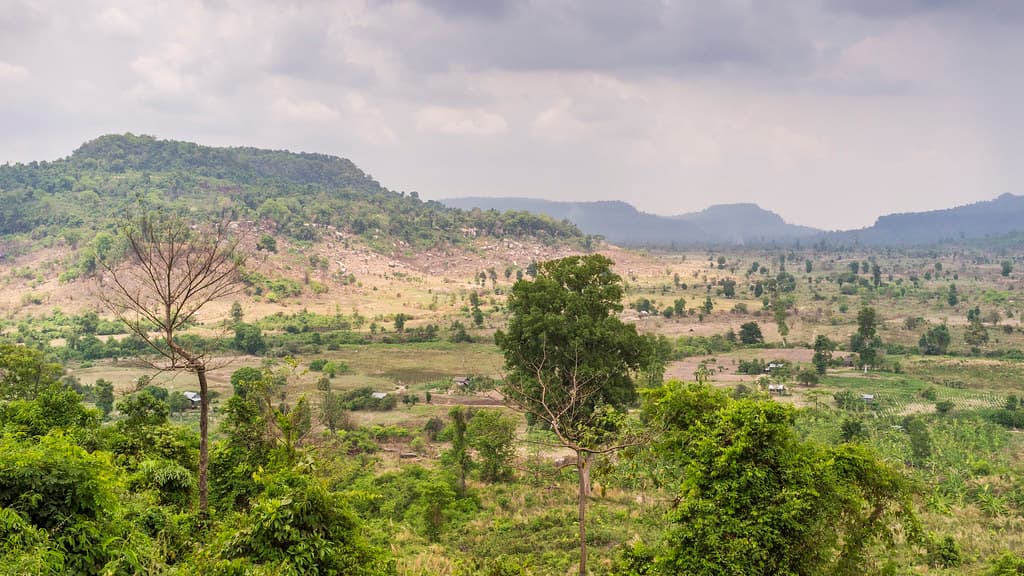
The drive to Koh Ker from Siem Reap takes approximately two and a half to three hours on roads that have improved significantly in recent years. The landscape transitions from the agricultural lowlands around Angkor to increasingly forested terrain. The site entrance gives way to a network of jungle paths connecting the scattered temples.
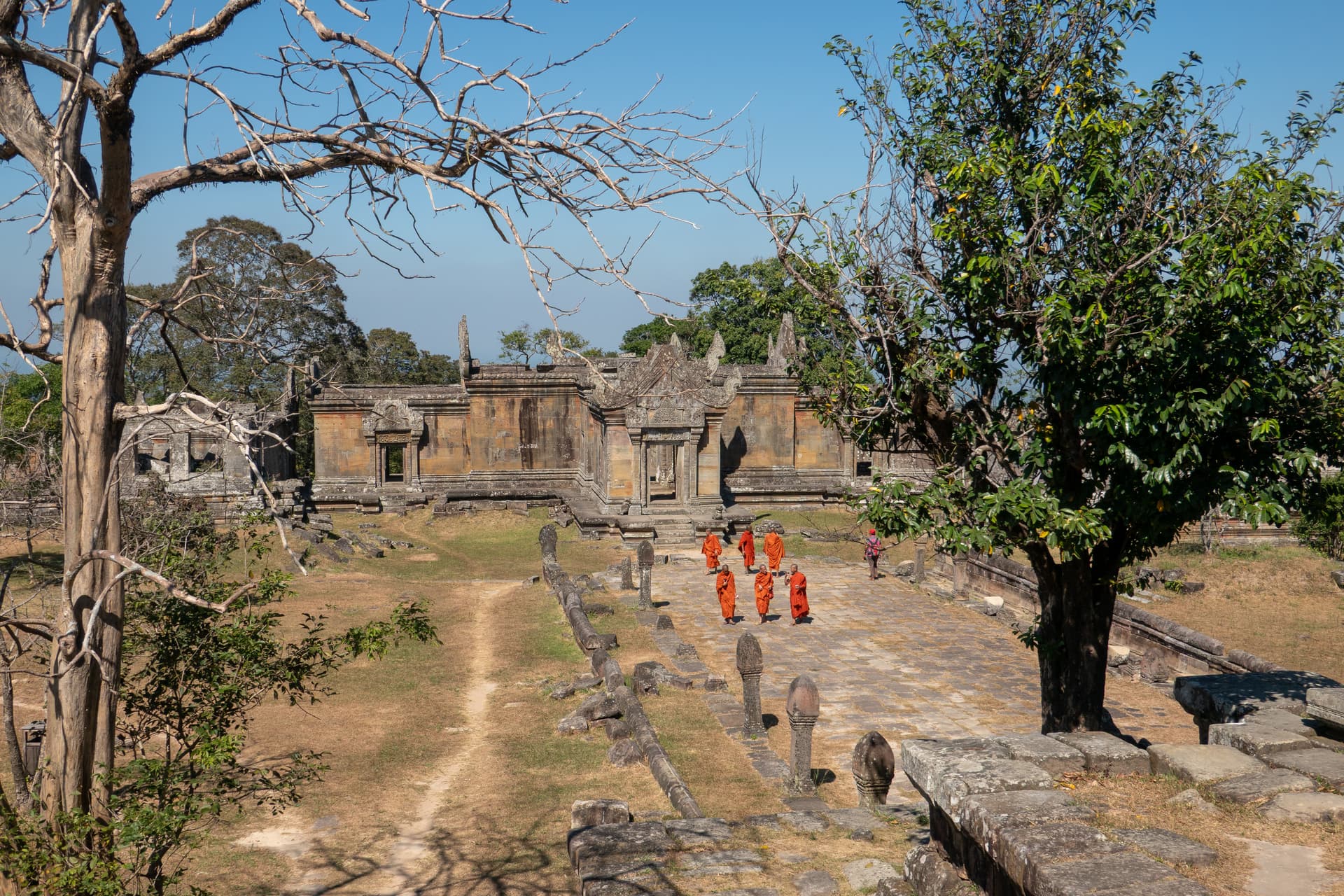
The first encounters are with ruins half-consumed by forest. Prasat Krahom, the Red Temple, shows its sandstone walls through a skin of roots and vines. Prasat Neang Khmau, the Temple of the Black Lady, stands in denser vegetation. The guardian lions of Prasat Chen stare out from their jungle positions with the calm authority of sculptures that have held their post for a millennium. These smaller temples prepare the visitor for the main event, but nothing fully prepares for Prasat Thom.
The pyramid announces itself gradually. Through the trees, a mass of stone resolves into tiers. Seven of them, stepping upward to a summit 35 meters above the forest floor. The base is broad enough to feel geological rather than architectural. The designated climbing route ascends one face of the pyramid on a steep staircase that demands attention and effort.
At the summit, the forest canopy spreads in every direction to the horizon. There is nothing to see above the trees except the sky. The 81-square-kilometer city that Jayavarman IV built is entirely invisible, consumed by the forest that has had a thousand years to complete its work. The pyramid, the one structure tall enough to breach the canopy, offers the vertigo of standing on the sole visible point of a buried civilization.
Descending, the visitor passes through the temple complex that surrounds the pyramid's base: galleries, libraries, and the remains of structures whose function can only be guessed. The Rahal Baray, the enormous reservoir, is visible to the north, its water still held by the earthen dikes that Jayavarman IV's engineers constructed.
Koh Ker is located in Preah Vihear Province, Cambodia, approximately 127 km northeast of Siem Reap. The archaeological zone covers 81 square kilometers with 180+ structures, of which Prasat Thom and a dozen other major temples are the most visited. The site entrance includes parking, basic facilities, and guides.
Koh Ker can be understood as an act of royal ambition, as a cosmological statement, as an archaeological puzzle, and as a meditation on the relationship between human aspiration and natural process.
Archaeologists regard Koh Ker as one of the most significant and understudied Khmer sites. UNESCO inscribed it in 2023 for its outstanding testimony to the Khmer Empire's creative ambition. Despite serving as capital for only sixteen years, the volume and quality of construction was extraordinary. The seven-tiered pyramid is unique in Khmer architecture. Recent research has revealed sophisticated water management and a more complex urban layout than previously understood. The site has suffered significant looting, with major sculptures removed and sold internationally, though some have been repatriated.
For Cambodians, Koh Ker represents a lesser-known but significant chapter of Khmer imperial history. Local communities maintain oral traditions about the ruins and consider them part of their ancestral landscape.
Some visitors find parallels between Prasat Thom's seven-tiered form and stepped pyramids in Mesoamerica and elsewhere. The concentration of sacred construction within a single generation invites speculation about the spiritual motivations behind Jayavarman IV's dramatic relocation. Garuda sculptures found at the site connect to Southeast Asian traditions of shamanic flight and spiritual ascent.
Why Jayavarman IV abandoned Angkor to build at Koh Ker remains debated. The exact form and dimensions of the tribhuvamaheshvara lingam are unknown. How many of the 180 sanctuaries were in active simultaneous use cannot be determined. The population of Koh Ker during its brief period as capital is unrecorded.
Pilgrim reflections
A portrait of encounter, not a score
Pilgrims describe what they felt, how present they could become, and whether the place would shape a journey. There are no stars and no ranking of traditions.
No reviewed reflections yet
The first pilgrims can help describe the character of being here.
Share a reflection
Available after an account-backed “Been there.” Every reflection is reviewed before publication.
Watch deeper
Films, episodes, and recorded talks for visitors who want more context before or after a visit. Speculative and alternative-history entries are labelled as perspectives, not as sources for established claims.
Streaming episode
Alternative-history media
Ancient Apocalypse: Legacy of the Sages
Graham Hancock's Giza/Sphinx-focused episode in Ancient Apocalypse season 1.
Perspective note: Highly contested by mainstream archaeology; included as a perspective, not as evidence.
Open on NetflixVideo resource
Alternative-history media
The Revelation of the Pyramids (La Revelation des Pyramides)
Influential 2010 French documentary on pyramid geometry, alignments, and ancient-site pattern claims.
Perspective note: Controversial and not a source for established archaeological claims.
Open on JustWatch MegalithomaniaUK / YouTube
Alternative-history media
Revelations Beneath Khafre's Pyramid FULL UPDATE
Gaia panel discussion connected to Ancient Civilizations and claims beneath Khafre's Pyramid.
Perspective note: Very speculative; pair with mainstream context before treating any claim as factual.
Open on MegalithomaniaUK / YouTubeVideo resource
Official / custodian
UNESCO Angkor videos
Official World Heritage video resources for Angkor.
Open on UNESCO World Heritage CentreVideo resource
Documentary / educational video
Journey to Angkor - The Essence of the Khmer Culture
UNESCO archive documentary on Angkor and conservation work.
Open on UNESCO ArchivesVisit planning
Located in Preah Vihear Province, approximately 127 km northeast of Siem Reap. Road quality has improved significantly. Approximately 2.5 to 3 hours by car from Siem Reap. Entry fee approximately $10 USD. Most visitors arrange private car from Siem Reap, often combining with Beng Mealea. Mobile phone signal may be unreliable within the jungle areas. No emergency services at the site; the nearest medical facilities are in Siem Reap.
No accommodation at the site. Siem Reap is the standard base for day trips. Some basic guesthouses exist in towns closer to the site for those wanting an early start.
A UNESCO World Heritage Site requiring respect for both the archaeological remains and the active conservation work. Stay on designated paths due to unexploded ordnance.
Cover shoulders and knees as standard for Cambodian temple sites. Sturdy closed-toe shoes recommended for uneven terrain and jungle paths. Long trousers advisable for protection against undergrowth and insects.
Photography is permitted throughout the site. Drone photography may require special permission. Be respectful of any conservation work in progress.
Not expected at this primarily archaeological site. Small offerings at any Buddhist shrine within the complex are appropriate.
Stay on marked paths due to unexploded ordnance risk. Do not climb on fragile structures. Do not remove stone, artifacts, or vegetation from the site. Follow posted restrictions about climbing the pyramid.
Plan your visit
Address
QGMP+7WQ, ស្រយ៉ង់ខាងជើង, Cambodia
Hours
Hours, fees, and access can change — verify on the official source before you travel. Practical details last checked Jun 2026.
Nearby sacred places
Sacred places within a half-day’s reach. Pilgrims often visit them together: walk one, stay for the other.

Key questions
What pilgrims usually ask
- Why is Thom Temple, Koh Ker considered sacred?
- Visit Prasat Thom at Koh Ker, a UNESCO-listed seven-tiered pyramid in the Cambodian jungle, built as a Khmer capital with 180 temples in one generation.
- What should I wear at Thom Temple, Koh Ker?
- Cover shoulders and knees as standard for Cambodian temple sites. Sturdy closed-toe shoes recommended for uneven terrain and jungle paths. Long trousers advisable for protection against undergrowth and insects.
- Can I take photos at Thom Temple, Koh Ker?
- Photography is permitted throughout the site. Drone photography may require special permission. Be respectful of any conservation work in progress.
- How long should I spend at Thom Temple, Koh Ker?
- Two to four hours to explore Prasat Thom and the surrounding temples. A full day for the wider archaeological zone. Most visitors combine Koh Ker with Beng Mealea as a day trip from Siem Reap.
- How do you visit Thom Temple, Koh Ker?
- Located in Preah Vihear Province, approximately 127 km northeast of Siem Reap. Road quality has improved significantly. Approximately 2.5 to 3 hours by car from Siem Reap. Entry fee approximately $10 USD. Most visitors arrange private car from Siem Reap, often combining with Beng Mealea. Mobile phone signal may be unreliable within the jungle areas. No emergency services at the site; the nearest medical facilities are in Siem Reap.
- What offerings are appropriate at Thom Temple, Koh Ker?
- Not expected at this primarily archaeological site. Small offerings at any Buddhist shrine within the complex are appropriate.
- What etiquette should visitors follow at Thom Temple, Koh Ker?
- A UNESCO World Heritage Site requiring respect for both the archaeological remains and the active conservation work. Stay on designated paths due to unexploded ordnance.
- What is the history of Thom Temple, Koh Ker?
- Jayavarman IV may have been a usurper, a rival prince, or a powerful provincial lord whose power base lay in the forests of Koh Ker. Whatever his origins, his decision to move the capital away from Angkor was unprecedented. In establishing Lingapura, he consecrated the site by installing the tribhuvamaheshvara, a colossal lingam representing Shiva as sovereign over all three cosmic realms. The scale of his building program, 180 sanctuaries within approximately two decades, required the mobilization of enormous labor forces and resources. The seven-tiered pyramid at the complex's heart surpassed anything that had been built at Angkor in height and ambition. The reasons for the relocation remain debated. Some scholars suggest political rivalry with factions at Angkor. Others point to the proximity of sandstone quarries and water resources. A spiritual interpretation holds that Jayavarman IV sought to create a new cosmic center, establishing his authority by building a sacred geography from scratch rather than adding to the accumulated monuments of Angkor.