Prasat Preah Vihear
Eight hundred meters of sacred architecture ascending a cliff where the earth falls away into Cambodia
Understand sacred places, explore living traditions, and learn how to engage respectfully with Pilgrim Map.
Access has not been verified. Check current local guidance before planning a visit.
Choam Ksant, Preah Vihear, Cambodia
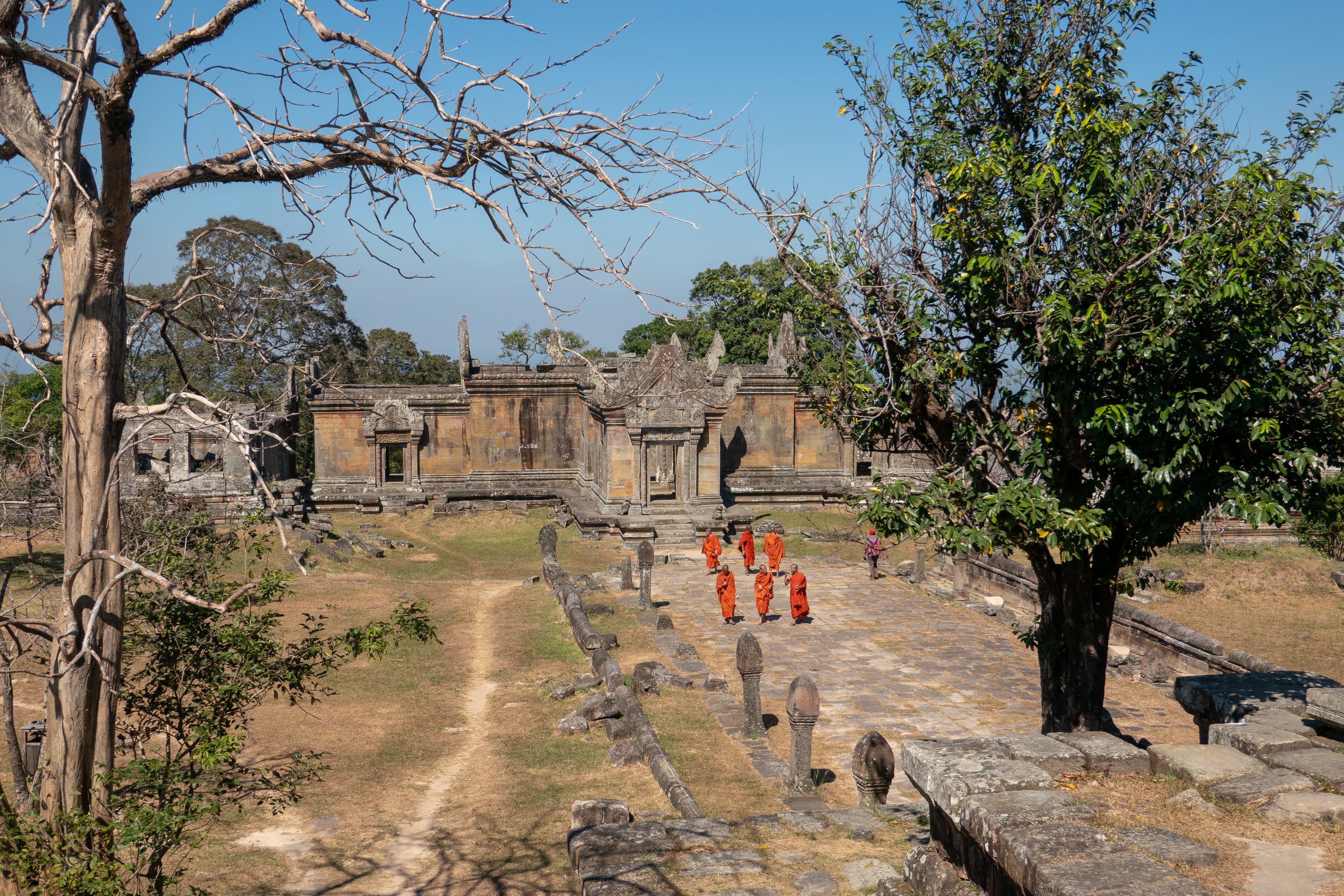
Image of Prasat Preah Vihear. Image source · CC-BY-SA-4.0
Visit essentials
A quick read before you go
- Duration
- Two to three hours to explore the full temple complex.
- Access
- Located on the Dangrek escarpment, Preah Vihear Province, Cambodia, on the Cambodian-Thai…
Overview
Prasat Preah Vihear was built at the edge of the world. Not metaphorically. The temple's central sanctuary sits on the lip of a cliff 525 meters above the Cambodian plain, and beyond the last carved stone, the earth simply stops. This is the endpoint of an 800-meter processional axis that ascends through five elaborately carved gateway pavilions, each marking a deeper level of sanctity, each requiring passage through doorways decorated with scenes from Hindu mythology.
The journey from base to summit enacts what the Khmer builders intended: a physical transition from the human world to the threshold of heaven.
Constructed between the ninth and twelfth centuries by successive Khmer kings including Yasovarman I, Suryavarman I, and the great Suryavarman II who also built Angkor Wat, the temple was dedicated to Shiva. Its north-south orientation, unusual for Khmer temples that typically face east, follows the natural axis of the Dangrek escarpment, allowing the processional approach to culminate at the cliff's edge. This was not compromise with terrain but collaboration with it.
The mountain provided what no flat-ground temple could: a built-in vertical dimension that made the spiritual ascent literal.
Today, Cambodian Buddhists worship at a small shrine within the complex, maintaining spiritual activity at a site where accumulated worship spans more than a millennium. The temple's inscription as a UNESCO World Heritage Site in 2008 and its role in the Cambodia-Thailand border dispute have added political and nationalist dimensions to its sacred significance.
For those who make the journey, the experience remains defined by the processional climb and the moment of arrival at the cliff's edge, where the carved stone ends and the sky begins.
Why this place is sacred
The thinness at Preah Vihear is architecturally engineered. The five gopuras that punctuate the processional axis function as thresholds, each one filtering the visitor's attention and marking passage into a more refined zone of sanctity. The first gopura is grand, cruciform in plan, announcing the temple's ambition. The second carries the Churning of the Ocean of Milk on its pediment, drawing the visitor into the mythological narrative. The third displays some of the finest carved lintels in Khmer art.
The fourth is smaller, more intimate. The fifth, the central sanctuary, stands at the cliff's edge.
This progression accomplishes something that flat-ground temples cannot. At Preah Vihear, you do not merely enter a sacred space. You ascend to it, through heat and effort and through increasingly demanding levels of artistic achievement, until you arrive at a point where the earth literally falls away. The cliff behind the central sanctuary drops hundreds of meters to the Cambodian plain below.
Standing at this edge, with the carved stones of a thousand-year-old temple at your back and the sky ahead, the distinction between above and below becomes visceral rather than theoretical.
The temple's remoteness adds another dimension. Unlike the Angkor temples, which are accessible within minutes of Siem Reap's hotels and restaurants, Preah Vihear requires hours of travel through increasingly sparse landscape. The journey itself becomes a form of pilgrimage, and the temple's distance from ordinary life makes its presence feel earned rather than consumed.
The political weight of the site, fought over between nations and adjudicated by the International Court of Justice, adds a contemporary layer. This is a place where the sacred has been claimed as national patrimony, where worship and sovereignty converge.
Prasat Preah Vihear was built as a royal Hindu sanctuary dedicated to Shiva. The central shrine housed a lingam that represented the cosmic axis. The processional approach through five gopuras enacted a ritual of spiritual ascent, with each gateway marking a deeper level of sanctity. The temple's cliff-edge placement was chosen to position worshippers at the threshold of heaven, following the Hindu cosmological principle that mountain-top sanctuaries represent earthly Mount Merus.
After the decline of Hinduism in the Khmer Empire, the temple was gradually adopted for Buddhist worship during the thirteenth and fourteenth centuries. Buddhist shrines were established within the Hindu architecture. In 1962, the International Court of Justice awarded sovereignty over the temple to Cambodia, resolving a long-standing dispute with Thailand. UNESCO inscribed the temple as a World Heritage Site in 2008, triggering renewed border tensions that led to military clashes in 2008-2011.
A 2013 ICJ interpretation confirmed Cambodia's sovereignty over the surrounding promontory.
Experience and orientation
Reaching Preah Vihear requires commitment. From Siem Reap, the journey is 250 kilometers, four to five hours through countryside that empties progressively of density and infrastructure. Most visitors base at Sra Em, the nearest town, and arrange transport for the final 30 kilometers up the mountain. The road is steep, and the options are motorcycle or shared truck. Neither is comfortable. Both are appropriate.
The temple announces itself from below as carved stone on a clifftop, visible from the plain as a linear progression of structures climbing the escarpment. The monumental stairway of 162 steps delivers visitors to the first gopura, where the processional axis begins. From here, eight hundred meters of causeways, gateways, and carved stone unfold along the ridge.
Each gopura rewards sustained attention. The carved pediments are among the finest in Khmer art. The Churning of the Ocean of Milk at Gopura II compresses an entire cosmological narrative into stone. The lintels at Gopura III achieve a delicacy that seems impossible given the hardness of sandstone. Between the gateways, causeways extend along the ridge, open to the sky and the wind, creating intervals of exposed walking between the enclosed density of each gateway.
The central sanctuary at the cliff's edge is the culmination. The view from behind the sanctuary, over the escarpment and across the Cambodian plain, extends to the Tonle Sap basin on clear days. The drop is severe. There is nothing gradual about the edge. One moment you are standing on carved stone that has held for a millennium. The next, the earth is gone.
The Buddhist shrine within the complex is modest but active. Cambodian visitors make offerings of incense and flowers. The shrine's presence reminds visitors that Preah Vihear is not merely a monument but a place where the sacred is still acknowledged.
Prasat Preah Vihear sits atop the Dangrek escarpment in Preah Vihear Province, Cambodia, on the border with Thailand. Access is from the Cambodian side only, through Sra Em town. The temple complex extends approximately 800 meters along a north-south axis, from the base stairway to the central sanctuary at the cliff's edge.
Context and lineage
The temple grew over three centuries of Khmer imperial ambition. Yasovarman I established the earliest structures in the ninth century. Suryavarman I expanded the complex in the early eleventh century. Suryavarman II, the builder of Angkor Wat, completed major work in the first half of the twelfth century. Each king added to the processional axis, extending and refining the approach to the cliff-edge sanctuary.
According to Khmer cosmological tradition, mountain-top temples served as earthly representations of Mount Meru, the cosmic mountain at the center of the universe. The Dangrek escarpment provided a natural mountain that needed no artificial elevation. The cliff's edge, where the earth drops away to the Cambodian plain, created a natural boundary between the terrestrial and celestial realms that the architects exploited with precision.
Prasat Preah Vihear belongs to the Khmer tradition of mountain-top sanctuaries representing Mount Meru. Its processional axis of five gopuras connected by causeways is considered one of the finest examples of Khmer axial planning. The temple's unusual north-south orientation, dictated by the natural axis of the Dangrek escarpment, makes it unique among major Khmer temples.
Yasovarman I
initiator of construction
Khmer king who reigned from 889 to 910 and established the earliest structures at Preah Vihear. He also founded the first city at Angkor, making him a pivotal figure in Khmer sacred architecture.
Suryavarman I
major builder
King who reigned from 1002 to 1050 and expanded Preah Vihear significantly. He also began the Western Baray at Angkor and built Phnom Chisor, connecting provincial and capital sacred architecture.
Suryavarman II
completer of major construction
The builder of Angkor Wat, who reigned from 1113 to 1150 and completed major construction at Preah Vihear. Under his patronage, the temple achieved its mature form as one of the finest Khmer sacred monuments.
Traditions and practice
During the Khmer Empire, the temple served as a royal Hindu sanctuary. A lingam in the central shrine received daily ablutions and offerings. Royal ceremonies connected the king's earthly authority to Shiva's cosmic power. The processional approach through five gopuras enacted a ritual purification, with each gateway marking a deeper level of sanctity.
Buddhist worship continues at the shrine within the complex. Cambodian devotees offer incense, flowers, and candles. Monks from nearby communities occasionally conduct prayers and blessings. The temple also serves as a site for national commemorative events, given its significance as a symbol of Cambodian sovereignty.
Begin at the base stairway and commit to the full processional walk. Do not rush through the gopuras to reach the view. Each gateway was designed to slow the visitor, to demand attention, and to deepen the experience of passage. At each gopura, look up at the carved pediments and lintels before passing through. The mythological narratives carved in stone were placed above doorways so that you would see them at the moment of transition.
At the central sanctuary, approach the cliff edge carefully. The physical sensation of standing where the earth drops away is the experience the builders intended. Let the panoramic view work on your sense of scale. The plain below held the Khmer civilization that built this temple, and from this elevation the relationship between height and power, between ascent and sanctity, becomes experiential rather than theoretical.
If the Buddhist shrine is active, observe the offerings with the awareness that you are witnessing a tradition that has survived the transition from one religion to another, military conflict, and international legal dispute.
Theravada Buddhism
ActiveFollowing the decline of Hinduism in the Khmer Empire, Preah Vihear was adopted for Buddhist worship. A small shrine within the complex receives regular offerings from Cambodian devotees. The temple holds deep significance as a symbol of national identity and sovereignty.
Offerings of incense, flowers, and candles at the Buddhist shrine. Occasional blessings conducted by monks. Buddhist pilgrimage, especially on holy days. National commemorative events at the temple.
Hinduism (Shaivism)
HistoricalPrasat Preah Vihear was originally dedicated to Shiva, built across three centuries by successive Khmer kings as a royal Hindu sanctuary. The lingam at the heart of the central shrine represented the cosmic axis. The carved pediments and lintels depict Hindu mythology including the Churning of the Ocean of Milk and episodes from the Ramayana.
Shaivite worship centered on the lingam, with daily ablutions and offerings. Royal ceremonies connecting the Khmer king to Shiva's divine authority. Processional approach through five gopuras symbolizing spiritual ascent.
Perspectives and open questions
Preah Vihear invites interpretation as architectural masterpiece, as sacred geography, as national symbol, and as a monument to the Khmer understanding of how built form can collaborate with landscape to create spiritual experience.
Scholarly perspective
Art historians and archaeologists recognize Preah Vihear as an outstanding example of Khmer architecture, distinguished by its adaptation to the natural landscape. UNESCO inscribed it under criterion (i) as a masterpiece of human creative genius. Scholars note its unusual north-south orientation, dictated by the Dangrek escarpment, and its processional plan as one of the finest examples of Khmer axial design. The carved lintels and pediments are ranked among the finest in Khmer art.
Living and traditional perspectives
For Cambodians, Preah Vihear is inseparable from national identity. The 1962 ICJ ruling and subsequent 2011 military clashes made the temple a symbol of sovereignty and cultural heritage. Buddhist devotees continue to worship at the site, maintaining spiritual continuity across the Hindu-Buddhist transition.
Alternative interpretations
Some visitors are drawn to the temple's liminal quality, its position at the edge of a cliff between earth and sky, between Cambodia and Thailand. The processional axis ascending from plain to precipice invites interpretation as a journey from the material to the transcendent.
Open questions
Why the temple was oriented north-south beyond the practical explanation of terrain remains an open question. The specific deity or form of Shiva enshrined in the central lingam has not been determined. How the temple functioned within the Khmer Empire's broader network of sacred sites and political power is incompletely understood. The rituals that marked the transition from Hindu to Buddhist use are unrecorded.
Plan your visit
Access and arrival
Located on the Dangrek escarpment, Preah Vihear Province, Cambodia, on the Cambodian-Thai border. Access from the Cambodian side only. From Sra Em, approximately 30 km by motorcycle or shared truck up the mountain road. From Siem Reap, approximately 250 km, four to five hours by road. Entrance fee approximately $10 USD. A valid passport may be checked at the access point. The temple can be closed during periods of border tension; check current conditions before traveling.
Mobile phone signal may be unreliable at the site.
Sra Em offers basic guesthouses. Tbeng Meanchey, the provincial capital, has more options. For greater comfort, some visitors make the long day trip from Siem Reap.
Respectful visit
Cover shoulders and knees. Sturdy closed-toe shoes are strongly recommended for the climb and uneven stone surfaces.
Generally permitted throughout the complex. Avoid photographing military personnel or installations. Do not use flash on carved surfaces. Be respectful when photographing worshippers at the Buddhist shrine.
Small offerings of incense or flowers may be made at the Buddhist shrine. These can sometimes be purchased from vendors near the entrance.
Do not climb on temple structures or sit on carved lintels. Stay on designated paths. Do not remove stone or artifacts. Observe any military or border-related restrictions posted at the site.
The cliff edge at the central sanctuary has no guardrails. Exercise extreme caution, especially in wet or windy conditions. The climb is strenuous in heat. The site may be closed during periods of border tension. Military presence at or near the temple is possible.
Current practical details
Address
9MRJ+746 On top of Preah Vihear mountain Dangrek mountain range, Cambodia
Hours
Hours, fees, and access can change — verify on the official source before you travel. Practical details last checked Jun 2026.
Location
Map loads as you approach this section.
Pilgrim reflections
A portrait of encounter, not a score
Pilgrims describe what they felt, how present they could become, and whether the place would shape a journey. There are no stars and no ranking of traditions.
No reviewed reflections yet
The first pilgrims can help describe the character of being here.
Share a reflection
Available after an account-backed “Been there.” Every reflection is reviewed before publication.
Watch deeper
Films, episodes, and recorded talks for visitors who want more context before or after a visit. Speculative and alternative-history entries are labelled as perspectives, not as sources for established claims.
Nearby sacred places
Explore other sacred places in the region. Proximity does not establish access or travel time; check each place’s guidance.


Share a photo
Help visitors recognize Prasat Preah Vihear. Every submission is reviewed before publication.