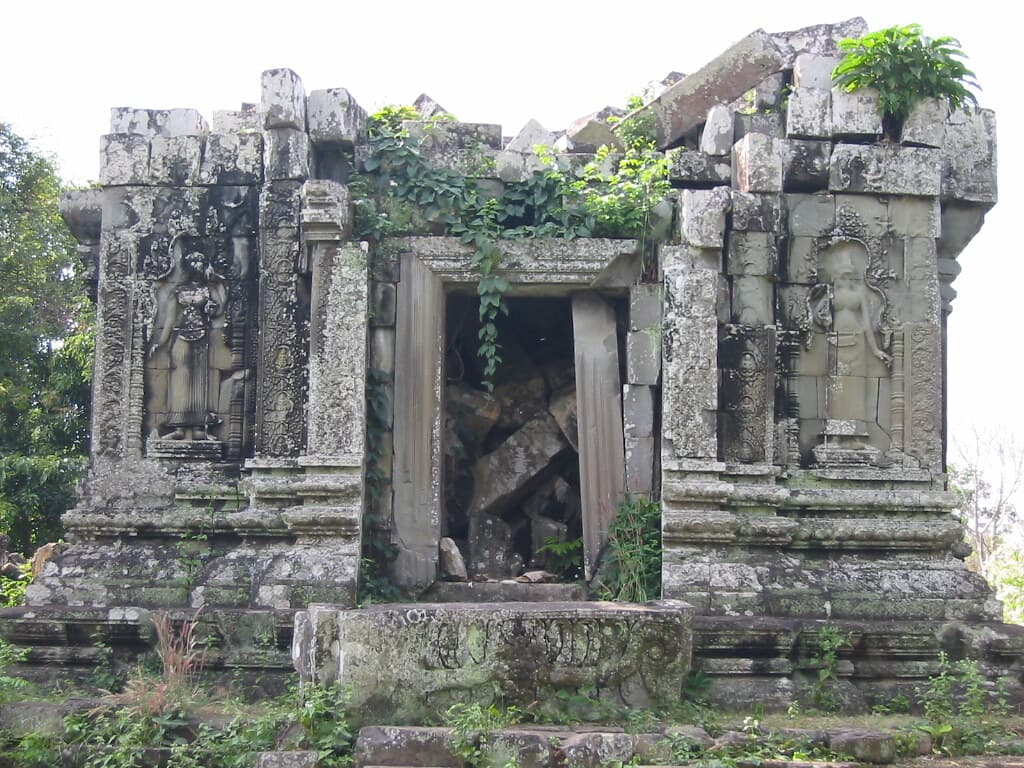
Phnum Kulen
The mountain where the Khmer Empire was born and every stone of Angkor was quarried
Svay Leu District, Siem Reap, Cambodia
Plan this visit
Practical context before you go
Full day from Siem Reap, approximately 1.5 hours drive each way. Allow four to five hours on the mountain to visit the reclining Buddha, waterfalls, and Kbal Spean.
Located approximately 50 km north of Siem Reap, Cambodia. Accessible by car or motorbike. $20 USD entrance fee for foreign visitors, separate from the Angkor pass. One-way road: ascend before 11:00 AM, descend after 11:00 AM. Guides available and recommended for the full mountain experience. Food stalls available near the waterfalls. Mobile phone signal may be unreliable in some areas of the mountain. No emergency access information was available at time of writing; check with local guides for current conditions.
A sacred mountain where active Buddhist worship requires modest dress, respectful behavior at shrines, and awareness that you are entering a pilgrimage site, not a tourist attraction.
At a glance
- Coordinates
- 13.5758, 104.0750
- Suggested duration
- Full day from Siem Reap, approximately 1.5 hours drive each way. Allow four to five hours on the mountain to visit the reclining Buddha, waterfalls, and Kbal Spean.
- Access
- Located approximately 50 km north of Siem Reap, Cambodia. Accessible by car or motorbike. $20 USD entrance fee for foreign visitors, separate from the Angkor pass. One-way road: ascend before 11:00 AM, descend after 11:00 AM. Guides available and recommended for the full mountain experience. Food stalls available near the waterfalls. Mobile phone signal may be unreliable in some areas of the mountain. No emergency access information was available at time of writing; check with local guides for current conditions.
Pilgrim tips
- Located approximately 50 km north of Siem Reap, Cambodia. Accessible by car or motorbike. $20 USD entrance fee for foreign visitors, separate from the Angkor pass. One-way road: ascend before 11:00 AM, descend after 11:00 AM. Guides available and recommended for the full mountain experience. Food stalls available near the waterfalls. Mobile phone signal may be unreliable in some areas of the mountain. No emergency access information was available at time of writing; check with local guides for current conditions.
- Modest clothing required at all Buddhist shrines. Shoulders and knees must be covered. Swimwear is acceptable only at the waterfalls, not at shrines. Remove shoes before entering shrine areas.
- Generally permitted at outdoor sites. Be discreet at the reclining Buddha shrine during active worship. Ask permission before photographing monks or worshippers. Drone use is prohibited within the national park without permit.
- Stay on marked trails. Unexploded ordnance from the Khmer Rouge period remains in some areas off established paths. The one-way road system is strictly enforced: ascend before 11:00 AM, descend after 11:00 AM. Do not walk on or touch the carved lingas at Kbal Spean. The waterfalls can be dangerous during heavy rain.
Continue exploring
Overview
Phnom Kulen is the most sacred mountain in Cambodia, the place where Jayavarman II declared the founding of the Khmer Empire in 802 CE. Every stone used to build Angkor Wat was quarried from its slopes. A river carved with over a thousand Shaivite lingas sanctifies the water flowing to the temples below. At the summit, a sixteenth-century reclining Buddha carved from living rock draws pilgrims who climb the mountain to touch the stone where their civilization began.
Phnom Kulen is where Cambodia begins. In 802 CE, on this forested plateau fifty kilometers north of what would become Angkor, King Jayavarman II performed a ceremony that unified the Khmer people, declared independence from Javanese suzerainty, and established the Devaraja cult of divine kingship. Every temple tower and carved devata at Angkor was made possible by what happened on this mountain. Every stone was quarried from its slopes. Every drop of water that sustained the empire's great reservoirs flowed over the lingas carved into the Kbal Spean riverbed, sanctified by Shiva before it reached the plains.
The mountain was Mahendraparvata, the Mountain of Great Indra, the axis mundi of a civilization that would build the largest premodern city on earth. Today it is Phnom Kulen, Lychee Mountain, a national park and Buddhist pilgrimage site where Cambodians come to pray before a giant reclining Buddha carved from the mountain's own sandstone in the sixteenth century. The lingas still bless the water. The forest still covers the remains of the first capital, now revealed by LIDAR to contain extensive urban infrastructure invisible from the ground.
For Cambodians, Phnom Kulen is not history. It is the living source from which national and spiritual identity flow. The pilgrims who climb the mountain are not visiting the past. They are returning to where they began.
Context and lineage
In 802 CE, Jayavarman II performed the ceremony on Phnom Kulen that established the Devaraja cult and founded the Angkor-era Khmer Empire, making this mountain the origin point of one of history's great civilizations.
Jayavarman II came to power in a period of Khmer political fragmentation, when the region was under the influence of the Javanese Sailendra dynasty. In 802 CE, he gathered his court on Phnom Kulen and, together with the Brahmin priest Hiranyadama, performed a ritual that established the Devaraja cult. This ceremony declared the Khmer king a chakravartin, a universal ruler, and a living manifestation of divine power. It simultaneously proclaimed independence from Javanese suzerainty and established the theological framework that would drive Khmer temple construction for the next six centuries.
The mountain was renamed Mahendraparvata, the Mountain of Great Indra, and served as the first capital of the unified empire. The choice of a mountain was not arbitrary. In Hindu cosmology, Mount Meru is the axis mundi, the center of the universe and the abode of the gods. Phnom Kulen, rising above the forested plain, became the Khmer Mount Meru, the sacred center from which political and spiritual authority radiated outward.
The quarrying of sandstone from the mountain for temple construction created a literal connection between the sacred source and its architectural expressions at Angkor. The carving of lingas into the Kbal Spean riverbed over subsequent centuries extended this connection through water: every drop that flowed to the Angkor reservoirs carried the mountain's blessing.
Phnom Kulen connects to the broader Hindu-Buddhist tradition of sacred mountains in South and Southeast Asia, from Mount Meru in cosmology to Mount Kailash in practice. The Devaraja cult established here drew on Indian Shaivite theology while creating something distinctly Khmer: a system of divine kingship expressed through monumental architecture. The mountain's role as both quarry and sacred source created a material and spiritual chain connecting Phnom Kulen to every temple at Angkor.
Jayavarman II
founder of the Angkor-era Khmer Empire
The king who in 802 CE performed the Devaraja ceremony on Phnom Kulen, establishing divine kingship and declaring Khmer independence from Javanese suzerainty. His choice of this mountain as the site for the founding ceremony and first capital made Phnom Kulen the origin point of the civilization that built Angkor.
Hiranyadama
Brahmin priest
The priest who performed the Devaraja consecration ritual alongside Jayavarman II, establishing the theological framework of divine kingship that would define Khmer civilization for six centuries.
Why this place is sacred
Phnom Kulen is where a civilization declared itself into existence. The mountain holds the origin point: the stone, the water, the ceremony that made Angkor possible.
The thinness at Phnom Kulen operates through origin. This is not a place where significant events once occurred. This is the place that made all subsequent events possible. Without the 802 CE ceremony, there is no Devaraja cult. Without the Devaraja cult, there is no theological framework for the building of Angkor. Without the mountain's sandstone, there is no physical material for Angkor. Without the lingas at Kbal Spean, the water flowing to the reservoirs is not sacred. Phnom Kulen is the necessary precondition for one of humanity's greatest civilizations.
The mountain communicates this through its physical qualities. The forest is dense, the air heavy with moisture, the sounds of water and insects creating a constant ambient presence. Carved lingas emerge from the riverbed like a text written in stone, transforming an ordinary stream into scripture. The reclining Buddha, eight meters long, was not placed on the mountain but carved from it, emerging from the rock as though the stone had always contained a sleeping figure waiting to be revealed.
The waterfalls that pilgrims use for ritual bathing carry water that has passed over the carved lingas upstream. To bathe in this water is to immerse yourself in a substance that has been consecrated by contact with Shiva's symbol, flowing from the same mountain where a king declared himself divine. The chain of connection is unbroken: mountain to linga to water to body.
LIDAR surveys have revealed what the forest conceals: streets, ponds, and structures of a city that predates Angkor, hidden beneath the canopy for a thousand years. This invisible city adds a dimension of depth to the mountain's thinness. You walk through a capital without knowing it. The ground beneath your feet held a civilization before Angkor existed.
Phnom Kulen served as the first capital of the Angkor-era Khmer Empire, known as Mahendraparvata. Jayavarman II's 802 CE ceremony established the Devaraja cult, in which the king was consecrated as a living god through a ritual performed by the Brahmin priest Hiranyadama. The mountain was simultaneously a political capital, a sacred mountain representing Mount Meru, and a quarry providing the physical material for temple construction. The river of lingas at Kbal Spean served a specific ritual technology: water flowing over the carved lingam forms was consecrated by contact with Shiva's symbol, ensuring that all water reaching the Angkor basin below carried divine blessing.
After the Khmer capital moved to the Angkor plain, Phnom Kulen retained its sacred status. The sixteenth-century reclining Buddha testifies to continued religious activity long after the empire's peak. The mountain was occupied as a Khmer Rouge stronghold from 1975 to 1979, and some areas remain affected by landmines. Since the establishment of the national park in 1993, the mountain has been developed as both a pilgrimage destination and a tourist site. Ongoing LIDAR surveys continue to reveal the extent of the pre-Angkorian urban infrastructure beneath the forest canopy. UNESCO added Phnom Kulen to the Tentative List in 2020.
Traditions and practice
Active Buddhist pilgrimage to the reclining Buddha, ritual bathing at the sacred waterfalls, and veneration of the river of lingas continue practices that began over a millennium ago.
The original Hindu practices centered on the Devaraja cult established in 802 CE. Royal ceremonies connected the king's earthly authority to Shiva's cosmic power. The carving of lingas into the Kbal Spean riverbed was itself a form of devotional practice, each carved form an act of worship that simultaneously served the ritual technology of water sanctification. The mountain functioned as a living temple complex, with shrines, water features, and ritual spaces distributed across the plateau.
Cambodian Buddhists visit Phnom Kulen as one of the holiest mountains in the country. The primary devotional focus is the reclining Buddha, Preah Ang Thom, where pilgrims offer incense, flowers, and candles. Monks maintain a presence at the shrine and may offer blessings. Ritual bathing at the sacred waterfalls is practiced especially on Buddhist holy days. The river of lingas at Kbal Spean is venerated as sacred water, though the Hindu theological framework has been absorbed into broader Buddhist understanding. Cambodian New Year celebrations draw large numbers of visitors to the mountain.
Arrive early to ascend before the 11:00 AM cutoff. Begin at the reclining Buddha. Observe the Cambodian pilgrims before approaching the shrine yourself. Notice how the Buddha was not placed on the rock but carved from it, as though the mountain chose to reveal the figure within its stone. If offerings of incense or flowers are available, make them following the example of Cambodian worshippers.
At the waterfalls, allow yourself to understand the water as the pilgrims do: blessed by its passage over the upstream lingas, carrying the mountain's sacred charge. If you choose to bathe, do so with awareness that you are participating in a practice that connects the physical body to the same water that sustained the Angkor civilization.
The hike to Kbal Spean rewards patience. When the carved lingas become visible in the riverbed, slow your pace. Each raised form was individually carved into the rock by hands that understood their work as devotion. The accumulation of a thousand lingas speaks to centuries of sustained religious attention directed at a single river.
Theravada Buddhism
ActivePhnom Kulen is one of the holiest mountains in Cambodia for Theravada Buddhists. The reclining Buddha carved from natural sandstone in the sixteenth century is a major pilgrimage object. Cambodian Buddhists visit to make merit, pray for blessings, and connect with the mountain's sacred power. The waterfalls are used for ritual bathing. The site represents continuity between the Hindu-Buddhist past of the Khmer Empire and contemporary Cambodian Buddhist practice.
Pilgrimage to the reclining Buddha for merit-making. Offerings of incense, flowers, and candles at shrines. Ritual bathing in the sacred waterfalls. Prayer and meditation at Buddhist shrines maintained by resident monks. Cambodian New Year celebrations at the mountain.
Hindu (Devaraja Cult)
HistoricalIn 802 CE, Jayavarman II established the Devaraja cult on Phnom Kulen, the theological system of divine kingship that drove Khmer civilization for six centuries. The mountain was Mahendraparvata, the first capital of the Angkor-era empire. The river of lingas at Kbal Spean transformed the water flowing to Angkor into sacred water blessed by Shiva. The mountain served as both axis mundi and quarry, providing the spiritual and physical foundations of the temple civilization.
Devaraja consecration ceremony establishing divine kingship. Carving of lingas and Vishnu images in the Kbal Spean riverbed. Imperial Hindu rituals at the mountain-top capital. Consecration of water through contact with carved lingam forms.
Experience and perspectives
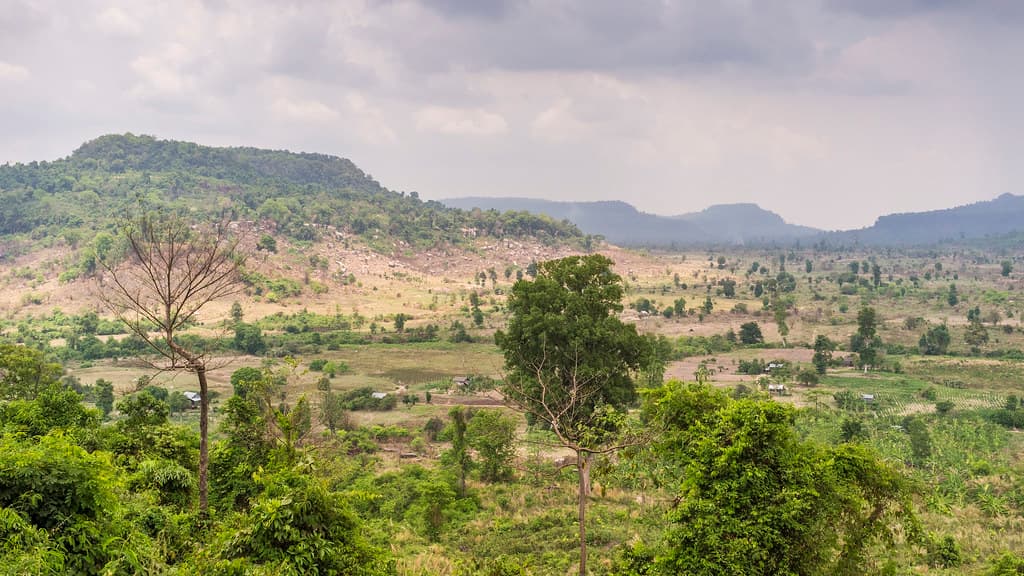
A full day's journey from Siem Reap through forest to a mountain plateau where carved rivers, sacred waterfalls, and a giant reclining Buddha coexist with the ruins of a lost capital.
The journey to Phnom Kulen begins with distance. Fifty kilometers from Siem Reap, the mountain requires a deliberate departure from the Angkor circuit. The road climbs through forest that thickens as elevation increases. A one-way road system controls the flow: vehicles ascend before eleven in the morning and descend after eleven. This constraint is practical but also shapes the experience, requiring early departure and creating a sense of committed arrival.
The first encounter for most visitors is the reclining Buddha, Preah Ang Thom. Eight meters of sandstone figure emerge from the mountain's rock, the Buddha lying on his right side in the posture of parinirvana. The stone is the mountain itself, carved in place. Cambodian pilgrims approach with offerings of incense, flowers, and candles. Monks maintain a presence at the shrine. The atmosphere is devotional rather than touristic, and visitors who arrive with respect for the ongoing worship find themselves included rather than observed.
The waterfalls draw both pilgrims and visitors. Water crashes over rock ledges into pools where people bathe, swim, and cool in the tropical heat. The spiritual dimension is not separate from the physical pleasure. Cambodians understand the water as sacred, blessed by its passage over the upstream lingas. To bathe is to receive that blessing through the body.
The Kbal Spean riverbed requires a separate hike. The carved lingas become visible as the water level drops, row upon row of raised stone forms emerging from the streambed. Vishnu images are carved into the rock face beside the river. The effect is of walking into a text written by a civilization that carved its theology into the landscape itself.
Beneath all of this, invisible, lies the city that LIDAR has revealed: streets and ponds and structures of Mahendraparvata, the first capital, hidden by centuries of forest growth. This invisible presence adds an extraordinary dimension. The mountain contains more than what you can see.
Phnom Kulen National Park is located approximately 50 kilometers north of Siem Reap, Cambodia. The main sites include the reclining Buddha (Preah Ang Thom) near the park entrance, the waterfalls, and the Kbal Spean linga carvings accessible by a short hike. Food stalls are available near the waterfalls. The one-way road system requires ascending before 11:00 AM and descending after 11:00 AM.
Phnom Kulen can be understood as a birthplace, a quarry, a pilgrimage site, and an ongoing archaeological discovery. Each perspective reveals different dimensions of a mountain that has been sacred for at least twelve centuries.
Historians and archaeologists recognize Phnom Kulen as the site of Jayavarman II's 802 CE founding ceremony, though the precise location and nature of the ceremony remain debated. Recent LIDAR surveys have revealed extensive pre-Angkorian urban infrastructure beneath the forest canopy, confirming the mountain's role as the first capital of the Angkor-era Khmer Empire. The river of lingas at Kbal Spean is understood as a ritual technology for sanctifying water. UNESCO's 2020 Tentative List nomination recognizes the site's outstanding universal value.
For Cambodian Buddhists, Phnom Kulen is not primarily an archaeological site but a living source of spiritual power. The mountain is understood as the origin point of Khmer civilization and a place where prayers carry particular efficacy. The reclining Buddha is venerated as a protector. The waterfalls are sacred purification sites. The mountain appears on Cambodian currency and in the national narrative as the birthplace of the nation.
Some visitors are drawn to Phnom Kulen by claims of concentrated spiritual energy. The carved lingas are sometimes interpreted in New Age contexts as energy-focusing devices rather than Shaivite devotional objects. The LIDAR-revealed urban infrastructure has attracted interest from alternative archaeology circles speculating about advanced lost civilizations.
The precise nature and location of Jayavarman II's 802 CE ceremony on the mountain remain uncertain. The extent of the pre-Angkorian urban infrastructure is still being discovered by ongoing LIDAR surveys. Whether the mountain held sacred significance before the Hindu period is suggested but not well documented. The full extent and meaning of the carved linga and image program at Kbal Spean has not been completely catalogued.
Visit planning
A full-day trip from Siem Reap requiring early departure, a $20 entrance fee for foreign visitors, and awareness of the one-way road system.
Located approximately 50 km north of Siem Reap, Cambodia. Accessible by car or motorbike. $20 USD entrance fee for foreign visitors, separate from the Angkor pass. One-way road: ascend before 11:00 AM, descend after 11:00 AM. Guides available and recommended for the full mountain experience. Food stalls available near the waterfalls. Mobile phone signal may be unreliable in some areas of the mountain. No emergency access information was available at time of writing; check with local guides for current conditions.
No accommodation on the mountain. Siem Reap offers the full range of options from budget guesthouses to luxury hotels and is the standard base for visiting Phnom Kulen.
A sacred mountain where active Buddhist worship requires modest dress, respectful behavior at shrines, and awareness that you are entering a pilgrimage site, not a tourist attraction.
Phnom Kulen is first and foremost a sacred site for Cambodian Buddhists. The tourists who visit are guests in a place of active devotion. The reclining Buddha shrine is a place of worship where pilgrims pray and make offerings throughout the day. Approaching with the seriousness due to an active shrine, rather than the casualness of a scenic viewpoint, honors both the tradition and the worshippers present.
Modest clothing required at all Buddhist shrines. Shoulders and knees must be covered. Swimwear is acceptable only at the waterfalls, not at shrines. Remove shoes before entering shrine areas.
Generally permitted at outdoor sites. Be discreet at the reclining Buddha shrine during active worship. Ask permission before photographing monks or worshippers. Drone use is prohibited within the national park without permit.
Incense, flowers, and candles are available for purchase near the reclining Buddha. Offerings may be made at any shrine. Follow the example of Cambodian pilgrims for appropriate practice.
Stay on marked trails due to unexploded ordnance risk. Do not touch or walk on the carved lingas at Kbal Spean. Do not remove stones, artifacts, or natural materials from the park. Observe the one-way road schedule. The park closes at 5:00 PM.
Nearby sacred places
Sacred places within a half-day’s reach. Pilgrims often visit them together: walk one, stay for the other.