Domus de janas, Sas Concas
Where the upside-down dead reveal pre-Nuragic understanding of transformation
Understand sacred places, explore living traditions, and learn how to engage respectfully with Pilgrim Map.
Access has not been verified. Check current local guidance before planning a visit.
Onieri/Oniferi, Nuoro, Italy
Read the sources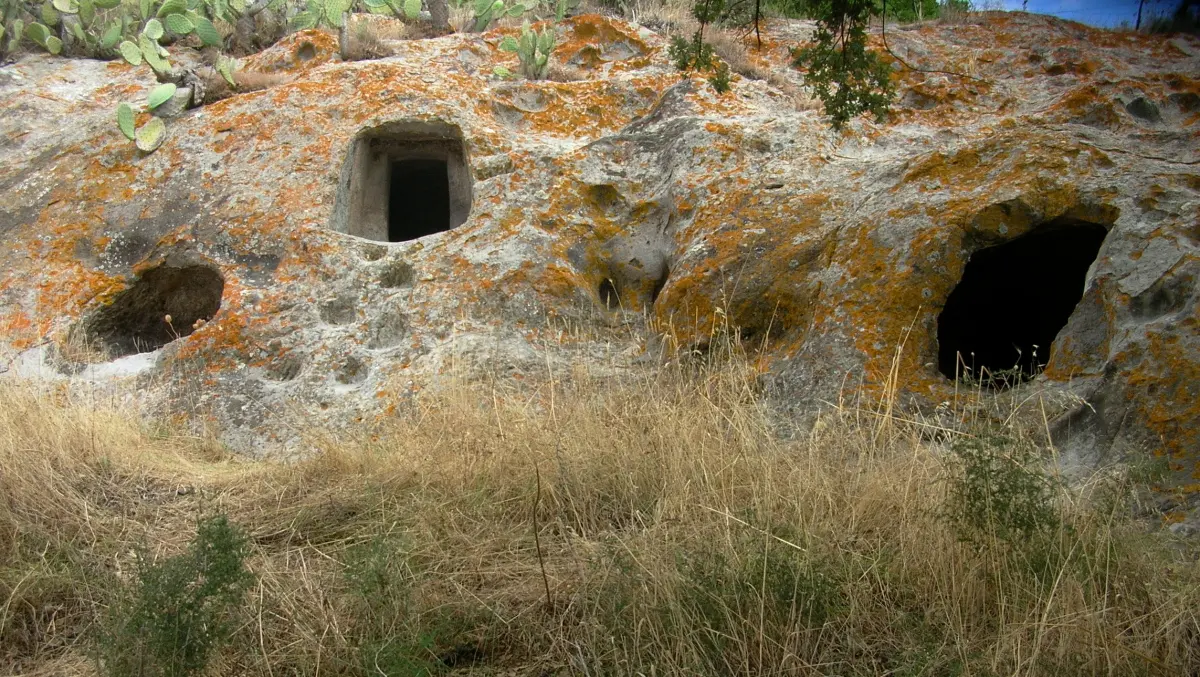
Image of Domus de janas, Sas Concas. Image source · CC-BY-SA-3.0
Visit essentials
A quick read before you go
- Duration
- 45 minutes to 1 hour
- Access
- From SS 131 DCN heading toward Nuoro, look for red trachyte outcrop on right.
Overview
Inside Sas Concas, stylized human figures hang upside-down on burial-chamber walls. Their makers' intent is lost, but the effect suggests death as reversal, the living world inverted.
The necropolis has 20 domus de janas—Sardinia's “houses of the fairies”—carved around 2700 BCE into red trachyte near Oniferi. It is Barbagia's most extensive and ancient collection of rock-cut tombs, distinguished by its art.
Several tombs bear oranti capovolti, inverted worshippers or praying figures: intentional communication reaching across 4,700 years to the site's UNESCO World Heritage designation in 2024. The Hemicycle Tomb contains eleven, with candelabra and anchor-shaped symbols incised by direct hammer.
Why this place is sacred
The upside-down figures demand interpretation. They hang inverted on the chamber walls—human forms, stylized but unmistakable, their orientation the opposite of the living. What did the pre-Nuragic artists mean?
One reading: death as inversion. What was up becomes down. The living stand; the dead hang. The world reverses at the boundary between realms. The figures may represent this transformation, carved into the walls where the living deposited the dead who had crossed over.
Another reading: the figures are 'oranti'—worshippers, people in prayer. Their inverted position may indicate prostration before the divine, or the ecstatic posture of shamanic trance, or the humility of the human before forces beyond understanding. The inversion may be spiritual rather than mortuary.
A third reading: we cannot know. The Abealzu-Filigosa culture that carved these figures left no texts, no explanatory traditions. The symbols speak, but we have lost the language. The mystery is irreducible.
The Hemicycle Tomb concentrates this mystery. Eleven upside-down figures, candelabra shapes, anchor symbols—all carved with direct hammer technique into the rock. The semi-circular chamber with its sloping ceiling creates a space unlike the simple chambers of other domus de janas. Here, architecture and art combined to achieve purposes we can only guess.
The 20 tombs of Sas Concas represent the most extensive collection in Barbagia, a region known for its prehistoric remains. The red trachyte outcrop provided workable stone that has preserved the carved chambers through millennia. The complexity of the layouts—anteroom, doorway, chamber—indicates architectural planning, not mere excavation.
The UNESCO inscription of 2024 recognized what Sardinians had long known: the domus de janas represent something significant in human history, the largest and most richly developed expression of hypogeal funerary architecture in the western Mediterranean. Sas Concas, with its upside-down figures, stands among the most distinctive.
Local tradition named these chambers 'houses of the fairies' or 'houses of witches.' The names acknowledge strangeness—the recognition that ordinary explanations do not suffice for what lies carved in the rock. Whether fairies, witches, or ancestors of immense antiquity, the makers of Sas Concas created something that exceeds normal categories.
Collective burial chambers with symbolic petroglyphs. The upside-down figures may represent death as inversion, spiritual states, or meanings we cannot recover. Part of pre-Nuragic mortuary complex.
Around 2700 BCE: Necropolis carved by Abealzu-Filigosa culture. 2024: UNESCO World Heritage inscription. Modern era: Archaeological preservation.
Experience and orientation
The approach from the SS 131 highway reveals the red trachyte outcrop—a distinctive geological feature that the pre-Nuragic people recognized as suitable material for their burial chambers. A short path leads from the road to the site, passing through a wooden gate into the necropolis.
The 20 chambers vary in complexity. Some are simple excavations; others display sophisticated layouts with anteroom, doorway, and shaped chambers. The Hemicycle Tomb stands apart—its large semi-circular main chamber with sloping ceiling creates a space unlike any other in the complex.
The petroglyphs demand attention. The upside-down figures—'oranti capovolti'—appear on the walls of several tombs, carved with direct hammer technique into the rock. In the Hemicycle Tomb, eleven such figures hang inverted, accompanied by candelabra and anchor-shaped symbols. The meaning eludes; the effect does not.
Entering the chambers requires bending, adjusting to the scale of the doorways. The transition from Sardinian sunlight to rock-enclosed darkness parallels what the pre-Nuragic people may have intended: a journey from the world of the living toward the realm where orientation reverses, where up becomes down, where the dead take forms the living cannot assume.
The red trachyte has preserved the carved surfaces through 4,700 years. The figures that the Abealzu-Filigosa culture created remain visible, their hammer marks still sharp, their inverted postures still arresting. Whatever was intended, whatever was believed, the art survives.
Guided tours are available during special events like Autunno in Barbagia, offering context that enriches the encounter. But even without guidance, the chambers speak. The upside-down figures ask questions that visitors must answer for themselves.
The Necropolis of Sas Concas is located near Oniferi, visible from the SS 131 DCN highway heading toward Nuoro. A short path leads from the road to the trachyte outcrop containing the 20 chambers.
Context and lineage
Around 2700 BCE, the Abealzu-Filigosa culture carved 20 burial chambers into a red trachyte outcrop near what is now Oniferi. They created the most extensive necropolis of domus de janas in the Barbagia region, with layouts ranging from simple chambers to the elaborate Hemicycle Tomb. And they carved something found nowhere else: upside-down human figures on the chamber walls, symbols whose meaning has been lost but whose presence makes Sas Concas unique.
In 2024, UNESCO recognized this and other domus de janas as World Heritage, acknowledging Sardinia's prehistoric burial traditions as among the most significant in the western Mediterranean.
Created by Abealzu-Filigosa culture of pre-Nuragic Sardinia. Part of the broader domus de janas tradition, now UNESCO World Heritage. No descendant tradition preserves original practices.
Traditions and practice
Collective burials in rock-cut chambers. Carving of symbolic petroglyphs including upside-down figures. Ritual use of architectural spaces like the Hemicycle Tomb.
Archaeological site visitation. Guided tours during Autunno in Barbagia and other festivals.
Enter the chambers to experience the transition from light to darkness. Examine the upside-down figures in the Hemicycle Tomb. Consider what death as inversion might have meant to pre-Nuragic Sardinians. Allow time for contemplation.
Pre-Nuragic Rock-Cut Tomb Tradition
HistoricalSas Concas represents the Abealzu-Filigosa culture (around 2700 BCE) at its most expressive. The unique upside-down figure petroglyphs suggest beliefs about death as inversion or transformation that have no parallel in other Sardinian sites.
No longer practiced. Archaeological evidence indicates collective burials with symbolic petroglyphs in complex architectural spaces.
Perspectives and open questions
Sas Concas offers encounter with one of Sardinia's most mysterious prehistoric sites—rock-cut chambers featuring unique upside-down figures that appear to represent death as transformation.
Scholarly perspective
Dated to around 2700 BCE (Abealzu-Filigosa culture). 20 domus de janas in red trachyte. Unique 'oranti capovolti' petroglyphs depicting upside-down human figures. Most extensive necropolis in Barbagia. UNESCO World Heritage 2024.
Living and traditional perspectives
Local tradition names these chambers 'Domus de Janas'—Houses of the Fairies or Witches—attributing them to supernatural beings.
Alternative interpretations
The upside-down figures have been interpreted as representing shamanic states, death as inversion, or spiritual transformation. The mystery remains open.
Open questions
The meaning of the upside-down figures. The rituals performed. The identity of those buried. The relationship between the 20 tombs.
Plan your visit
Access and arrival
From SS 131 DCN heading toward Nuoro, look for red trachyte outcrop on right. Short path to site. Car recommended.
Accommodations in Nuoro, Orosei, or Barbagia agriturismo.
Respectful visit
No dress code. Comfortable shoes for path and chamber entry.
Photography permitted.
None; archaeological site.
Do not touch petroglyphs | Respect chamber structures | Follow guide instructions during tours
Some chambers require bending to enter. Bring a flashlight for interior viewing.
Current practical details
Address
75RC+CH, 08020 Oniferi, Province of Nuoro, Italy
Phone
Hours
Hours, fees, and access can change — verify on the official source before you travel. Practical details last checked Jun 2026.
Location
Map loads as you approach this section.
Pilgrim reflections
A portrait of encounter, not a score
Pilgrims describe what they felt, how present they could become, and whether the place would shape a journey. There are no stars and no ranking of traditions.
No reviewed reflections yet
The first pilgrims can help describe the character of being here.
Share a reflection
Available after an account-backed “Been there.” Every reflection is reviewed before publication.
Nearby sacred places
Explore other sacred places in the region. Proximity does not establish access or travel time; check each place’s guidance.

References
Sources consulted for this page. Source categories describe the publication, not a guarantee that every claim is verified. Traditional accounts and outside interpretations may differ.
- 01Necropoli Sas Concas | SardegnaTurismo — Regione Sardegna TourismofficialOfficial tourism information
- 02Domus de Janas: the House of Fairies in Sardinia | Italia.it — Italia.itofficialOfficial Italian tourism
- 03Domus de janas Sas Concas | IDESE — Italian Ministry of CultureofficialOfficial cultural heritage database
- 04Necropolis of Sas Concas - Wikipedia — Wikipedia contributorsencyclopediaArchaeological overview
Share a photo
Help visitors recognize Domus de janas, Sas Concas. Every submission is reviewed before publication.