Santuario di Nostra Signora di Gonare
The highest church in Sardinia, where a medieval king's vow meets a mountain path carved with the Virgin's footprints
Understand sacred places, explore living traditions, and learn how to engage respectfully with Pilgrim Map.
Access has not been verified. Check current local guidance before planning a visit.
Orani, Nuoro, Italy
Read the sources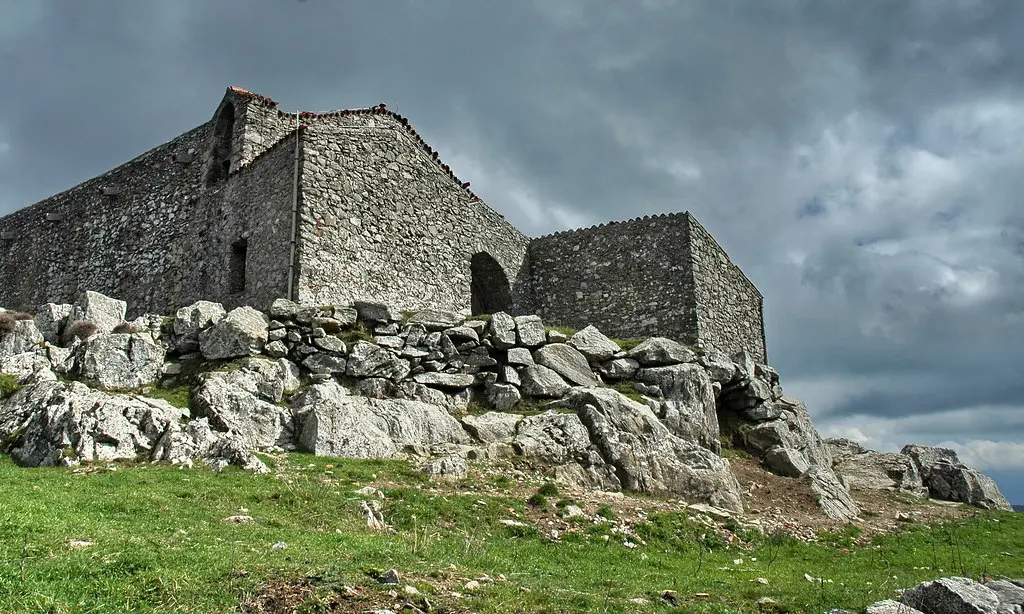
Image of Santuario di Nostra Signora di Gonare. Image source
Visit essentials
A quick read before you go
- Duration
- Half day including ascent, visit, and descent
- Access
- The trailhead is accessible by car from Orani or Sarule.
Overview
Monte Gonare rises in limestone from central Sardinia's granite landscape. Its three summits—Gonare, Gonareddu, and Punta Lotzori—are visible across the island's interior. On the central peak at 1,100 metres, Nostra Signora di Gonare is Sardinia's highest place of worship and a Marian sanctuary.
Tradition says Judge Gonario II of Torres, returning from the Holy Land in the mid-twelfth century, met a storm in the Gulf of Orosei and vowed a church on the first land seen if the Virgin saved him. Through mist, sunlight revealed Monte Gonare. Ascending, he met a woman and child who accompanied him; she left a cradle, seat-shaped niche, and palm-print depression in the rock, landmarks still shown to pilgrims.
The current church dates to the early seventeenth century, while a 1341 payment is the cult's first documentation. Orani and Sarule parishes jointly own the sanctuary and alternate responsibility for its major feast.
Three feasts shape the year: March 25, the Annunciation, with votive bread; May's last Sunday, the coronation anniversary; and September 8, the 'big feast,' drawing climbers from both mountain sides. Ancient porticoed stone cumbessias shelter pilgrims, embodying Sardinian sacred hospitality.
Why this place is sacred
What makes Gonare thin is not the church itself — which is modest — but the act of reaching it. The ascent is steep, rocky, and sustained. As you climb, the inhabited world falls away. The granite landscape of central Sardinia opens below in every direction, and on clear days both the eastern and western coasts become visible. The path narrows. The stone gets rougher.
And along the way, the sacred landmarks appear — the cradle, the seat, the handprint — as though the Virgin had walked this same path and left evidence in the rock.
These landmarks are geological features that have been given narrative meaning. The cradle is a natural hollow; the seat is a boulder of the right shape; the handprint is a depression in stone. But the attribution is not trivial. It expresses a conviction that the sacred does not merely inhabit buildings — it leaves traces in the earth itself.
The mountain, in this reading, is not just the location of a church but a surface on which the divine has walked.
The summit offers a revelation of a different kind. From the church steps, central Sardinia unfolds in every direction. The perspective is comprehensive — the entire heartland of the island laid bare. The experience of arriving here, having climbed through rock and narrative, and then seeing the world from this vantage, produces an effect that the church's modest interior cannot contain. The thinness is in the ascent, in the arrival, and in the seeing.
According to legend, built by Judge Gonario II of Torres in fulfillment of a vow made during a storm at sea (mid-12th century). The current church dates to the early 17th century.
From a medieval votive chapel through centuries of Sardinian Marian devotion to a featured stage on the Cammino di Bonaria pilgrimage route. The alternating parish responsibility keeps the sanctuary embedded in living communal practice.
Experience and orientation
The ascent begins from either Orani or Sarule, depending on which path you choose. Both are steep, both are carved into rock, and both pass through the Sardinian landscape of granite, cork oak, and Mediterranean scrub that characterizes central Sardinia at middle altitudes.
The sacred landmarks appear along the path like stations. Su brazzolu — the cradle — is a natural hollow where the Virgin is said to have laid the infant Christ. S'imbaradorgiu is a seat-shaped boulder where she rested. A small depression bears what tradition identifies as the imprint of her palm. These are not monumental — they are intimate, easily missed if you do not know to look.
Their power comes from the attribution: someone, at some point, looked at these geological features and recognized in them the traces of a divine passage.
As the altitude increases, the vegetation thins and the views expand. The approach to the summit is exposed — limestone replacing granite, the sky coming closer. The church itself is small and plain, its architecture serving function rather than display. Around it, the cumbessias stand like a small village, their porticoed structures designed to shelter pilgrims during the multi-day feasts.
From the summit, the reward: central Sardinia in panorama. On clear days, the sea is visible to both east and west, and the island's mountain spine extends north and south. The sense of elevation is not merely physical — it is the culmination of a climb that has passed through narrative, effort, and landscape to arrive at a point of comprehensive vision.
Begin early in the morning to climb in cooler temperatures. Carry water. Stop at each sacred landmark. At the summit, spend time outside the church before entering — the panorama is the first and most powerful encounter. Inside, the simplicity of the church allows the altitude and isolation to speak.
Context and lineage
Judge Gonario II of Torres, ruler of the Sardinian giudicato of Logudoro, returned from the Second Crusade in the mid-twelfth century. Caught in a storm in the Gulf of Orosei, he vowed to build a church on the first land he saw. Through the mist, a single peak shone in sunlight — Monte Gonare. On his ascent, a woman with a child accompanied him, leaving marks in the rock. The woman, the tradition holds, was the Virgin Mary.
The sanctuary emerges from the intersection of Sardinia's medieval giudicato culture, Crusade-era Marian devotion, and the island's deep tradition of mountaintop worship. The cumbessias — pilgrim shelters — connect Gonare to the broader Sardinian tradition of rural church festivals.
Gonario II of Torres
Judge of Logudoro (r. 1128-1154) who legendarily founded the sanctuary after a Crusade vow
Traditions and practice
The three feasts are the pillars of the year. March 25, the Annunciation, includes distribution of votive bread to pilgrims — a Sardinian custom that ties sacred celebration to communal nourishment. The last Sunday of May marks the coronation anniversary. September 8 is the 'big feast,' celebrated in alternating years by the parishes of Orani and Sarule, with pilgrims climbing from both sides of the mountain.
The sanctuary features as a stage on the Cammino di Bonaria, Sardinia's pilgrimage route connecting sacred sites across the island. Outside the feast days, individual pilgrims and hikers ascend the mountain throughout the year.
Visit during one of the three feast days for the fullest experience of communal pilgrimage. September 8 draws the largest crowds. At other times, the solitary ascent offers its own rewards — the quiet of the mountain and the absence of others can make the sacred landmarks feel more personally addressed.
Roman Catholicism - Sardinian Marian devotion
ActiveThe highest church in Sardinia and one of its most evocative Marian sanctuaries, shared between two parishes
Three annual feasts, mountain pilgrimage, votive bread distribution, communal celebration in cumbessias
Perspectives and open questions
Gonare can be approached as Marian sanctuary, mountain pilgrimage, Sardinian cultural tradition, or a convergence of all three.
Scholarly perspective
The sanctuary is recognized as one of Sardinia's most significant Marian pilgrimage sites, with documented devotion spanning at least seven centuries. The cumbessias represent a distinctive Sardinian form of sacred architecture.
Living and traditional perspectives
Within Sardinian Catholic tradition, the climb to Gonare is both physical devotion and communal identity. The alternating parish responsibility ensures that the sanctuary remains embedded in lived social relationships rather than becoming an abstraction.
Alternative interpretations
The mountain's prominence and the sacred landmarks along the path have led some to wonder whether Monte Gonare held significance before the Christian era. No evidence supports this, but the natural authority of the peak — visible across central Sardinia, limestone amid granite — invites the question.
Open questions
Whether the sacred landmarks along the path are entirely products of folk attribution or whether they mark older, pre-Christian points of significance remains an open question that available evidence cannot resolve.
Plan your visit
Access and arrival
The trailhead is accessible by car from Orani or Sarule. The ascent takes 1.5-2 hours depending on fitness. No vehicle access to the summit.
Basic accommodation in Orani and Sarule. Cumbessias at the summit may shelter pilgrims during feasts. More options in Nuoro (about 25 km).
Respectful visit
Hiking clothes for the ascent; modest dress at the church.
Permitted throughout.
Traditional offerings during feasts.
Respect the communal nature of feast celebrations | Do not damage the sacred landmarks along the path
The path is steep, rocky, and exposed at higher altitudes. Proper hiking footwear and water are essential. In summer, begin early to avoid heat. The summit can be windy and cold even when lowlands are warm.
Current practical details
Address
Al Monte Gonare, 08020 Sarule NU, Italy
Phone
Hours, fees, and access can change — verify on the official source before you travel. Practical details last checked Jun 2026.
Location
Map loads as you approach this section.
Pilgrim reflections
A portrait of encounter, not a score
Pilgrims describe what they felt, how present they could become, and whether the place would shape a journey. There are no stars and no ranking of traditions.
No reviewed reflections yet
The first pilgrims can help describe the character of being here.
Share a reflection
Available after an account-backed “Been there.” Every reflection is reviewed before publication.
Nearby sacred places
Explore other sacred places in the region. Proximity does not establish access or travel time; check each place’s guidance.

References
Sources consulted for this page. Source categories describe the publication, not a guarantee that every claim is verified. Traditional accounts and outside interpretations may differ.
- 01Nostra Signora di Gonare - Sardegna Turismo — Regione SardegnaofficialOfficial Sardinia tourism with description of the sanctuary and pilgrimage path
- 02Rural church of Nostra Signora di Gonare - IDESE — IDESE / Ministero della CulturaofficialItalian Ministry of Culture entry
- 03Cammino di Bonaria - Stage 7: Orani/Sarule - Monte Gonare — Cammino di BonariaguidePilgrimage route guide with Gonare as a key stage
- 04Sarule, Gonare: The mountain of the spirit - Sardegna Sentieri — Sardegna SentieriofficialHiking and pilgrimage guide to Monte Gonare
- 05Sanctuary of Nostra Signora di Gonare - Distretto Culturale del Nuorese — Distretto Culturale del NuoreseSource contextCultural district description with historical context
- 06Gonario II of Torres - Wikipedia — Wikipedia contributorsencyclopediaHistorical context for the legendary founder
Share a photo
Help visitors recognize Santuario di Nostra Signora di Gonare. Every submission is reviewed before publication.