Dolmen di Ladas
The largest dolmen in Sardinia and the central Mediterranean
Understand sacred places, explore living traditions, and learn how to engage respectfully with Pilgrim Map.
Access has not been verified. Check current local guidance before planning a visit.
Luras, Sassari, Italy
Read the sources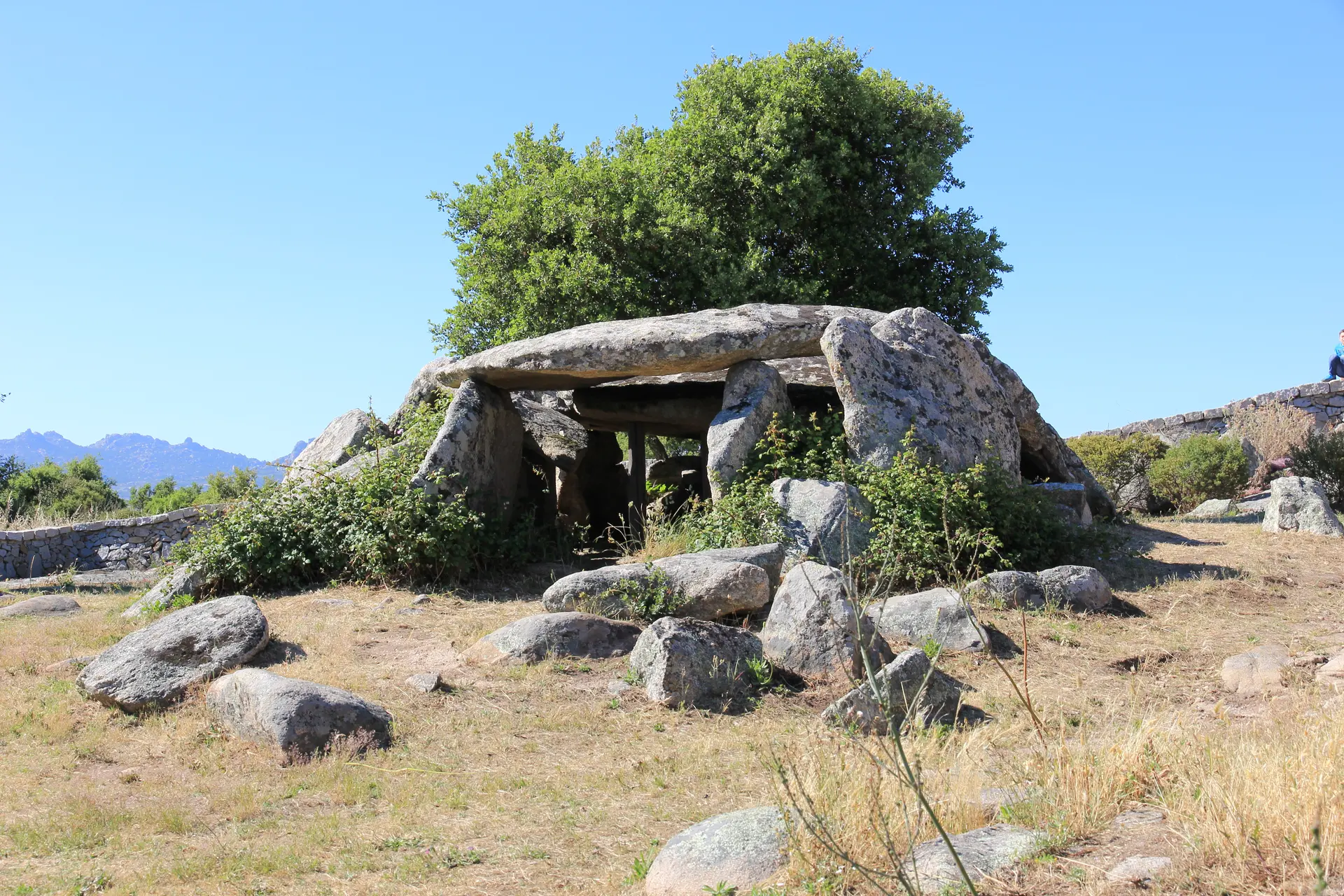
Image of Dolmen di Ladas. Image source · CC-BY-SA-4.0
Visit essentials
A quick read before you go
- Duration
- 30-45 minutes; combine with other Luras dolmens for 1.5-2 hours total
- Access
- From Luras, take SP 10 toward Luogosanto.
Overview
Dolmen di Ladas announces significance through scale: a six-meter gallery, two covering slabs—the largest nearly five meters—and a fifteen-square-meter backing stone worked and polished by hands committed to their task. It is not a tomb but a threshold.
Its allée couverte, or covered-gallery, form creates a corridor rather than a simple chamber. Whatever rituals occurred here, they involved movement, progression, a journey from daylight into the realm of ancestors. Quarrying, transporting, and precisely fitting such slabs demanded shared Neolithic purpose. Their endurance across five millennia marks Ladas as a destination worth that collective cost.
Why this place is sacred
The allée couverte form distinguishes Ladas from simpler dolmen construction. This is not merely a chamber but a gallery—six meters of passage that create ritual space. The living who came here to honor the dead did not simply approach; they entered, they processed, they moved through architecture designed to frame their journey.
The scale is without parallel in the central Mediterranean. The largest covering slab measures 4.80 meters by 3.42 meters, forty-five centimeters thick. Calculating the weight of such a stone, the logistics of its transport and placement, reveals the communal investment that Ladas required. This was not a project for a single family or even a single generation.
The backing stone—fifteen square meters of polished surface—closes the gallery. The care taken with this interior wall speaks of attention to the space's purpose. Those who entered saw stone that had been worked, smoothed, prepared. The rough exterior hid a finished interior.
The walls of the gallery use regular vertical slabs flanked by flat masses arranged obliquely. This engineering created stability that has endured five millennia of weather and earthquake. The Neolithic builders understood their materials and their task: to create something permanent, something that would house the dead as long as the dead required housing.
The apse at the rear of the gallery creates a focal point. Those who processed the six meters of passage arrived at this rounded end, where the dead presumably lay. The architectural progression—entry, passage, arrival—structured whatever rituals occurred here.
The name 'Sepultura de Zigantes' preserves folk wisdom about the monument's strangeness. Giants, paladins, beings of another order—only such figures could account for what ordinary analysis could not explain. The name is not primitive but appropriate: something extraordinary happened here, something that exceeded normal human capacity.
Within Luras, three companion dolmens—Ciuledda, Alzoledda, and Billella—create a sacred landscape. This concentration is unmatched in Sardinia. Whatever logic governed dolmen placement, Luras was central. Ladas, the largest, may have anchored a network of burial sites that together constituted a regional necropolis.
Gallery tomb (allée couverte) for collective burial and processional ritual. Largest dolmen in the central Mediterranean. Part of Luras four-dolmen sacred landscape.
3500-2700 BCE: Dolmen constructed during Late Neolithic. Modern era: Archaeological preservation with explanatory signage.
Experience and orientation
The approach is easy. From the small parking area—space for six or seven cars—a short walk leads to the dolmen. Two explanatory panels offer context in multiple languages. Then the monument itself.
The scale registers first. This is not a modest structure but something ambitious, something that required collective effort to achieve. The two covering slabs that roof the gallery are massive, the larger measuring nearly five meters. Standing beside the entrance, you face architecture that was designed to impress—and still does.
The gallery extends six meters. In processional terms, this is significant space: enough distance to create transition, enough passage to separate entry from arrival. Stepping into the allée couverte, you move from daylight toward the darkness where the dead once lay.
The walls demonstrate care. Regular vertical slabs, flanked by masses arranged obliquely, create stable structure that has endured five millennia. The builders knew what they were doing; the results prove their competence.
The backing stone closes the gallery. Fifteen square meters of surface, worked and polished, create a finished interior that contrasts with the rough exterior. Those who reached this point—after processing the full six meters—encountered prepared space, intentional space, sacred space.
The apse at the rear provides a focal point. The architectural progression leads here, to this rounded end where ceremonies concluded. Whatever the Neolithic people did to honor their dead, this was where they did it.
From Ladas, the other dolmens of Luras are accessible. Ciuledda stands a few hundred meters away. Alzoledda and Billella complete the circuit. Taking them together transforms individual monuments into a landscape—a geography of death that reveals Luras as a place of particular prehistoric significance.
Dolmen di Ladas is located on a rocky plateau near Luras at 472 meters elevation. Accessible by short walk from parking area on SP 10.
Context and lineage
Between 3500 and 2700 BCE, Neolithic communities in what is now Luras undertook their most ambitious construction project: a gallery tomb that would become the largest dolmen in the central Mediterranean. They created an allée couverte—a covered passage—extending six meters, roofed by slabs nearly five meters long, closed by a polished backing stone of fifteen square meters. The result was a processional space where the living could approach the dead through architecture designed to frame the encounter.
For five millennia, Ladas has remained what its builders intended: a monument to the ancestral dead.
Built by Neolithic communities of Sardinia. Part of Western Mediterranean dolmen tradition. No descendant tradition preserves original practices.
Traditions and practice
Collective burials in the gallery tomb. Processional rituals through the six-meter passage. Ancestor veneration at the apse.
Archaeological site visitation. Part of Luras dolmen circuit.
Enter the gallery to experience the processional space. Notice the scale of the covering slabs. Appreciate the polished backing stone. Consider what rituals might have occurred along this six-meter passage. Continue to the other Luras dolmens for full context.
Neolithic Burial Tradition
HistoricalDolmen di Ladas represents the most ambitious expression of the Late Neolithic (3500-2700 BCE) dolmen tradition in the central Mediterranean. The gallery form created processional space for approaching ancestral dead.
No longer practiced. Archaeological evidence indicates collective burial and processional ritual through the six-meter gallery.
Perspectives and open questions
Dolmen di Ladas offers encounter with the central Mediterranean's largest prehistoric tomb—a processional gallery that creates passage to the ancestral dead.
Scholarly perspective
Largest dolmen in Sardinia and central Mediterranean. Gallery tomb (allée couverte) dated to Late Neolithic (3500-2700 BCE). Six meters long, over two meters high. Largest covering slab: 4.80 x 3.42 meters. Fifteen square meter polished backing stone. Served collective burial and processional ritual functions.
Living and traditional perspectives
Local tradition names it 'Sepultura de Zigantes' (Tomb of Giants), attributing construction to mythical beings.
Alternative interpretations
The processional gallery form has been interpreted as creating ritual space for approaching ancestors. Some propose astronomical alignments.
Open questions
The specific rituals performed. The identity of those interred. The ceremonies that accompanied burial. The relationship to other Luras dolmens.
Plan your visit
Access and arrival
From Luras, take SP 10 toward Luogosanto. Turn right at signs. Small parking area (6-7 spaces). Short walk to dolmen.
Accommodations in Luras, Tempio Pausania, Olbia.
Respectful visit
No dress code. Comfortable walking shoes.
Photography permitted.
None; archaeological site.
Do not climb on stonework | Do not damage structure
The gallery is a confined space. Summer can be hot.
Current practical details
Address
Via Tirso, 07025 Luras OT, Italy
Hours
Hours, fees, and access can change — verify on the official source before you travel. Practical details last checked Jun 2026.
Location
Map loads as you approach this section.
Pilgrim reflections
A portrait of encounter, not a score
Pilgrims describe what they felt, how present they could become, and whether the place would shape a journey. There are no stars and no ranking of traditions.
No reviewed reflections yet
The first pilgrims can help describe the character of being here.
Share a reflection
Available after an account-backed “Been there.” Every reflection is reviewed before publication.
Nearby sacred places
Explore other sacred places in the region. Proximity does not establish access or travel time; check each place’s guidance.


References
Sources consulted for this page. Source categories describe the publication, not a guarantee that every claim is verified. Traditional accounts and outside interpretations may differ.
- 01Dolmen di Luras | SardegnaTurismo — Regione Sardegna TourismofficialOfficial tourism information
- 02Dolmen di Ladas | IDESE — Italian Ministry of CultureofficialOfficial cultural heritage database
- 03Dolmen Ladas, Alzoledda, Ciuledda and Billella - Luras — Sardegna verso UNESCOSource contextUNESCO candidacy documentation
- 04Dolmen di Ladas - AroundUs — AroundUsguideVisitor information
Share a photo
Help visitors recognize Dolmen di Ladas. Every submission is reviewed before publication.