Cave of Los Letreros
The clifftop shelter where Almería's guardian symbol was first painted
Understand sacred places, explore living traditions, and learn how to engage respectfully with Pilgrim Map.
Access has not been verified. Check current local guidance before planning a visit.
Vélez-Blanco, Almería, Spain
Read the sources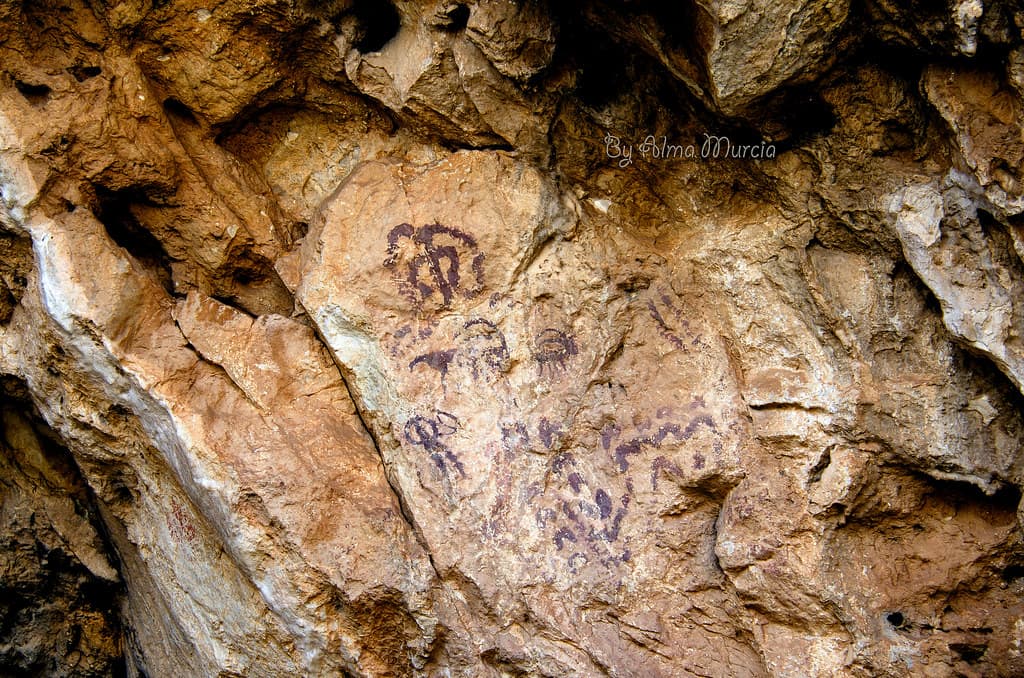
Image of Cave of Los Letreros. Image source
Visit essentials
A quick read before you go
- Duration
- Approximately 1 to 1.5 hours total, including the uphill approach walk from the trailhead, the…
- Access
- Guided-visit only — independent entry is not permitted.
Overview
Somewhere between roughly 7,500 and 4,500 years ago, communities in what is now the Sierra de María-Los Vélez climbed to a cliff shelter and painted archers, animals, abstract signs, and stick-figure 'idols'. One small, faded figure holding what looks like a rainbow in its outstretched hands has traveled far beyond the shelter. That figure is the Indalo, now Almería province's most recognized symbol, painted on house fronts and sold as jewelry as protection against misfortune.
Its origin is Cueva de los Letreros — the 'Cave of Inscriptions' — named for the red-pigment marks early observers mistook for writing.
Why this place is sacred
Most rock art sites offer only archaeological significance — images whose original meaning has been entirely lost to the communities that made them. Los Letreros offers something more unusual: a direct, traceable line from a single prehistoric figure to a symbol still painted on doors and sold as jewelry today.
The Indalo — a stick figure holding an arc, interpreted as a rainbow — was extracted from this shelter's panel and adopted, in the twentieth century, as a protective charm and later as the official emblem of Almería province.
The rest of the panel is harder to pin to any single narrative. Around 174 figures crowd the shelter in predominantly red ochre: hunters with bows, animals, abstract signs, and several anthropomorphic 'idol' figures, most strikingly a large horned figure known as 'El Brujo' — the Sorcerer or Witchdoctor.
Academic analysis has proposed that this figure depicts a ritual specialist, possibly tied to fertility or pastoral-protection magic connected to livestock and land, but this remains a scholarly hypothesis rather than a documented rite; no text or continuous oral account explains what the community that painted El Brujo believed he did.
What gives the site its particular charge is less any single answer than the coexistence of two very different kinds of evidence: rigorous but incomplete archaeological interpretation of the panel as a whole, and a folk tradition — the Indalo custom — that is genuinely alive, verifiably continuous in some form, and still shapes how the region sees itself.
The shelter was used across an extended span from the Neolithic into the Chalcolithic and Bronze Age by early agro-pastoral communities, who returned repeatedly to add figures to the panel. There is no single founding act or purpose to identify — like most sites in the wider Levantine-Schematic tradition, its significance accumulated through repeated use by different groups over centuries, likely tied to hunting, fertility, or territorial marking, though the specific intent behind any individual figure is not confirmed.
Ceremonial or symbolic use of the shelter appears to have ended with prehistory; it then passed through documentation (first published by Manuel Góngora y Martínez in 1868, scientifically surveyed by Henri Breuil and Juan Cabré in 1913) into its current status as a protected UNESCO component site.
Separately, and much later, the Indalo image was lifted from the panel and adopted by the mid-twentieth-century Mojácar artist community as a protective emblem — a modern act of meaning-making distinct from, though inspired by, the prehistoric original.
Experience and orientation
Reaching Los Letreros takes effort before it offers anything to see: a guide meets visitors in Vélez-Blanco, drives the group to a trailhead off the A-317, and leads them up a roughly 1 to 1.5 kilometre approach that climbs via stairway and zigzag ramps partway up a cliff face. Accounts consistently note the exposure and the views that come with it — the Vélez valley opening out below as the path ascends.
At the shelter itself, a metal security fence separates visitors from the panel, viewed rather than entered. What visitors describe finding there is often a moment of recognition rather than surprise: the Indalo figure many will already have seen painted on a Mojácar doorway or sold as a keychain, now visible in its faded, original red-ochre form alongside dozens of other figures, including the horned El Brujo.
Several accounts describe the site's remoteness and guided-only format as giving it a quieter, less touristic character than its symbolic fame might suggest.
The climb is the main physical consideration — comfortable hiking footwear matters more here than at many rock art sites, since the approach is steep and partly exposed. Visitors report that pausing at the fence rather than photographing quickly is what allows the panel's scale and the density of its figures to register.
Context and lineage
The shelter's modern documentation history has several dates attached to it depending on which event a source describes: some cite 1861 as a discovery date, but the first published account is Manuel Góngora y Martínez's 1868 work, and the first rigorous scientific survey — drawings and rubbings by Henri Breuil and Juan Cabré — dates to 1913.
As with La Pileta, prehistoric use long predates any of this documentation; the panel itself carries no legend of its own creation, only the images its makers left. Local folklore has since supplied a story for its most famous figure: that the Indalo was a spirit capable of holding a rainbow, or a man who sheltered from a storm in the cave and left his image on the wall as the rain cleared.
Some tourism sources also connect the name 'Indalo' to Saint Indaletius, a legendary early bishop of Almería, though this etymology is contested and may be a later overlay rather than the image's original meaning.
No continuous prehistoric ritual lineage survives at the shelter itself. What does continue is the Indalo folk custom — painting or displaying the figure for protection and luck — passed through generations of Almerían communities and now formalized as the province's official civic emblem, a lineage of adopted meaning rather than unbroken prehistoric belief.
Manuel Góngora y Martínez
documenter
Published the first documented account of the shelter's rock art in 1868.
Henri Breuil
archaeologist
French prehistorian who led the first scientific survey and rubbing campaign at the shelter in 1913.
Juan Cabré Aguiló
archaeologist
Spanish archaeologist who collaborated with Breuil on the 1913 documentation and later led his own excavations in the area from 1916.
The Mojácar artist community
modern steward of symbol
Mid-20th-century artists in nearby Mojácar are credited with popularizing the Indalo figure as a regional protective emblem, extending its meaning well beyond the prehistoric panel.
Traditions and practice
Academic analysis of the horned 'El Brujo' figure has proposed that it depicts a ritual specialist — a shaman or sorcerer — possibly linked to fertility or pastoral-protection magic connected to livestock and land. This is a scholarly hypothesis drawn from the figure's form and position in the panel, not a documented ritual; no surviving text or oral tradition describes what, if anything, was actually performed.
The site itself hosts no ceremony. Its living ritual legacy exists entirely off-site: the Indalo is painted on the exterior walls of homes and businesses throughout Almería province as a protective gesture, and sold as jewelry, keychains, and pottery, with a folk belief — noted by multiple sources — that the charm confers luck only if received as a gift rather than bought for oneself.
Visitors who want to engage with the site as more than a photo stop might notice, on the climb up, that they are retracing a route to a place people once considered worth the effort to reach and mark — then carry that recognition into wherever they later encounter the Indalo again, on a doorway or a piece of jewelry, as the same image continuing its very long second life.
Prehistoric Levantine/Schematic rock art tradition
HistoricalThe shelter's roughly 174 figures, painted predominantly in red ochre, represent one of the most important painted panels in southern Iberia and a core site within the UNESCO-listed Rock Art of the Mediterranean Basin.
Believed by researchers to relate to hunting-magic, fertility ritual, territorial marking, or symbolic communication among early agro-pastoral communities; no liturgical text or continuous oral tradition confirms specific rites.
Indalo folk-protective custom
ActiveThe Indalo figure originates from this shelter's panel and has become the most recognized rock-art image in the region, regarded locally as a protective totem warding off misfortune and adopted as the official emblem of Almería province.
Painted or displayed on the exterior walls of homes and businesses throughout Almería; sold and gifted as jewelry, keychains, and pottery, with folk belief holding that the charm confers luck only when received as a gift.
Archaeological and heritage stewardship
ActiveThe shelter remains an active subject of archaeological study and is managed under Spanish and UNESCO heritage frameworks as part of the Rock Art of the Mediterranean Basin listing.
Guided-access management, panel fencing, and ongoing scholarly analysis, including academic work specifically addressing the El Brujo figure's possible ritual meaning.
Perspectives and open questions
Los Letreros sits at an unusual intersection: rigorous but incomplete archaeological reading of an ancient panel, and a genuinely living folk tradition built from one image lifted out of it. Neither perspective should be allowed to overwrite the other.
Scholarly perspective
Archaeologists broadly agree that the shelter's roughly 174 figures were created over an extended period spanning the Neolithic into the Chalcolithic and Bronze Age by early agro-pastoral communities, and that the imagery likely served symbolic, ritual, or communicative functions tied to subsistence, territory, or belief — though the precise meaning of individual figures, including the Indalo and El Brujo, remains debated rather than settled.
Living and traditional perspectives
The closest living 'traditional' framework connected to the site is the regional Almerían folk custom that treats the Indalo as a protective guardian figure — a belief transmitted through generations of local communities rather than an unbroken line back to the prehistoric painters themselves.
Alternative interpretations
Popular and esoteric interpretations frame the Indalo as a rainbow-holding deity, spirit, or divine messenger, and some sources link the name to Saint Indaletius or to broader ideas of ancient sky-god worship. These readings carry real cultural weight but are not supported by direct prehistoric textual or iconographic evidence, and are best understood as belief and legend rather than established fact.
Open questions
The exact ritual purpose of the panel, the identity and role of the El Brujo figure, why this particular combination of animals, archers, and abstract signs was assembled at this shelter, and the true etymology and original meaning of the image later called Indalo all remain open questions, with no surviving textual record from the culture that made them to settle the matter.
Plan your visit
Access and arrival
Guided-visit only — independent entry is not permitted. Visitors typically arrange a guide through the Vélez-Blanco tourist office (Almacén del Trigo), where identification may be requested; the group then drives to a trailhead near a petrol station off the A-317 north of Vélez-Blanco and follows a signed path with stairs and zigzag ramps partway up the cliff to the fenced shelter.
Mobile signal along the approach path should be assumed unreliable given the remote, exposed cliffside setting; confirm booking details before leaving Vélez-Blanco, where the tourist office serves as the nearest point of contact and settlement with full services.
Vélez-Blanco offers the closest lodging options; no accommodation exists at the shelter itself, and the tourist office there is also the point of contact for arranging the guided visit.
Respectful visit
No formal dress code, but sturdy hiking footwear is recommended given the steep, exposed approach path and stairway/ramp ascent.
Photography for personal use is generally permitted during guided visits, though visitors should follow the guide's instructions; flash or close-contact photography near the fragile pigment may be restricted.
There is no offerings tradition at this site.
Visitors must not touch the rock art panel, and entry beyond the security fence is prohibited. The shelter can only be visited as part of a guided tour arranged through the Vélez-Blanco tourist office — independent entry is not permitted.
There is no ceremony to observe or replicate at the shelter, and visitors should not expect or request ritual framing from guides, whose role is custodial. If drawn to the Indalo tradition itself, the appropriate way to participate is off-site, through the regional gift custom, rather than through any act at the prehistoric panel.
Location
Map loads as you approach this section.
Pilgrim reflections
A portrait of encounter, not a score
Pilgrims describe what they felt, how present they could become, and whether the place would shape a journey. There are no stars and no ranking of traditions.
No reviewed reflections yet
The first pilgrims can help describe the character of being here.
Share a reflection
Available after an account-backed “Been there.” Every reflection is reviewed before publication.
Nearby sacred places
Explore other sacred places in the region. Proximity does not establish access or travel time; check each place’s guidance.


References
Sources consulted for this page. Source categories describe the publication, not a guarantee that every claim is verified. Traditional accounts and outside interpretations may differ.
- 01Rock Art of the Mediterranean Basin on the Iberian Peninsula — UNESCO World Heritage CentreofficialOfficial UNESCO World Heritage listing (inscribed 1998) covering 727 rock-shelter sites across eastern Spain, including the Almería sites; confirms overall designation and significance as largest rock-art concentration in Europe.
- 02La Cueva de los Letreros en Vélez-Blanco, Almería — Junta de Andalucía — Agenda Cultural de AndalucíaofficialRegional government cultural agency page; states paintings date to first inhabitants of the Vélez area c. 7,500 years ago and confirms the Culture and Sport Department's role in protection, conservation, and access management.
- 03CUEVA DE LOS LETREROS - Ventana del Visitante - Portal Ambiental — Junta de Andalucía — Consejería de Sostenibilidad, Medio Ambiente y Economía AzulofficialOfficial environmental/visitor portal; confirms guided-access model (meet guide, drive to trailhead, ~1.5km approach walk) within the Sierra de María-Los Vélez Natural Park.
- 04Los inicios de la documentación gráfica del Arte Rupestre en España: La Comisión de Investigaciones Paleontológicas y Prehistóricas — Museo Nacional de Ciencias Naturales (MNCN-CSIC)academicAcademic history-of-archaeology source documenting Henri Breuil and Juan Cabré's 1913 scientific survey, drawing, and rubbing campaign at Los Letreros and neighboring Vélez-Blanco/Vélez-Rubio shelters, following the site's earlier description by Manuel Góngora y Martínez in 1868.
- 05Indalo — Wikipedia — Wikipedia contributorsencyclopediaSummarizes origin, dating (c. 2500 BC), location in Cueva de los Letreros, iconography, and modern cultural adoption as the symbol of Almería province.
- 06Rock art of the Iberian Mediterranean Basin — Wikipedia — Wikipedia contributorsencyclopediaBackground on the broader UNESCO-listed rock art tradition (Levantine, Schematic, Macroschematic styles) to which Los Letreros belongs.
- 07Cueva de Los Letreros de Vélez-Blanco — PRAT / CARP (Prehistoric Rock Art Trails / Camino de Arte Rupestre Prehistórico project)academicEU-funded transnational prehistoric-rock-art heritage project profile of the site, used for cross-referencing archaeological framing.
- 08El brujo de la Cueva de los Letreros (Vélez Blanco, Almería) ¿Un conjuro para proteger el ganado y fecundar la tierra? — Revista Cuadernos de Arte PrehistóricoacademicAcademic journal article specifically analyzing 'El Brujo' (the Sorcerer/Witchdoctor) figure as a possible fertility/protective-magic ritual image; used for interpretive-perspectives section on the sorcerer figure's ritual meaning.
- 09Rock Art - UNESCO World Heritage — Andalucia.comguideRegional tourism/heritage guide confirming 1998 UNESCO inscription of 727 shelters across Valencia, Murcia, Catalonia, Almería, Granada and Jaén.
- 10Cueva de los Letreros, Velez Blanco | Cave visits in Andalucia — Andalucia.comguideDetails on shelter dimensions (25m wide, ~6m deep, 8-10m high in central area), 1861 discovery date, ~174 identified figures, predominance of red pigment, and description of 'El Hechicero' (The Witchdoctor/Sorcerer) figure.
- 11Cueva de Los Letreros in Velez Blanco, Almeria, Andalucia is where the Indalo Man inscription was found — Visit-Andalucia.comguideDescribes the Indalo pictograph as a c. 2500 BC stick figure holding a rainbow-like arc, and situates the shelter within the wider Sierra de María-Los Vélez rock art landscape.
- 12What Does The Indalo Symbol Mean? History & Facts — Mojácar Life NewsblogLocal-interest piece on the Indalo's adoption as a protective/lucky charm painted on house and business fronts, and its association with Mojácar's mid-20th-century artist community.
Share a photo
Help visitors recognize Cave of Los Letreros. Every submission is reviewed before publication.