Basilica Shrine of Caravaca de la Cruz, Spain
Where angels carried a cross to a captive priest, and pilgrims still climb toward grace
Understand sacred places, explore living traditions, and learn how to engage respectfully with Pilgrim Map.
Access has not been verified. Check current local guidance before planning a visit.
Caravaca de la Cruz, Murcia, Spain
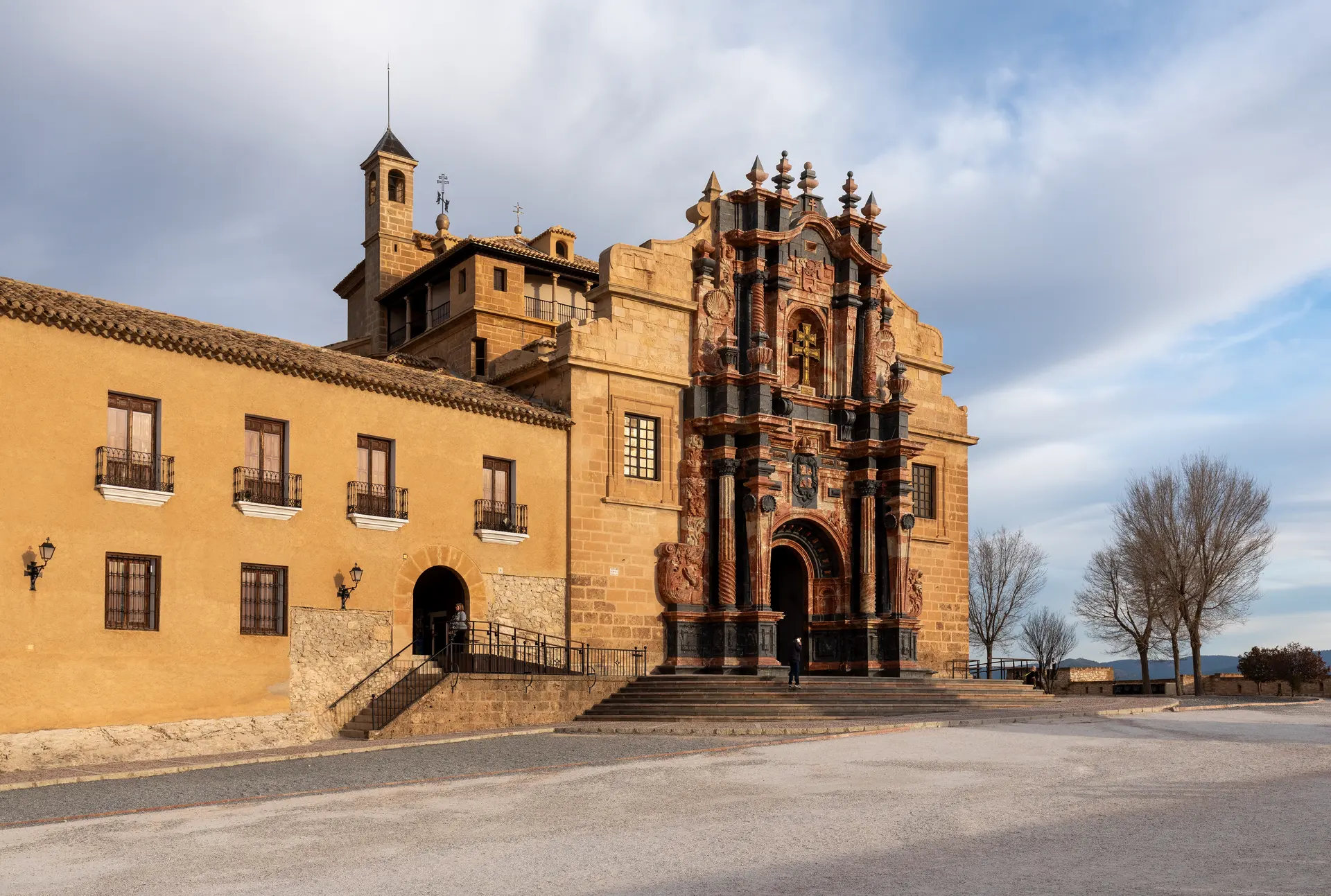
Image of Basilica Shrine of Caravaca de la Cruz, Spain. Image source · CC-BY-SA-4.0
Visit essentials
A quick read before you go
- Duration
- Half a day to explore the basilica, castle, and museum at a contemplative pace.
- Access
- Located in the town of Caravaca de la Cruz, approximately 70 km northwest of Murcia city in the…
Overview
Above Caravaca de la Cruz, medieval walls lead to a hilltop where an Islamic fortress became a Christian sanctuary and a double-armed cross has drawn pilgrims since the thirteenth century. Tradition says two angels brought the captive priest Gines Perez de Chirinos a cross containing the Lignum Crucis when he lacked a crucifix for Mass before a Moorish king; historians read the account as a Reconquista-era foundation legend. Either way, pilgrimage has continued for nearly eight hundred years.
With Rome, Jerusalem, Santiago de Compostela, and Santo Toribio de Liebana, Caravaca holds the privilege of a Perpetual Jubilee. Every seven years the Holy Door opens, and pilgrims arriving by the Camino de Levante or other designated routes may receive plenary indulgence. Daily Mass and display of the Vera Cruz continue between jubilees, alongside the annual May festival and its UNESCO-recognized Wine Horses race.
The austere military exterior and theatrical baroque basilica hold the site's unresolved layers of fortification, relic, conflict, and devotion.
Why this place is sacred
The hilltop position is the first threshold. Rising from the town below, visitors ascend through fortified walls that have witnessed the passage of Moorish rulers, Knights Templar, the Order of Santiago, and centuries of Catholic pilgrims. The climb itself enacts a separation from the ordinary world, each step upward carrying the visitor further from the daily and closer to something set apart.
At the summit, the convergence intensifies. The Vera Cruz relic, a double-armed cross of the patriarchal or Lorraine type, is believed to contain a fragment of the Lignum Crucis, the actual wood of Christ's cross. The relic's journey to Caravaca, whether by angelic delivery or Templar convoy, connects this hilltop in southeastern Spain to Jerusalem, to Golgotha, to the central event of Christian soteriology.
To stand before the reliquary is to stand at the end of a chain of custody, real or imagined, stretching back two millennia.
The architectural layering reinforces this quality of accumulated sacred presence. Each successive custodian built upon what came before, the Moorish fortress giving way to Templar towers and then to the baroque basilica, each layer adding its own form of devotion to the same hilltop. The result is a place where the boundaries between faiths, centuries, and worlds feel permeable.
The Holy City designation amplifies the effect, setting Caravaca in kinship with Jerusalem and Rome and creating a spiritual geography that transcends physical distance. Pilgrims who arrive during jubilee years report a sense of participating in something that connects them not only to this site but to the entire network of Christian sacred geography.
The castle was originally an Islamic military fortification controlling the surrounding territory. Following the legendary miracle of 1232 and the subsequent Christian reconquest, it was transformed into a sanctuary for the Vera Cruz relic. The Knights Templar, entrusted with the site from 1266, maintained it as both military stronghold and religious sanctuary, embodying the medieval fusion of martial and spiritual purpose.
The site's transformation from Islamic fortress to Templar commandery to Catholic basilica traces the broader religious and political evolution of medieval Iberia. After the Templar dissolution in the early fourteenth century, the Order of Santiago assumed custodianship. The current baroque basilica, begun in 1617 and completed in 1703, replaced earlier structures and established the architectural presence visitors encounter today.
The granting of Minor Basilica status in 2007 and the Perpetual Jubilee privilege formalized what centuries of pilgrimage had already established: Caravaca as a place of enduring spiritual significance.
Experience and orientation
The approach through the castle gates establishes the quality of the encounter. Stone walls that once defended against siege now channel visitors upward through a narrowing passage, the town falling away below, the sky opening above. By the time the basilica facade appears within the fortress, the transition from everyday life to sacred precinct feels complete.
Inside, the contrast intensifies. The baroque interior is theatrically ornate, every surface worked with devotional imagery. The eye is drawn forward and upward toward the space where the Vera Cruz relic is displayed. When the relic is brought out at its scheduled hours, the gathering of visitors waiting for its appearance carries its own quality of anticipation and communal devotion.
Those who time their visit to the display of the relic describe a charged stillness in the room. The cross is small, the reliquary elaborate, and the gap between the modest fragment of wood and its claimed significance, a piece of the instrument of Christ's death, generates a contemplative tension that each visitor must resolve in their own way. Some weep. Some pray.
Some simply stand in its presence and allow the accumulated weight of centuries of devotion to work upon them.
From the castle walls, panoramic views of the Murcian countryside complete the experience. The arid landscape stretching to the horizon reinforces the sense of the hilltop as a place set apart, elevated above the ordinary terrain of daily life.
Begin your visit by walking up through the town rather than driving. The physical ascent through the medieval streets and castle walls is integral to the experience. Allow the climb to establish the contemplative quality of the encounter before entering the basilica. If possible, time your arrival to coincide with the relic's display schedule.
After viewing the Vera Cruz, spend time on the castle walls, where the expansive views offer a different register of sacred encounter, one that connects the intimate devotional interior to the vast landscape beyond.
Context and lineage
In 1232, the captive priest Gines Perez de Chirinos was brought before the Moorish king Abu Zeid and ordered to demonstrate the celebration of Mass. Lacking a crucifix, the priest could not proceed. According to the tradition that has sustained Caravaca's identity for nearly eight centuries, brilliant light filled the chamber. Two angels descended bearing a double-armed cross containing the Lignum Crucis, a fragment of the True Cross.
During the consecration, Abu Zeid reportedly witnessed a vision of the Christ Child and immediately converted to Christianity.
An alternative account holds that the Knights Templar brought the relic from the Holy Land and installed it in the castle for safekeeping. Historians tend to view the miracle narrative as a foundation legend that legitimized Christian claims to the region during the Reconquista. Whatever the historical reality, the legend's power to draw pilgrims has never diminished.
The site's custodianship traces a lineage through some of the most consequential institutions of medieval Christendom. From the Moorish governors who controlled the original fortress, guardianship passed to the Knights Templar in 1266 under the authority of King Alfonso X. When the Templar order was dissolved in the early fourteenth century, the Order of Santiago assumed responsibility. The construction of the baroque basilica in the seventeenth century marked the transition from military to purely devotional custodianship.
Today, the Diocese of Cartagena oversees the sanctuary, while the municipal and regional governments manage the castle and its heritage programs.
Gines Perez de Chirinos
The captive priest whose celebration of Mass before the Moorish king occasioned the miraculous appearance of the cross
Abu Zeid
Moorish king whose command to witness the Mass led to the miracle and his own conversion to Christianity
Knights Templar
Military-religious order entrusted with defending Caravaca and safeguarding the relic from 1266 until their dissolution
Friar Alberto de la Madre de Dios
Court architect who designed the current baroque basilica, begun in 1617
Pope John Paul II
Granted Caravaca the privilege of Perpetual Jubilee in 1998, confirming its status among the five Catholic Holy Cities
Traditions and practice
The most distinctive traditional practice is the Bathing of the Cross, held annually on May 3. The Vera Cruz relic is ceremonially dipped in water, which is then distributed to the faithful, who believe it carries healing properties. This ritual connects to ancient Iberian water-blessing traditions and draws large crowds to the basilica.
The Caballos del Vino, the Wine Horses, is a tradition inscribed on UNESCO's Intangible Cultural Heritage list. During the May festival, elaborately caparisoned horses race up the steep castle hill, commemorating a legendary Templar relief of the besieged town. The spectacle combines devotional significance with the visceral thrill of horses charging upward through narrow streets.
The Moros y Cristianos parades during the May 1-5 festival reenact the historical battles between Moors and Christians, processing through the old town in elaborate costumes that embody the site's layered history of conflict and conversion.
Daily Mass is celebrated in the basilica year-round, anchoring the site in ongoing liturgical life. The Vera Cruz relic is displayed at scheduled times, typically thirty minutes past the hour during opening times, allowing visitors to view the cross in its ornate reliquary.
During jubilee years, celebrated every seven years with the most recent in 2024, pilgrims walk the Camino de Levante from Orihuela or other designated routes, collecting credential stamps along the way. Passage through the Holy Door of the basilica completes the pilgrimage and enables the receipt of plenary indulgence.
The annual patronal festival from May 1-5, declared of International Tourist Interest, brings together religious processions, cultural celebrations, and the dramatic Wine Horses race in a fusion of devotional and festive energy.
If visiting outside festival season, time your arrival to the relic's display schedule to experience the communal anticipation as visitors gather for its appearance. Attend Mass if the liturgical setting resonates with your practice. Walk the castle walls after viewing the relic, allowing the panoramic views to settle whatever arose in the intimate interior space.
For those drawn to the pilgrimage dimension, the Camino de Levante offers a multi-day walking route that transforms the visit from destination to journey. Even walking the final kilometers from the town center up through the medieval streets to the hilltop can carry a pilgrimage quality if approached with intention.
Roman Catholic pilgrimage and Perpetual Jubilee
ActiveCaravaca de la Cruz is one of only five Catholic Holy Cities worldwide, alongside Rome, Jerusalem, Santiago de Compostela, and Santo Toribio de Liebana. Pope John Paul II granted it the privilege of Perpetual Jubilee in 1998, permitting the celebration of a jubilee year every seven years in which pilgrims can receive plenary indulgence.
Pilgrims walk the Camino de Levante from Orihuela or other designated routes, collecting credential stamps along the way. During jubilee years, they pass through the Holy Door of the basilica. Year-round, daily Masses and devotional prayers before the Vera Cruz relic sustain the pilgrimage tradition. The annual patronal festival from May 1-5 brings the community's devotion to its most public and festive expression.
Fiesta de la Santisima y Vera Cruz with Caballos del Vino
ActiveThe annual patronal festival from May 1-5 is declared of International Tourist Interest. The Caballos del Vino (Wine Horses) tradition, inscribed on UNESCO's Intangible Cultural Heritage list, combines devotional procession with a spectacular horse race up the castle hill, commemorating the legendary Templar relief of the besieged town.
Elaborately caparisoned horses race up the steep castle hill at remarkable speed. The Moros y Cristianos parades process through the old town in costumes representing the historical battles between Moors and Christians. The Bathing of the Cross on May 3 involves ceremonially dipping the Vera Cruz in water that is then distributed to the faithful. Religious processions, cultural events, and communal celebrations fill the five-day festival.
Knights Templar heritage
HistoricalFrom 1266, the Knights Templar were entrusted by Alfonso X with defending Caravaca and safeguarding the True Cross relic. They fortified the castle with fifteen towers and maintained it as both military stronghold and religious sanctuary until the order's dissolution in the early fourteenth century. Their legacy is woven into the site's architecture and historical identity.
The Templars expanded the castle fortifications, maintained a permanent military and religious presence, and established the frameworks of relic custodianship that successors would continue. Their tenure represents the period when martial and devotional functions were most explicitly fused at the site. Today, their legacy is commemorated in annual medieval fairs and interpreted through the castle's architectural remains.
Perspectives and open questions
Caravaca de la Cruz sits at the intersection of historical event, miracle tradition, and living pilgrimage. How one interprets the site depends in large part on one's relationship to these overlapping frames of meaning.
Scholarly perspective
Historians generally view the miracle legend as a medieval foundation narrative that legitimized Christian claims to the region during the Reconquista. The relic likely arrived through Templar networks connecting the Holy Land to Iberian frontier castles. The castle's transformation from Islamic fortress to Christian sanctuary reflects the broader cultural and religious shifts of medieval Iberia.
The concentration of military-religious orders at Caravaca, first the Templars and then the Order of Santiago, corresponds to the political strategy of securing reconquered territory through the establishment of sacred sites.
Living and traditional perspectives
The Catholic tradition receives the miraculous delivery of the cross not as legend but as living faith. That founding narrative has been central to local identity for nearly eight centuries and remains the conviction of the community and the millions of pilgrims who visit. The papal granting of Perpetual Jubilee status in 1998 represents the Church's formal endorsement of Caravaca's spiritual significance.
The tradition is not merely historical: it is renewed with each jubilee year, each May festival, each daily Mass celebrated in the presence of the Vera Cruz.
Alternative interpretations
The Cross of Caravaca, with its distinctive double horizontal bars, has been adopted in various folk magic and syncretic spiritual traditions, particularly in Latin American and Caribbean practices. It appears as a protective amulet and in folk rituals for blessing and healing, extending its significance well beyond orthodox Catholic devotion.
This diffusion speaks to the cross's power as a symbol that transcends its institutional context, carrying meaning into communities and practices the medieval builders of the basilica could never have anticipated.
Open questions
In 1934, the original Lignum Crucis was stolen during the turbulent period preceding the Spanish Civil War. While a fragment was recovered, questions persist about whether the current relic contains any of the original medieval material. The precise provenance of the original relic and how it arrived in Caravaca before the documented Templar period remain historically unresolved.
These gaps do not diminish the site's devotional power, but they place it in a space of faith rather than certainty, which may be precisely the point.
Plan your visit
Access and arrival
Located in the town of Caravaca de la Cruz, approximately 70 km northwest of Murcia city in the Region of Murcia, southeastern Spain. Accessible by road; no direct rail service, with the nearest stations in Murcia or Cieza. The basilica sits atop the castle hill, reached on foot through the medieval streets or by car to a point near the summit. Mobile phone signal is available throughout the town and at the hilltop.
No specific accessibility arrangements were documented at time of writing; contact Turismo Region de Murcia for current details.
The town of Caravaca de la Cruz offers hotels, guesthouses, and rural accommodation options. During jubilee years and the May festival, booking well in advance is essential. The town center provides easy walking access to the castle hilltop.
Respectful visit
Modest attire appropriate for a Catholic place of worship. Shoulders and knees should be covered when entering the basilica. The castle grounds and exterior are less formal, but the hilltop can be hot in summer and cool in winter.
Photography is generally permitted in the castle grounds and exterior. Interior photography in the basilica may be restricted during services. Flash photography near the relic is discouraged. When in doubt, observe what others are doing.
Candles can be lit in the basilica. Donations are welcomed for the maintenance of the sanctuary. During the May festival, participation in the public celebrations is the most meaningful offering.
Silence and reverence are expected inside the basilica, particularly during Mass and relic display times. The relic cannot be touched. No food or drink inside the basilica. During the May festival, follow crowd management instructions, especially near the Wine Horses route.
The relic is displayed behind protective glass and cannot be touched. During the May festival, the town becomes extremely crowded, and the Wine Horses race involves real horses at speed through narrow streets; maintain safe distances. Summer heat in Murcia can be intense; plan the hilltop ascent for morning or evening during July and August.
Current practical details
Address
C. Cta. del Castillo, 9, 30400 Caravaca de la Cruz, Murcia, Spain
Phone
Hours
Hours, fees, and access can change — verify on the official source before you travel. Practical details last checked Jun 2026.
Location
Map loads as you approach this section.
Pilgrim reflections
A portrait of encounter, not a score
Pilgrims describe what they felt, how present they could become, and whether the place would shape a journey. There are no stars and no ranking of traditions.
No reviewed reflections yet
The first pilgrims can help describe the character of being here.
Share a reflection
Available after an account-backed “Been there.” Every reflection is reviewed before publication.
Nearby sacred places
Explore other sacred places in the region. Proximity does not establish access or travel time; check each place’s guidance.


Share a photo
Help visitors recognize Basilica Shrine of Caravaca de la Cruz, Spain. Every submission is reviewed before publication.