Sanctuary of the Fuensanta
The holy spring that named a mountain, and the drought-ending Virgin Murcia calls La Morenica
Understand sacred places, explore living traditions, and learn how to engage respectfully with Pilgrim Map.
Access has not been verified. Check current local guidance before planning a visit.
Murcia, Murcia, Spain
Read the sources
Visit essentials
A quick read before you go
- Duration
- A visit to the sanctuary itself typically takes 30-60 minutes; the romería pilgrimage days are…
- Access
- Located in Algezares within the Sierra del Valle Natural Park, about 5-5.5 km south of Murcia…
Overview
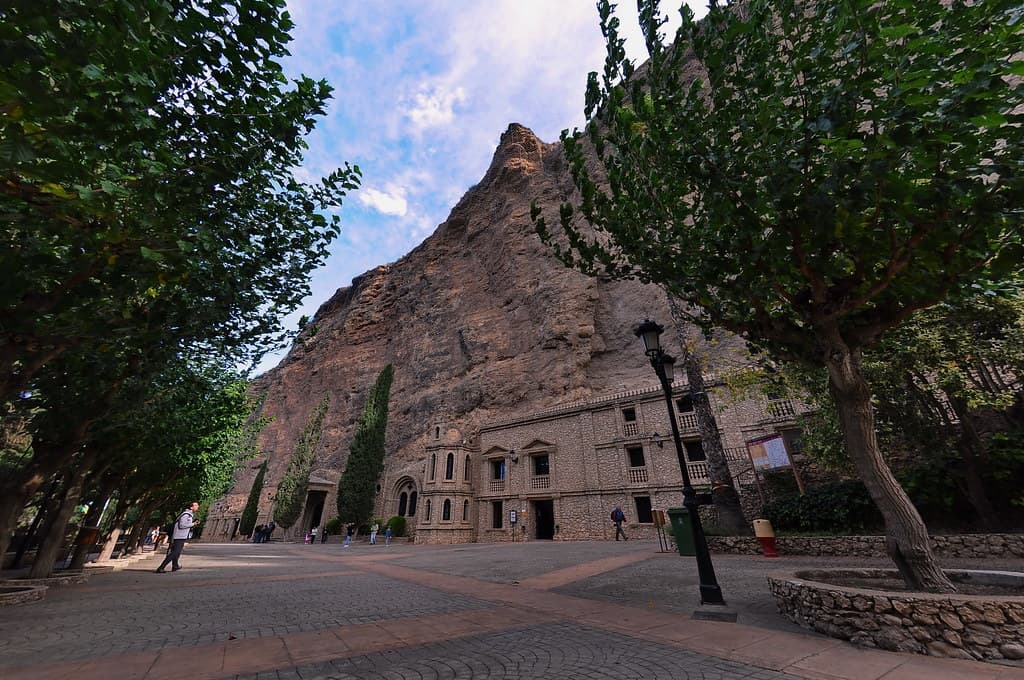
Monte Fuensanta means holy-spring mountain. Versions of the Virgin's story disagree whether the spring preceded the apparition or flowed because of it. January 1694 is firmer: after a punishing drought, her image was carried down from the mountain hermitage to Murcia, and subsequent rain was credited to her intercession.
That winter transformed a modest medieval devotion, first documented in 1429 and likely older, into the region's central civic-religious cult. A new Baroque mountain sanctuary stood by 1705, its facade and reliefs made by named architects and sculptors. The Virgen de la Fuensanta became Murcia's formal patroness in 1731 and was canonically crowned before a crowd on the Puente de los Peligros in 1927.
Murcianos still affectionately call her 'La Morenica'—the little dark-skinned one—joining formal patroness with familiar hometown image. Twice yearly, in Lent and September, she descends the mountain and Murcia walks her back up.
Why this place is sacred
Most sacred sites accumulate their significance slowly, through centuries of undocumented use. The Fuensanta is unusual in having a hinge point historians can actually date: January 17, 1694, when the image was first brought down from the mountain to Murcia during a severe drought, and the rains that followed were read as her answer. That single winter did more to establish the site's civic-religious weight than the preceding two and a half centuries of quieter hermitage devotion combined.
Beneath that datable history sits an older, less resolved layer — the legend of the 'fuente santa' itself, the holy spring on the slope of El Hondoyuelo that gives the mountain and the Virgin both their name. Sources differ on the exact sequence: some describe a shepherd finding a Marian image near an already-flowing spring; others describe a Marian apparition on the mountainside that caused the spring to flow in the first place.
Neither version is treated as verified history by the sources reviewed, and no single authoritative account has survived beyond this pattern of retelling. What both versions share is the same underlying claim — that water, healing, and the Virgin's presence are bound together at this specific point on the mountain, well before the earliest documentary reference to a hermitage here in 1429.
The Civil War tested that continuity directly. When the sanctuary's interior was destroyed, the image itself survived only because a private citizen, Fernando Monerri, hid it — keeping it concealed until March 1939. That the devotion resumed at full civic scale afterward, with the interior fully restored by mid-century, suggests the attachment was never really about the building.
The mountain hermitage existed from at least 1429 as a site of Marian devotion tied to the holy spring legend, with no documented function beyond housing the venerated image and receiving visitors and petitioners from the surrounding huerta. Its transformation into a civic patroness cult with a purpose-built Baroque sanctuary followed directly from the 1694 drought-ending processions.
The medieval hermitage gave way to the current Baroque sanctuary, built 1694-1705, its facade designed by Toribio Martínez de la Vega and its sculptural reliefs the work of Jaime Bort, completed by José Balaguer. Later additions filled out the interior: a main altarpiece by Antonio Carrión Valverde and Nicolás Prados López, and dome and choir murals by Pedro Flores García.
The Spanish Civil War interrupted this accumulated interior entirely — it was destroyed, and the image itself hidden and preserved by Fernando Monerri until March 29, 1939 — after which a 20th-century restoration included new side-chapel reliefs by Juan González Moreno. The devotion itself formalized in parallel: patroness designation in 1731, canonical coronation on April 24, 1927, at the Puente de los Peligros in Murcia, and the eventual splitting of the pilgrimage calendar into the twice-yearly bajada/subida cycle now observed.
Experience and orientation
For most of the year, a visit here is unhurried. The sanctuary sits within the Sierra del Valle Natural Park, reached by a short drive or bus ride from the city, and a typical visit — thirty to sixty minutes inside the church — leaves time to take in the dome frescoes, the sculpted reliefs recounting episodes from Mary's life, and the view south over the Segura river valley and Murcia's fertile huerta.
Visitors and pilgrims consistently mention this view and the Baroque interior's ornamentation as the two things that stay with them.
The other register is entirely different. Twice a year the image leaves the mountain for Murcia Cathedral and the sanctuary becomes a departure and return point for one of Spain's most heavily attended Marian pilgrimages, mentioned in the same breath as El Rocío and the Virgen de la Cabeza.
The September Subida in particular is reported to draw over half a million people walking the image back up the mountain — not a formal confraternity procession but an open, public accompaniment that turns the whole route into a shared civic event. For local Murcianos, the site functions as a strong marker of regional identity and continuity of custom; visitors arriving specifically for a romería should expect a genuinely large crowd rather than a contemplative visit.
Decide in advance which register you want. A quiet visit to the Baroque sanctuary and its views is best taken outside the Lent and September pilgrimage windows, in the late morning or afternoon opening hours. Arriving specifically for a bajada or subida means arriving for a large, loud, genuinely civic event — walk with the crowd rather than around it, and expect the sanctuary itself to be secondary to the procession on the road.
Context and lineage
Local tradition holds that the devotion originated from a Marian apparition on the mountain of El Hondoyuelo, tied to the 'fuente santa' — the holy spring that gives the site its name. Some retellings describe a shepherd finding an image of the Virgin near an already-existing spring; others describe the apparition itself causing the spring to flow.
Both versions circulate without resolution in the sources reviewed, and the site was already venerated in some form before the earliest documentary record, a reference from 1429. The event that changed the devotion's scale is better documented: a severe regional drought ended after the image was carried down to Murcia beginning January 17, 1694, in the first of what became a series of rain-rogation processions.
Murcia declared the Virgin its patroness in 1731, and the current Baroque sanctuary — built 1694-1705, in the same years the drought miracles were being credited to her — replaced whatever earlier hermitage structure had stood on the mountain.
From a medieval mountain hermitage first documented in 1429, through the 1694 drought miracles that made the Virgin de la Fuensanta Murcia's central civic devotion, to the 1731 patroness designation and 1927 canonical coronation, the site's history runs continuously into the present bajada/subida cycle — interrupted only by the Civil War, after which the interior was fully restored and the twice-yearly pilgrimage resumed at civic scale.
Toribio Martínez de la Vega
architect
Designed the facade of the current Baroque sanctuary, built 1694-1705.
Jaime Bort
sculptor
Created the sanctuary's sculptural reliefs depicting episodes from the life of Mary, later completed by José Balaguer.
Fernando Monerri
layperson
Hid and preserved the venerated image of the Virgin during the Spanish Civil War, when the sanctuary's interior was destroyed; the image remained concealed until March 29, 1939.
Juan González Moreno
sculptor
Created the side-chapel reliefs added during the 20th-century restoration of the sanctuary's interior following its destruction in the Civil War.
Traditions and practice
The pattern now formalized as the bajada/subida cycle began as rain-rogation processions (rogativas): the image was carried down to Murcia during droughts, starting with the drought that ended in January 1694. Over time this evolved from an occasional emergency measure into the fixed twice-yearly calendar observed today.
Two annual cycles structure the devotional year. In spring, the bajada takes place on the second Thursday of Lent, and the image remains in Murcia Cathedral through the Easter season, with a novena beginning the Saturday after Resurrection Sunday; the subida returns the image to the sanctuary on the Tuesday following the Sunday that novena concludes.
In September, the bajada falls on the Thursday before the September novena begins, coinciding with the opening of Murcia's September Fair; the feast-day Pontifical Mass and a cloistered procession take place inside the Cathedral on the Sunday following September 8; the subida — the Return Pilgrimage — follows on the next Tuesday, a local public holiday in Murcia. Outside these cycles, daily and Sunday Mass continue at the sanctuary on a seasonal schedule.
A visitor without a personal stake in the devotion can still take part meaningfully by walking a portion of the September subida alongside the crowd returning the image to the mountain — an open, public event rather than a closed confraternity rite — or by visiting the sanctuary itself in a quieter month, sitting with the dome frescoes and the huerta view before or after attending an ordinary Sunday Mass.
Roman Catholic Marian devotion (Virgen de la Fuensanta)
ActiveCentral patron-saint devotion for the city of Murcia and its surrounding huerta; focus of civic identity as well as personal petitions for health, protection, and good harvests.
Daily and Sunday Mass, Novena services, votive offerings, personal prayer at the shrine, veneration of the image known affectionately as 'La Morenica'.
Romería de la Bajada y Subida de la Virgen de la Fuensanta
ActiveA twice-annual pilgrimage tradition in which the venerated image is carried between the mountain sanctuary and Murcia Cathedral, historically tied to the drought-ending processions beginning in 1694 and now a major civic and religious event marking Lent/spring and the September Fair.
Bajada (descent) procession from the sanctuary to the Cathedral; extended stay with Novena and Masses; Subida (ascent) return procession, described as one of Spain's most heavily attended romerías alongside El Rocío and Virgen de la Cabeza.
Perspectives and open questions
Historians, popular Catholic tradition, and the pattern of the site's own legends each offer a different account of what makes the Fuensanta significant, and the gaps between them are worth holding rather than resolving.
Scholarly perspective
Historians treat the 1694 drought-ending processions as the documented turning point that elevated a modest medieval hermitage devotion into Murcia's principal civic-religious cult, formalized with patroness status in 1731 and canonical coronation in 1927. The Baroque sanctuary building itself is well documented architecturally, with named designers and sculptors across its construction and later restoration phases.
Living and traditional perspectives
Local popular Catholic tradition holds the apparition-and-spring legend as sacred history in its own right rather than a claim requiring external verification; the image's affectionate local nickname, 'La Morenica,' reflects a devotion experienced as intimate and civic at once rather than purely formal.
Alternative interpretations
No significant esoteric or New Age interpretive layer was found associated with this site in the sources reviewed; its significance is framed almost entirely within Spanish Catholic civic-religious tradition.
Open questions
The precise origin and date of the earliest devotion before the 1429 documentary record remain unclear, as does the original form of the apparition/spring legend, which survives in variant popular retellings — shepherd-finds-image versus apparition-causes-spring — rather than a single canonical account.
Plan your visit
Access and arrival
Located in Algezares within the Sierra del Valle Natural Park, about 5-5.5 km south of Murcia city center; reachable by urban bus or by car via the road toward Santo Ángel, with free parking nearby. Wheelchair accessible with advance notice to the sacristan. Free admission.
Respectful visit
Standard modest attire expected for a Catholic church visit; no specific published dress code found beyond ordinary respectful conduct.
No explicit restriction found in the sources reviewed; general courtesy is expected during active Mass or procession.
Votive offerings and personal prayer intentions are customary, continuing a formal ex-voto tradition tied to petitions for health, harvests, and protection.
None beyond respecting Mass times and the sacristan's guidance; wheelchair access is available with prior notice.
Location
Map loads as you approach this section.
Pilgrim reflections
A portrait of encounter, not a score
Pilgrims describe what they felt, how present they could become, and whether the place would shape a journey. There are no stars and no ranking of traditions.
No reviewed reflections yet
The first pilgrims can help describe the character of being here.
Share a reflection
Available after an account-backed “Been there.” Every reflection is reviewed before publication.
Nearby sacred places
Explore other sacred places in the region. Proximity does not establish access or travel time; check each place’s guidance.


References
Sources consulted for this page. Source categories describe the publication, not a guarantee that every claim is verified. Traditional accounts and outside interpretations may differ.
- 01Sanctuary of Our Lady of Fuensanta - Wikipedia — Wikipedia contributorsacademicEnglish-language overview of history, architecture, construction dates (1694-1705), Civil War destruction, and heritage designation.
- 02Virgen de la Fuensanta (Murcia) - Wikipedia, la enciclopedia libre — Wikipedia contributorsacademicDetailed Spanish-language account of the 1694 drought miracle, 1731 patroness designation, 1927 canonical coronation, and specific romería bajada/subida dates for both Lent and September cycles.
- 03Santuario de Nuestra Señora de la Fuensanta (Murcia) - Wikipedia, la enciclopedia libre — Wikipedia contributorsacademicSpanish-language architectural and historical detail on the sanctuary building itself.
- 04Santuario Ntra. Sra. de la Fuensanta : Web oficial turismo Región de Murcia — Región de Murcia tourism boardofficialOfficial regional tourism page; visitor hours, mass schedule, location, National Monument designation, contact details.
- 05Santuario de la Fuensanta — Catedral de MurciaofficialOfficial cathedral page describing the shrine's relationship to the Cathedral, where the image resides during its Lent and September visits.
- 06Arranca la peregrinación histórica de la Virgen de la Fuensanta con motivo del centenario de su coronación — Ayuntamiento de MurciaofficialMunicipal government page confirming the 1927 coronation centenary pilgrimage and civic significance of the romería.
- 07Santuario Ntra. Sra. De La Fuensanta Murcia - Historia y Personajes — Región de Murcia DigitalSource contextRegional heritage digital archive covering history and notable figures associated with the sanctuary.
- 08La 'fuente santa' y otras leyendas sobre la Patrona de Murcia — Murcia PlazaSource contextLocal news feature collecting popular legends about the origin of the holy spring and the Virgin's discovery.
- 09Fiestas y solemnidades de la virgen de la fuensanta — Caballeros de la Fuensanta (lay confraternity)spiritualConfraternity page detailing the Novena, Pontifical Mass, cloistered procession, and September feast day sequence.
- 10Santuario De Nuestra Señora De La Fuensanta In Algezares, Murcia — Murcia TodaySource contextEnglish-language local guide with practical visitor details and local color.
Share a photo
Help visitors recognize Sanctuary of the Fuensanta. Every submission is reviewed before publication.