Cave of La Pileta
A lamp-lit cave in Andalusia where painted marks span 20,000 years of return
Understand sacred places, explore living traditions, and learn how to engage respectfully with Pilgrim Map.
Access has not been verified. Check current local guidance before planning a visit.
Benaoján, Málaga, Spain
Read the sources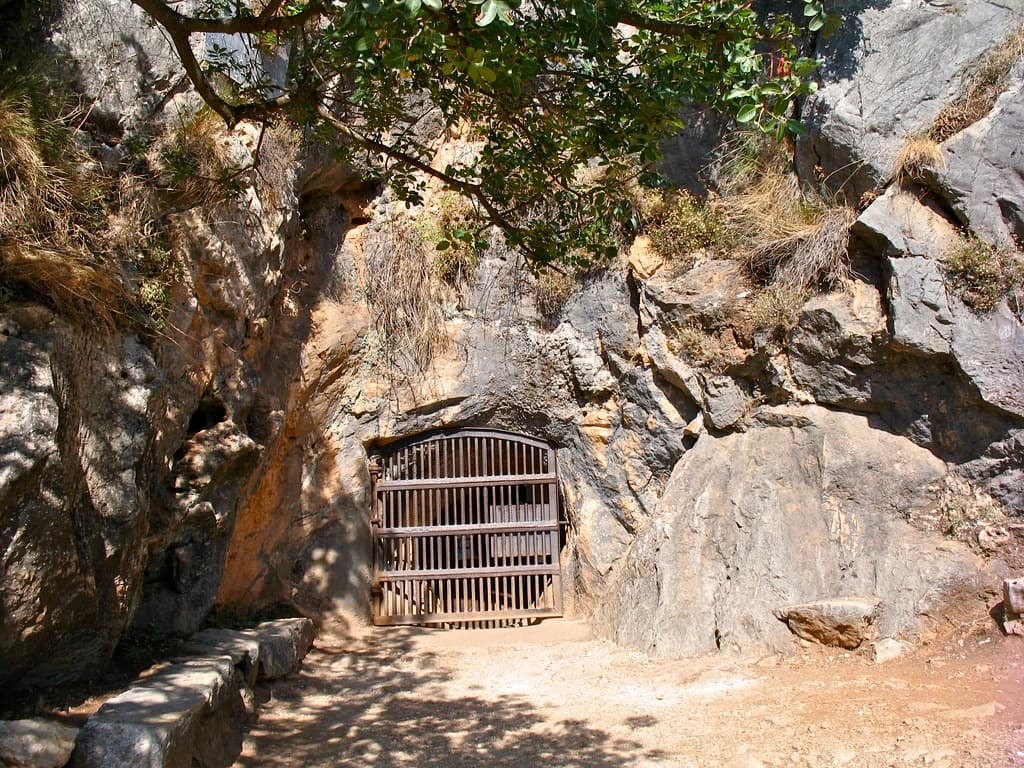
Image of Cave of La Pileta. Image source
Visit essentials
A quick read before you go
- Duration
- The guided tour itself runs about an hour, with some sources citing up to 1.5 hours depending on…
- Access
- The cave sits on a hillside in the Sierra de Líbar near Benaoján, Málaga province, reached by a…
Overview
La Pileta is a cave system stretching hundreds of metres into the Sierra de Líbar, its walls carrying images that waited in darkness for millennia. Researchers say its rock-art sequence spans an unusually long period, with successive groups returning to paint and engrave over tens of thousands of years — dating estimates vary considerably by source and by panel.
Animal figures, hand stencils, and abstract signs — spirals, cross-shapes, serpentine lines — accumulate through the chambers, growing more concentrated farther from daylight. No one performs ceremony here now. The cave is a protected heritage site, still guided by descendants of the man who found it and lit only by the same kind of flame that likely illuminated the original painters' work.
Why this place is sacred
The case for La Pileta's significance is built less on any single image than on the accumulation of them. More than 400 paintings and engravings occupy the cave's galleries, concentrated most heavily in its farthest, darkest reaches — a pattern some researchers read as evidence that the deepest chambers were reserved for something other than daily habitation, while areas nearer the entrance served ordinary group life.
This remains an interpretation rather than a documented fact, since no text or oral account survives to confirm it, but the spatial logic of the cave — habitation near light, symbol-making near darkness — is difficult to read as accidental.
The abstract signs themselves resist easy translation. Cruciform marks, serpentine lines, spirals, and the so-called 'Spanish tectiforms' recur across the galleries alongside a striking black fish nearly a metre and a half long. Some researchers have proposed that certain repeating marks track lunar, seasonal, or gestational cycles, but this is a hypothesis advanced by specific writers rather than settled scholarly consensus, and it should be read as such.
What is not in dispute is the span of time involved. Successive groups, likely separated by centuries or millennia, chose to return to this same cave and add to what earlier hands had left. Whatever compelled that return — devotion, memory, practical use of a technique — its result is one of the most extensive rock art sequences on the Iberian Peninsula.
Archaeological evidence points to intermittent use across an extended prehistoric span, moving from painting and habitation activity into later periods of settlement. There is no single founding moment or founding purpose to recover — the cave accumulated meaning through repeated visits by different groups over a very long stretch of time, not through one act of construction or consecration.
Use of the cave for painting appears to have tapered off in later prehistory, after which the site passed out of active memory until Bullón's 1905 discovery. Since then it has moved from misattributed curiosity (initially assumed to be Moorish) to a scientifically documented monument, formally protected under Spanish heritage law, and stewarded across multiple generations by the family that first found it.
Experience and orientation
Accounts of visiting La Pileta converge on a few consistent details: the flickering, uneven light of paraffin lamps rather than fixed electric fixtures; the total absence of outside sound once the group is deep enough inside; and a steady ~15°C chill that holds regardless of season.
Travelers and tour writers describe the format as noticeably less commercial than larger show-caves — small groups, sometimes a wait for enough people to gather, a family member of the original discoverer sometimes still leading the tour.
The darkness is not incidental to the experience. Because the paintings are viewed only by lamp, the images seem to emerge and recede as the light moves, rather than being flatly illuminated all at once — an effect visitors often connect, rightly or not, to how the original painters might have worked and seen their own marks.
Whether or not that connection holds historically, it shapes how the cave is experienced now: less as a museum display, more as a direct, unmediated encounter with old marks in old dark.
The physical demands are real — a short uphill walk to the entrance, then slippery rock and narrow stretches inside — and mobility-impaired visitors may find sections difficult. Those who want more than a checklist visit report that slowing down and letting the lamp-lit darkness settle, rather than rushing toward each named panel, is what makes the hour memorable.
Context and lineage
In 1905, José Bullón went looking for bat guano near what locals called the 'chasm of the bats' and found the cave's entrance instead. For several years afterward, the paintings inside were assumed to be the work of Moorish craftsmen — a plausible guess in a region shaped by centuries of Moorish presence, but a mistaken one.
Around 1911, British officer and ornithologist William Willoughby Cole Verner recognized the images as far older and alerted Henri Breuil, whose survey — funded by the Prince of Monaco and conducted alongside Hugo Obermaier — identified roughly fifty distinct drawings.
A later re-study in 1978 identified 134 paintings, and the two counts don't fully reconcile: some of Breuil's original identifications could no longer be located, a discrepancy sources attribute variously to pigment fading, surface change, or differing identification standards, without full agreement.
No continuous ritual or religious lineage connects prehistoric use of the cave to the present. What continues instead is a lineage of stewardship — the same family that found the cave in 1905 has guided visitors through it ever since, making the site unusual among major rock art locations for having stayed under private, familial care rather than passing entirely into state or institutional management.
José Bullón
discoverer
Local farmer who found the cave's entrance in 1905 while searching for bat guano to fertilize his fields.
Henri Breuil
archaeologist
French prehistorian who conducted the first scientific survey of the cave's art around 1911–1912, funded by the Prince of Monaco.
Hugo Obermaier
archaeologist
Studied the cave's paintings and engravings alongside Breuil, contributing to the earliest scientific documentation.
William Willoughby Cole Verner
discoverer
British officer and ornithologist who first recognized the paintings as prehistoric rather than Moorish and alerted Breuil to the site.
The Bullón family
steward
Descendants of José Bullón have owned and personally guided visitors through the cave across multiple generations since its discovery.
Traditions and practice
Some researchers have proposed that the deepest, most remote chambers were reserved for what they describe as ritual or 'propitiatory' activity, based on the concentration of abstract symbolic art far from areas showing signs of habitation. This remains an interpretive hypothesis rather than a documented practice — no ritual text, oral account, or unambiguous archaeological marker confirms what, if anything, was performed there.
There is no revived or reconstructed ceremony at La Pileta. The guided tour itself — small groups, paraffin lamps, a slow descent into successive galleries — is the only structured way the site is encountered today, and it functions as a heritage visit rather than a spiritual practice.
Visitors seeking more than a walkthrough might treat the descent itself as the practice: noticing how the quality of silence changes with depth, how the lamp's light picks out one image and lets the rest recede into the dark it has occupied for millennia, and how the body's own caution on the slippery rock keeps attention anchored in the present rather than racing ahead to the next chamber.
Upper Paleolithic / prehistoric ritual and symbolic practice
HistoricalSuccessive prehistoric groups returned to paint and engrave La Pileta's chambers over an extended span, producing one of the most extensive rock art sequences on the Iberian Peninsula and a foundational site for studying symbolic expression outside the Franco-Cantabrian core.
Some researchers propose that the cave's most remote chambers were used for ritual or propitiatory purposes, based on the concentration of abstract signs far from habitation areas — an interpretation, not a documented rite.
Archaeological and conservation stewardship
ActiveThe cave remains the subject of ongoing archaeological interest and is actively managed as a Bien de Interés Cultural under Spanish heritage law, with the Bullón family continuing to steward physical access across generations.
Conservation-guided visitation with lamp-only lighting, restricted photography, and capped group sizes designed to protect fragile pigment from light and touch damage.
Perspectives and open questions
Because so much about La Pileta rests on interpretation rather than surviving testimony, honest engagement means holding scholarly caution alongside the genuine sense of depth the site produces in visitors — without letting either one overstate what is actually known.
Scholarly perspective
Archaeologists broadly agree that La Pileta is among the most important and best-preserved rock art sites on the Iberian Peninsula, valuable in part because it extends the study of Paleolithic cave art beyond its Franco-Cantabrian heartland. There is less agreement on specifics: dating estimates for the paintings vary substantially across sources, and the exact function of the cave's abstract sign system — whether calendrical, cosmological, territorial, or something else — remains actively debated rather than resolved.
Alternative interpretations
Some non-academic commentary treats the cave's abstract, repeating signs as evidence of sophisticated proto-astronomical or calendrical knowledge among its painters. These readings are suggestive rather than peer-reviewed, and are best treated as one interpretive lens among several rather than an established finding.
Open questions
The precise meaning of La Pileta's abstract signs — the cruciforms, serpentine lines, spirals, and tectiforms that recur through its galleries — remains unknown. Researchers also have not fully reconciled the gap between Breuil's original identification of roughly fifty images and the 134 catalogued in a 1978 re-study, leaving open questions about what changed in the cave, or in how it was studied, between those two counts.
Plan your visit
Access and arrival
The cave sits on a hillside in the Sierra de Líbar near Benaoján, Málaga province, reached by a short but uphill walk from a parking area. Entry is by advance phone reservation only, in small guided groups. Mobile signal in the immediate rural area should be assumed unreliable; visitors should confirm reservations and directions before leaving areas of stronger coverage, and note that Benaoján and Ronda are the nearest towns with full services.
Ronda and Benaoján offer the closest range of lodging; no accommodation exists at the cave site itself, and visitors typically base themselves in one of these towns.
Respectful visit
No formal dress code, but sturdy, non-slip footwear is strongly advised given the slick rock surfaces underfoot, and a light jacket is useful given the constant ~15°C (59°F) interior temperature year-round.
Photography, flash, and any artificial lighting are not permitted inside the cave, in order to protect the pigments; the tour is lit only by paraffin lamp.
There is no offerings tradition at this site; it is a secular, conservation-managed cave with no devotional practice to accompany a visit.
Entry is by guided tour only, arranged in advance by phone reservation — there is no self-guided or independent access. Groups are capped at around twenty, and tours have historically waited for roughly fifteen people to gather before departing. Visitors are expected to arrive about twenty minutes early or risk losing their reservation. The site is not recommended for those with claustrophobia, discomfort around bats, or mobility impairments, given narrow passages and uneven steps.
There is no ritual or offering practice to observe or avoid here — the cave is a conservation-managed archaeological site, not a devotional one. Visitors should not touch the walls or paintings, and should not expect or request any ceremonial framing from guides, whose role is custodial and interpretive rather than spiritual.
Location
Map loads as you approach this section.
Pilgrim reflections
A portrait of encounter, not a score
Pilgrims describe what they felt, how present they could become, and whether the place would shape a journey. There are no stars and no ranking of traditions.
No reviewed reflections yet
The first pilgrims can help describe the character of being here.
Share a reflection
Available after an account-backed “Been there.” Every reflection is reviewed before publication.
Nearby sacred places
Explore other sacred places in the region. Proximity does not establish access or travel time; check each place’s guidance.
References
Sources consulted for this page. Source categories describe the publication, not a guarantee that every claim is verified. Traditional accounts and outside interpretations may differ.
- 01Cueva de la Pileta ('Cave of the Pool') in Benaoján — Spain.info (Turespaña, official Spanish tourism board)officialOfficial government tourism description confirming art content, dating range, and access.
- 02Cueva de La Pileta (La Pileta Cave) — Province of Málaga — Diputación de MálagaofficialProvincial government heritage record; location and natural-area context.
- 03BOE-A-1997-9605 — Decreto 527/1996 declaring Cueva de la Pileta a Bien de Interés Cultural (archaeological zone) — Boletín Oficial del Estado (Spanish Official State Gazette)officialLegal/official confirmation of Bien de Interés Cultural (Cultural Interest Site) protected status, delimiting the archaeological zone in Benaoján.
- 04Cueva de la Pileta — Wikipedia — Wikipedia contributorsencyclopediaDiscovery by José Bullón in 1905, Breuil/Verner investigation, 1924 new entrance, National Monument status, 1978 re-survey, coordinates, dimensions.
- 05Art of the Pileta Cave — Archaeology Now (nonprofit archaeology education organization)academicOverview of cave art significance and comparison to Franco-Cantabrian tradition.
- 06PALEOLITHIC FISHING — THE LA PILETA HALIBUT — Rock Art BlogblogSpecialist rock-art blog describing the famous 1.5m black fish painting in the 'Fish Chamber'; used with epistemic caution as a non-peer-reviewed source but consistent with academic descriptions.
- 07Caving in Andalucia — Cueva de la Pileta — Andalucia.comguideVisitor logistics: tour size limits, lamp-lit tours, no artificial light/flash photography rule, uncommercialized guided format run by Bullón descendants.
- 08Pileta Paleolithic Cave Paintings at Benaojan — Ronda TodayguideLocal visitor guide with booking, tour timing, and access details; corroborates group-size limits and seasonal tour schedules.
- 09La Pileta Cave Art: Andalucía — ArtsLookUp.comencyclopediaDetailed catalogue of abstract signs (cruciforms, serpentiforms, spirals, 'Spanish tectiforms', zig-zags) and mention of lunar/annual/gestation-period calendar markings.
- 10Pileta Cave, Prehistoric Sanctuary of Benaoján — Andalucía RústicaguideDescribes the deepest, most isolated chambers as likely used for 'magical and propitiatory rituals' versus the outer 200m used for daily group life — an interpretive claim, treated as scholarly hypothesis rather than settled fact.
Share a photo
Help visitors recognize Cave of La Pileta. Every submission is reviewed before publication.