Seville Cathedral
Where an Almohad minaret still tolls the hour above the world's largest Gothic cathedral
Understand sacred places, explore living traditions, and learn how to engage respectfully with Pilgrim Map.
Access has not been verified. Check current local guidance before planning a visit.
Seville, Seville, Spain
Read the sources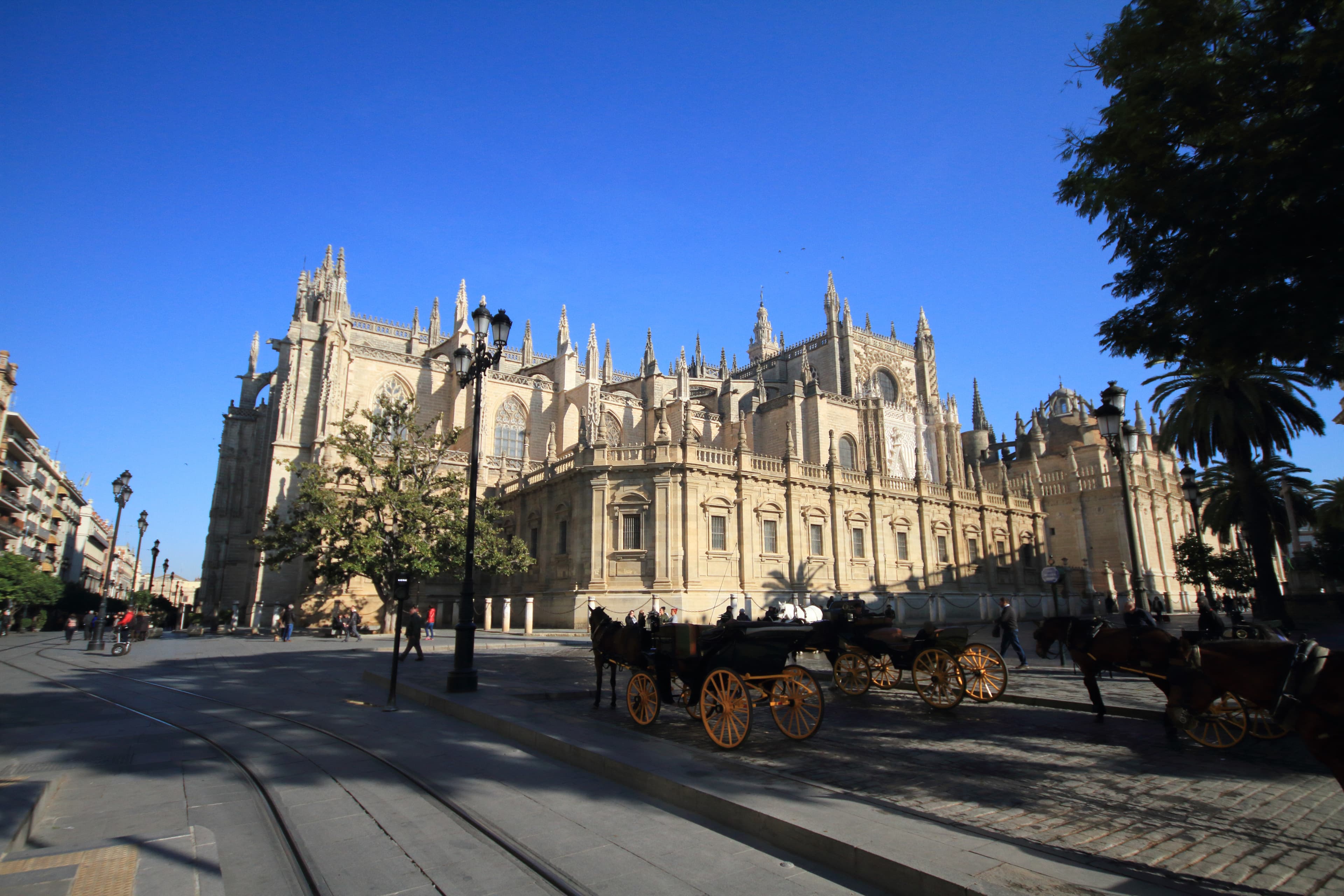
Image of Seville Cathedral. Image source
Visit essentials
A quick read before you go
- Duration
- Most visitors spend roughly one and a half to two and a half hours touring the interior,…
- Access
- Entry is by paid, timed ticket through the official cathedral website or authorized resellers.
Overview
Seville Cathedral folds two buildings into one across seven centuries. Beneath its Gothic vaulting and golden retablo mayor lies the rectangular plan of a 12th-century congregational mosque; the Giralda retains the silhouette of the minaret that summoned Seville's Muslims to prayer. When the cathedral chapter decided in 1401 to replace the converted mosque, tradition holds that it sought a church so grand that those seeing it finished would take the builders for madmen.
The result remains the functioning heart of Catholic Seville. The Archbishop presides here, and the Virgen de los Reyes, the city's patroness, receives daily devotion in her chapel. For one week each spring, dozens of penitential brotherhoods converge from across the old town amid candle smoke, silence, and improvised flamenco laments called saetas. Kings lie beneath the floor. Christopher Columbus is entombed near the entrance in a monument whose contents remain disputed four centuries later.
The cathedral is a palimpsest where a Muslim caliphate's public architecture and a Christian kingdom's religious ambition occupy the same footprint, neither fully erasing the other.
Why this place is sacred
Most cathedrals accumulate meaning gradually, one relic or miracle at a time. Seville Cathedral's charge is structural. The Giralda's lower two-thirds are unmistakably the walls of an Almohad minaret, their sebka brickwork left largely intact when the tower was heightened with a Renaissance belfry in the sixteenth century.
The Patio de los Naranjos — the Patio of the Oranges — still traces the outline of the mosque's ablutions courtyard, its orange trees standing where the Almohad congregation once washed before prayer. Nothing about this juxtaposition is hidden or reconstructed for effect; it is simply what remained when the mosque's prayer hall was finally demolished in stages to make room for the Gothic building begun in 1401.
That layering gives the cathedral a different kind of gravity than a church built on a single, unbroken religious foundation. It asks visitors to hold two histories in the same glance: the tower that called Seville's Muslims to prayer for seventy years, and the nave built, in part, on the memory of the 1248 Reconquista conquest that ended that era.
UNESCO's 1987 inscription frames the ensemble — cathedral, Alcázar, and Archivo de Indias — explicitly as testimony to both civilizations rather than to one triumphing over the other, and the building itself, read carefully, supports that framing better than any triumphal narrative would.
Layered onto this architectural charge is the cathedral's ongoing civic role. It is where Ferdinand III of Castile, the conqueror of Seville, and his son Alfonso X are buried, where Pedro I of Castile lies, and where Christopher Columbus's bones — or bones asserted to be his — rest in a nineteenth-century monument carried by four kingdom-bearers.
Each Holy Week, the building becomes the single point every penitential brotherhood in the city is walking toward, so that for a few days its ordinary quiet is replaced by the sound of an entire city arriving at once.
The site's first religious function was as Seville's great Friday mosque, commissioned by the Almohad caliph Abu Yaqub Yusuf, built between 1172 and 1198, and serving as the congregational center of Almohad Seville for roughly seventy years before the 1248 Reconquista conquest converted it to Christian use. The Gothic building begun in 1401 was conceived from the outset as a cathedral proper — seat of the Archbishop, burial place for Castilian royalty, and stage for the city's civic-religious calendar.
The transition from mosque to cathedral was not a single event but a slow substitution: the mosque was first adapted for Christian worship after 1248, then progressively dismantled over more than a century as the Gothic structure rose around and eventually replaced it, with the minaret and ablutions courtyard deliberately preserved rather than destroyed.
In the centuries since, the cathedral's role has widened again — from purely liturgical space to UNESCO World Heritage monument, paid visitor attraction, and, every spring, the terminus of Seville's largest annual public ritual.
Experience and orientation
The scale registers before any single object does. Seville Cathedral is, by floor area, the largest Gothic cathedral in the world, and the nave is built to make that fact felt rather than merely stated — vaulting rises far enough overhead that voices and footsteps both seem to arrive from somewhere above rather than beside you.
The retablo mayor, one of the largest altarpieces anywhere, holds that height with gilded relief scenes stacked nearly to the ceiling; it takes long, unhurried looking rather than a single glance to register as more than gold.
Near the entrance, the Columbus monument works differently — theatrically rather than devotionally. Four bronze figures representing the medieval kingdoms of Castile, Aragon, Navarre, and León carry an ornate bier aloft, a design (by the sculptor Arturo Mélida, installed in 1899) built for visual drama rather than quiet contemplation.
Visitors often linger here specifically because the question of whose remains actually lie within has followed the monument since it arrived from Havana, a question the building itself makes no attempt to resolve.
The climb up the Giralda offers a third, quieter register of experience. Rather than the stairs one expects in a bell tower, the ascent follows a continuous interior ramp — wide enough, according to local tradition, for the elderly muezzin who once served the mosque to be carried up by donkey five times a day for the call to prayer.
Whatever the ramp's original purpose, climbing it produces a gentler, more gradual sense of ascent than a stairwell would, and the view from the top takes in the whole of the old town at once.
During Holy Week, all of this recedes behind a different kind of experience entirely. Visitor and press accounts describe incense, candlelight, and the arrival of the pasos — the ornamented floats bearing images of Christ and the Virgin — moving through the cathedral to the sound of brass bands and, at unpredictable moments, the unaccompanied flamenco lament called the saeta, sung directly at the images as they pass.
The overnight La Madrugá procession, crossing from Holy Thursday into Good Friday, is widely reported as the emotional peak of the week, with the building staying active and full through the small hours in a way it is at no other time of year.
A first visit benefits from sequence: the nave and retablo first, while attention is freshest and the scale can register without competing for notice; the Columbus monument and treasury next; the Giralda ascent last, both because its ramp rewards unhurried legs and because the rooftop view works well as a closing rather than an opening impression. Outside Holy Week, mornings and the first entry slots of the day offer the closest approximation of quiet the building allows.
Context and lineage
Seville's Almohad mosque was commissioned by Caliph Abu Yaqub Yusuf, with construction running from 1172 to its completion in 1198; it served as the city's principal congregational mosque until Ferdinand III of Castile took Seville on 23 November 1248, after which the building was adapted for Christian worship.
That arrangement lasted roughly a century and a half before the cathedral chapter and the city's civic leadership decided, in 1401, to demolish the mosque's prayer hall in stages and build a new Gothic cathedral in its place, funded through local taxation.
Tradition attributes to the chapter a founding declaration — "Hagamos una Iglesia tan hermosa y tan grandiosa que los que la vieren labrada nos tengan por locos," let us build a church so beautiful and so grand that those who see it finished will think us mad — though, as with much oral tradition, the exact wording and moment of utterance cannot be verified beyond local memory.
The Gothic building was substantially complete by the early sixteenth century, roughly a century after ground was broken.
No single architect's name survives attached to the Gothic cathedral's design in the sources consulted; it was, like most cathedrals of its era, the work of successive masons and master builders across roughly a century, working under the authority of the cathedral chapter rather than a single credited designer.
That anonymous, multi-generational building pattern continues today in a different form: the cathedral's ongoing academic documentation of the Giralda, active from 1984 through at least 2024, treats the building as a still-unfolding subject of architectural-historical research rather than a closed case.
Abu Yaqub Yusuf
historical
The Almohad caliph who commissioned Seville's congregational mosque in 1172, the building whose footprint, minaret, and ablutions courtyard the present cathedral still occupies and partly preserves.
Ferdinand III of Castile
historical
The Castilian king whose 1248 conquest of Seville ended Almohad rule in the city and began the mosque's conversion to Christian use; he is buried within the cathedral.
Christopher Columbus
historical
Explorer whose remains, after a journey from Valladolid through Santo Domingo and Havana, were installed in a monument inside the cathedral in 1899; whether the bones inside are genuinely his remains a live, unresolved historical question rather than settled fact.
Arturo Mélida
historical
The sculptor who designed the cathedral's Columbus tomb monument, installed in 1899, with its four bronze bearers representing the medieval kingdoms of Castile, Aragon, Navarre, and León.
Virgen de los Reyes
deity
Patroness of Seville, venerated in her own chapel within the cathedral and held to have been present with Ferdinand III's forces during the conquest of the city.
Traditions and practice
The estación de penitencia, the formal 'stop' each Holy Week brotherhood makes at the cathedral on its way from and back to its home church, has medieval roots but took on its present elaborate, image-laden form during the Baroque period.
Each of the roughly sixty-one participating brotherhoods processes its pasos — floats bearing sculpted images of Christ or the Virgin — through the cathedral in a fixed order across the week, a sequence structured enough that it functions as much as civic choreography as private devotion.
Daily Mass and the sacramental life of the Archdiocese continue alongside the annual liturgical calendar: the feast of Corpus Christi, the Immaculate Conception, and, most visibly, Holy Week itself, which culminates in the overnight La Madrugá procession between Holy Thursday and Good Friday. A seventeenth-century crucifix by Juan de Mesa, ordinarily kept from public view, is displayed only during Holy Week, marking the week as liturgically distinct rather than simply more crowded.
A visitor drawn to the building's living religious life, rather than only its architecture, might attend a public Mass rather than a timed tourist entry, sitting toward the rear of the nave without expectation of anything beyond ordinary parish worship carried out at unusual scale.
Outside Holy Week, the Patio de los Naranjos rewards a slower pause than most visitors give it — it is the one part of the building where the Almohad past is legible without interpretation, simply as a courtyard of orange trees around a fountain once used for ablution.
Roman Catholic
ActiveSeville Cathedral is the seat of the Archbishop of Seville, the site of daily liturgy and devotion to the Virgen de los Reyes, patroness of the city, and the burial place of Ferdinand III of Castile, Alfonso X, Pedro I of Castile, and Christopher Columbus.
Daily Mass and sacramental life; annual observance of Corpus Christi and the Immaculate Conception; and Holy Week (Semana Santa), when Catholic brotherhoods process to and through the cathedral, culminating in the overnight La Madrugá procession.
Sunni Islam (historical)
HistoricalThe site was home to Seville's great Almohad congregational mosque, built 1172–1198 under Caliph Abu Yaqub Yusuf, one of the most important religious buildings of Almohad al-Andalus; its minaret, now the Giralda, and its ablutions courtyard, now the Patio de los Naranjos, survive as physical remnants of that phase.
Perspectives and open questions
The cathedral supports at least three distinct readings that need not resolve into one another: an architectural-historical view of the building as a two-civilization palimpsest, a set of local legends that explain specific oddities of the fabric, and a genuinely unresolved historical question about who actually rests in its most famous tomb.
Scholarly perspective
Architectural historians treat Seville Cathedral as a palimpsest rather than a single-period building: it occupies the rectangular footprint of the twelfth-century Almohad mosque, retains the mosque's minaret (the Giralda) and ablutions courtyard (the Patio de los Naranjos), and was substantially rebuilt from 1401 onward as the world's largest Gothic cathedral, following the earlier Christian conversion of the mosque after 1248.
UNESCO's 1987 inscription reflects this reading directly, recognizing the ensemble as testimony to both Almohad and Christian Andalusian civilization rather than treating either phase as merely a prelude to the other.
Alternative interpretations
Local legend accounts for two specific features of the building that guides and visitors ask about most often. The Giralda's interior ramp, rather than stairs, is explained in local tradition by the practical need to carry an elderly muezzin up by donkey five times daily for the call to prayer — a story that may or may not be literally true but has stayed attached to the tower regardless.
Separately, 'el lagarto de la catedral,' the cathedral crocodile, refers to a taxidermied or mummified crocodile once displayed in the building and replaced by the current wooden effigy in 1752; its origin story varies by teller and is treated locally more as folklore than history.
Open questions
Whether the remains inside the Columbus tomb monument are genuinely Christopher Columbus's is not a settled question, despite how the monument's confidence and scale might suggest otherwise. Seville and the Dominican Republic (Santo Domingo) have both claimed to hold his true remains since his bones were moved between the two cities and Havana over four centuries.
A 2003–2005 genetic study and a 2024 University of Granada study led by forensic scientist José Antonio Lorente have both reportedly supported the Seville identification, but some sources continue to describe the matter as unresolved, and no single study has closed the dispute to the satisfaction of both claimant cities.
Plan your visit
Access and arrival
Entry is by paid, timed ticket through the official cathedral website or authorized resellers. The cathedral sits centrally in Seville's old town, adjacent to the Real Alcázar and within the same UNESCO World Heritage ensemble. Wheelchair accessibility is partial: the Giralda's ramp system, built without stairs, is not fully accessible in its upper reaches, but the main cathedral floor is largely accessible.
Seville's old town offers lodging across every price range within walking distance of the cathedral; no single property has a documented historical or devotional connection to the site itself, so visitors are best served by general old-town accommodation searches rather than a specific recommendation.
Respectful visit
Decorous dress is required: no sleeveless, low-cut, or sheer tops, and no very short shorts or skirts; shoulders should be covered and hats removed on entering.
General photography is permitted in visitor areas, but flash is prohibited; phone use should be kept to a minimum and artworks must not be touched.
No smoking, eating, or drinking inside; no running, particularly within the Giralda's ramps; no animals other than guide dogs; and visitors are asked to keep a low tone of voice in keeping with the building's atmosphere of tranquility and reflection.
Holy Week is not a good week to visit for architectural quiet or unhurried viewing of the retablo — areas of the building are given over to procession logistics, crowds are dense day and night, and visitor access is secondary to the week's liturgical purpose. Those specifically seeking the festival experience should expect to participate in it as a spectator among a very large civic crowd rather than as a solitary visitor.
Location
Map loads as you approach this section.
Pilgrim reflections
A portrait of encounter, not a score
Pilgrims describe what they felt, how present they could become, and whether the place would shape a journey. There are no stars and no ranking of traditions.
No reviewed reflections yet
The first pilgrims can help describe the character of being here.
Share a reflection
Available after an account-backed “Been there.” Every reflection is reviewed before publication.
Nearby sacred places
Explore other sacred places in the region. Proximity does not establish access or travel time; check each place’s guidance.

References
Sources consulted for this page. Source categories describe the publication, not a guarantee that every claim is verified. Traditional accounts and outside interpretations may differ.
- 01Seville Cathedral — Wikipedia — Wikipedia contributorsencyclopediaGeneral history, Almohad mosque origins, Gothic rebuilding from 1401, UNESCO status, Columbus tomb.
- 02Cathedral, Alcázar and Archivo de Indias in Seville — UNESCO World Heritage Centre — UNESCOofficialConfirms 1987 UNESCO World Heritage inscription alongside the Alcázar and Archivo de Indias; frames site as testimony to Almohad and Christian Andalusian civilization.
- 03Official Website of the Cathedral of Seville — Cabildo de la Catedral de SevillaofficialConfirms active liturgical life, devotion to the Virgen de los Reyes, sacramental pastoral care, and World Heritage Site page.
- 04Four Decades of Documentation of the Almohad Giralda: 1984-2024 — Cabildo de la Catedral de SevillaofficialConfirms Giralda's Almohad architectural origin and ongoing academic documentation.
- 05Mezquita de Sevilla, Seville, Spain — ArchNet (MIT-affiliated architecture archive)academicAcademic architectural-history source on the Almohad mosque predecessor structure.
- 06Giralda — Wikipedia — Wikipedia contributorsencyclopediaDetail on the bell tower's Almohad minaret origin, ramp-not-stairs design, and legend of the muezzin's donkey.
- 07Holy Week in Seville — Wikipedia — Wikipedia contributorsencyclopediaConfirms Semana Santa brotherhood processions (estación de penitencia) terminating at the cathedral, La Madrugá, pasos, nazarenos, saeta.
- 08Tomb of Christopher Columbus — Wikipedia — Wikipedia contributorsencyclopediaHistory of Columbus's remains' journey (Valladolid → Seville → Santo Domingo → Havana → Seville 1898), tomb installed 1899, designed by Arturo Melida, ongoing authenticity debate.
- 09Cathedral Rules — La Catedral de Sevilla — Cabildo de la Catedral de Sevilla (visitor services)officialSource for dress code, photography, noise, and behavior rules for visitors.
- 10Seville, Spain's Semana Santa Holy Week blends faith, tradition, spectacle — NPRnewsContemporary journalistic account of Holy Week processions culminating at Seville Cathedral.
- 11Tomb of Christopher Columbus in Seville — Atlas ObscuraguidePopular travel-reference account of the monument and the four-kingdom-bearer sculptural design (Castile, Aragon, Navarre, León).
Share a photo
Help visitors recognize Seville Cathedral. Every submission is reviewed before publication.